haunted by high dangers
pp. 13-17 · Read in the full issue

New Hebrides: High hopes are haunted by high dangers
‘Lini.’ ‘Walter Lini,’ ‘Father Lini’ ... the gravel voice of Aime Malere, member of the New Hebrides Representative
Assembly, was reading aloud
the votes cast in the election just held for chief minister at the first session of the assembly since the elections of November 14.
The scene in the New Hebrides Government Build ing in Vila on November 29 was one of vote-counting, Melanesian-style. No nonsense here about self-important scrutineers rushing off with ballot boxes to do the job in some hidden backroom. Each voting paper as it was opened was read to the assembly in exactly the form in which it was written down.
But whatever the method of counting the votes, the result was predictable: Fr Walter Lini, president of the Vanuaaku Party, received 26 votes exactly the same num ber as his party had won seats in the 39-member assembly on November 14. There were three votes for Father Gerard Leymang, chief minister in the former Government of National Unity, and three abstentions.
As the applause died down after announcement of the re sult, it was impossible not to think back to the scene in Vila two years to the day, to November 29 1977 to the boycott by the VP of the (uncontested) ‘elections’ held on that day, to its proclamation of a People’s Provisional Government, and to the civil strife to which these events gave rise in Vila. The official claim was that the timing was ‘pure coincidence’. But like many official claims it strained belief. The VP leaders can read calendars as well as if not better than most people. But the sym bolic flourish was probably
generally accepted as justified
by the recent sweeping elec toral success of the VP, and by the dramatic change in its for-
The 1980 s open with the British-French Con dominium of the New Hebrides on the threshold of independence. Some time this year, between May and July, the New Hebrides becomes the Republic of New Hebrides. The foundations for independence were laid at the end of 1979, with the promulgation of a constitution and the in augural session of the New Hebrides Represen tative Assembly, following general elections. RIM associate editor MALCOLM SALMON was in New Hebrides for these events, and visited the important regional areas of Santo and Tanna.
Here he gives the first detailed report of what took place in that heady period.
tunes from that of the ‘outlaw’ party reviled by many just two years before.
After electing the chief minister, the main business of the day was announcement of the new government. Specu lation had been rife in Vila for days as to whether the new government would be a mixed one, or one made up exclus ively of VP ministers. The
speculation was probably
fuelled by the precedent of the GNU, which was made up of five VP ministers and five non-VP, with a casting vote in the hands of the non-VP Chief Minister Fr. Gerard
Leymang.
Political insiders in Vila con cede that the GNU was a pol itical success, paving the way as it did for a unanimously agreed constitution and for the November 14 elections. But from an administrative view point it was a different story, with the GNU causing endless frustrations because of its incapacity to take firm de cisions on matters of any sub stance.
In the event, the names of the nine new ministers read out to the assembly by Walter Lini on November 29 were all of men elected on the VP ticket
(see accompanying panel).
This too was really predict able. The VP had always
strongly upheld the principle of
majority rule - that if a party can win a majority in a parlia
ment it has a right to govern.
The absence of a guarantee of majority rule was in fact one of the reasons for its boycott of the 1977 elections. It also had to face questions of an inner party character the pressure exerted for positions of re
sponsibility by many talented,
highly educated VP members in the assembly, who could under no circumstances be per suaded to stand aside for a member of one of the oppo sition groupings. Then, per haps most important of all, there was the position of the
party’s grassroots organisation
to be considered, especially the 70 or 80 ‘commissars’ who are the backbone of VP strength in rural areas.
One can imagine what their reaction to a mixed govern ment would have been. They would have reproached the VP leaders along the lines that ‘Here we’ve been slogging it out for the party in the villages for years, and you, sitting in air-conditioned comfort in Vila, make ministers of people who stood against our own VP candidates.’
So, hopes for some new form of‘coalition’ government, how ever sincerely held by some, were doomed to remain just
that hopes.
Despite the underlying ten
sions, the assembly session was quiet. As one with some experi ence of observing affairs from the vantage point of the
parliamentary press gallery in
Canberra, I was struck by the courtesy with which members treated each other. This was particularly notable in the re lations between Fr. Lini and his predecessor as chief minis ter, Fr. Leymang. Political
passions have clearly not
undermined the respect and affection existing between these two priests of the Anglican and Roman Catholic churches.
After an exchange of views between these two, the as
sembly agreed to plan for the
proclamation of the indepen
dent Republic of New Hebrides somewhere within the three-month time bracket of May-July 1980.
The session closed with a prayer recited by Pastor Sethy Regenvanu, the new Minister for Lands. I couldn’t under stand his pidgin at all well and asked my neighbour in the gal lery whether it was the Lord’s Prayer we were hearing. I was told that it was not. It was a
prayer improvised by the
speaker as he went along, and that it would become the cus tom of the assembly for the Speaker, Pastor Fred Timakata, to nominate one or other of the numerous minis ters of religion in the assembly to do likewise at the close of each session. (The-Presbyterian Church in the New Hebrides is believed to have held a crisis meeting in Vila on the week end of December 1-2 to decide what to do about the sudden drain on its pastoral strength created by the new as
sembly!)
One left the government building with the feeling that for the first time in history a
freely elected and authentically
representative government
existed in the New Hebrides, and that it would be an honest and determined government in
grappling with the country’s
problems.
Problems there are in plenty.
For example, careful readers will have noticed that while
there are 39 members of the as sembly, only 32 took any part in the election of the chief minister. The session was in fact boycotted by seven Mod erate Party members for Santo, Tanna and Aoba/Maewo.
At a brief inaugural as sembly session on November 28. Guy Prevot, Federal Party member for Vila (and the onJv person of all-French extraction in the assembly) had read a statement on their behalf in
which they alleged ‘numerous
and large-scale electoral frauds on the part of the Vanuaaku Party’ in the November 14 poll ing. Their statement added: ‘We have decided that when we have completed our investi gations and within the time al lowed by the law, we shall lodge a complaint on the sub ject of these frauds with the Electoral Disputes Committee ... Until the committee has given its decision we feel it is our duty to refrain from par ticipating in the work of the
Representative Assembly.’
The fact that most of the boycotters came from Santo and Tanna is of the greatest sig nificance. As reported earlier (PIM Nov. p 14) the New Hebrides constitution provides
not only for a national Rep resentative Assembly to sit in Vila, but also for Regional Assemblies on the two islands of Santo and Tanna. Voting for these regional bodies, which
were clearly designed as safety
valves for the particularist. not to say separatist, sentiments which are most marked in these two islands, took place simul taneously with the elections to
the Representative Assembly
on November 14.
The rub was that the Vanuaaku Party won these elections as well as the national ones, with 8-7 majorities in both Santo and Tanna. To say that this surprised the non-VP par ties would be gross under statement. They were flabbergasted and angry. Their mood was expressed in the ‘We wuz robbed’ claims voiced in
the boycott petition to the Rep
resentatives Assembly.
On Santo, Nagriamel leader
Jimmy Stevens expressed the
sentiments of the defeated groups when he told the
French/Bislama weekly
Nabanga (November 24); ‘l’m shocked and feel like a man who’s been played a dirty trick.’
But Jimmy Stevens did not
limit himself to expressions of shock, hurt and surprise. He took action.
Reasoning that the regional
assembly had been lost by his side by a margin of about 300 votes, and that the opposition VP had probably received these votes from the several hundred residents of Santo who came from other islands, he and his advisers decided that if these ‘foreigners’ could be forced off the island, and if at the same time the petition alleging electoral fraud suc ceeded in winning a re-run of the election to the regional as sembly, his side would win after all.
So, on November 19, groups of Nagriamel supporters and supporters of an associate movement. Tabwemassana of Port-Olry, took to the streets, some carrying clubs, and. gen erally bows and arrows in the case of the ‘man bush’ of Jimmy Stevens (known as ‘naked men’). In trucks
equipped with loudspeakers
they passed through areas such
as Sarakata, where there was a concentration of people from Pentecost Island, and Mango Station, where the inhabitants were predominantly from the Banks group. Their message
was simple : ‘Foreigners out.
Get back to your islands, or else ...’
Fear spread rapidly among
those who were threatened.
They fled the centre of Lugan ville, or Santo town, some taking to the bush, others head ing off to board boats at the
wharf, others again taking
refuge in the Anglican church compound and a number of other safe places. There were at
one point 359 people living in
the Anglican compound.
According to estimates, be tween 300 and 500 people actu ally left Santo as a result of the threats.
What of the police? If man)/ Third World countries suffer from overactive and inter ventionist police forces, New Hebrides appears to have the opposite problem. The twc resident commissioners were unable to agree on the use ol police during the troubles on Santo.
It is sometimes argued that the British and French concep tions of the use of police are so far apart as to be forever in compatible. The British, it is said, see the despatch of police primarily as a means of restor ing calm without resorting to force. The French on the other hand feel that police forces should be kept hidden before they are suddenly moved in and that this should be done only when the moment has come to start cracking heads.
Not even 73 years of ‘marriage’ in the condominial set-up in the New Hebrides have created a meeting of minds on this issue.
While no police were used, two senior British and French officials, Messrs Turner and Peres, went to Santo and talked to Stevens at his Fanafo encampment. To his credit, British resident commissioner Andrew Stuart also visited Santo on November 22.
But most important of all in restoring some degree of calm was the visit on Saturday, November 24, of a high powered party of New Hebridean political figures: the then Chief Minister Gerard Leymang, his then deputy Walter Lini, and two other top
politicians, George Kalkoa andl
Maxime Carlot.
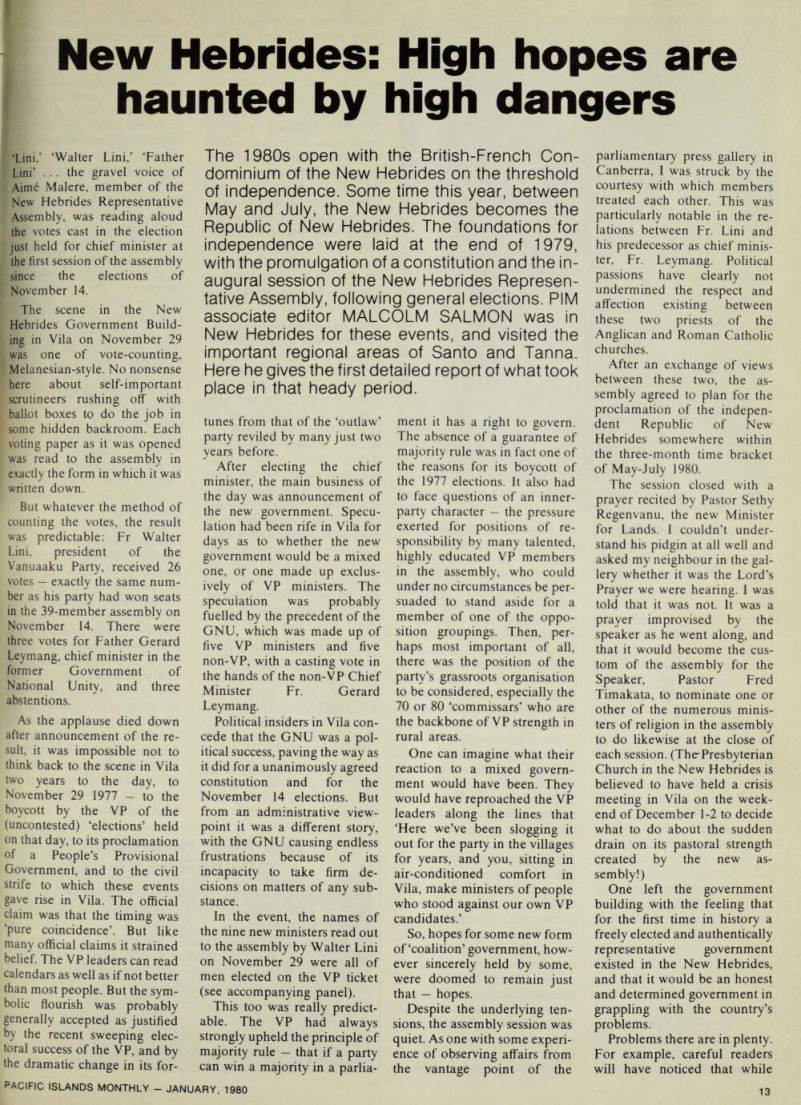
Father Gerard Leymang ... from Chief Minister to backbencher, but without bitterness. Na banga photo.
Calm had by and large re turned to Santo when I visited the island on November 30. A number but by no means all - of those who had fled to the bush had returned to the rusted old US military Quonset huts that are home to about 60% of the population of Santo town.
Although the affair was ‘black man against black man’, longtime Santo resident, den tist and cattleman, Ken Hut ton, told me he had been threatened by a youthful mem ber of one mob. ‘You British, get out!’ he yelled at Mr Hut ton. ‘You cheeky little little c . . ~’ said the forthright Mr Hutton. ‘Anyway, get your facts right.
I’m not British, I’m Australian.
And don’t wave that bloody stick in my face!’ (Meek depar ture of the youthful demon strator.) I’ve referred above to Stevens’ ‘advisors’ in this sorry affair. Wherever one inquired on Santo as to their identity, the same names would crop up.
One was that of Georges Cron steadt, a mixed-race member of the Representative As
sembly representing Santo
town, and another was that of Jean-Claude Creugnet, a businessman, of the Santo
Development Corporation.
Cronsteadt himself, in an interview in Nabanga (Nov 24) described the expulsion of the people from other islands as a
‘logical’ reaction by ‘Man
Santo’ to the defeat in the re
gional assembly elections. He
added: ‘There are lots of people who think that I’ve been somewhat responsible for what has happened. Far from it. On the contrary, I’ve restrained them greatly in what they have
been doing, things would have been worse if I hadn’t been around with them.’
Restraint, yes. When things appear to be ‘going too far’ it is normal for leaders to urge re straint even after they have offered encouragement in the
first place.
An opinion offered by ‘J. M.’ in the same issue of Nabanga as to how the affair unfolded deserves quoting. ‘J. M.’ wrote that, leaving the obvious politi cal motives aside, ‘there is one explanation that’s worth think ing about. “The man bush,” the “naked man” [such as Stevens’ followers] is, for the coast dwelling Melanesians, the “man soltwater”, rather like the Huns were for our ances tors back in the sth century.
Certainly, for many years now, there have no longer been armed conflicts between them, but an ancestral fear persists.
The naked man, carrying a club or bow and arrow, revives a certain sense of terror that was thought to be dead but in fact had only become hidden.
Perhaps this explains the scope of the panic that gripped Santo town, even among those who never saw any “naked men” but had heard by word of mouth that “they” had come.’
There is the closest relation
ship between what happened
on Santo and the events
though much less publicised,
actually much graver far to the south on Tanna. In each case the motivation was the same refusal to accept defeat in the regional assembly elec tions.
Co-ordination of ‘tactics’ be-
tween the electoral losers on both islands was plainly to be seen in the visit to Vila, and then to Santo, by Alexis Yolou, member of the Representatives Assembly for Tanna under the banner of the cultist John Frum movement. On arrival at Santo, Yolou was taken straight to Fanafo to confer with Jimmy Stevens. On his return to Tanna a move was started, exactly as on Santo, to expel non-Tannese islanders, mainly people from the small island of Futuna (not to be confused with Wallis/Futuna), about 70 km off Tanna’s east coast. It was widely said on Tanna that Guy Prevot was probably no stranger to the arz rangements necessary for Yolou’s Santo visit.
An Australian settler in the New Hebrides of 33 years standing. Bob Paul, who has lived on Tanna for many years, was in the thick of the troubles there, which included acts of arson against a ‘bush market’ greatly valued by the local
people, the uprooting of family
vegetable gardens, and the
potentially murderous action of digging holes and a trench across Tanna’s grass airstrip in an attempt to prevent the land-
ing of French and British mo bile police forces, Bob Paul has given the following account for PIM ; ‘The period prior to the elec tions on Tanna was punctuated by a series of visits by French resident commissioner Robert
handing out large quantities of
rice, tinned fish, boats, out board motors, and so on. The people of Tanna were some what taken aback by all this and the custom people re turned the gesture by deliver ing a large amount of sugar cane, taro, manioc, etc, to the French contact in the area (one Tuk Niau) to avoid being under any obligation, ‘The election itself was well run and no serious problems came up. ‘The results were a shattering blow to the “moderates”. Im mediately a planned move got underway, protests were lodged under various pretexts and a demonstration was held with club-bearing “moderates” protesting that they had been cheated ...
‘People leaving for the
National Arts Festival, an his toric event for the New Hebrides, were told by the “moderates” that as the elec
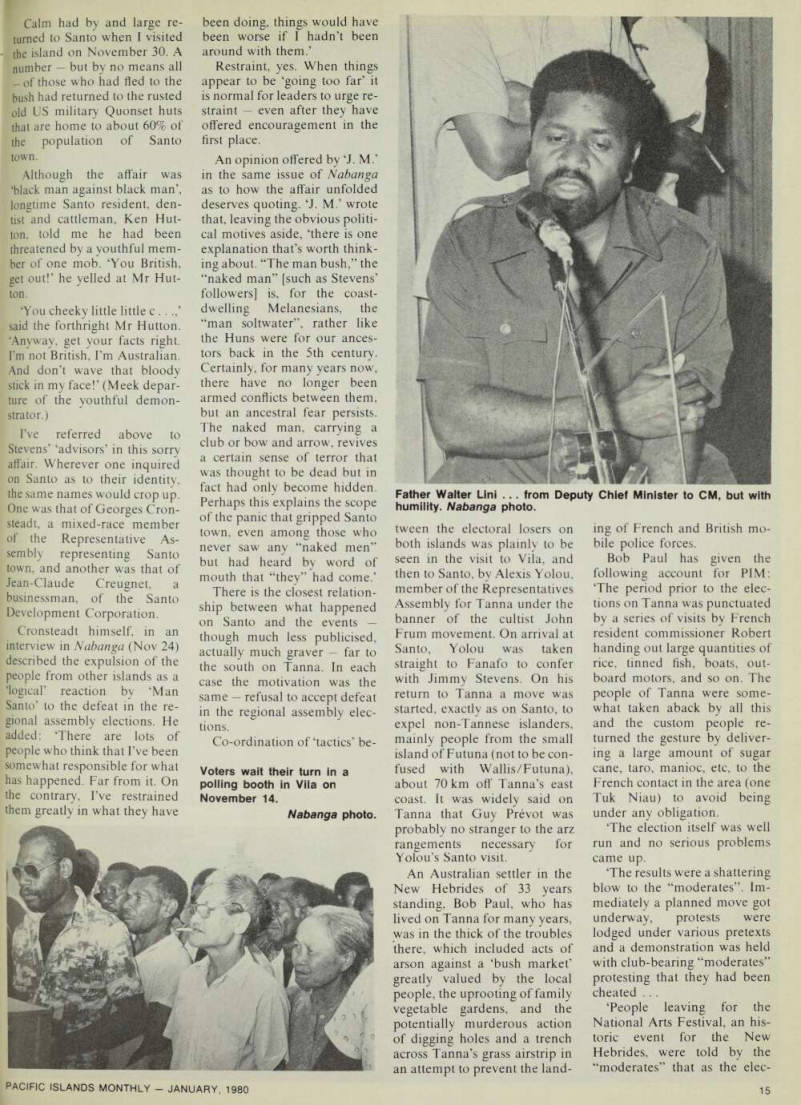
Voters wait their turn in a polling booth in Vila on November 14.
Nabanga photo.
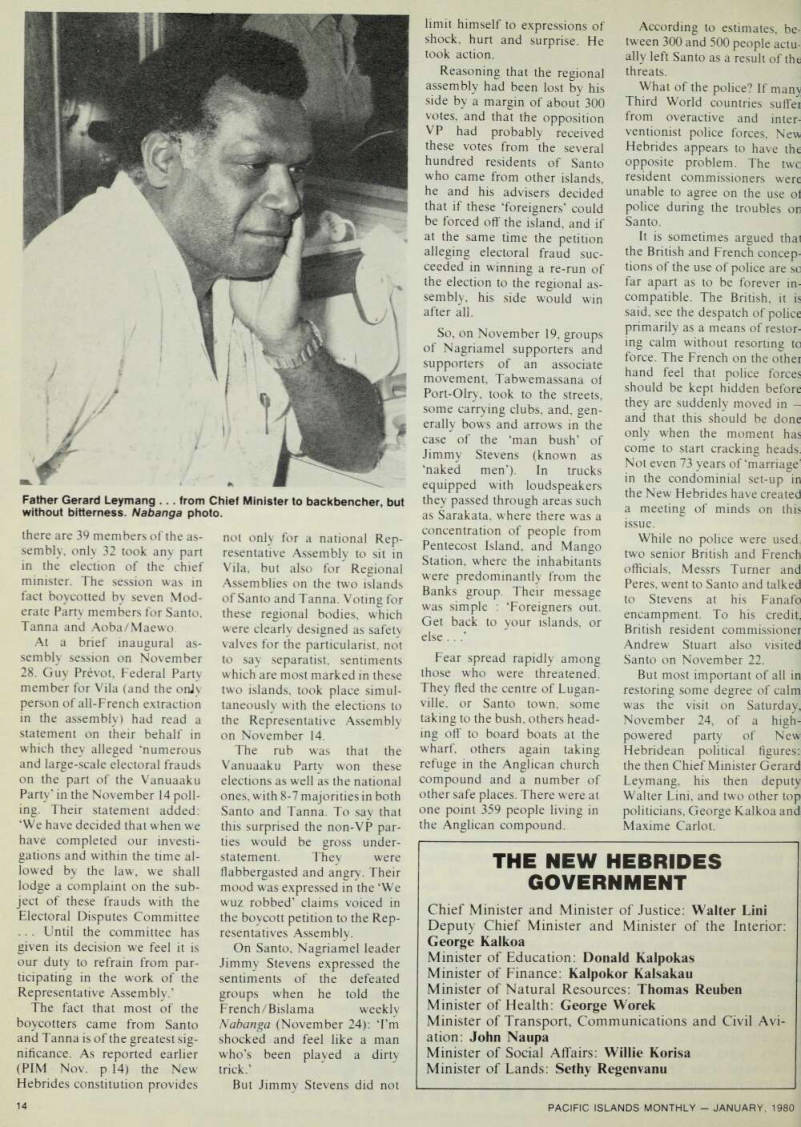
Father Walter Uni ... from Deputy Chief Minister to CM, but with humility. Nabanga photo.
tions had not been “straight” the John Frum and Kapiel would stop them going to Vila until a new election was held. ‘The people for the Arts Fes tival gathered at our property waiting for the ship and 120 Kapiel one of the many cults on this “island of cults” and John Frum standover men arrived armed with clubs and with red bands around their heads. They moved over to where the people were as sembled and their leader an nounced loud and clear in pidgin “Anyone who goes to the Arts Festival we will kill his wife and children and burn his house”... ‘After abortive talks with representatives of the British and French residencies who had arrived from Vila, and who
appeared interested in doing
nothing, I returned in disgust to my workshop where I found
people carving out weapons
they had made they had had
enough.
‘The standover men an nounced that they would be back the following morning to a) remove the Futunese on my property (80% of my staff are Futunese) as they were VP fol lowers, and b) they would burn out all the villages on the west coast from Loanei to Bethel, and c) they would prevent the projected election of five chiefs to the regional assembly due to be held the following day. ‘A night of feverish activity on my property resulted. The Futunese moved out and up into the bush as they did from the other three Futunese settle ments. The people of White sands started arriving and positioning themselves around the plantation to intercept any attackers. I was astounded when at daylight I found some
300 people busily making
weapons in and around my
workshop.
‘A message that the mobile police would be down at Tanna from Vila at 8.00 am the next morning was passed on at 10 pm. We monitored every ve hicle which passed along the road and the only one from the Agencies was the French
Toyota. Presumably this car
ried the message that the air craft were due from 8 am on and that the British police were on the first three aircraft. ‘During the night a group
moved out from the area of Alexis Yolou’s village and dug a trench across the airfield, as well as 19 holes at the landing area and invisible from the air, as the spoil from the holes had been scattered around the air field. ‘At 7.10 am Air Melanesiae advised me from Vila that the special mobile force were due from 8 am onwards. At the same time word came down from the airfield of the damage done there. How word got as far as Vila I don’t know. ‘I called on the local share holders of the New Hebrides
Airways, mostly Melanesians,
and told them that if they ral lied with me we could use the remaining 40 minutes to repair
the airstrip. Fifty-one adults,
plus children, toiled with me using three vehicles and filling the airfield markers as well with soil to carry to the holes.
Women were actually carrying
soil in their skirts. A mag nificent effort by the people to restore “their” aerodrome.
During this operation two
senior local French officials arrived on the scene, drove around but made no effort to help tried to talk to some of the people who ignored them, so they just drove off. Not a single person, truck or machine was offered by them. The air
strip was nevertheless repaired
in time. ‘Meanwhile a force of “mod erates” armed with clubs com plete with their red headbands left from Loanatum Alexis Yolou’s village and headed towards Lenakel. The crowd at my place by now was over 500 and they were spoiling for a fight. The “moderates” did not attempt to burn out the Futunese but continued on to the British and French agencies at Isangel. The Kapiel from the Middle Bush area moved and destroyed the bush market and gardens in that area. ‘We persuaded the mob at our place not to proceed to Isangel as they were too excited and, having attained a local
majority, and being armed
with various vicious weapons,
a cooling-off period was
indicated. ‘All this time, expense and misery should never have hap
pened. It will happen again and
again. I have been putting in
writing for two years now the cause of this misery. I say it
again. Stop this using of the
cargo cultists by unscrupulous characters and incredibly stu pid government officials be fore we have a real tragedy on our hands.’
Bob Paul’s account confirms the dominant impression I gathered on my short, week long visit to the New Hebrides.
It was that the real line of div ision in New Hebrides political life is not between ‘Anglophone’ and ‘Franco phone’, nor even between the British and French on the one hand and the New Hebrideans on the other. It is between New Hebrideans who have been more and those who have been less influenced by the modern world in particular those who have been influenced rather strongly by the missions, for example not so much in many cases by their religious teachings as by their edu cational, medical and other social activities. Most of these activities just happened to have been carried on in English,
although the French, especially
in recent years, have made massive efforts in the edu cational field. For example, Fr.
Walter Lini, an Anglican priest trained in New Zealand, will under no circumstances be threatening Fr. Gerard Leymang, a Roman Catholic priest trained in France, with a club.
Two short statements from
directly opposite New
Hebridean sources seem to sum up these divisions. One is an election slogan of the VP.
One saw it often on the walls of Vila in the post-election period. It said: ‘Vote for the VP the party with 10 years ex perience of politics at home and throughout the world!’
The election result shows that this kind of outward-looking, modernist approach has
obviously won the majority
support of the New Hebrides
population.
But now listen to Jimmy Stevens’ vision of politics in the New Hebrides: ‘A regional council should be formed for each island. Independence should not come all at once for the whole country. Each island should first have its own auton omy . . . There can be no New Hebrides with a strong and
authoritative central govern ment. There’s no question about this.’
As far as foreigners are con cerned, the great danger lies as Bob Paul indicates in the
manipulation of people like
Stevens and his ‘man bush’ fol lowers, and Tanna’s Alexis Yolou and his John Frums by interests as diverse as the American financial adven turers Eugene Peacock and Michael Oliver (with their way-out brand of private
enterprise fundamentalism),
conservative political figures
like Cronsteadt and Prevot,
politically prejudiced district
agents, and unwanted figures like Antoine Fornelli, who although a prohibited
immigrant after his previous
activities trying to start a cultist movement on Tanna (the so called ‘4-Corners Movement’), turned up there briefly again in November in an obvious attempt to fish in the troubled waters.
There is no doubt that the condominial powers ‘want out’, and it is certainly time they went. The whole context of their political and economic re lations is such that their situ ation in New Hebrides is rather an embarrassment to them than anything else.
It is obvious that in the pre sent situation, the French have an effective veto over con dominial actions, since the Bri tish have concluded that while New Hebrides matters little to them, it matters much more to France, especially in view of the unsettled situation in that country’s territories, par ticularly New Caledonia. It simply can’t be imagined that the British are going to do any thing to annoy the French in New Hebrides, especially in view of the delicate nature of their relations in the Common Market.
So, it is certainly time they went. New Hebrides does not need government whose de cisions are coloured by Com mon Market or NATO anxieties.
These people need a govern ment whose prime concern is the New Hebrides. There is no doubt that, whatever the prob lems it will face in the future, the government headed by Walter Lini is such a govern ment.