Islands problems
pp. 40-44 · Read in the full issue

Pim Looks Back On 50 Years
And finds many Islands problems still with us
In this, our 50th anniversary year, PIM intends to review the half century of news highlights in its pages. Each month we’ll survey a four-year period under the highly-expert guidance of former PIM editor and publisher JUDY TUDOR, who has known the people who have made the news. She launches what promises to be a fascinating survey with a review of the years 1930-34.
Standing on the threshold of the 1980’s and looking back to the 16th of August 1930 when the publication made its debut, it seems that PlM’s Pacific then bore little resemblance to today’s version. But, like the poet said, the more we change, the more we remain the same, at least in some respects, and many of the Islands problems of 1930 are with us yet the price of copra, rubber or ba
nanas, political wrangles,
development and the need for investment.
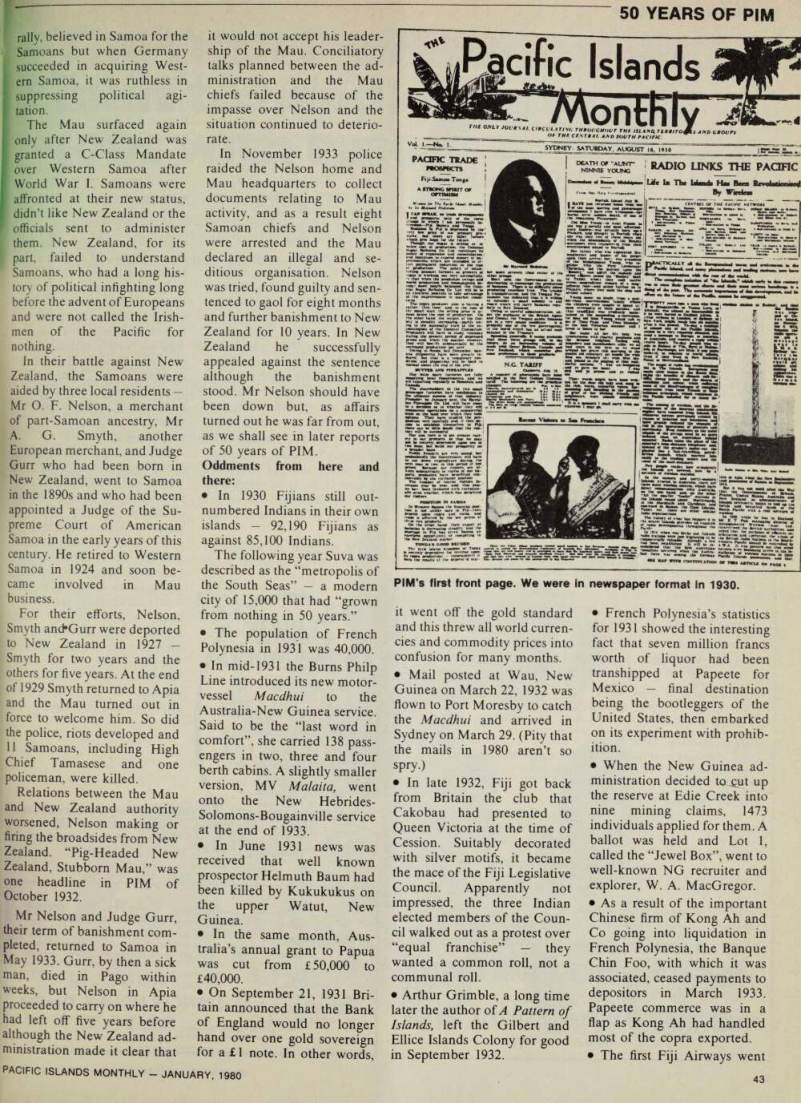
At its birth PIM was of tab loid newspaper size and did not adopt its now familiar maga zine format for about 15 months. It carried a dateline August 16, September 20, etc for even longer than that, although we now wonder why, as distribution was all by sea mail and the most isolated sub scribers waited literally months for their copies. Except intern ally in New Guinea, air trans port was non-existent; Islands people were used to intervals of weeks or months between ships and were not noticeably less happy for it.
In spite of the fact that the
total European population of
the South Pacific Islands was considerably less than it is today, the inhabitants of PlM’s Pacific were indisputably white, or nearly so. Asians, called Asiatics and sometimes
coolies, were frequently “prob
lems that had to be solved’’.
Islanders were not problems, except the West Samoans who were generally ‘sullen’ or
‘unco-operative’ when they
were not being straight-out
bloody minded; and of course New Guinea kanakas, in uncontrolled areas, were oc casionally wild, fierce or war like, and during the four years under review managed to kill a number of Europeans.
In its first issue, PIM stated its aims as (1) providing world and other news that affected the Islands as a whole and (2) fostering Australian trade with them’
It proceeded to do both, in relation to (2) never letting up on the Commonwealth Government which it con sidered was doing less than it ought and making a pretty poor fist of what it did do; and in relation to (1) taking up causes with an enthusiasm that would make any editor blanch today. This made PIM enemies as well as friends, but right or wrong there was no fence sitting in PlM’s editorial pol
icy.
The infamous Wall Street collapse of October 29, 1929, which set off the Great De gression had occurred about: nine months before PlM’s first
issue. The magazine’s early
years therefore were coloured gloomily by the economic cir cumstances of the time.
But PIM, like all right minded organisations of the: time, expected its clientele to< shoulder the white man’s bur den uncomplainingly, to see; fair play and justice and set aj good example to local inhabi tants.
From its first issue, PIM la jmented the fact that there were 17 distinct administrations in
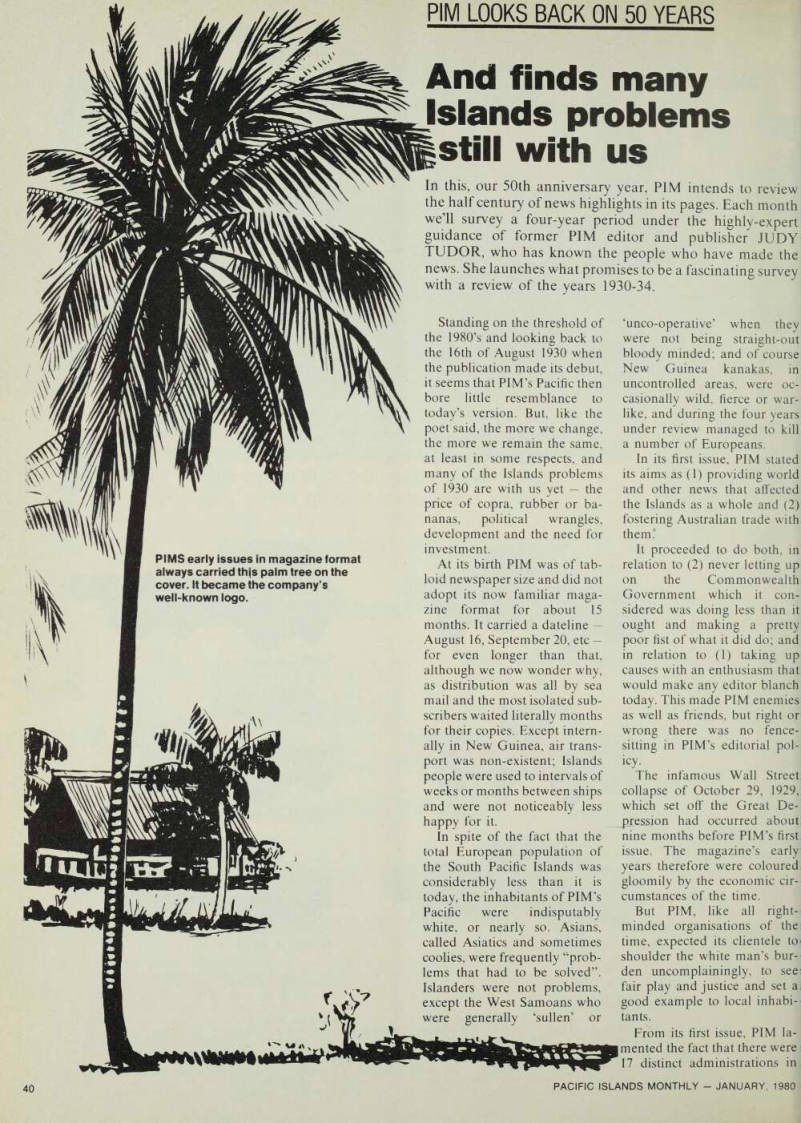
RIMS early issues in magazine format always carried this palm tree on the cover. It became the company’s
well-known logo.
the Pacific and urged an associ . ation or confederation which could discuss and deal with I problems common to all islands indigenous edu cation, health, future develop ment, quarantine laws, transport etc. It was a theme that was pushed periodically in PIM over the next 17 years, until, in fact, the South Pacific I Commission was set up after World War II as a consultative body. In the event the SPC turned out to be something of a disappointment, at least to PIM. but that was yet to come.
Other matters that took up a lot of space in PIM in its first four years included the follow
ing;
Copra: From the time in the 1860’s when the Hamburg firm of Jon Cesar Godeffroy und Sohn had pioneered the Islands copra industry from head quarters in Western Samoa, until the late 1920’5, all Islands economies floated along on this industry. Coconuts were ‘the consols of the East’ and planters believed the old saw that if you looked after them for the first seven years of their life they would keep you for the rest of yours. World War I
produced high copra prices
that boomed on into the 1920’5.
In 1926 copra brought a record £Stg29 per ton in London.
By the time PIM was born in 1930, the price had fallen to £ 14 in London and much less on an Islands beach, and planters
everywhere were showing the
first signs of panic. Amongst those most affected were the 182 returned servicemen who
had bought ex-German plan
tations in the Mandated Terri tory of New Guinea from the
Australian Expropriation
Board, the instrumentality set up to take over the German estates as part of war repar ations. Few of the Australians had paid cash, but the Expro Board made purchase reason ably easy with low interest and
long-term repayment of prin
cipal.
When copra prices nose dived in 1930, the Expro Board scrubbed interest for that year and deferred repayment of principal until June 1931, when the situation was to be re viewed. Copra prices con
tinued to sink and the moratorium was renewed year after year.
In early 1931. R. W. Robson, founder and editor of PIM, was in London and he made it his business to investigate the disastrous and to many, mys terious, falling copra market.
He attributed the slump to the general depression, to whale and other vegetable oils which when treated with new scien tific methods had become almost as suitable for mar garine as copra, but saved his biggest blast for the actions of the Unilever combine. This
had amalgamated powerful
European manufacturers of margarine with British soap makers, Lever Bros., in 1929 and as a result the combine controlled the Euro-British copra; oil seeds and whale oil markets. R. W. Robson’s stories won PIM many new readers.
Except for a brief period when Britain went off the gold standard in 1931, copra con tinued its- downward plunge, reaching £7.12.6 Stg c.i.f. Lon don in January 1934. With deductions for freight, hand
ling, shrinkage, insurance and
the rest, what the poor old
planter got ex-plantation was
below the cost of production, so news of the copra industry was always of interest to him.
Rubber which had brought 12/- a lb in 1911 was down to 3d a lb in 1930. Papua was the
biggest South Pacific producer
although Fiji and Western
Samoa has been minor ex porters. Papua’s annual 600 tons brought in .£200,000 in 1925; the same quantity in 1930-31 realised only £50,000.
The Papuan industry was saved from complete extinction by 4d a lb preference on the Aus tralian market.
The alternatives: As things went from bad to worse in established Islands industries, no issue of PIM was complete without some reference to alternative crops or new things to do with coconut oil (such as use in motor vehicles).
Castor oil seed was tried in Papua and three firms in Fiji
experimented with pineapple
growing and canning. Two
young men in the Mandated
Territory were distilling some
thing called massoi oil from trees found in the Finisterre Ranges - it was said to re semble cinnamon.
There was a plea for the resumption of Bird of Paradise shooting that had been banned in New Guinea, it being al leged that some German planters had financed their plantations on the sale of BOP skins to Europe. The ban stayed but planters were urged, 25 years before the idea did take off, to try coffee. A firm in Papua proposed to grow kapok on a large scale, others were trying sisal hemp and it was suggested that the Gulf district’s millions of nipa palms might produce power alcohol.
PIM urged everyone, every where, to try tung oil or pea nuts and Papua got a lot of publicity but no action from four groups trying to float sugar companies, leading PIM to comment sourly in an edi torial: .. so far as some of them are concerned the only kind of sugar they will ever produce is that which they will take out of the pockets of their deluded share and bond holders.”
Papua never did get a sugar industry but the fact that it was well established in Fiji allowed that colony to weather the worst of the depression in good shape due to some extent to the Ottawa Agreement that gave Fiji preference in UK and Canada. The same Ottawa Agreement gave Fiji entry to Australia for 40,000 centals of bananas per annum and de spite the screams of anguish from NSW and Queensland banana growers, shipments ac tually arrived in Sydney and Melbourne in early 1933.
Gold and air services. Gold was the great hope in the de
pressed 1930’s although when
PIM came into the picture only Papua and New Guinea had well established industries. In Papua, Misima Island was the biggest producer. In the Man dated Territory, the first phase of alluvial mining on Morobe field was over and a hiatus ensued until the viable big boys of the industry got going. At the end of 1930, 29 New Guinea
mining companies were listed
in Sydney, most of them never getting off the ground.
Those that did included Day Dawn, New Guinea Goldfields and, most impressive of all.
Placer Development/Bulolo
Gold Dredging, the last through the farsightedness of a former District Officer, C. J.
Levien, who had quit the NG service to become one of the pioneers of the Wau goldfield in the early 1920’5. Through his urging, Guinea Gold NL was formed in Adelaide in 1926 to work the Koranga leases and test 12 miles of the Bulolo River.
In 1928 Placer, a Vancouver company, took an option over Guinea Gold and proved a dredging area of 1100 acres.
Bulolo Gold Dredging was formed as a Placer subsidiary in 1930 to work the leases and by then Levien had persuaded his friends that air transport was the only way to solve the goldfields transport problem.
An old war-time DH37 plane pioneered the way and in 1927 Guinea Airways was bom, the following year purchasing two W 34 Junkers
planes, the only commercial
aircraft then capable of uplift ing the largest component of the dredges that were to be built on the Bulolo a three ton tumbler shaft. By the end of 1933, there were 26 airstrips in New Guinea and four in Papua, and New Guinea was leading the world in air trans port.
BCD’s first dredge went into operation in March 1932, No 2 in October 1932, No 3 in November 1933 and No 4 soon after. Levien never saw any of them in operation he died in Melbourne in January 1932.
In early 1932 an old prospec tor named Bill Borthwick,
grub-staked by Pat Costello,
well known resident of Fiji, discovered gold in the dry hills about seven miles inland from Tavua, in Fiji’s Viti Levu. A small paragraph appeared in PIM stating this bare fact, but from this discovery were to de velop the rich Loloma and Emperor Mines of Vatukoula,
Fiji.
The Mau. This Samoan or ganisation had its beginnings in the rivalry between the great powers for possession of Samoa at the end of last cen tury. Members, not unnatu
rally, believed in Samoa for the Samoans but when Germany succeeded in acquiring West ern Samoa, it was ruthless in
■ suppressing political agi-
F tation.
The Mau surfaced again I only after New Zealand was granted a C-Class Mandate i over Western Samoa after [World War I. Samoans were affronted at their new status, f didn’t like New Zealand or the f officials sent to administer them. New Zealand, for its f part, failed to understand Samoans, who had a long his
tory of political infighting long
before the advent of Europeans and were not called the Irish men of the Pacific for
nothing.
In their battle against New Zealand, the Samoans were aided by three local residents Mr O. F. Nelson, a merchant of part-Samoan ancestry, Mr A. G. Smyth, another
European merchant, and Judge
Gurr who had been bom in New Zealand, went to Samoa in the 1890 s and who had been appointed a Judge of the Su preme Court of American Samoa in the early years of this century. He retired to Western Samoa in 1924 and soon be came involved in Mau business.
For their efforts, Nelson,
Smyth and*Gurr were deported
to New Zealand in 1927 Smyth for two years and the others for five years. At the end of 1929 Smyth returned to Apia and the Mau turned out in force to welcome him. So did the police, riots developed and
11 Samoans, including High
Chief Tamasese and one policeman, were killed.
Relations between the Mau and New Zealand authority worsened, Nelson making or firing the broadsides from New Zealand. “Pig-Headed New Zealand, Stubborn Mau,” was one headline in PIM of October 1932.
Mr Nelson and Judge Gurr, their term of banishment com pleted, returned to Samoa in May 1933. Gurr, by then a sick man, died in Pago within weeks, but Nelson in Apia proceeded to carry on where he had left off five years before although the New Zealand ad ministration made it clear that
it would not accept his leader ship of the Mau. Conciliatory talks planned between the ad ministration and the Mau chiefs failed because of the impasse over Nelson and the situation continued to deterio rate.
In November 1933 police raided the Nelson home and Mau headquarters to collect documents relating to Mau activity, and as a result eight Samoan chiefs and Nelson were arrested and the Mau declared an illegal and se ditious organisation. Nelson was tried, found guilty and sen tenced to gaol for eight months and further banishment to New Zealand for 10 years. In New Zealand he successfully
appealed against the sentence
although the banishment stood. Mr Nelson should have been down but, as affairs turned out he was far from out, as we shall see in later reports of 50 years of PIM.
Oddments from here and there: • In 1930 Fijians still out numbered Indians in their own islands 92,190 Fijians as against 85,100 Indians.
The following year Suva was described as the “metropolis of the South Seas” a modern city of 15,000 that had “grown from nothing in 50 years.” • The population of French Polynesia in 1931 was 40,000. • In mid-1931 the Burns Philp Line introduced its new motor vessel Macdhui to the Australia-New Guinea service.
Said to be the “last word in comfort”, she carried 138 pass engers in two, three and four berth cabins. A slightly smaller version, MV Malaita, went onto the New Hebrides-
Solomons-Bougainville service
at the end of 1933. • In June 1931 news was received that well known prospector Helmuth Baum had been killed by Kukukukus on the upper Watut, New Guinea. • In the same month, Aus tralia’s annual grant to Papua was cut from £ 50,000 to £40,000. • On September 21, 1931 Bri tain announced that the Bank of England would no longer hand over one gold sovereign for a £ 1 note. In other words,
it went off the gold standard and this threw all world curren cies and commodity prices into confusion for many months. • Mail posted at Wau, New Guinea on March 22, 1932 was flown to Port Moresby to catch the Macdhui and arrived in Sydney on March 29. (Pity that the mails in 1980 aren’t so
spry.)
• In late 1932, Fiji got back from Britain the club that Cakobau had presented to Queen Victoria at the time of Cession. Suitably decorated with silver motifs, it became the mace of the Fiji Legislative Council. Apparently not impressed, the three Indian elected members of the Coun cil walked out as a protest over
“equal franchise” they
wanted a common roll, not a communal roll. • Arthur Grimble, a long time later the author of A Pattern of Islands, left the Gilbert and Ellice Islands Colony for good in September 1932.
• French Polynesia’s statistics for 1931 showed the interesting fact that seven million francs worth of liquor had been
transhipped at Papeete for
Mexico final destination being the bootleggers of the United States, then embarked on its experiment with prohib ition. • When the New Guinea ad ministration decided up the reserve at Edie Creek into nine mining claims, 1473 individuals applied for them. A ballot was held and Lot 1, called the “Jewel Box”, went to well-known NG recruiter and
explorer, W. A. MacGregor.
• As a result of the important Chinese firm of Kong Ah and Co going into liquidation in French Polynesia, the Banque Chin Foo, with which it was associated, ceased payments to depositors in March 1933.
Papeete commerce was in a flap as Kong Ah had handled most of the copra exported. • The first Fiji Airways went
PlM’s first front page. We were In newspaper format in 1930.
into service about March 1933 with two Moth planes equipped with floats. Services linked Suva, Lautoka, Levuka and Labasa. Government was subsidising the airline to the tune of £ 1500 per year for three years.
• In June 1933 all eyes were on London where an international conference was being held to try to sort out the world’s econ omic ills, including currency and exchange, trade, unem ployment and war debts. The German delegation walked out
to emphasise Germany’s de mand for the return of former colonies without which, according to Hitler who by then was in control, Germany could not survive. The con ference failed to solve any thing. Another cloud on the horizon, said PIM editorially, was Japan. ‘. . . It is inevitable that it will turn southwards.
The result is likely to be
tragedy.” PIM wasn’t always
right in its prognostications.
This time it was. • In mid-1933, a group of Papuans was sent to Sydney University for a six-month medical course, after which they would return to their vil lages as medical aides. PIM was in favour of the scheme but some Europeans in the Man
dated Territory wrathfully saw
it as another step towards mak ing the natives even more ‘big headed’ than they were. • About 500 Fiji-Indians, most of whom had gone to the col ony under the old indenture system, chose to be repatriated to India, leaving Suva on the
steamer Gabges in August
1933. • PIM editorialised in October 1933 that Britain’s efforts in the
New Hebrides were a scandal..
Although the French lookedl after their nationals, who num bered 1000, allowing them tot import labour from Indo- China and subsidising copra,.
Britain did nothing for its 200! nationals, PIM said it was not wonder that scores of British) had sold out to the French, or taken French nationality. • At the end of 1933 the firstl news of the existence of what are now the Highlands prov inces of New Guinea reached! the outside world. Explorations under Assistant District Officer J. L. Taylor and Mick andl Danny Leahy added to New Guinea an estimated 300,0001 new inhabitants and a vast pla teau and valley system of fer tile land between Bena Bena and Mt. Hagen a region pre
viously thought to be just a
continuation of uninhabited mountains.
Odd Advts Dept.
In 1931 if you were toothless in the wilds of the Islands there was no need to despair. A Syd ney dentist named Nolan undertook to send you false teeth by post first sending you a tin of wax with detailed instructions on how to take your own dental impressions.
An optician in the same city would, on demand, send an eye chart so other do-it-yourself experts could test themselves for spectacles. Someone named Wastall in Suva advertised that he would supply literature on whether or not aluminium) cookware was poisonous.