Skulduggery (and
p. 43 · Read in the full issue
Books
Skulduggery (and much more) In a tale of airlines
Airline. By lan Driscoll, Shortland Publications, 360 Dominion Rd, Auckland, New Zealand. SNZ 12.95.
Impressions left with the reader of Airline a 300-page history of the development of aviation in the South Pacific and New Zealand in particular include; • The fun people had flying and pioneering air routes in the
early days compared with the
almost antiseptic flights we
now take; • The impact of aviation on the Islands; • The political scramble be tween Britain and the United States to claim islands as staging points across the Pa cific.:
• The role played by flying
boats; and, in connection with that, • British skulduggery in push ing onto New Zealand three
poorly patched up Sunderland
flying boats which were renamed Sandringhams. One arrived in New Zealand with its bilges full of concrete poured there in Singapore en route be cause the riveting had given way.
Aucklander lan Driscoll who seven years ago published
Flightpath South Pacific
which traces the arrival and development of airlines in the region, is scathing of Britain’s shabby ethics in shoving the aircraft onto New Zealand.
The installation of the motors was an outrageous piece of en gineering and he quotes the then New Zealand Director of Civil Aviation, E. A. Gibson, as
saying:
The installation was inef ficient and to wish them on New Zealand which was tech
nically unequipped to know
any better was an act of blatant dishonesty and fraud.’
More important perhaps
however was the fact that the
deal meant that the trans pacific capability of TEAL, as the New Zealand airline was then known, disappeared with New Zealand’s decision, under pressure from Whitehall, to accept the flying boats.
Australia on the other hand stood firm at that time a year or two after the war and Qantas re-equipped itself not with British aircraft but with Lockheed Constellations.
Driscoll traces aviation in the South Pacific through vari
ous people who played leading
roles in plotting the routes, test
ing the landing places, instal
ling the equipment.
Predominant throughout is the role played by Pan American and indeed Dris coll traces American involve ment in the region back to the
days when Admiral Perry
forced the Japanese to open their doors to the West. Then by stages he unravels the sub
terfuge used by the major
powers to plot possible air routes across the Pacific. In that game of aviation poker New Zealand was very much the raw rookie who almost slavishly followed Britain’s footsteps.
That trust disintegrated in 1953 when Britain said in effect that New Zealand was not wel come in Pacific aviation oper ations, but it was not until 1958, when the New Zealand govern ment bought out Australia’s share in TEAL, that the New Zealanders were in a position to go it alone on trans-Pacific operations. This they did with
stunning success.
While Driscoll’s account understandably is dominated by American, British, New Zealand and Australian oper ations, he switches to a brief account in one chapter on the birth and demise of New Caledonia’s Societe Francaise de Transports Aeriens du Pacifique Sud (TRAPAS), and
the sad death of one of its most colourful pilots Rene Allais who crashed a Catalina in the lagoon at Raiatea, the second largest of the Society Islands, in 1958 killing all 15 aboard.
Out of a host of characters and personalities who devel oped aviation in the region Driscoll points to “the most un noticed of New Zealand’s air line pioneers”, Oscar Garden who, among other things, pilo ted TEAL’s first flying boat from England to New Zealand.
Even though the account of that flight is brief it stirs the im agination as to what the trip must have been like for the passengers.
The Pacific War accelerated British and American interest in the region. They looked for
staging points for flying boat
and land-based aircraft to link Europe and the United States with New Zealand and Aus tralia.
Driscoll spends time tracing
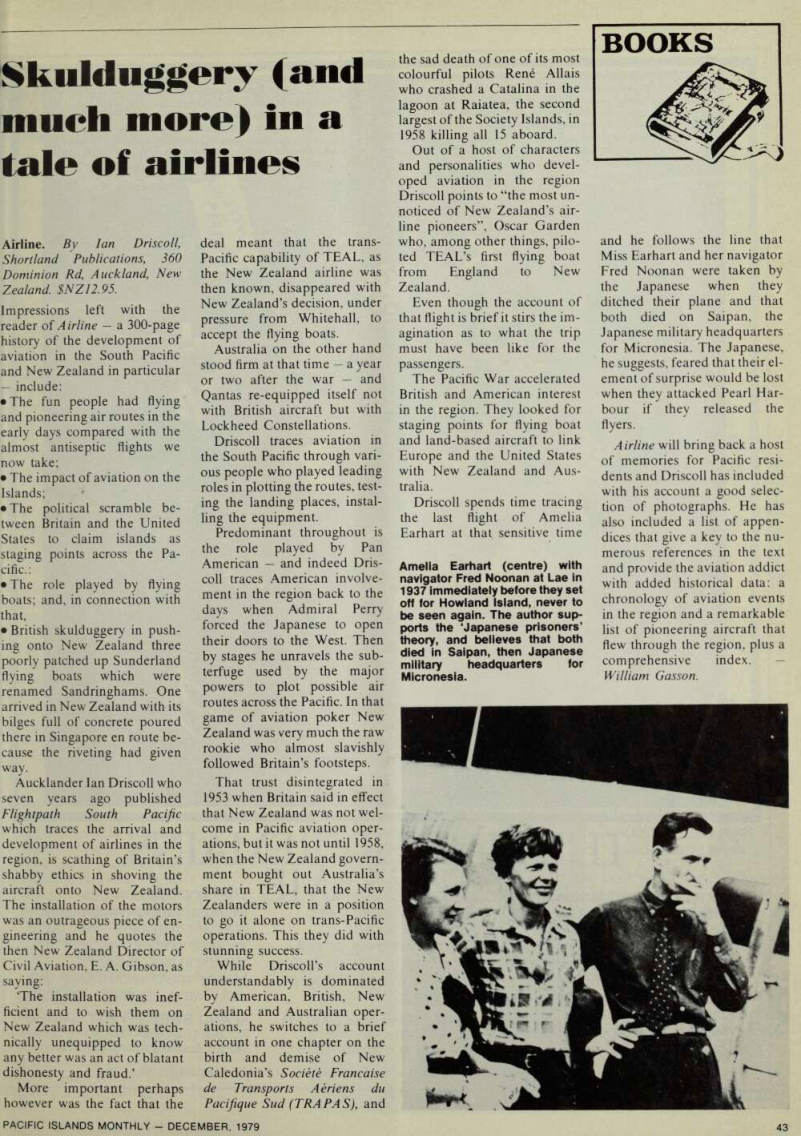
the last flight of Amelia Earhart at that sensitive time
and he follows the line that Miss Earhart and her navigator Fred Noonan were taken by the Japanese when they ditched their plane and that both died on Saipan, the
Japanese military headquarters
for Micronesia. The Japanese, he suggests, feared that their el ement of surprise would be lost when they attacked Pearl Har bour if they released the flyers.
Airline will bring back a host of memories for Pacific resi dents and Driscoll has included with his account a good selec tion of photographs. He has also included a list of appen dices that give a key to the nu merous references in the text and provide the aviation addict with added historical data: a chronology of aviation events in the region and a remarkable list of pioneering aircraft that
flew through the region, plus a
comprehensive index.
William Gasson.
Amelia Earhart (centre) with navigator Fred Noonan at Lae in 1937 immediately before they set off for Howland Island, never to be seen again. The author sup ports the ‘Japanese prisoners’ theory, and believes that both died in Saipan, then Japanese military headquarters for Micronesia.