enjoyed - but
p. 45 · Read in the full issue
An adventure
not too well communicated
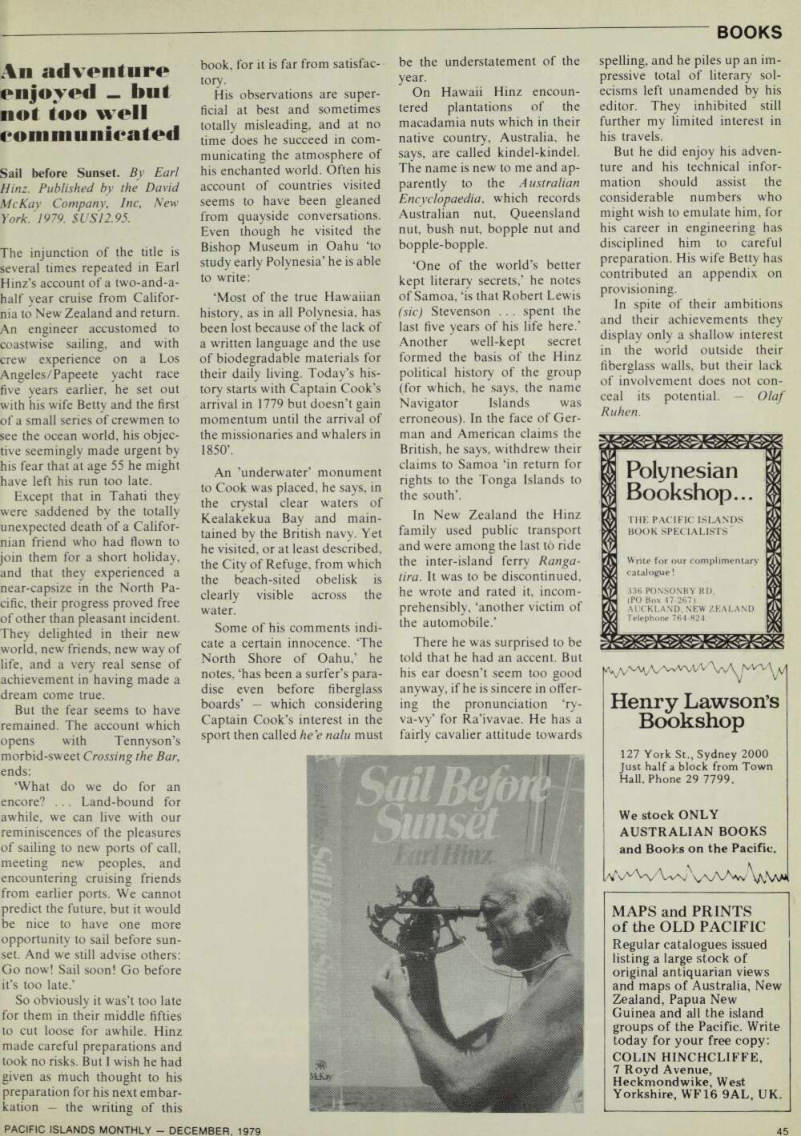
Sail before Sunset. By Earl Hinz. Published by the David McKay Company, Inc, New York. 1979. $U512.95.
The injunction of the title is several times repeated in Earl Hinz’s account of a two-and-a half year cruise from Califor nia to New Zealand and return.
An engineer accustomed to
coastwise sailing, and with
crew experience on a Los
Angeles/Papeete yacht race
five years earlier, he set out with his wife Betty and the first of a small series of crewmen to see the ocean world, his objec tive seemingly made urgent by his fear that at age 55 he might have left his run too late.
Except that in Tahati they
were saddened by the totally
unexpected death of a Califor nian friend who had flown to join them for a short holiday, and that they experienced a near-capsize in the North Pa cific, their progress proved free of other than pleasant incident.
They delighted in their new world, new friends, new way of life, and a very real sense of achievement in having made a dream come true.
But the fear seems to have remained. The account which opens with Tennyson’s morbid-sweet Crossing the Bar, ends; ‘What do we do for an encore? ... Land-bound for awhile, we can live with our reminiscences of the pleasures of sailing to new ports of call,
meeting new peoples, and
encountering cruising friends
from earlier ports. We cannot predict the future, but it would be nice to have one more opportunity to sail before sun set. And we still advise others: Go now! Sail soon! Go before it’s too late.’
So obviously it was’t too late for them in their middle fifties to cut loose for awhile. Hinz made careful preparations and took no risks. But I wish he had given as much thought to his preparation for his next embar kation the writing of this
book, for it is far from satisfac tory.
His observations are super ficial at best and sometimes totally misleading, and at no time does he succeed in com
municating the atmosphere of
his enchanted world. Often his account of countries visited seems to have been gleaned from quayside conversations.
Even though he visited the Bishop Museum in Oahu ‘to
study early Polynesia’ he is able
to write: ‘Most of the true Hawaiian history, as in all Polynesia, has been lost because of the lack of a written language and the use of biodegradable materials for
their daily living. Today’s his
tory starts with Captain Cook’s arrival in 1779 but doesn’t gain momentum until the arrival of the missionaries and whalers in 1850’.
An ’underwater’ monument to Cook was placed, he says, in the crystal clear waters of Kealakekua Bay and main tained by the British navy. Yet he visited, or at least described, the City of Refuge, from which the beach-sited obelisk is clearly visible across the water.
Some of his comments indi cate a certain innocence. ‘The North Shore of Oahu,’ he notes, ‘has been a surfer’s para dise even before fiberglass boards’ which considering Captain Cook’s interest in the sport then called he’e nalu must
be the understatement of the year.
On Hawaii Hinz encoun tered plantations of the macadamia nuts which in their native country, Australia, he says, are called kindel-kindel.
The name is new to me and ap parently to the Australian
Encyclopaedia , which records
Australian nut, Queensland nut, bush nut, bopple nut and
bopple-bopple.
‘One of the world’s better kept literary secrets,’ he notes of Samoa, ‘is that Robert Lewis (sic) Stevenson ... spent the last five years of his life here.’
Another well-kept secret formed the basis of the Hinz political history of the group (for which, he says, the name Navigator Islands was erroneous). In the face of Ger man and American claims the British, he says, withdrew their claims to Samoa ‘in return for rights to the Tonga Islands to the south’.
In New Zealand the Hinz
family used public transport
and were among the last to ride
the inter-island ferry Ranga
tira. It was to be discontinued, he wrote and rated it, incom prehensibly, ‘another victim of the automobile.’
There he was surprised to be told that he had an accent. But his ear doesn’t seem too good anyway, if he is sincere in offer
ing the pronunciation Ty
va-vy’ for Ra’ivavae. He has a fairly cavalier attitude towards
spelling, and he piles up an im pressive total of literary sol ecisms left unamended by his editor. They inhibited still further my limited interest in his travels.
But he did enjoy his adven ture and his technical infor mation should assist the considerable numbers who might wish to emulate him, for his career in engineering has disciplined him to careful preparation. His wife Betty has contributed an appendix on
provisioning.
In spite of their ambitions and their achievements they display only a shallow interest in the world outside their fiberglass walls, but their lack of involvement does not con
ceal its potential. Olaf
Ruhen.