new territory
pp. 37-40 · Read in the full issue
Tropicalities
Unesco In
Do Pacific Islanders read books? And who should be chosen to write UNESCO pub lications about the Pacific way of life? These were some of the questions tossed around at a re
cent UNESCO meeting of
islanders hosted in Noumea by the South Pacific Commission.
The meeting brought together
members of 14 Pacific Island educational and cultural or ganisations, besides represen tatives of Australia, France and New Zealand, and two direc tors of UNESCO from Paris.
It was the first time UNESCO had held a meeting in Noumea, this being the third session of the Advisory Com mittee for the Study of Oceanic Cultures. It was chaired by George Cowan of the Cook
Islands Library and Museum
Society. The other two mem bers of the working bureau
elected by the meeting are Carl
Heine, of the Pacific Island Re search Institute in Honolulu and Godwin Ligo from Vila, New Hebrides. The aim of the committee is to recommend ways in which UNESCO can help Pacific Islanders more
fully enjoy the advantages of
their cultural traditions.
In a significant move into the Pacific Island area, UNESCO
is helping with preparations for
the third South Pacific Festival of Arts, to be held in Port Moresby in August 1980. The Director of UNESCO’s Div ision of Cultural Studies, Mr.
E. Pouchpa Dass of Pakistan, flew from Paris for the
Noumea meeting and told
delegates that UNESCO is preparing an exhibition of oceanic art works collected from museums around the world. The Director of the Bremen Museum is co ordinating the collection which will be exhibited during the Port Moresby festival.
UNESCO is also planning to
produce a series of publications entitled ‘lntroduction to Oceanic Cultures’. This raised some keen debate: by whom, for whom and in what languages should the texts be written? Generally it was agreed that writers should be from the culture concerned, writing for the people of the area, in the language of the cul ture involved.
Georges Pilioko from the Territory of Wallis and Futuna asked what was the purpose of writing books for Islanders. He claimed that on Wallis nobody liked to read, except elderly people who were too old to go to Mass. He felt radio was an
easier way to help people enjoy
more of their cultural life.
Samoan writer Albert Wendt pointed out the conflicting in terpretations of Island values but he stressed that ‘conflict fertilises art and culture’. He pointed to the difference of opinion between the young generation and elders of a
given community who might
tell a writer ‘You are not a true Samoan, or a true Tongan’ if their ideas confided. But he said there should be no single viewpoint, among locals or outsiders.
In a further bid to promote the preservation of living cul ture, UNESCO is working on the recording of Island tra ditions which are not written down but only passed on
orally. The study of Island
languages with preparation of
grammar texts and dictionaries is also recommended. In this area it was suggested that col laboration should be sought from the University of Hawaii (Micronesian languages), Uni versity of Auckland (Polynesian) and the Aus tralian National University (Melanesian). As one island remarked ‘Your lanugage is your whole way of life’.
From the Maori point of view, Mr Peter Sharpies of New Zealand pleaded for help in preserving the Maori language. He said that of 300 000 Maoris ‘you would be lucky to find 20 000 fluent Maori speakers’. Still on the
language problem, Georges
Pilioko spoke of Wallis Island children bom in New Caledonia who visit their homeland and can only speak in broken Wallisian, having been educated in French.
From Tuvalu, Silinga Kofe spoke of local government measures being taken by his
country’s new independent
government. He said the exact workings of the old system of maneaba (meeting house) councils were very hard to re establish as they had been recorded only in oral tra dition.
These Islander views on the preservation of Pacific languages and the writing up of oceanic cultures were among numerous recommendations Mr Pouchpa Dass was able to take back to UNESCO head quarters in Paris. Helen Rousseau.
A dear bunch
of bananas
On September 29 at about 10 am the Speaker of the Tuvalu Parliament, the Hon Elia Tavita, and his cousin, were out fishing in the south west passage into Funafuti la goon when they were approached by a South Korean fishing vessel, Samsong No 16.
The crew asked to be taken ashore to obtain some bananas and coconuts.
On arrival at the government headquarters on Funafuti the members of the crew were taken to the police station where it was pointed out that the ship would have to come into the lagoon in order to col lect the supplies.
As it had appeared there was fresh fish on board the Fish Processing Officer, Keith Machell, went aboard and examined the catch. He found that the top fish in the hold had been caught not later than two
days previously, as they were
not properly frozen.
The logbook was then examined and, as was stated in court, ‘as the book was being looked at the Chief Officer was
virtually found rubbing out
some of the entries. The charts were examined and showed pencilled markings of a course for fishing inside Tuvalu’s waters’. This apparently oc curred to the northwest of Niu-
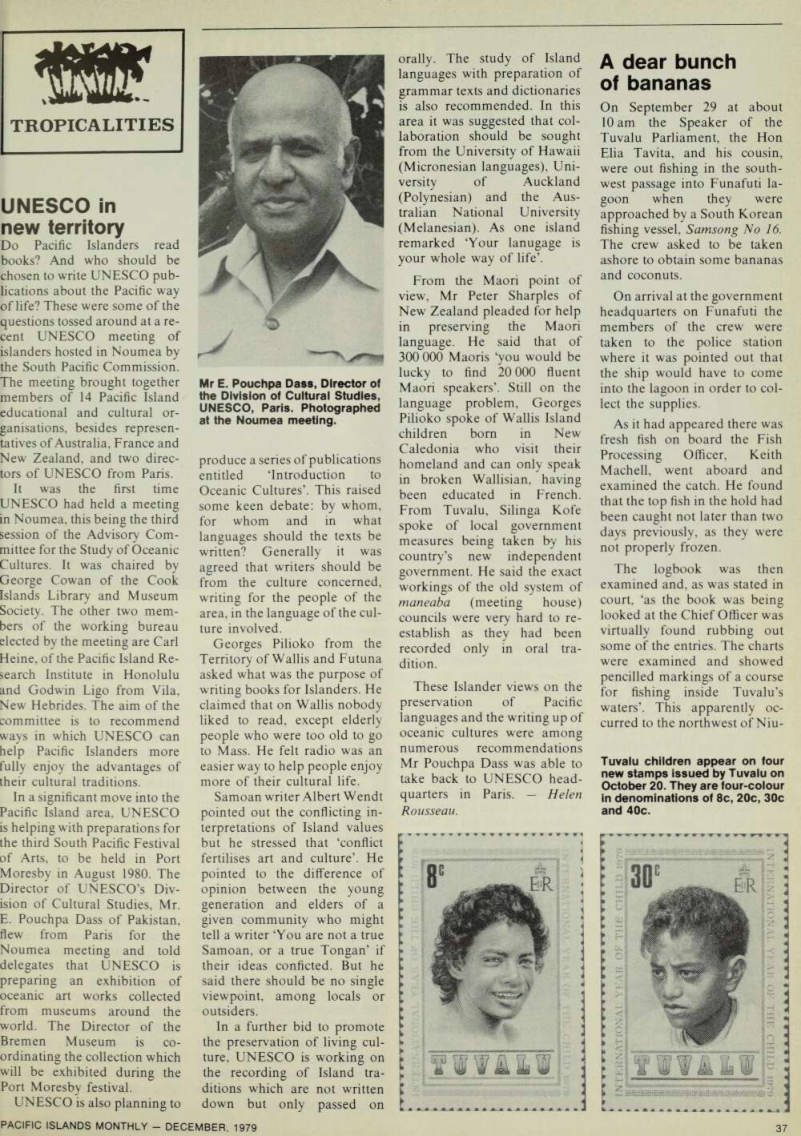
Mr E. Pouchpa Dass, Director of the Division of Cultural Studies, UNESCO, Paris. Photographed at the Noumea meeting.
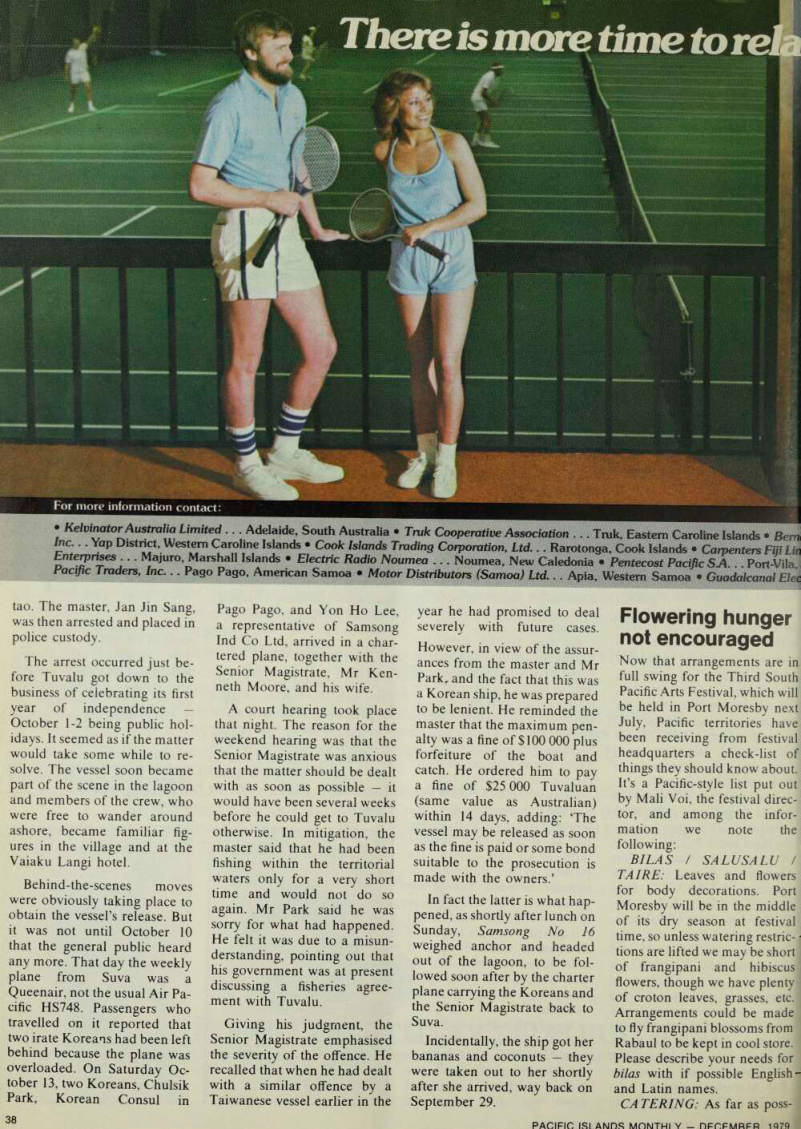
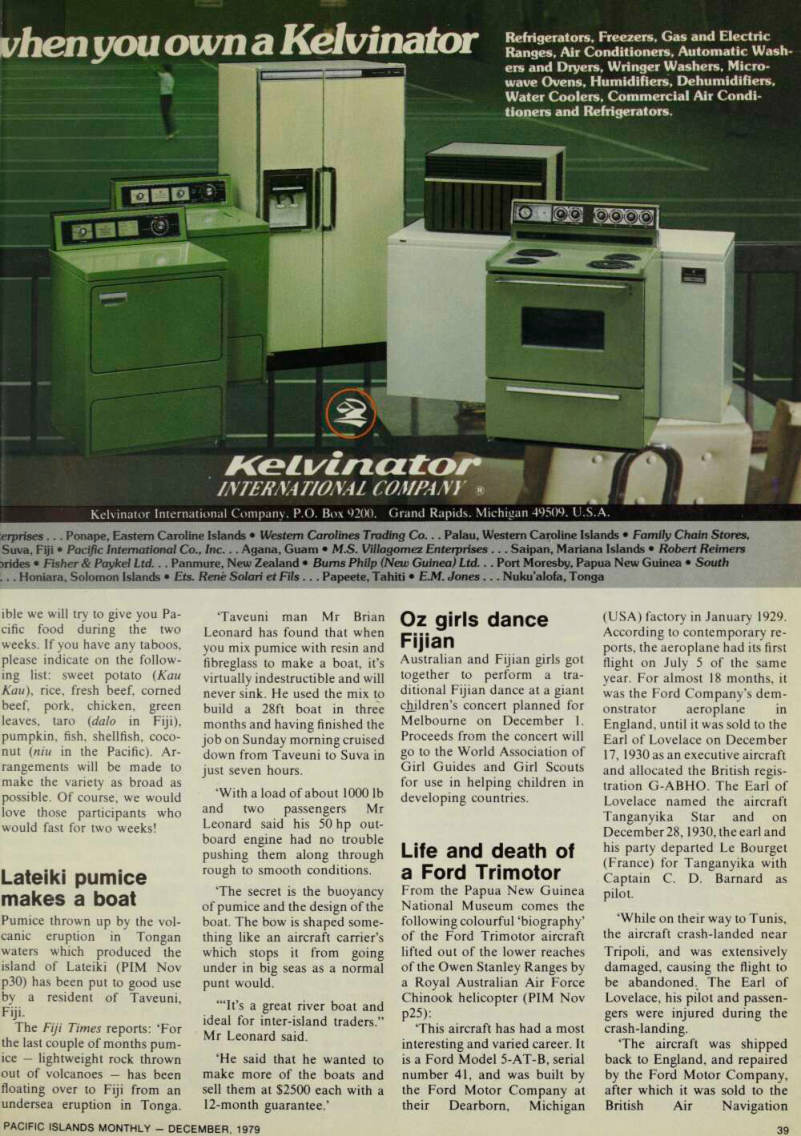
Tuvalu children appear on four new stamps issued by Tuvalu on October 20. They are four-colour in denominations of 8c, 20c, 30c and 40c.
tao. The master, Jan Jin Sang, was then arrested and placed in police custody.
The arrest occurred just be fore Tuvalu got down to the business of celebrating its first year of independence October 1-2 being public hol idays. It seemed as if the matter would take some while to re solve. The vessel soon became part of the scene in the lagoon and members of the crew, who were free to wander around ashore, became familiar fig ures in the village and at the Vaiaku Langi hotel.
Behind-the-scenes moves were obviously taking place to obtain the vessel’s release. But it was not until October 10 that the general public heard any more. That day the weekly plane from Suva was a Queenair, not the usual Air Pa cific HS74B. Passengers who travelled on it reported that two irate Koreans had been left behind because the plane was overloaded. On Saturday Oc tober 13, two Koreans, Chulsik Park, Korean Consul in
Pago Pago, and Yon Ho Lee, a representative of Samsong Ind Co Ltd, arrived in a char tered plane, together with the Senior Magistrate, Mr Ken neth Moore, and his wife.
A court hearing took place that night. The reason for the weekend hearing was that the Senior Magistrate was anxious that the matter should be dealt with as soon as possible it would have been several weeks before he could get to Tuvalu otherwise. In mitigation, the master said that he had been fishing within the territorial waters only for a very short time and would not do so again. Mr Park said he was sorry for what had happened.
He felt it was due to a misun
derstanding, pointing out that
his government was at present discussing a fisheries agree ment with Tuvalu.
Giving his judgment, the
Senior Magistrate emphasised
the severity of the offence. He recalled that when he had dealt with a similar offence by a Taiwanese vessel earlier in the
year he had promised to deal severely with future cases.
However, in view of the assur ances from the master and Mr Park,, and the fact that this was a Korean ship, he was prepared to be lenient. He reminded the master that the maximum pen alty was a fine of $ 100 000 plus forfeiture of the boat and catch. He ordered him to pay a fine of $25 000 Tuvaluan (same value as Australian) within 14 days, adding: The vessel may be released as soon as the fine is paid or some bond suitable to the prosecution is made with the owners.’
In fact the latter is what hap pened, as shortly after lunch on
Sunday, Samsong No 16
weighed anchor and headed out of the lagoon, to be fol lowed soon after by the charter plane carrying the Koreans and the Senior Magistrate back to Suva.
Incidentally, the ship got her bananas and coconuts they were taken out to her shortly after she arrived, way back on September 29.
Flowering hunger
not encouraged
Now that arrangements are in full swing for the Third South Pacific Arts Festival, which will be held in Port Moresby next July, Pacific territories have been receiving from festival headquarters a check-list of things they should know about.
It’s a Pacific-style list put out by Mali Voi, the festival direc tor, and among the infor mation we note the
following;
Bilas / Salusalu /
TAIRE: Leaves and flowers for body decorations. Port Moresby will be in the middle of its dry season at festival time, so unless watering restric- ■ tions are lifted we may be short of frangipani and hibiscus j flowers, though we have plenty of croton leaves, grasses, etc.
Arrangements could be made to fly frangipani blossoms from Rabaul to be kept in cool store.
Please describe your needs for bilas with if possible English and Latin names.
CA BERING: As far as poss
ible we will try to give you Pa cific food during the two weeks. If you have any taboos, please indicate on the follow ing list; sweet potato (Kau Kau), rice, fresh beef, corned beef, pork, chicken, green leaves, taro (dalo in Fiji), pumpkin, fish, shellfish, coco nut (niu in the Pacific). Ar rangements will be made to make the variety as broad as possible. Of course, we would love those participants who would fast for two weeks!
Lateiki pumice
makes a boat
Pumice thrown up by the vol
canic eruption in Tongan
waters which produced the island of Lateiki (PIM Nov p3O) has been put to good use by a resident of Taveuni,
Fiji.
The Fiji Times reports: ‘For the last couple of months pum ice lightweight rock thrown out of volcanoes has been floating over to Fiji from an
undersea eruption in Tonga.
‘Taveuni man Mr Brian Leonard has found that when you mix pumice with resin and fibreglass to make a boat, it’s virtually indestructible and will never sink. He used the mix to build a 28ft boat in three months and having finished the
job on Sunday morning cruised
down from Taveuni to Suva in just seven hours. ‘With a load of about 10001 b and two passengers Mr Leonard said his 50 hp out board engine had no trouble
pushing them along through
rough to smooth conditions. ‘The secret is the buoyancy of pumice and the design of the boat. The bow is shaped some thing like an aircraft carrier’s which stops it from going under in big seas as a normal punt would. ‘“lt’s a great river boat and ideal for inter-island traders.”
Mr Leonard said. ‘He said that he wanted to make more of the boats and sell them at $2500 each with a 12-month guarantee.’
Oz girls dance
Fijian
Australian and Fijian girls got together to perform a tra ditional Fijian dance at a giant children’s concert planned for Melbourne on December 1.
Proceeds from the concert will go to the World Association of Girl Guides and Girl Scouts for use in helping children in
developing countries.
Life and death of
a Ford Trimotor
From the Papua New Guinea National Museum comes the
following colourful ‘biography’
of the Ford Trimotor aircraft lifted out of the lower reaches
of the Owen Stanley Ranges by
a Royal Australian Air Force Chinook helicopter (PIM Nov p 25): ‘This aircraft has had a most interesting and varied career. It is a Ford Model 5-AT-B, serial number 41, and was built by the Ford Motor Company at their Dearborn, Michigan
(USA) factory in January 1929.
According to contemporary re ports, the aeroplane had its first flight on July 5 of the same year. For almost 18 months, it was the Ford Company’s dem onstrator aeroplane in England, until it was sold to the Earl of Lovelace on December 17, 1930 as an executive aircraft and allocated the British regis tration G-ABHO. The Earl of Lovelace named the aircraft Tanganyika Star and on December 28,1930, the earl and his party departed Le Bourget (France) for Tanganyika with Captain C. D. Barnard as
pilot.
‘While on their way to Tunis, the aircraft crash-landed near
Tripoli, and was extensively
damaged, causing the flight to
be abandoned. The Earl of Lovelace, his pilot and passen gers were injured during the
crash-landing.
‘The aircraft was shipped back to England, and repaired by the Ford Motor Company, after which it was sold to the British Air Navigation
Company (BANCO), and was registered in their name on November 27 1933. With its new owner, it also received a new name, Voyager. BANCO operated the aircraft on their
Heston-Le Touquet-Deauville
service, and from May 5 1934 it was operated on the Heston- Berck service which was extended to Dieppe from June 29,1934. ‘ln addition to these services, Voyager was used as a relief
aircraft by Jersey Airways on
their Channel Islands services, and on charter work. During one such flight, it became the first Ford Trimotor to be seen in Sweden. ‘ln June 1935, the aircraft was sold to Guinea Airways, New Guinea, arriving at Salamaua in October 1935 and was regis tered VH-ÜBI. In July 1938, VH-ÜBI crashed at Eilogo but was repaired and placed back in service by June 1940, which is an indication of the damage the aircraft sustained. It was
again damaged in December
1941 when it tipped on its nose at Yodda Aerodrome. ‘Back on July 14, 1936, VH-ÜBI flew what was con
sidered the longest flight
within Papua New Guinea at that time, when it flew 900 miles to drop supplies to the second Archbold Expedition, Aub Koch being the pilot. The
supplies were safely dropped to
the Mt Mabiom base camp, near the headwaters of the Fly River. ‘Then came the war in the Pacific, and the urgent require ment of the Royal Australian Air Force for aircraft. Guinea Airway’s VH-ÜBI was im pressed into the RAAF service on February 6, 1942, and used for general freight runs, until it was converted to an aerial am bulance in May 1942. It was diverted to Lake Myola to evacuate wounded Australian soldiers, during the middle of the Kokoda Trail campaign.
The first evacuation flight took place on November 23, 1942, when eight soldiers were flown back to Port Moresby with vet eran pilot Tommy O’Dea at the controls. Next day, he returned to Lake Myola, but fate was against him and the Ford, as the aircraft hit a soft patch on the landing ground and flipped
onto its back, badly injuring the pilot. The aircraft was righted, but without the avail ability of parts, it was con sidered uneconomic to repair, and after the removal of all sal vageable items, the aircraft was written off the final act of an exciting career, which stretched from England, to Europe, North Africa, and finally Papua New Guinea.’
Free advice to
PNG, Fiji
A reader’s letter in the Papeete daily, Les Nouvelles, has offered free and not too friendly advice to the governments of Papua New Guinea and Fiji following their expressed support for indepen dence for French Pacific terri tories.
The correspondent starts in on PNG, making four points: ‘1) At the last elections for
the European Assembly the
pro-independence parties took part with independence as their campaign theme. The result of the elections proved that the populations of the French Pa cific territories by a substantial majority prefer to remain an integral part of the French Re public. Let us recall here the saying: the voice of the people is the voice of God.
‘2) Let the PNG Govern ment get around to effectively
governing its own territory,
where people are fighting and killing each other like real sav ages over trifling matters the rape of a woman or the theft of a pig before trying to
impose on others independent
government such as they are running in a thoroughly disor ganised and contemptible fashion. ‘3) After the bloody fight ing, it appears that the flesh of the unfortunate human victims is eaten by the victors. The United Nations and Amnesty International ought to look into this subject, and if this practice is in fact found to be going on, PNG should be excluded from the UN for 10 years, to give it time to educate itself, and to prevent it from becoming a source of inter national contamination. Im agine the representative of this nation offering a banquet to UN members at the Waldorf Astoria in New York at which the main dish comprises ... ‘4) That it devote itself as a prime task to liberating its racial brothers from under the heel of the Indonesians (in the western part of the island). This is something they could be con gratulated on, instead of setting out to annoy people who are quite happy in their own coun tries, and do not seek to teach lessons to others, even though they have a good education.’
To Fiji: ‘You too are making a great fuss in an attempt to impose on us an independence in accordance with your taste, despite the fact that we are cer tainly better off than you. A few examples to prove it.
T) Your minimum wage is only half of ours, and so your standard of living can only be half as high as ours. ‘2) You’ve got no television while we have colour tele vision, not simple black and white. ‘3) People from your islands who come to Tahiti enjoy themselves thoroughly, and wish they could stay here for the rest of their days. ‘4) At the last South Pacific Games, you weren’t up to the task of organising them, while we had no such problems when we staged them here in Tahiti in 1976. So we’ve no need at all to learn lessons from you. ‘5) In the monthly magazine
Pacific Islands Monthly (PIM)
of May 1979, pB, it was reported that a Fijian couple in Australia chose to leave their three-year-old child in Aus tralia because it would have a better future in Australia than in Fiji. Separating oneself from a child of that age is a serious sacrifice. To have lost con fidence in your own country’s future is a serious matter indeed. We would all do better to mind our own business, and we’d find our affairs would go much more smoothly.’
Literacy award
to PNG
The Papua New Guinea branch of the Summer Institute of Linguistics has been awarded the International
Reading Association’s literacy
award for 1979 by UNESCO.
The group had shown out standing devotion to the cause of literacy, said the citation.
Members in recent years had engaged in intensive activity j
codifying, conserving and
utilising vernacular languages
and in anthropological re search.
They had developed more
awareness among primary j
school teachers of the value of -
using vernacular languages and
encouraged adult education.
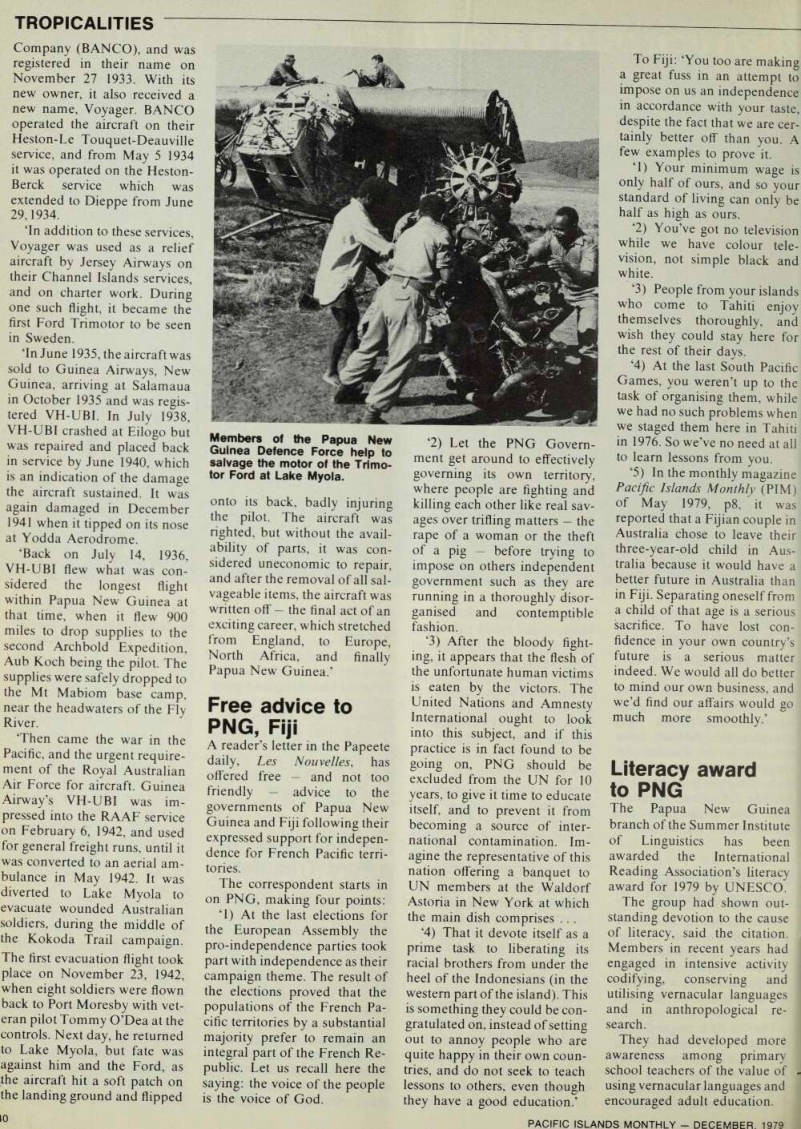
Members of the Papua New Guinea Defence Force help to salvage the motor of the Trimo tor Ford at Lake Myola.