Currents
pp. 21-22 · Read in the full issue
Political
iVhen more than 70 academics ind administrators took part in ate October in the first inter lational conference to be con vened on Easter Island, the ocale turned out to be of ;reater interest than the
igenda items.
The conference was con
vened by the University of
Chile’s Institute of Inter mtional Studies and the Zhilean Institute of Human stic Studies, with the financial upport of a number of organ
sations, notably the Tinker
foundation of New York and Conrad Adenauer Foundation
>f West Germany. The subject
vas ‘The Pacific Community:
towards a Role for Latin America’.
After four days of listening o papers on everything from economics to mari
ime history, it was tacitly
greed that Latin America new as much about the prob ;ms and aspirations of the Pa ific Islanders as the Islanders new about the Chileans, and bat there appeared no
mmediate scope for changing
tie role of either.
Most of the papers were on natters of little concern for the louth Pacific Islands a fact
vhich was bluntly pointed out
>y Young Vivian, secretary
;eneral of the South Pacific lommission, towards the end >f the conference. He said; We may have satisfied our icademic whims in the last few lays, but we’ve just been naking sounds. We didn’t get lown to realities. Where will hese meetings get us? The big jest asset in the Pacific today s peace you can’t find it any vhere else. But we need action n the Islands. I am humiliated vhen we talk about big coun ries what about us little mes? Let’s talk about a future :conomy for the Islands the ealities of solving the prob ems. I represent the little man. fou represent the big ones.’
Said Professor Ron Crocombe, of the University of the South Pacific: ‘For the next century, South-east Asia will be the most important influ ence on the Pacific Islands. I can’t see much connection with Chile.’
The main difficulty, as sev eral speakers concluded, was that Latin America really didn’t have much excuse to get involved in the Pacific Islands.
It simply wasn’t enough that Chile thought it was time for it to draw closer to the Islands for political reasons of its own. In volvement was a two-way affair, and one could expect the Pacific Islands to appreciate
help only if they thought Latin
America’s interest in their situ ation was genuine.
From the comments made at discussion time it was clear that some conference delegates felt Chile’s own record with the Easter Island people showed Chile didn’t understand the as pirations of Islanders that it didn’t understand that the Islands were not merely a geo graphic region of 30 million square kilometres, four-and-a half million people and 20 countries, but a ‘state of mind’.
Unless Latin America understood the state of mind, and was prepared to go hand in-hand into the Islands with the Islanders, including the Easter Island people, unless it listened to the Islands people, it was unlikely to be permitted to play any significant part in the future of the Islands.
Only one Easter Islander was present at the conference Sergio Rapu, director of the Easter Island Museum.
The police with walkie talkies on duty at all hours at the small Hanga Hoa Hotel, where the meeting took place, were clearly not there to keep the delegates in, but it
appeared to many delegates
that they probably effectively
kept Easter Islanders out.
There had been earlier rumours that islanders wanted to stage a demonstration
against the high cost of living
and lack of job opportunities on the island. Chile’s Minister for the Economy, Roberto Kelly, whose ministerial re sponsibilities include Easter Island, was on hand for the conference.
Living costs, always high on
an island with two ships a year from the mainland and vir
tually dependent on air trans
port for regular supplies,
recently escalated fivefold overnight with the govern ment’s removal of its freight subsidy to the national airline, Lan Chile. One of the unex pected results of this decision has been a dramatic increase in cattle-thieving on the island
foals making good, cheap
food.
In answer to questions asked after he presented a paper at the conference, Mr Kelly said that Chile ‘wants islanders to live and develop the same way as Chileans’, and that the sub sidy meant that they weren’t
producing as they had, but they
purchased goods from Chile
and thus ‘destroyed the pro ductivity of the island we are trying to help recover’. The island was capable of produc ing an enormous range of goods, yet today it didn’t pro duce a single egg, he said. It was too expensive to build ports for ships that arrived only twice a year, especially with the oceanic conditions surround ing the island, so it was import ant that the island became self-sustaining.
Mr Willi Otten, represen tative in Chile of the Adenauer Foundation, remarked that self-sufficiency of that kind would take time, that the island couldn’t do without imports, and that it would presumably be necessary for some time to operate a subsidy if the islanders weren’t ‘to suffer too much’. Minister Kelly said the government did subsidise sea freights and he considered ‘the government is managing the problem very well’. That seemed to be the end of the matter.
The ‘state of mind’ of the Pa
cific Islands might possibly
have made a greater im pression on the minister and some others present if there had been more Pacific Islanders at the conference. But through no fault of the organisers there was only a handful there. Many others who were invited never got round even to acknowledging their letters of invitation (‘Doesn’t anybody in the South Seas answer their correspon dence?’ privately asked one of
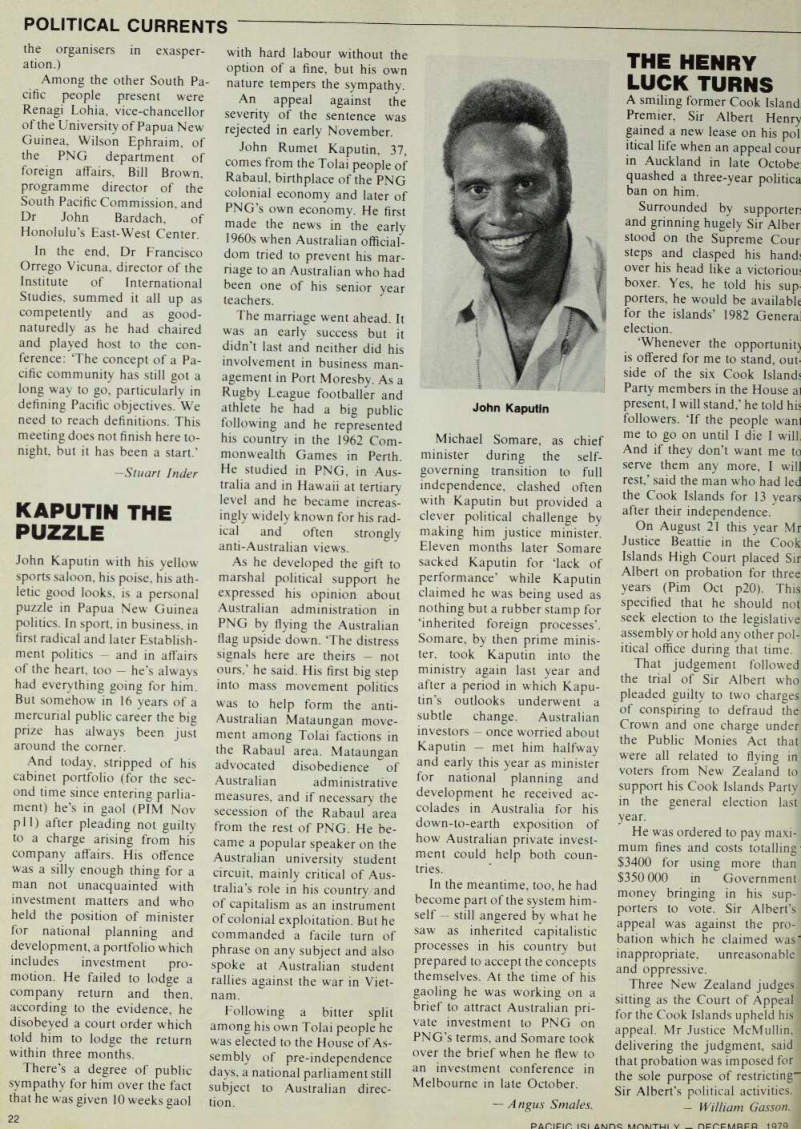
Young Vivian, secretary-general of the South Pacific Commission, on Easter Island ... ‘I represent the little man, you represent the big ones’. He is photographed at a memorial to leading American archeologist William Mulloy, who died last year.
the organisers in exasper ation.) Among the other South Pa cific people present were Renagi Lohia, vice-chancellor of the University of Papua New Guinea, Wilson Ephraim, of the PNG department of foreign affairs. Bill Brown, programme director of the South Pacific Commission, and Dr John Bardach, of Honolulu’s East-West Center.
In the end, Dr Francisco Orrego Vicuna, director of the Institute of International Studies, summed it all up as competently and as good naturedly as he had chaired and played host to the con ference: ‘The concept of a Pa cific community has still got a long way to go, particularly in
defining Pacific objectives. We
need to reach definitions. This meeting does not finish here to night, but it has been a start.’
Stuart Inder