from and where it goes
p. 19 · Read in the full issue
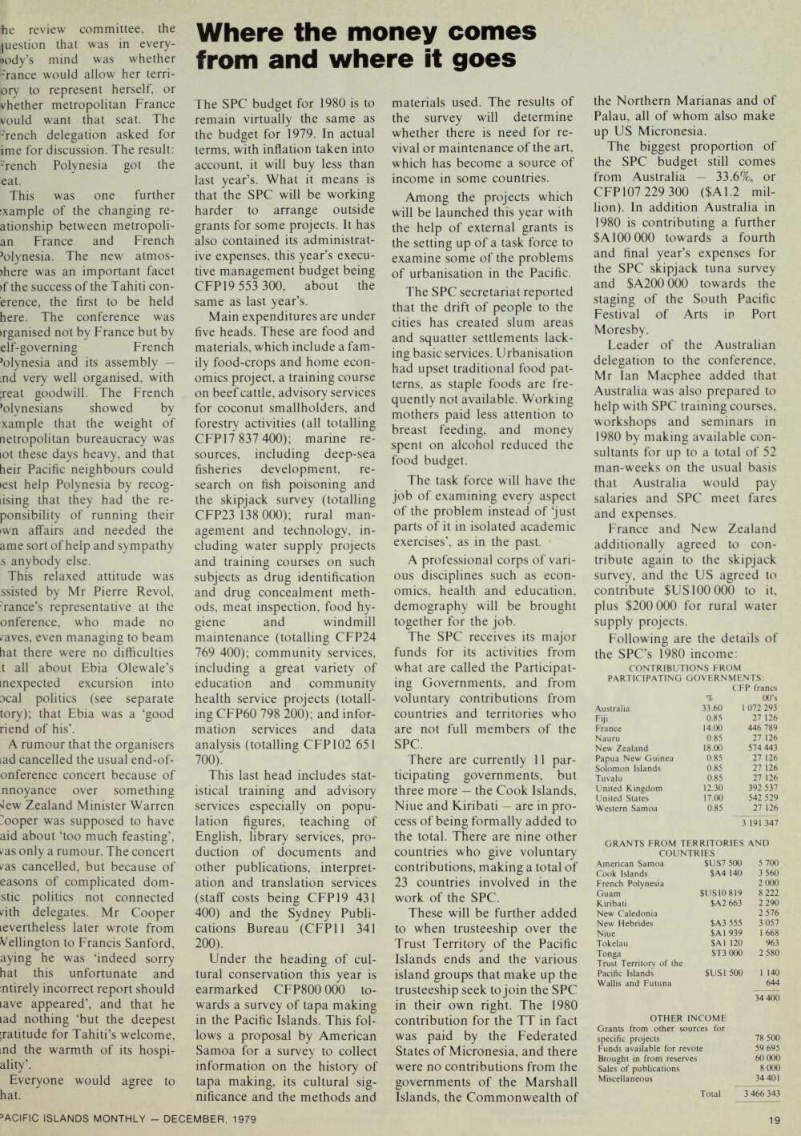
Where the money comes from and where it goes
The SPC budget for 1980 is to remain virtually the same as the budget for 1979. In actual terms, with inflation taken into account, it will buy less than last year’s. What it means is that the SPC will be working harder to arrange outside grants for some projects. It has also contained its administrat ive expenses, this year’s execu
tive management budget being
CFPI9 553 300, about the same as last year’s.
Main expenditures are under five heads. These are food and materials, which include a fam ily food-crops and home econ omics project, a training course on beef cattle, advisory services for coconut smallholders, and
forestry activities (all totalling
CFPI7 837 400); marine re
sources, including deep-sea
fisheries development, re search on fish poisoning and
the skipjack survey (totalling
CFP23 138 000); rural man agement and technology, in
cluding water supply projects
and training courses on such
subjects as drug identification
and drug concealment meth ods, meat inspection, food hy giene and windmill maintenance (totalling CFP24 769 400); community services, including a great variety of education and community health service projects (totall ing CFP6O 798 200); and infor mation services and data
analysis (totalling CFPIO2 651
700).
This last head includes stat
istical training and advisory
services especially on popu
lation figures, teaching of
English, library services, pro
duction of documents and
other publications, interpret
ation and translation services (staff costs being CFPI9 431 400) and the Sydney Publi cations Bureau (CFPII 341 200).
Under the heading of cul tural conservation this year is earmarked CFPBOO 000 to wards a survey of tapa making in the Pacific Islands. This fol lows a proposal by American Samoa for a survey to collect information on the history of tapa making, its cultural sig nificance and the methods and
materials used. The results of the survey will determine whether there is need for re vival or maintenance of the art, which has become a source of income in some countries.
Among the projects which will be launched this year with the help of external grants is the setting up of a task force to examine some of the problems of urbanisation in the Pacific.
The SPC secretariat reported that the drift of people to the cities has created slum areas and squatter settlements lack ing basic services. Urbanisation had upset traditional food pat terns, as staple foods are fre
quently not available. Working
mothers paid less attention to breast feeding, and money spent on alcohol reduced the
food budget.
The task force will have the job of examining every aspect of the problem instead of ‘just parts of it in isolated academic exercises’, as in the past.
A professional corps of vari ous disciplines such as econ omics, health and education,
demography will be brought
together for the job.
The SPC receives its major funds for its activities from what are called the Participat ing Governments, and from voluntary contributions from countries and territories who are not full members of the
Spc.
There are currently 11 par ticipating governments, but three more the Cook Islands, Niue and Kiribati are in pro cess of being formally added to the total. There are nine other
countries who give voluntary
contributions, making a total of 23 countries involved in the work of the SPC.
These will be further added to when trusteeship over the Trust Territory of the Pacific Islands ends and the various island groups that make up the trusteeship seek to join the SPC in their own right. The 1980 contribution for the TT in fact was paid by the Federated States of Micronesia, and there were no contributions from the governments of the Marshall Islands, the Commonwealth of
the Northern Marianas and of Palau, all of whom also make up US Micronesia.
The biggest proportion of
the SPC budget still comes from Australia 33.6%, or
Cfpio7 229 300 (Sai.2 Mil
lion). In addition Australia in 1980 is contributing a further $A 100 000 towards a fourth and final year’s expenses for the SPC skipjack tuna survey and SA2OO 000 towards the staging of the South Pacific Festival of Arts in Port
Moresby.
Leader of the Australian delegation to the conference, Mr lan Macphee added that Australia was also prepared to help with SPC training courses, workshops and seminars in 1980 by making available con sultants for up to a total of 52 man-weeks on the usual basis that Australia would pay salaries and SPC meet fares and expenses.
France and New Zealand
additionally agreed to con
tribute again to the skipjack survey, and the US agreed to contribute SUSIOO 000 to it, plus $2OO 000 for rural water
supply projects.
Following are the details of the SPC’s 1980 income;
Contributions From
Participating Governments:
CFP francs % 00’s Australia 33.60 1 072 293 Fiji 0.85 27 126 France 14.00 446 789 Nauru 0.85 27 126 New Zealand 18.00 574 443 Papua New Guinea 0.85 27 126 Solomon Islands 0.85 27 126 Tuvalu 0.85 27 126
United Kingdom
12.30 392 537 United Stales 17.00 542 529 Western Samoa 0.85 27 126 3 191 347
Grants From Territories
And
Countries
American Samoa $US7 500 5 700 Cook Islands $A4 140 3 560 French Polynesia 2000 Guam
Sus10819
8 222 Kiribati $A2 663 2 290 New Caledonia 2 576 New Hebrides $A3 555 3 057 Niue $A1 939 1 668 Tokelau SA1 120 963 Tonga ST3 000 2 580 Trust Territory of the Pacific Islands $US1 500 1 140 Wallis and Futuna 644 34 400
Other
Income
Grants from other sources for
specific projects
78 500 Funds available for revote 59 695 Brought in from reserves 60 000 Sales of publications 8000 Miscellaneous 34 401 Total 3 466 343