Kaputin The
p. 22 · Read in the full issue
Puzzle
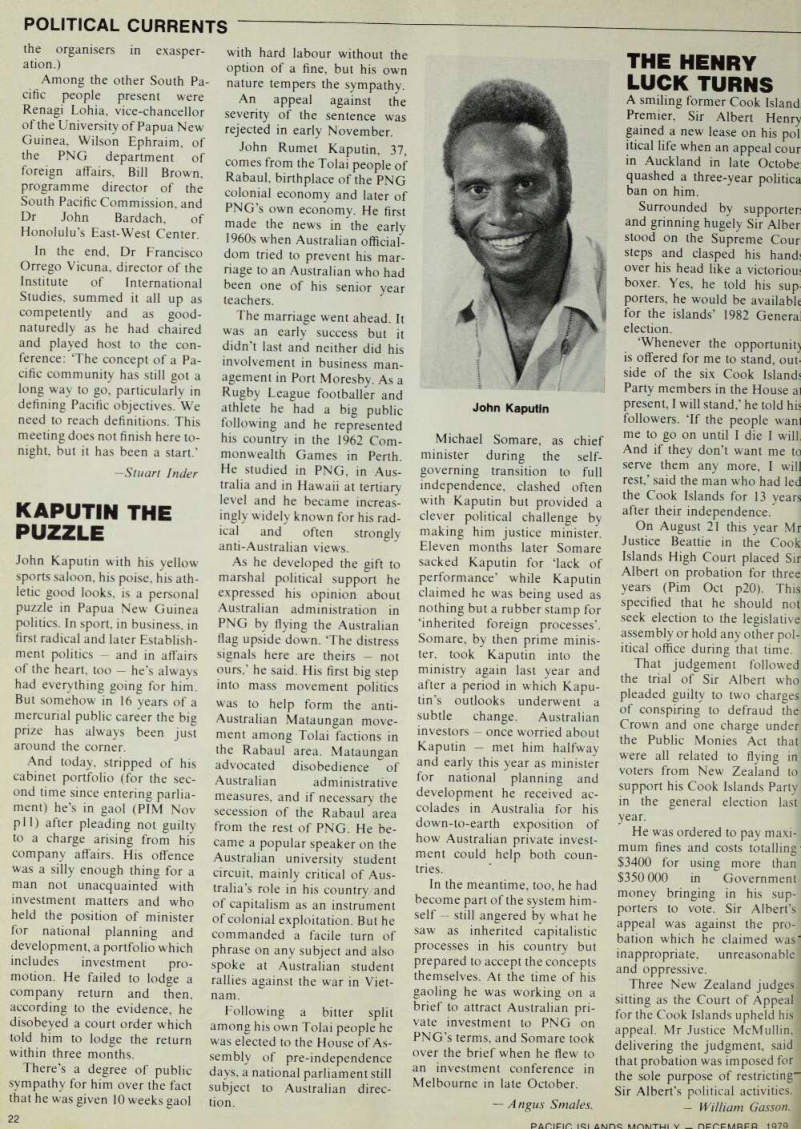
John Kaputin with his yellow sports saloon, his poise, his ath letic good looks, is a personal puzzle in Papua New Guinea politics. In sport, in business, in first radical and later Establish ment politics - and in affairs of the heart, too he’s always had everything going for him.
But somehow in 16 years of a mercurial public career the big prize has always been just around the corner.
And today, stripped of his cabinet portfolio (for the sec ond time since entering parlia ment) he’s in gaol (PIM Nov p 11) after pleading not guilty to a charge arising from his company affairs. His offence was a silly enough thing for a man not unacquainted with investment matters and who held the position of minister for national planning and development, a portfolio which includes investment pro motion. He failed to lodge a company return and then, according to the evidence, he disobeyed a court order which told him to lodge the return within three months.
There’s a degree of public sympathy for him over the fact that he was given 10 weeks gaol
with hard labour without the option of a fine, but his own nature tempers the sympathy.
An appeal against the severity of the sentence was rejected in early November.
John Rumet Kaputin, 37, comes from the Tolai people of Rabaul, birthplace of the PNG colonial economy and later of PNG’s own economy. He first made the news in the early
1960 s when Australian official
dom tried to prevent his mar riage to an Australian who had been one of his senior year teachers.
The marriage went ahead. It was an early success but it didn’t last and neither did his involvement in business man agement in Port Moresby. As a Rugby League footballer and athlete he had a big public following and he represented his country in the 1962 Com monwealth Games in Perth.
He studied in PNG, in Aus tralia and in Hawaii at tertiary level and he became increas ingly widely known for his rad ical and often strongly anti-Australian views.
As he developed the gift to marshal political support he expressed his opinion about Australian administration in PNG by flying the Australian flag upside down. ‘The distress signals here are theirs not ours,’ he said. His first big step into mass movement politics was to help form the anti- Australian Mataungan move ment among Tolai factions in the Rabaul area. Mataungan advocated disobedience of Australian administrative measures, and if necessary the secession of the Rabaul area from the rest of PNG. He be came a popular speaker on the Australian university student circuit, mainly critical of Aus tralia’s role in his country and of capitalism as an instrument of colonial exploitation. But he commanded a facile turn of phrase on any subject and also spoke at Australian student rallies against the war in Viet nam.
Following a bitter split among his own Tolai people he was elected to the House of As
sembly of pre-independence
days, a national parliament still subject to Australian direc tion.
Michael Somare, as chief minister during the self governing transition to full independence, clashed often with Kaputin but provided a
clever political challenge by
making him justice minister.
Eleven months later Somare sacked Kaputin for ‘lack of performance’ while Kaputin claimed he was being used as nothing but a rubber stamp for ‘inherited foreign processes’.
Somare, by then prime minis ter, took Kaputin into the ministry again last year and after a period in which Kapu tin’s outlooks underwent a subtle change. Australian investors once worried about
Kaputin met him halfway
and early this year as minister for national planning and development he received ac colades in Australia for his down-to-earth exposition of how Australian private invest ment could help both coun tries.
In the meantime, too, he had become part of the system him self still angered by what he saw as inherited capitalistic processes in his country but prepared to accept the concepts themselves. At the time of his gaoling he was working on a brief to attract Australian pri vate investment to PNG on PNG’s terms, and Somare took over the brief when he flew to an investment conference in Melbourne in late October.
Angus Smales.
John Kaputin