Australia-Pacific
pp. 68-77 · Read in the full issue

PNG, focus of the Australia-Pacific connection
PI M's Port Moresby correspon dent Angus Smales reports below on the current state of re lations between A ustralia and its • special case' Pacific neighbour, Papua New Guinea.
Papua New Guinea is the focus of Australian external involve ment in the Pacific, it’s the country where the Australian presence is strongest, and the country where Australian over seas investment is highest.
Looked at the other way round, PNG is the biggest recipient of Australian foreign aid not only in the Pacific but in the world.
Geography and a hundred years of history have combined to forge the link.
Geographically PNG is Aus tralia’s nearest neighbour, with a sea border running from north of the Torres Strait Islands to south of the Gulf of Papua and out across the Coral Sea. The mainland-to mainland distance is only 110 km, but less than two hours paddling a canoe will cover the most northerly of the Aus tralian islands to the PNG coast.
Historically, Australian in volvement began with
freebooting, missionary and
trader influence and contacts about 100 years ago.
Australia eventually
assumed control of the
southern regions of PNG as a colonial possession, and quali fied control of the northern re
gions under internationally
recognised agreements. There were two consecutive agree ments for the northern admin istration, the first a League of Nations mandate and the second a United Nations trus
teeship.
The colonial possession dur ing this period was Papua, and the mandated and trustee terri tory was New Guinea once a German colony. For the final 27 years of Australian control Papua and New Guinea were under a joint administration, although Australia was still obliged to recognise the separ ate status identities which they held.
The current chapter of the
relationship began four years
ago when the politically uni fied nation of Papua New Guinea achieved its indepen dence with a population of three million, a Westminster type democracy and mem bership of the Commonwealth and the United Nations.
With independence came an Australian guarantee of high level aid which has since been formalised into an immediate five-year programme, and the inferred continuation of sub stantial continuing aid after wards.
There was never any serious formal consideration of early suggestions that PNG should have become a State of Aus tralia. However the mere fact that such a possibility was advocated as little as 15 years ago with the support of a small body of Papua New Guinean opinion indicates the historical strength of Australia-PNG involvement.
Today formal diplomatic
links between the two countries are strong, and Port Moresby and Canberra share a fairly common line towards the Pa cific as a region. Neither has any significant criticism of the role played by the other as a member of the region.
But the Australian presence in PNG as distinct from the Australian Establishment and what it has to offer is not so easily defined. In theory, the whole thrust of modem PNG national and provincial politics is to remove the Australian presence from the workforce, the economy and perhaps the community. Most of the country’s political leaders don’t like to express the situation quite so bluntly as this, but their own laws and the trend of their parliamentary debates say it for them.
What is really happening is that PNG is striking a sort of commonsense compromise in its own long-term interests affecting its economy and its national stability. There is not great affection today for the Australian presence and its size, but neither is there any significant ungraciousness for the time being in tolerating that presence.
Formal links: Australia and PNG, as geographic neigh bours and as members of the Commonwealth, each has a high commission in the other’s country.
The Australian High Com mission in Port Moresby is the
biggest diplomatic post main
tained by Australia with the exception of Australia House in London. The 12-floor high commission building (part of which is used by the New
Zealand High Commission) i: the tallest building in Waigani the Port Moresby suburl specially created for nationa administration.
The High Commissioner Gerald Nutter, sees the posting as filling a predominantly prac tical ‘service’ situation created by the extensive requirements of aid, trade, investment; special services, agency work, movement of people, defence co-operation and the presence in PNG of more than 20 00(1 Australians.
There are sensitivities afl times, but in the context of day] to-day working relationships they are not great. The onld sensitive public incident of anJ real note which has directlJ involved the high commission was when allegations were made that a staff member was! a political spy with particular] interest in university radical! politics. Students marched on the high commission, throwing mud onto the lenses of security! monitor cameras outside the
building, trampling the garden!
and tearing branches from! bushes and young trees.
Despite the extent of Aus-I tralian involvement or per-l haps because of it in the! post-independence period -I Australia has deliberately kept I a low diplomatic profile. Anl aid project from New Zealand I or a helpful business offer from 1 Japan tends to attract morel ballyhoo than the fact that 1 something like one dollar in I every three spent by the PNG I Government comes from Aus-1 tralian aid grants.
The adoption of a low-key I image was encouraged by the I Australian presence to bolster I the concept of political disen-1 gagement which was inherent I in independence.
Now, four years after I independence, there are I suggestions that the emphasis I may shift slightly. Informal in- I formation from the PNG I Government itself indicates I
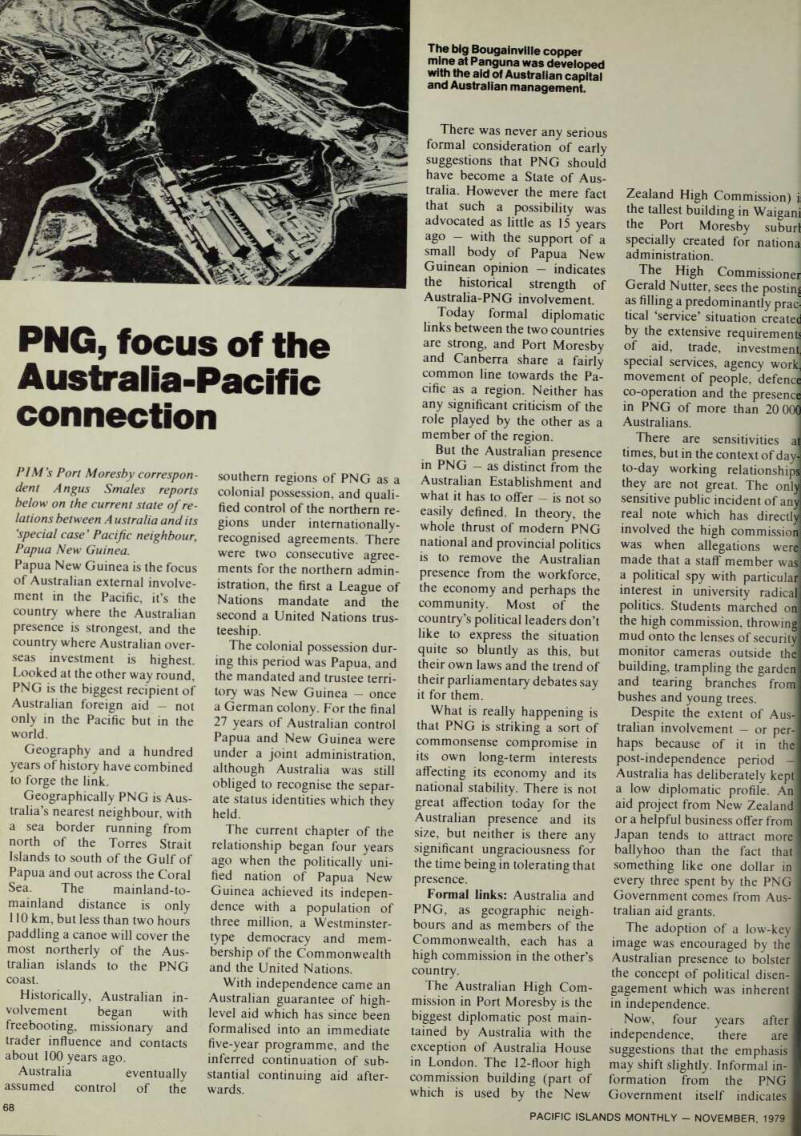
The big Bougainville copper mine at Panguna was developed with the aid of Australian capital and Australian management.
Australia has been given t approval to make a bit •e noise about its contri on to PNG development jects. Certainly Mr Nutter is marking on a widened xlule of visits to projects ch have been made possible \ustralian aid. he formal links also include
hared approach to Pacific
irs through involvement in South Pacific Forum, and ries of agreements between G and Australia on marine
mrces, trade, agriculture
defence. atempts are being made to elop greater reciprocity in il processes. Many overlap g legal situations which had ost been taken for granted
?re independence have
n ended by independence,
i PNG the loser in some cir istances. Not the least of >e is the inability of the G tax office and other emment agencies to orce orders and to make ections in Australia. The •arture of many Australians owing income and com iy taxes has left PNG with
ieficit running into several
lion dollars. Legal teams m both countries are now mining the situation and ore the end of the year they icct to have made recom ndations for some form of iprocal tax collection >cess. fhe border between Aus lia and PNG is another facet the Australian presence ich was not as simple to ablish as might have been aected. Ironically, of all four emational borders inherited PNG, the Australian one s the most difficult to for ilise. To the west, a land rder difinition and manage ;nt treaty with Indonesia has
ig been signed, and although
is currently under review ;re are no suggestions of ious dissent. To the north JG has a high seas border, d to the east a tacit and non ntentious interim sea border th Solomon Islands.
But to the south the delin tion and management of a a border with Australia was T settled until more than
ree years after independence,
le protracted and highly
technical negotiations were
friendly enough but frequently
encountered delays and dif ferences over the sharing of re sources and over the situation of the Torres Strait Islanders.
The Islanders at the time were adamant they wanted to retain Australian status, but PNG has now expressed con cern at reports that some of them are seeking a form of
independence.
The elaborate border treaty which PNG and Australia have signed establishes a shared marine resources arda, protects the traditional use of the sea by Papua New Guineans and Torres Strait Islanders alike, and has created Australian island enclaves in a PNG sea.
But even today there is some PNG irritation about its Torres Strait border relations because of statements by the Queensland Premier, Mr Bjelke-Petersen, that PNG is waiting for a chance to ‘take over the islanders’. Recently the PNG Foreign Minister, Mr Olewale, said he would not allow Mr Bjelke-Petersen’s ‘of fensive’ remarks to cloud re
lations with federal Australia, but Mr Olewale and some of his fellow-leaders are
nonetheless annoyed.
Australian aid programme: Australian aid to PNG in this year’s budget is $A234.8 million a shade over half of the total Australian foreign aid programme. The main allo cation to PNG is a single grant of $223 million which is an untied payment of funds for budget support and represents about one-third of the total budget revenue in PNG.
The bulk of the remaining funds Australia is paying to PNG this year is a defence co operation agreement grant, representing the lion’s share of defence co-operation funds which Australia allocates to PNG, Singapore, Indonesia and Malaysia.
The Australian Foreign Minister, Mr Peacock, said re cently that Australia recog nised in principle that its greatest overseas aid responsi bility was to PNG and that this attitude would continue to
guide Australian aid policies.
One of the biggest problems which confronted the newly independent PNG was budget
planning rather than budget
aid itself. Australia has guaran teed substantial budget support in general principle, but PNG claimed that if it was going to plan its financial affairs prop erly a year-by-year aid nego tiation was not good enough.
As a result Australia agreed to a five-year aid commitment which started in 1976. Under this commitment a minimum annual grant of $lBO million is
guaranteed, with a supplement
to be fixed each year by nego tiation, taking into account
special requirements, currency
movements and other factors.
This year’s supplement was $43 million and the overall effect was that Australian aid to PNG
increased in figures, dropped
slightly in real spending terms and also dropped as a pro portional component of the PNG budget. This effect has the support of the PNG Government which wants its
budget to become increasingly
less reliant on Australian aid, rather than to face a sudden cut-off in some future year.
The most important development in Australia- PNG aid involvement in the immediate future will be nego tiating the form and content of aid when the present agree ment ends in 1981. ‘Substantial but reducing support’ is the
general undertaking Australia
has already given.
A significant aspect of Aus tralian aid is the manner in which PNG is spending the budget support which it gets.
As a matter of PNG Govern ment policy the money is being directed where possible to
development projects which
will become self-generating rather than to recurrent government expenses. This attitude, despite some obvious deficiencies in PNG financial management, is one of the
most encouraging signs Aus
tralia has seen in the aid re lationship. It will certainly go a long way towards ensuring continued Australian support.
In addition to the formal government - to - government aid relationship, Australia and Australians provide a wide range of less-measurable assist ance in PNG. This includes the presence of volunteers from the Australian Volunteers
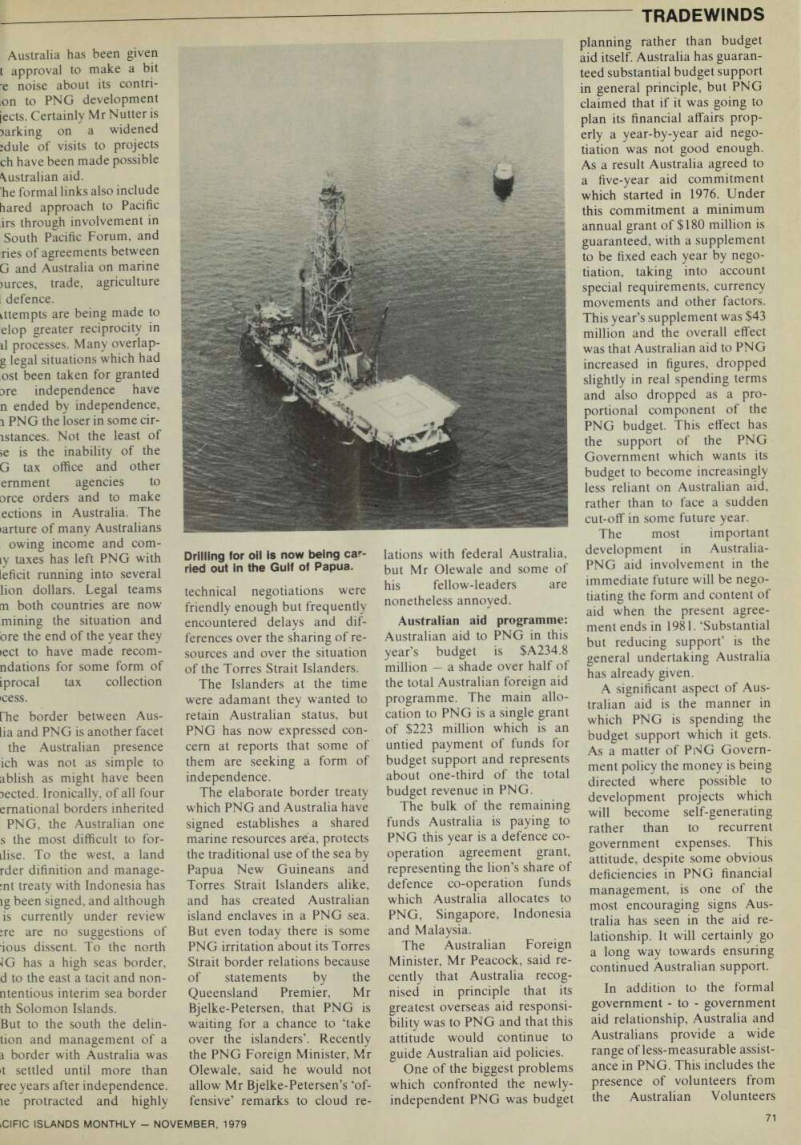
Drilling for oil Is now being ca-ried out In the Gulf of Papua.
>road scheme, and volunteer alth, education and technical >rkers in church missions, istralian community service ganisations also direct many their projects to PNG.
Defence: One of the stron st links in the Australia-PNG ationship today is in defence -operation, but this is also an ja where misunderstanding the Australian role can easily cur. Australia has no defence esence’ in PNG and has no fence or military treaty with 4G, but the two countries ve letters of understanding defence co-operation and is arrangement has a wide ect. Like all such arrange mts there are ultimate politi l considerations on both ies, but in essence the re ionship is a technical one.
Under the arrangement Aus ilia makes an annual defence -operation grant to PNG was about $lO million in the
;t budget helps train Papua
jw Guineans for their own fence force, provides access
equipment and expertise,
akes available the services of
illed Australian personnel,
d detaches some formed
.istralian units for specific
>ks (usually engineering) in
sIG.
PNG permits Australia to e its territory and facilities
r training exercises, an
(portunity taken particularly
r the RAAF for its Caribou
id Hercules squadrons. Re
ntly, too, there was a major
mbined infantry exercise in
vfG.
There are two main con lerations in the Australian iproach to defence co leration in PNG. One is the nple extension of aid which iplies to the entire PNG corn
unity under responsibilities
knowledged by successive
ustralian governments. The her is that Australia’s own ffence concepts are far better
rved by supporting a loyal
id efficient defence force in a
righbouring country than by
ly attempts to negotiate an
ustralian military sphere. As
result Australia extends
inds, general aid, personnel
id expertise to the PNG De uce Force but PNG calls ie tune and controls its own ffence affairs.
At present there are 247 Aus tralians in the PNG Defence Force, of whom 170 are on di rect loan from all three Aus tralian defence services. They cover a broad range of special
skills - engineers, signals
experts, pilots, technicians, ship’s company and medical and headquarters staff officers.
Many of them fill training roles, but not necessarily so.
The number of Australians in the PNG Defence Force is being gradually reduced as a matter of policy, but there is no target date to phase them out and specialists on short-term attachments are likely to be with the force for many years yet.
In addition there are 161 Papua New Guinean officers and men at Australian training establishments 109 Army, 29 RAAF and 23 RAN but be cause of what the PNG De fence Force calls ‘culture shock’ problems, it prefers to train as many of its men as
possible on home ground.
Investment: Australia re mains the biggest overseas investor in PNG, following the pattern set in pre independence times. The Aus tralian involvement is mainly direct investment, but it also provides a channel for the investment of some funds originating in other parts of the world. This occurs when inter
national companies use their Australian subsidiaries for
PNG expansion.
The nature of Australian investment covers every facet of service, manufacturing, business and commerce in PNG, and a declining share in
agriculture.
In the past 10 years as ac
curately as widely divergent re
cords and currency approximations allow the rate of Australian investment in PNG has been running at an average of $lO5 million a year.
Repatriated earnings on Aus
tralian investment were $6O million last year, but the
amount of capital generating
this figure is not available from current records.
The Australian investment pattern of the past 10 years in cluded two high-intensity periods the first in the very early 70s and the second quite recently. But it also included the year of self-government, 1973, and the year of indepen dence, 1975, when more Aus tralian capital was pulled out than was put in.
The total net loss of Aus tralian investment during those years was about $4O million, not a large figure in the overall pattern. However, it is a sig nificant indication of the some what mercurial attitude of Australian sources towards political and allied factors in PNG. This attitude runs
through the whole range of Australian involvement the investment market itself, the firms already established in PNG, the Australians who may have expertise as well as capital to offer, and the financial insti tutions.
Many of the current invest ment statistics, depending on their source, vary widely. This is because of differing defi nitions involving branch and subsidiary funds, the position of unremitted and undistribu ted profits, and the situation of Australian money controlled by permanent residents who are classified as financial tem poraries. One point is clear, however, and that is that Aus tralian investment attitudes in
particular are increasingly sen
sitive to PNG conditions and politics, and this in turn in the eyes of Australian investors is increasing the speculative com ponent of PNG investment.
Recent suggestions of attempted government inter ference in a court matter (although the matter was of a non-financial nature) affected at least one finely-balanced investment deal.
It is doubtful if this sensi
tivity is fully grasped by many
PNG leaders who say they are committed to encouraging external investment. There appears to be a belief that Aus tralian investors are clamour ing to get in or to hang on to
what they already have at any price. Australia is probably more sensitive than other coun tries to the PNG financial scene because of the earlier
long-standing association
when PNG politics were simply an extension of Aus tralian management and con ditions.
It is true that PNG contains good, continuing and new investment potential for Aus tralian capital, but certainly not at any price. The speculative issues are now high enough to dictate a raised threshold for
assessing viability. This situ
ation exists despite guarantees on the repatriation of earnings, on capital, and on non discrimination, which are extended to all approved investment enterprises.
Agriculture, once the back bone of Australian financial in volvement in PNG, is no longer a proposition for the investor from outside except for special major developments which are usually partnerships between government and a de veloper.
Plantation properties, many of them Australian soldier settler allocations in the 19205, are being acquired by the government for resale to PNG village communities. The Lands Minister, Mr Sali, told parliament recently that the government planned to have all plantations out of the hands of non-nationals within three years.
PNG is also expressing con cern that its private banking system, dominated by Aus tralian banking firms or their subsidiaries, is not sufficiently flexible. Some critics claim that even the nationally-owned PNG Banking Corporation is too much steeped in Australian concepts.
The government is expected to make an early announce ment for plans to establish an internationally - connected merchant banking company, although on present indi cations Australian interests will have a share of the proposed company.
Tourism: Just under 60% of all tourists flying to PNG are from Australia, not counting visitors from further overseas who come via Australia. This
amounts to about 12 000 visi tors a year - not a large num ber for a big island country right on the Australian door step.
In the accommodation andj travel industries, too, there’s some questioning of how many of these visitors should be classified as tourists in the strict I sense. Many of them are seen
more accurately as ‘short-terml
visitors’ coming to PNG be cause they have friends or rela-i fives already there.
Lack of uniformity in the mi- 1 gration and travel cards of the two countries also tends to ob scure the facts, although many of these statistical record prob lems are now being corrected. (Cruise ships bring 15 000 visitors from Australian ports and through PNG ports everyl year, but the ‘hullo and good bye’ nature of these visits is not the hard-core type of tourism] which PNG would like to] attract. In any event there are] indications that the cruise ship visits are producing a declining number of visitors as far as PNG is concerned.
A number of factors appear! to be discouraging a really high j level of Australian tourisn in: PNG, not the least of which is the psychological factor which says, ‘if you’re going overseas anyway, there’s not much point I in only going as far as your own front door’. More practical is I
the comparatively high cost of ;
air travel from Australia and on PNG internal routes. This is 1
heightened today by new I
cheaper fare structures on I
popular long-haul tourist I
routes which do not include
Png.
There is also some criticism I in the Australian travel indus- I try that Air Niugini, the PNG 1 national carrier, pays lip ser- ] vice to PNG tourism but is I unwilling to pay the ‘whole sale’ agency commissions offered by some airlines from other countries.
Whatever the reasons, many I PNG interests criticise Aus- j tralian agency interests for al
legedly not really trying hard to
sell the PNG tour. There are I tentative plans to increase pro motion in Australia.
Like investment but often ; with less reason PNG politi- j cal and social developments j
to have a significant t on tourist interest from alia. The so-called ‘state
icrgency’ proclaimed re-
in the PNG highlands to ) down on tribal warfare »ood case in point. The of emergency’ sounded lore dramatic than the ion it named and caused 3 in tourist interest. There probably be long-term its however because
ssness in the highlands,
being cleaned up, was iting the tourist industry
irely practical grounds.
ide: Australia is PNG’s st trade partner and the ice of trade runs strongly astralia’s {favour. Figures m put the value of Ausn exports to PNG at 5290 m, and the value of PNG rts to Australia at $6O )n odstuffs of all types. -
d, packaged, fresh and
n are a major part o f the alian export marked in , but the overall trade sts of a big range o f raw rials and manufactured
goods of all types ranging from clothing and stationery, through electrical and mechan ical equipment, to vehicles and machinery.
The vehicle market has suf fered heavy inroads at Japanese hands in the past six to eight years, but generally Australia has retained its PNG markets at constant or rising levels.
Despite the growth of
Japanese electronic equipment sales throughout the Pacific, Australia continues to provide a significant export to PNG of specialised electrical and elec tronic equipment and domestic
appliances,
Australian purchases from PNG are made up of cocoa, coffee, gold, timber and rub ber.
Existing terms of trade be tween the two countries are not complex, with Australia grant ing special export access to PNG products. Endorsed by successive governments, Aus tralia has given undertakings that PNG will continue to retain special access.
Png Freezes
Plantation
Take-Overs
Papua New Guinea has set a three-year target date to ac quire all plantation proper ties owned by non-citizens.
The properties are mainly owned by A ustralians, Australian-based companies and Chinese with Australian nationality. PI M's Port Moresby correspondent Angus Smales comments on the problems raised by the plan, and how they have led to a temporary freeze on its implementation.
About 80 plantation properties previously owned by non nationals of Papua New Guinea have been taken over by the government since the plantation acquisition scheme was established about the time of independence.
They have been sold to nationals individuals, com munity and village groups, companies either as going concerns, as nucleus-type
estates, or divided for smallholder use. The transfers from non-national interests have generally been trouble free, with the government showing a willingness to nego tiate where there has been dif ference of opinion over values.
The total number of proper ties to which the acquisition act could apply was estimated at 1200 when the scheme was first established. However, this is now being reviewed, and it is believed that 800 would have been a closer estimate. The confusion was caused by the fact that many properties con sist of up to four individual parcels of land, often
physically separated, and the
original estimate was based on the separate parcels rather than on properties as entities.
There is also some doubt now about whether the state ment by Lands Minister Boyamo Sali that all properties will have been acquired within three years will necessarily apply. The entire scheme has been frozen while a committee
eview looks at it and makes to cabinet. ; recommendations were »ected to be made early in vember. They were to take ) account land pressures, liable finances, statistics on
at has already been
ieved and the problems of king sure that management DK under the new national
nership.
V register of properties to
ich the act applies is also ng drawn up. 4any groups who have en over the first 80 proper ; have run into financial iblems, sometimes because an obvious lack of expertise, t sometimes claiming that previous owners let the )perties run down when time s running out. fhere is some political inion that in areas where id pressures are not urgent : retention of properly and rly run foreign-owned or sed properties is an advan ;e to an area.
Basic government policy is the acquisition of all
aperties not owned by
tionals, but the mechanics d time-scale of the process ; subject to continuing re ;w to suit general and scific circumstances.
N O.K. For
>K Tedi?
nal decisions by the consor im of mining companies on 2 multi-million-dollar Ok
:di copper project in Papua
New Guinea are expected by the end of November.
Senior executives of the companies met top PNG officials and politicians in Port Moresby in September to dis cuss PNG’s economic outlook and development strategy.
The consortium partners sent a delegation headed by the Sir James McNeill, chairman of Australia’s largest company, Broken Hill Proprietary, the president of AMOCO Min erals, Ray Ballmer, and direc tors of the German company,
Kupfer Exploration.
PNG Prime Minister Michael Somare told them at a dinner in their honour: ‘Know ing the potential effects of the project, and knowing that PNG is exploiting a non-renewable resource, the government has set out to make sure our country receives a fair bar
gain.’
The Ok Tedi project, if it goes ahead, will cost K5OO million. More than Kl 2 million has already been spent by the consortium on feasibility studies.
There will be a large cost to the PNG Government as well, Mr Somare said. ‘lf the govern ment takes up its entitlement to 20% equity in the project, that will involve a commitment of K 35 million.’
Guam Talks
On Energy
An energy technology work shop held on Guam in August- September is believed to have been the first time Trust Terri tory and Guam government officials have got together to pledge support for alternate energy research.
Participants included energy experts from the United States, Peace Corps officials, various governors, legislators and Trust
Territory officials.
Unable to attend due to pressure of other business, High Commissioner Adrian P.
Winkel had a speech read to the workshop which named solar, wind, hydropower, ocean thermal, and fuel from biomass as some of the indigenous en ergy resources that can be de veloped in the Trust
Territory.
[?]er Marriott, newly appointed [?]ort sales engineer for Mono [?]ps (Australia) Pty Ltd. Mr Marriott's main responsibility be to service the company’s [?]anded operations in the [?]th Pacific.