Milne Bay - The Place
pp. 64-67 · Read in the full issue
Yesterday
Where Turnbull Fell
The jungles of Papua New Guinea have silently obliterated scores of battlefields, airfields and war re ICS since the dark days of 1942. Even so, it is a tribute to the protective powers of the Jungle that ,he'7n h relic of the Battle of Milne Bay can be found, still in its original crash position, within J of the provincial capita / of Alotau. Squadron-Leader Peter Turnbull's broken Kittyhawk lies almost forgotten on the floor of a picturesque gorge within 200 metres of the main coastal road Paul Croft reports. J
Of the very few people who are aware of the existence of Peter Turnbull’s aircraft, most know nothing of its historical import ance and those who do have no funds to preserve it. For the time being, it is safer where it rests.
When Milne Bay in south east PNG was a key military base, supporting two airfields, it was the staging area for more than a million military person nel. The lucrative war souvenir business saw to it that all battlefields were stripped.
Turnbull’s plane suffered too.
The only item known to be officially saved is a single Browning 0.5 inch machine gun, now on permanent exhi bition at the Canberra War Memorial.
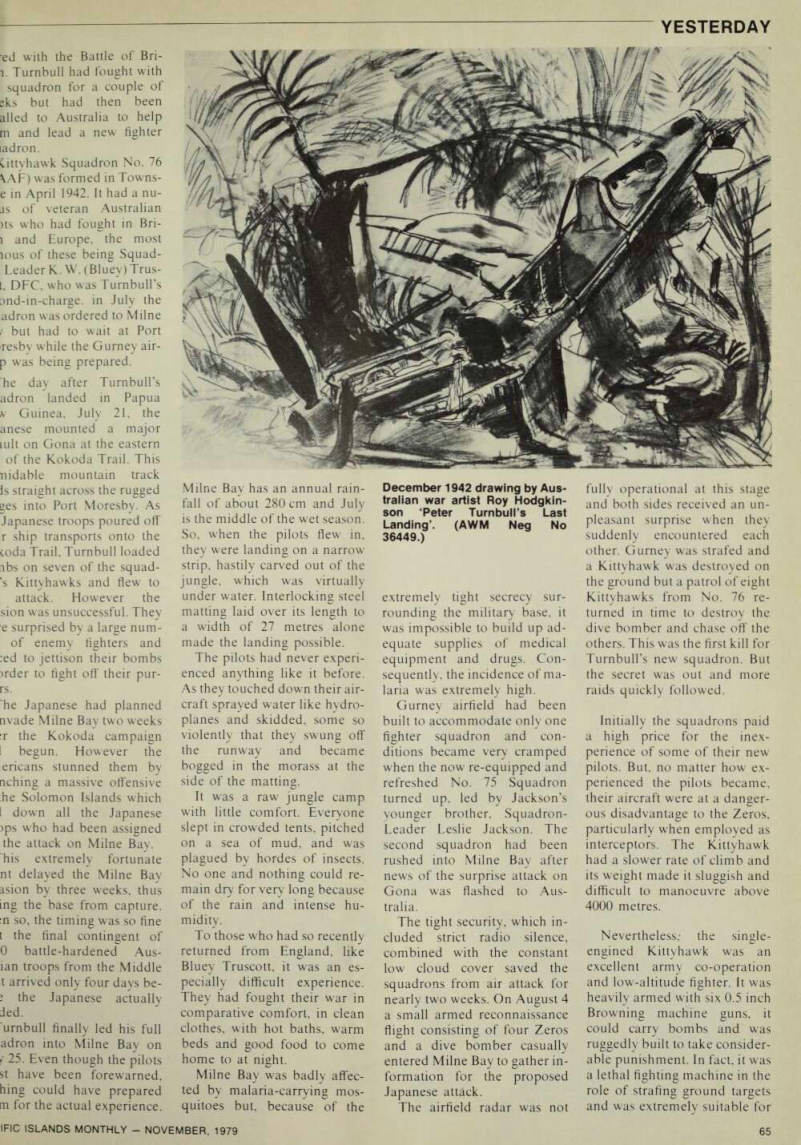
The wreckage today consists
of the main fuselage with nose and tail sections missing. It is quite possible that they lie scat tered and buried in the jungle and mud and will be found one
day. The wreckage is lying on
its back, in the position it crashed 37 years ago.
All that remains of the port wing is a short stump with a jagged edge, a grim reminder of how Turnbull met his death when his Kittyhawk hit a lone palm tree at the edge of the gorge.
It is astonishing, after so many years in a wet tropical cli mate, that some parts on the undercarriage still move; some are so shiny and new-looking
someone might recently have
polished them. Most of the cabin frame, in which Turnbull died, is intact.
When Squadron-Leader
Peter Turnbull was killed he was only 25. Born in Armidale, Australia, he joined the Royal Australian Air Force (RAAF) as a career pilot eight months before war was declared in
Europe. In the month the war
began, September 1939, he
graduated from Point Cook Officer Training School. Vic toria, and was soon in the Middle East flying Toma hawks with No. 3 Squadron RAAF. The Tomahawk was an early version of the famous
Kittyhawks.
While in Libya he distin guished himself and won the DFC after shooting down three Messerschmitts in one engagement over the desert. By the time he arrived in Milne Bay, in command of his own squadron, he had built up a successful flying career over three long years of war. His strong leadership and adminis trative abilities were recog nised and he had a reputation as an intrepid fighter pilot.
The shock entry of Japan into the war in December 1941 forced the Australian Govern ment to withdraw most of its military personnel from Europe and the Middle East to protect the homeland. With the capture of Rabaul in late January 1942 and the first Japanese air raid on Port Moresby on February 3. the need for immediate action was even more apparent. A month later 75 Squadron was formed at Townsville in northern Queensland, the first RAAF fighter squadron in Australia.
It had 24 Kittyhawks and was led by Squadron-Leader J. F.
Jackson, DFC (after whom Jacksons Airport, Port Moresby was named).
The backbone of this squad ron consisted of men like Turn bull and Jackson who had just returned from the Middle East but most of its pilots had no combat experience. Only nine days were allowed for training and familiarisation on the new Kittyhawks. No. 75 was im
mediately sent north to strengthen the hard-pressed defences of Port Moresby which was just experiencing its sixteenth air raid.
On March 21. after a long round-about flight from Townsville, Flight Lieutenant Turnbull led the vanguard flight of four Kittyhawks at low level into the approach to Port Moresby aerodrome. To the pilot’s horror. Australian ma chine gunners opened up, per forating three of the aircraft so badly they needed extensive re pairs. Miraculously no pilot
was injured. The beleaguered
Australian troops had never seen friendly fighter planes over Port Moresby and had abandoned hope of ever being sent any. The rumoured re inforcements, which never seemed to arrive, were called ‘Tomorrowhawks’. From bitter
experience the gunners hJ learnt to expect the worst an only ceased firing when Turn bull had actually landed an the other three pilots haj
dropped their undercarriages
The squadron quickly for gave the army its rude welcom] and organised an attack on thl menacing Japanese aerodrom at Lae. Turnbull again distin guished himself by shootinj down a Zero. So intense wer those daily encounters that th squadron was a spent fore within five weeks. Squadron'
Leader Jackson, along witl
many others, had been killed and few if any planes were suit able for combat.
Despite the sickening cost in young lives, their efforts had provided a much-needea breathing space to prepare rel inforcements. The action o those brave pilots who flevJ against overwhelming odds in inferior machines often is corn]
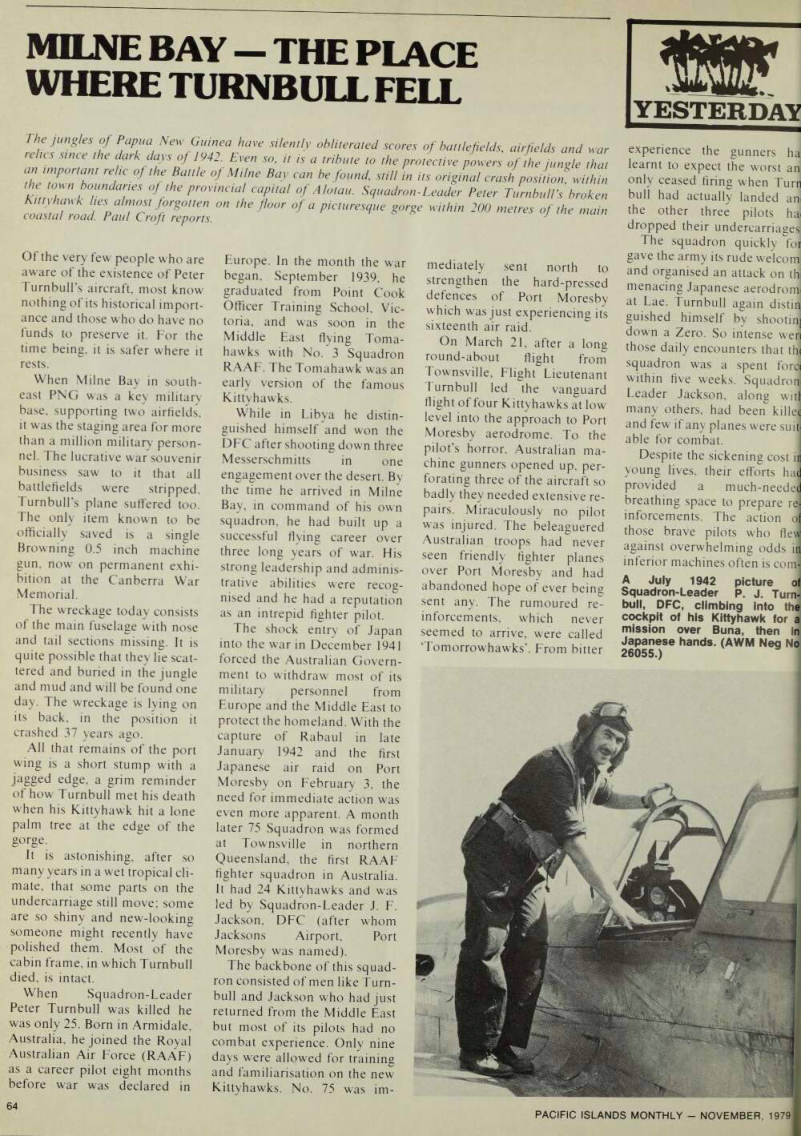
A July 1942 picture of Squadron-Leader P. j. Turn bull, DFC, climbing into the cockpit of his Kittyhawk for a mission over Buna, then in Japanese hands. (AWM Neg No 26055.)
■ed with the Battle of Bri i. Turnbull had fought with squadron for a couple of sks but had then been ailed to Australia to help m and lead a new fighter ladron.
Cittyhawk Squadron No. 76
\AF) was formed in Towns e in April 1942. It had a nu ns of veteran Australian )ts who had fought in Bri i and Europe, the most
ious of these being Squad-
Leader K. W. (Bluey) Trus t. DEC, who was Turnbull’s
and-in-charge. in July the
adron was ordered to Milne f but had to wait at Port resby while the Gurney air
p was being prepared.
he day after Turnbull’s adron landed in Papua v Guinea, July 21, the anese mounted a major lult on Gona at the eastern of the Kokoda Trail. This nidable mountain track
is straight across the rugged
ges into Port Moresby. As
Japanese troops poured off
r ship transports onto the coda Trail, Turnbull loaded lbs on seven of the squad ’s Kittyhawks and flew to attack. However the sion was unsuccessful. They e surprised by a large num of enemy fighters and :ed to jettison their bombs irder to fight off their pur rs.
he Japanese had planned
nvade Milne Bay two weeks
:r the Kokoda campaign
1 begun. However the
ericans stunned them by aching a massive offensive he Solomon Islands which I down all the Japanese ips who had been assigned the attack on Milne Bay. his extremely fortunate
nt delayed the Milne Bay
asion by three weeks, thus ing the base from capture, in so, the timing was so fine t the final contingent of 0 battle-hardened Aus ian troops from the Middle t arrived only four days be-
J the Japanese actually
Jed. urnbull finally led his full adron into Milne Bay on
/ 25. Even though the pilots
st have been forewarned, hing could have prepared m for the actual experience.
Milne Bay has an annual rain fall of about 280 cm and July is the middle of the wet season.
So, when the pilots flew in, they were landing on a narrow strip, hastily carved out of the
jungle, which was virtually
under water. Interlocking steel matting laid over its length to a width of 27 metres alone made the landing possible.
The pilots had never experi enced anything like it before.
As they touched down their air craft sprayed water like hydro planes and skidded, some so violently that they swung off the runway and became bogged in the morass at the side of the matting.
It was a raw jungle camp with little comfort. Everyone slept in crowded tents, pitched on a sea of mud, and was plagued by hordes of insects.
No one and nothing could re main dry for very long because of the rain and intense hu
midity.
To those who had so recently returned from England, like Bluey Truscott, it was an es
pecially difficult experience.
They had fought their war in comparative comfort, in clean clothes, with hot baths, warm beds and good food to come home to at night.
Milne Bay was badly affec
ted by malaria-carrying mos
quitoes but, because of the
extremely tight secrecy sur
rounding the military base, it was impossible to build up ad equate supplies of medical
equipment and drugs. Con
sequently, the incidence of ma
laria was extremely high.
Gurney airfield had been built to accommodate only one
fighter squadron and con
ditions became very cramped when the now re-equipped and refreshed No. 75 Squadron turned up, led by Jackson’s younger brother, Squadron- Leader Leslie Jackson. The second squadron had been rushed into Milne Bay after news of the surprise attack on Gona was flashed to Aus tralia.
The tight security, which in cluded strict radio silence, combined with the constant low cloud cover saved the squadrons from air attack for nearly two weeks. On August 4 a small armed reconnaissance flight consisting of four Zeros and a dive bomber casually entered Milne Bay to gather in formation for the proposed
Japanese attack.
The airfield radar was not
fully operational at this stage and both sides received an un
pleasant surprise when they
suddenly encountered each other. Gurney was strafed and a Kittyhawk was destroyed on the ground but a patrol of eight Kittyhawks from No. 76 re turned in time to destroy the dive bomber and chase off the others. This was the first kill for Turnbull’s new squadron. But the secret was out and more raids quickly followed.
Initially the squadrons paid
a high price for the inex perience of some of their new pilots. But, no matter how ex
perienced the pilots became,
their aircraft were at a danger ous disadvantage to the Zeros,
particularly when employed as
interceptors. The Kittyhawk
had a slower rate of climb and its weight made it sluggish and difficult to manoeuvre above 4000 metres.
Nevertheless; the single
engined Kittyhawk was an
excellent army co-operation and low-altitude fighter. It was heavily armed with six 0.5 inch Browning machine guns, it could carry bombs and was ruggedly built to take consider able punishment. In fact, it was a lethal fighting machine in the role of strafing ground targets and was extremely suitable for
December 1942 drawing by Aus tralian war artist Roy Hodgkin son Peter Turnbull’s Last Landing’. (AWM Neg No 36449.)
e vital role it played in the :tory at Milne Bay.
Eight days before the
panese landed the Allies had ;en forewarned of the attack,
lis remarkable piece of
telligence was possible
rough the work of ingenious merican technicians who had cretly broken the famous irple Code, the highest code ‘ the Japanese Government, ansequently, a flight of Hud ns, long range armed recon ussance aircraft, arrived on
ugust 23 and immediately
;gan patrolling out towards
e Trobriand Islands in search
‘ the expected Japanese land
g fleet. On August 25 their forts were rewarded when e large Japanese convoy was
rotted speeding towards
fine Bay. No help could be :pected from the American avy which was already ;avily committed in the >lomon Islands.
All afternoon the air force ied to find the convoy. Nine
merican Flying Fortresses
id flown up from Australia at could not locate it through e thick cloud cover. How ler, as night drew closer the mvoy finally came into range
the waiting Kittyhawks
hich had been loaded up with Dmbs.
Turnbull led the last and ost successful attack. Swoop ig in to little more than mast sight through a storm of
iti-aircraft fire, his squadron
dentlessly bombed and rafed the convoy. The attack ;sulted in a corvette being ink and two other vessels amaged. Machine gun fire died and wounded many oops crowded on the ships’ ecks.
Turnbull led his squadron ack to base in complete dark ess.
Behind them the Japanese anvoy entered Milne Bay and
egan unloading troops and
quipment on a deserted beach n the northern arm of the bay. hey were undefeated warriors ith a fearsome reputation and n enthusiasm born from an nbroken string of victories on
md. But they had gravely
nderestimated the strength of te Allies at Milne Bay and 'ere landing on the wrong each, an area surrounded by
swamps and a long way from Gurney, their objective.
As a light-hearted gesture of determination, the men of 75 and 76 Squadrons vowed never to shave clean again until the battle had been won. 75 Squad ron vowed to shave only on the right side of the face and 76 Squadron the left.
The next couple of days
proved exhausting. Everyone
gave completely of themselves under extremely difficult con ditions. Few men in the squad rons slept as ground staff prepared the aircraft for battle.
Probably never before had a squadron been based so close to troops in action. The Kittyhawks were in effect air borne artillery, being over their targets within minutes after taking off.
At first light Turnbull led his
squadron off the water-logged
runway and scudded under the low ceiling of dense cloud to bomb and strafe the landing craft and supply dumps that the Japanese had put ashore
during the night. The deadly
strafing attack continued unmercifully as often as the aircraft could be refuelled and re-armed. By the end of the day the Japanese had suffered heavy losses from which they never really recovered.
During the night of August 26, the Australian troops were forced back from K.B. Mission (now a suburb of Alotau) and a new Japanese convoy arrived with reinforcements. The Japanese control over the local seas meant that no one knew whether a second attack would be launched from a completely new direction. The Japanese were now fighting at night and
resting during the day in order
to avoid the lethal strafing attacks of the Kittyhawks. The position looked serious and even greater efforts were re
quired.
Turnbull carried a frightful
responsibility. A shortage of
staff dictated that he must de vise and direct the operations for his squadron as well as fly them.
At first light on August 27 Turnbull raced his squadron into the air to repeat the pre vious days successes. He had only just returned from his first dawn raid when a very strange
incident stunned everyone into momentary bewilderment and disbelief. Out of the heavy clouds and low early morning
mists appeared eight Japanese
dive bombers escorted by 12 Zeros which had dropped into the Gurney landing circuit with their landing gear down. The
optimistic Japanese had
expected the attack to be mov ing on schedule and by this stage Gurney airstrip should have been captured.
As the moment of realisation dawned on both sides, all hell broke loose with the Japanese pilots diving to the attack and every gun on the ground open ing up at the low flying aircraft.
Turnbull raced to an anti aircraft gun at the edge of the runway and fought shoulder to shoulder with the gunners.
Luckily, Squadron Leader
Jackson’s Kittyhawks were still in the air and they returned to
help disperse the attackers.
This engagement lost the Japanese at least seven aircraft to the Allies’ two.
As the attackers disap
peared, Turnbull’s squadron
was quickly in the air. Their efforts forced the Japanese troops to retire and enable the Australians to retake the stra tegic K.B. Mission. So deter mined were the pilots that their guns belched 85 000 rounds during the course of the day’s feverish fighting. The barrels had worn smooth and widened from 0.5 to 0.6 inches, making them suitable only for strafing attacks.
Before the morning’s air raid one of Turnbull’s returning
pilots had spotted a Japanese
tank bogged in a creek east of K. B. Mission. This creek runs through a short jungle gorge into Sandersons Bay, a pic turesque inlet on the north coast of Milne Bay. It is now used as the small boat harbour for Alotau. The Japanese had landed with two light tanks which were causing havoc among the poorly-equipped Australian troops in the front line. However, by the time the pilot could return to attack the tank, it had been moved and hidden in the jungle. Despite a continuous search for the two tanks all day they remained undiscovered.
This situation was extremely
frustrating for the weary Turn bull who felt a personal re sponsibility to save the army from further harassment from these tanks. He reasoned that since the Japanese were only coming out at night he should make a final search before
nightfall.
Turnbull rushed his flight to K. B. Mission and began sweeping southward along the track, skimming low across the tops of palm trees at around 500 km an hour. Within min utes his aircraft had arrived at Sandersons Bay where a large body of Japanese troops were
spotted just emerging from the
gorge onto the main track.
Turnbull instinctively twisted his aircraft into a tight turn and swooped in over Cameron Pla teau where the Alotau hospital now stands. As the plateau forms one wall of the gorge this manoeuvre enabled Turnbull to obtain a clear line of fire down the ravine and onto the track.
As the Kittyhawk crested the edge of the plateau it was seen to strike a tall palm tree with the left wing. It then flipped on its back and plunged straight into the gorge. Within seconds
the crumpled wreckage had
been swallowed by the jungle.
It was more than a week before Turnbull’s body could be reached by the advancing Aus tralian troops who by then were very familiar with the legend of Peter Turnbull.
No one really knows how an
experienced pilot with Turn
bull’s reputation could make such an error of judgement.
One theory is that his aircraft was damaged by enemy fire.
However, most believe the ac cident was the result of excess stress on both man and ma chine.
In honour of Squadron Leader Peter Turnbull and in
recognition of the significant
contribution made by his pilots in the Battle of Milne Bay, the second airfield constructed at Milne Bay was called Turnbull Strip. It was at this partly con structed airfield that the
Japanese advance was finally
stopped and Milne Bay be came famous as the site of the first land defeat for the Japanese in the Second World War.