many things
pp. 25-28 · Read in the full issue
Tropicalities
Coconut milk is
It’s now official . . . Add to the long fist of useful things that :ome from the coconut tree the news that coconut water has definite medical value.
The August issue of the New Zealand Medical Journal car ries a three-page paper headed ip ‘Coconut Water as a
dehydration Fluid’.
The paper looks at the use of
coconuts, including using it
ntravenously, during a cholera
outbreak last year in Kiribati.
The paper’s authors were Dr
fim Kuberski, until recently
South Pacific Commission’s epidemiologist, (see Letters), Vir A. Roberts, a specialist with he ministry of health in farawa, Dr B. Linehan, the earn leader of the New Zealand Cholera Relief Team, vlr R. N. Bryden, director of igriculture in Tarawa and Mr vl. Teburae, a laboratory tech lologist in Tarawa.
It is well known in the slands that fresh coconut milk’ can be used in place of terile water. But the team took amples of coconut water, and :ompared it with the usual luids used for rehydration of :holera sufferers. It was found
o have adequate potassium
ind glucose, but was deficient n sodium, chloride and bicar >onate.
The addition of table salt to :oconut water is suggested to :ompensate for the sodium and :hloride deficiency. In areas of he world where coconuts are
ilentiful, the advantages of
terility, availability and ac
:eptability make coconut water heoretically feasible for oral
ehydration of patients with
evere gastro-enteritis when :onventional fluids are un ivailable.
The paper noted that during he cholera outbreak in
Ciribati, some patients re
quired more than eight litres of
ntravepous fluid, quickly
lepleting conventional fluids.
‘Coconut water was used
frequently for oral hydration
(and) patients seemed to re
cover satisfactorily when given
coconut water orally as an adjunct to their fluid ther
apy.’
The paper says the coconut presents distinct advantages in areas where it is not possible to prepare sterile solutions, es pecially in areas where con taminated water is the source of infections.
The paper concludes that the coconut should not be used as a substitute for conventional fluid replacements, but in emergency situations it could be an effective and life-saving alternative.
‘Walk across
the Pacific’
A ‘Walk across the Pacific’ was planned for late October to raise funds for the Third South Pacific Festival of Arts to be held in Port Moresby in 1980.
The idea was not that par ticipants should attempt any Galilee-like performances, but that in every country taking part in the festival national leaders should join in a spon sored walkathon to raise funds
for their country’s contingent.
The start of each walk was to be at sunrise. East of the Inter national Date Line the mara thon would get under way at
first light on Saturday, October 20, and west of the IDL, at dawn on October 21. Thus a span of six hours in real time would separate the start times of the most eastern walks in
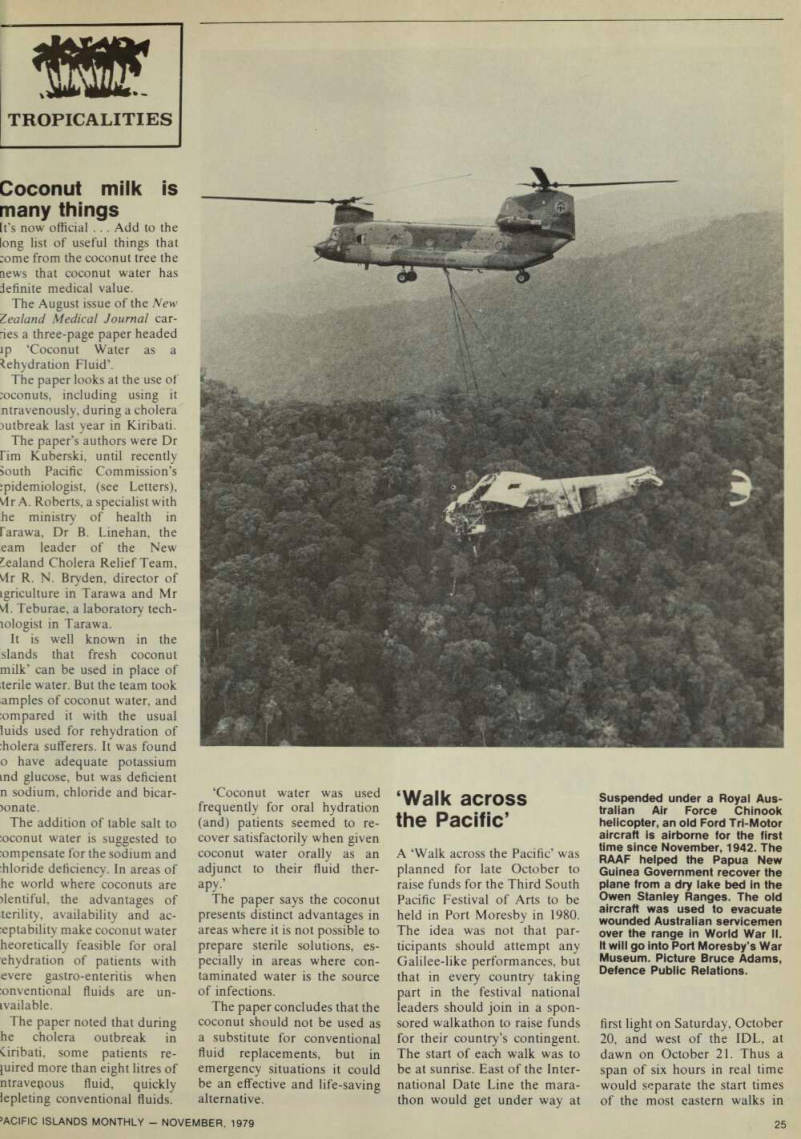
Suspended under a Royal Aus tralian Air Force Chinook helicopter, an old Ford Tri-Motor aircraft is airborne for the first time since November, 1942. The RAAF helped the Papua New Guinea Government recover the plane from a dry lake bed in the Owen Stanley Ranges. The old aircraft was used to evacuate wounded Australian servicemen over the range in World War II.
It will go into Port Moresby’s War Museum. Picture Bruce Adams, Defence Public Relations.
Tahiti and Hawaii and the westernmost walks in PNG and Guam.
The Tongans who
never arrived
The original intention of Bri tish colonial planners who worked on the idea of settling Australia was that the bulk of the settlers should come from - wait for it - Tonga and China. Only felons and a few others would be sent from
England.
This surprising piece of in formation emerges from one of the most significant acqui sitions made this year by the National Library of Australia:
a three-page pamphlet, dated
1785, in which Admiral Sir
George Young recommended
the establishment of a colony in New South Wales.
The extremely rare pam phlet, acquired from an anti quarian bookseller, was printed in London at the time of the recommendation. It be came the basis of the official scheme for the colonisation of Australia.
Under the heading ‘The
following is a Rough Outline of the Many Advantages that may result to this Nation, From a Settlement made on the Coast of New South Wales’.
Sir George Young stated cat egorically: ‘The Settlers of New South Wales are prin cipally to be collected from the Friendly Islands (contem porary name for Tonga -PIM) and China.’
One off 1000
bokola
Udre Udre, a Tui (King) of Navitilevu, whose seat of power was at Rakiraki, Fiji, in the early 19th century, must be an unchallenged world record holder for cannibalism.
A report in Fiji, magazine of the ministry of information in Suva, says: ‘Udre Udre had a very effective way of recording the number of bokola (human victims) he ate during his life time. ‘Every time a man was clubbed for Udre’s pot, a stone was put away in a certain spot.
When Udre died, the stones had accumulated to 999, one short of 1000 bokola.
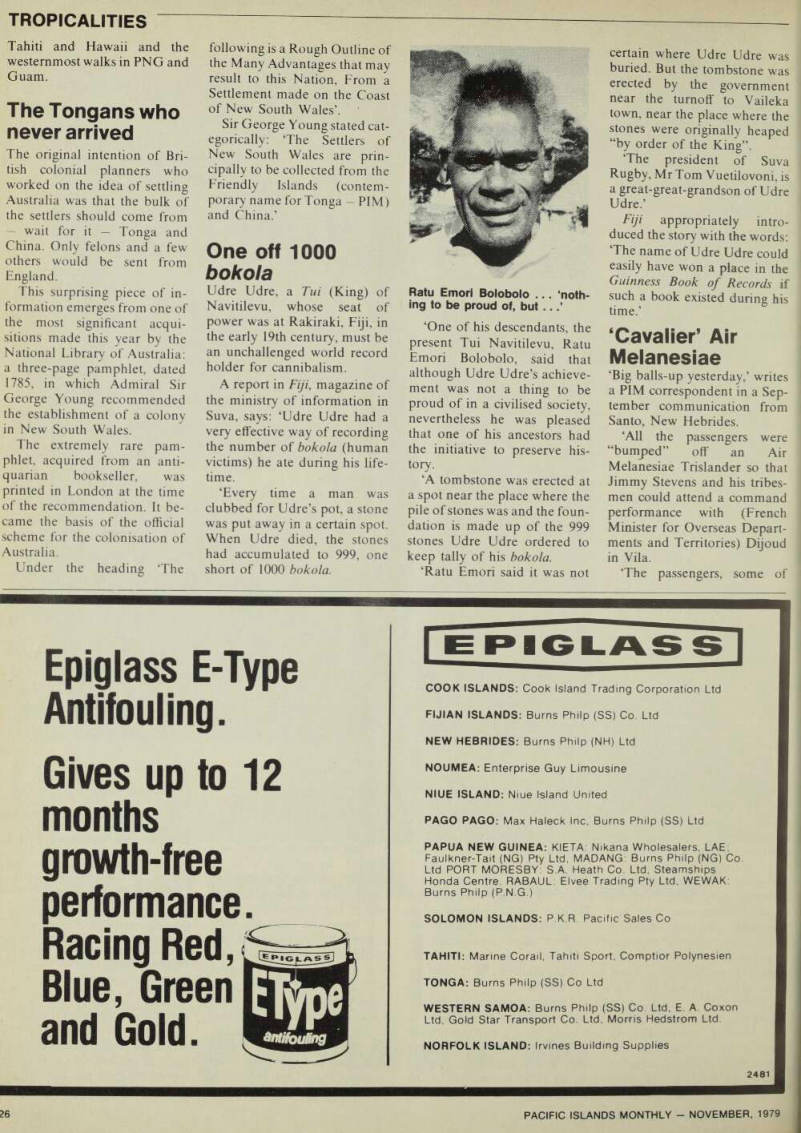
‘One of his descendants, the present Tui Navitilevu, Ratu Emori Bolobolo, said that although Udre Udre’s achieve ment was not a thing to be proud of in a civilised society, nevertheless he was pleased that one of his ancestors had the initiative to preserve his tory. ‘A tombstone was erected at a spot near the place where the pile of stones was and the foun dation is made up of the 999 stones Udre Udre ordered to keep tally of his bokola. ‘Ratu Emori said it was not
certain where Udre Udre was buried. But the tombstone was erected by the government near the turnoff to Vaileka town, near the place where the
stones were originally heaped
“by order of the King”. ‘The president of Suva u gby, Mr Tom Vuetilovoni, is a great-great-grandson of Udre Udre.’
Fiji appropriately intro duced the story with the words: ‘The name of Udre Udre could easily have won a place in the Guinness Book of Records if such a book existed during his time.’
‘Cavalier’ Air
Melanesiae
‘Big balls-up yesterday,’ writes
a PIM correspondent in a Sep tember communication from Santo, New Hebrides. ‘All the passengers were “bumped” off an Air Melanesiae Trislander so that Jimmy Stevens and his tribes men could attend a command performance with (French Minister for Overseas Depart ments and Territories) Dijoud in Vila. ‘The passengers, some of
Ratu Emori Bolobolo ... ‘noth ing to be proud of, but ...'
:m with international con :tions to make, were over ;hted in Santo and flown out *t morning at 6 am on the ne Trislander which had re ned at 7 pm with the igriamel chief the night be e.
The French Government ;ked up the tab.
It certainly demonstrates w “free” Air Melanesiae is to
ye their fare-paying passen
•s treated in this cavalier hion.’
hot time in the
d town
sidents of the charming old i capital of Levuka, on the md of Ovalau, have been •rifled at the news that per »sion has been granted for erection of a nightclub in town. The Levuka His ical and Cultural Preser ion Committee in itember held a special meet , and fired off a unanimous test to just about everybody ;ly to help put a stop to it. fhe nightclub was first moo a year ago, and the locals ught they had knocked it on head at that time.
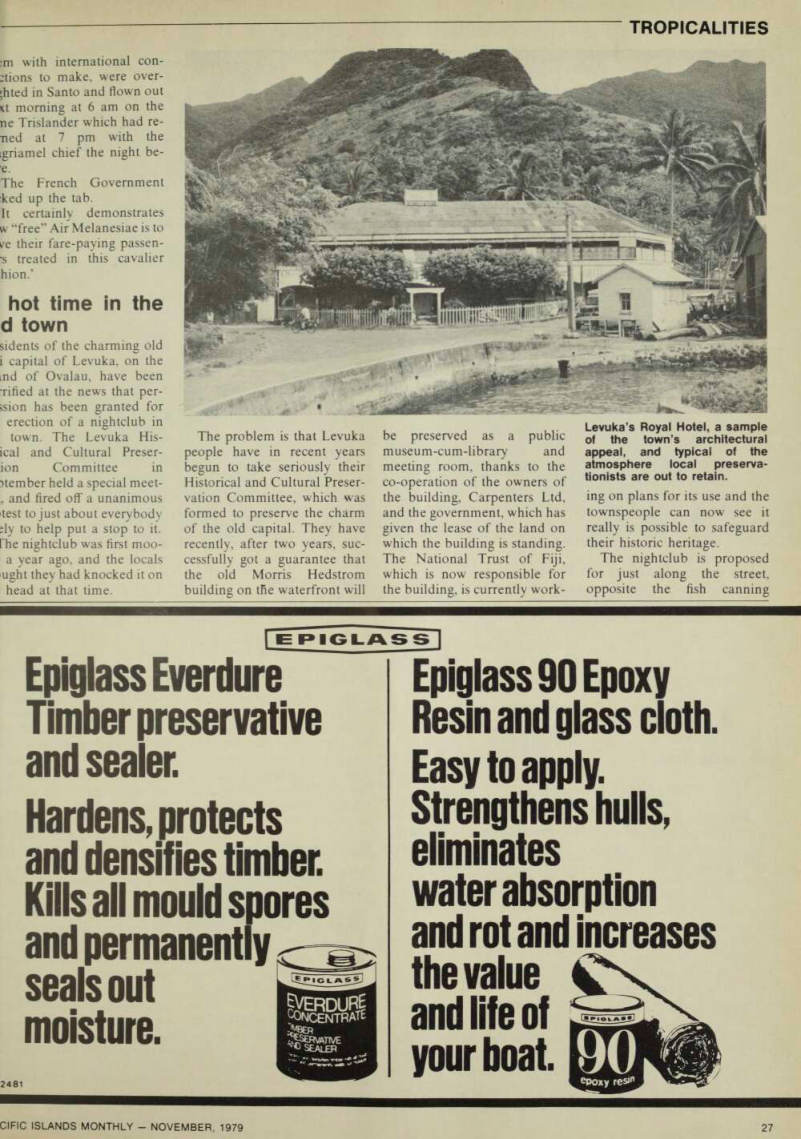
The problem is that Levuka people have in recent years begun to take seriously their Historical and Cultural Preser vation Committee, which was formed to preserve the charm of the old capital. They have recently, after two years, suc cessfully got a guarantee that the old Morris Hedstrom building on the waterfront will
, , , be preserved as a public
museum-cum-library and
meeting room, thanks to the co-operation of the owners of
the building, Carpenters Ltd,
and the government, which has given the lease of the land on which the building is standing.
The National Trust of Fiji, which is now responsible for the building, is currently work-
ing on plans for its use and the townspeople can now see it really is possible to safeguard their historic heritage.
The nightclub is proposed for just along the street,
opposite the fish canning
Levuka's Royal Hotel, a sample of the town’s architectural appeal, and typical of the atmosphere local preserva tionists are out to retain.
freezer and factory. The town attracts Asian fishermen who supply the factory after spend mg weeks at sea.
The public meeting was told that the nightclub would be seen as an open invitation ‘for this gentle and historic town to
become the happy hunting
ground of prostitutes, pimps, standover men and drug oper a tors ’
Levuka on September 2 held successful celebrations for the centenary of the famous Levuka Public School - the oldest school in Fiji. Guest of honour was the school’s most distinguished son, Ratu Sir George Cakobau, who spoke to ‘be S: S d C by m pressure ot self-importance', and whose serenity rubs off on all who live in Levuka for any length
Historic BP
get-together
P . . , For the first time in history, at least m living memory, there was a convivial gathering at the head office of many retired members of the Burns, Philp family, with some of the longer-serving current mem bers of head office staff, on September 19. It was a move towards more human relation ships with the company’s loyal servants. Mr David Burns, the chairman, explained that he had been trying to initiate such a meeting for some years, to give the retired members a feeling of belonging to the family, and it was obvious that although some had left the company nearly 20 years ago, they still appreciated the wel
come extended to meet their old friends in head office.
Most of the 70 people pre sent, of whom 16 were ladies, had joined the company about 50 years ago; the oldest admit ted to 88 years Mr Lee, the secretary for many years.
Not all those present had served in the Islands, but there were some stalwarts from New
Guinea, including Bernie Ryan
of Lae, Monty Stobo, George Clarke and Jack Sherry, with
John Beveridge who inspected
plantations as far afield as Fan ning Island. Among the tall poppies in the crowded func tion room were the present general manager, Philip Best, Arthur Furze of BP Trustee Company, and Ray Sharp, the personnel manager, as well as being a very active Brigadier in the Army Reserves.
The shipping side of the company’s history included five ex-Captains, Gordon Howe, Alan Aitken, John Ealey, Frank Sadler and my self, with Arthur Lloyd, Lachie McQueen, George Hazell and Bill Williams of the shore staff.
Two veterans were unable to be present owing to ill health, Roy Waddell, 86, the engineer superintendent, and Herbert Baker, 93, who was shipping manager until he was 78. There were some other notable absentees, but the invitation list had to be severely re stricted, for the available space, and for the same reason no wives were invited.
The history of the company was certainly revived in the hours of personal contacts and reminiscences, and everyone was most appreciative of the chairman’s initiative in holding the function. When asked jok
ingly whether the historic event might be repeated every 50 or 100 years, David Burns said he hoped to repeat it, perhaps making it an annual event.
The party began at 5.15 pm and was to end at 7.30, but I noticed that it was 10.30 when I left, and I was not the last
though probably I was the only
guest who had flown from Queensland specially for the occasion. The hospitality was generous in both food and con vivial fluids, including the best Macleay Duff. - Brett Milder.
Micronesia
on US TV
A team from the top-rating CBS television programme 60 Minutes has visited Micronesia and filmed an episode on the islands’ progress and problems since the 1958 bombing mora torium.
Scheduled for screening in November, the film is based on a two-week visit by CBS cor
respondent Merely Safer and
five CBS crewmen. They visi
ted Guam, Ponape, Kwajalein
and Palau.
Vavau piggery
bogged down
After the success of a beach and entertainment area project
developed communally by the
72 families making up the vil lage of Tuanikivale in Vavau, Tonga, to entertain cruise ship passengers who visit their vil lage, an even more ambitious programme was undertaken by
the village co-operative, writes
Jimmy Cornell.
All the pigs which normally roam undisturbed around the village, messing up the roads
and ruining the crops, were tc be housed together in a model piggery. The plans for an
integrated farming systeml
including a piggery, algae and
fish ponds and market garden
ing plots, were provided by the
South Pacific Commission, which also contributed techl nical assistance, while the US based Foundation for the Peoples of the South Pacific donated $2O 000.
The people of Tuanikivale put in thousands of hours of
voluntary work providing
labour, but the whole project came to a halt with the depar-j ture from the SPC of Mr Chan, who had been directly involved] with the project.
At the site of the piggery one
building is complete, as are the!
gas digesters which were expected to supply the village! with lighting and even cooking gas.
Unfortunately, according to
village chief Hingano PalefauJ
who is also chairman of the co-J
operative, everything has come]
to a standstill, with no help!
coming from the ministry of]
agriculture in Nukualofa and]
no word from the SPC.
Meanwhile, the pigs are]
roaming the village, and the unused building will soon be swallowed up by the encroach
ing forest.
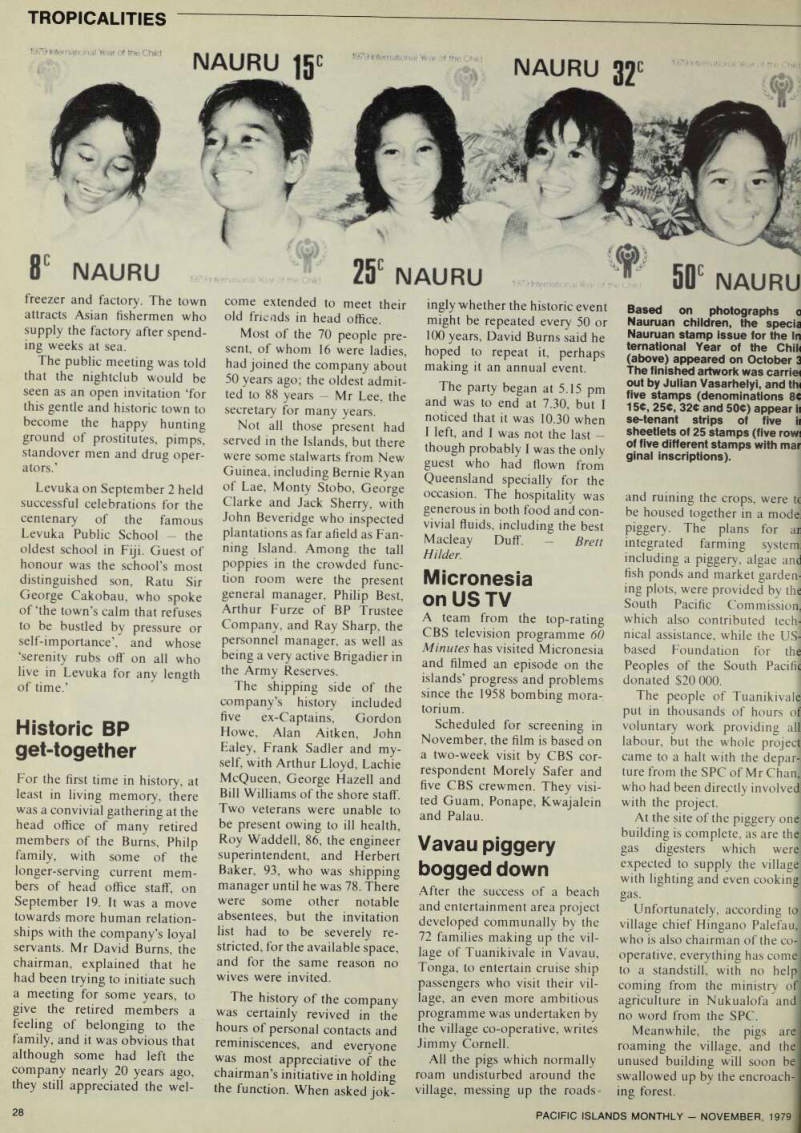
Based on photographs o[?] Nauruan children, the special Nauruan stamp issue for the In ternational Year of the Children (above) appeared on October 3[?] The finished artwork was carried out by Julian Vasarhelyi, and the five stamps (denominations 8$ 15$, 255$, 32$ and 50$) appear in se-tenant strips of five in sheetlets of 25 stamps (five rows of five different stamps with mar
ginal inscriptions).