When Custom,
pp. 20-23 · Read in the full issue

Political
Currents
Kiribati and Mr William Bodde Jnr, Director of Pacific Island Affairs of the United States Department of State.
A witness to the signing was Mr Peter Tali Coleman, Governor of American Samoa, who accompanied Mr Bodde to Tarawa. Governor Coleman represents the US in the joint administration of Canton Island and in any future joint ventures based on Canton.
The island is one of 14 in the Phoenix and Line groups to which the US has relinquished all claims in the new treaty of
friendship. The relinquished
islands are Caroline, Christ mas, Flint, Malden, Starbuck, and Vostock, all in the Line group, and the atolls of Birnie, Gardner, Hull, McKean, Phoenix and Sydney, and the islands of Canton and Ender bury, all of the Phoenix group.
In the treaty the two govern ments agree to consult on mat ters of mutual concern and interest and to promote econ omic and social development.
They also agree to consult con cerning any military use of the 14 islands by third parties, and that facilities constructed by the US on Canton, Enderbury and Hull islands would not be used by third parties for mili tary purposes without US agreement.
Mr Bodde said the treaty looked forward to especially close and friendly co-operation between American Samoa and
Kiribati, using the American built facilities on Canton island
for joint fishing ventures.
When Custom,
Law Conflict
‘The term “political crisis” is frequently over-used,’ writes Mike Field in Wellington’s Evening Post. ‘But what other expression could be used when a nation faces the possibility of having almost all its elected representatives in a criminal court dock?’
Despite the many dif ferences, the Western Samoan situation discussed by Field also has telling parallels with recent developments in Papua New Guinea.
In a lengthy review of recent events in Western Samoa, Field notes that the root of the issue was a series of judgments made earlier this year by a New Zealander, the country’s Chief Justice Bryan Nicholson, con
cerning charges of ‘bribery’
and ‘treating’ in the country’s February elections.
He writes; Western Samoa’s legislative assembly enacted an electoral act which was taken almost word for word from a similar New
Zealand act. Although banning
corrupt practices like bribery and treating, in the words of one lawyer, the members who passed the act gave little or no thought to the conflict that could arise between the act and the fa’a Samoa ... a catchword
Micronesia:
New Faces
For the many people in the Pa cific who have difficulty keep ing up with political developments in the US Trust Territory of the Pacific Islands, here is a brief guide to the four new states slated to succeed to control of its 2000-plus islands spread over 7.7 million square kilometres of the Pacific when the US trusteeship expires in 1981. • Federated States of Micronesia: In the central area of the trust territory, the dis tricts of Yap, Truk, Ponape, Kosrae and a large number of atolls will form the FSM.
Ponape’s Kolonia will be the capital. Land area: 108 square kilometres, population 65 000
(approx.).
• Marshall Islands: In the east of the trust territory, the Marshall Islands will have an
independent political set-up.
The government centre of Majuro has about 8000 popu lation. Land area: 179 square kilometres, population 25 000. • Commonwealth of the Northern Marianas: In the northwest of the trust territory.
About 12 000 people live on Saipan, the main island. All inhabitants of the common wealth will become US citizens in 1981. Land area: 471 square kilometres, population 15 000. • Republic of Belau (for merly Palau District): In the southwest of the trust territory.
Government centre Koror.
Land area: 461 square kilo metres, population 13 000.
Us, Kiribati
Sign Pact
A treaty of friendship between the Republic of Kiribati and the United States was signed in
Tarawa in September. Signing
on behalf of their nations were President leremia Tabai of
to describe traditional customs in the country.
The conflict remained vir tually unnoticed until in February this year the country’s 10 000 matais, extended family heads and the only people entitled to vote, went to the polls to elect 47 members of the new legislative
assembly.
‘ln many constituencies voters only total about 200 people, and margins between candidates can average out at about five votes. In spite of warnings from electoral officials, a great deal of money, iood and alcohol was handed out by candidates to likely voters.’
Field records that in one court challenge an unsuccessful candidate, Frances Moore, charged that a successful can didate, George Lober, had committed corrupt electoral practices by handing out food and beer at election meetings.] Field writes; ‘ln his judg ment, Mr Nicholson noted that Moore had served home-made cordial and sandwiches as refreshments at her meetings.!
This, he said, could not be seen as an attempt to induce voters. ‘But Lober, in handing out < beer and kegs of salt beef, went “far beyond the category of
light refreshments”.’
Field sums up: ‘Since
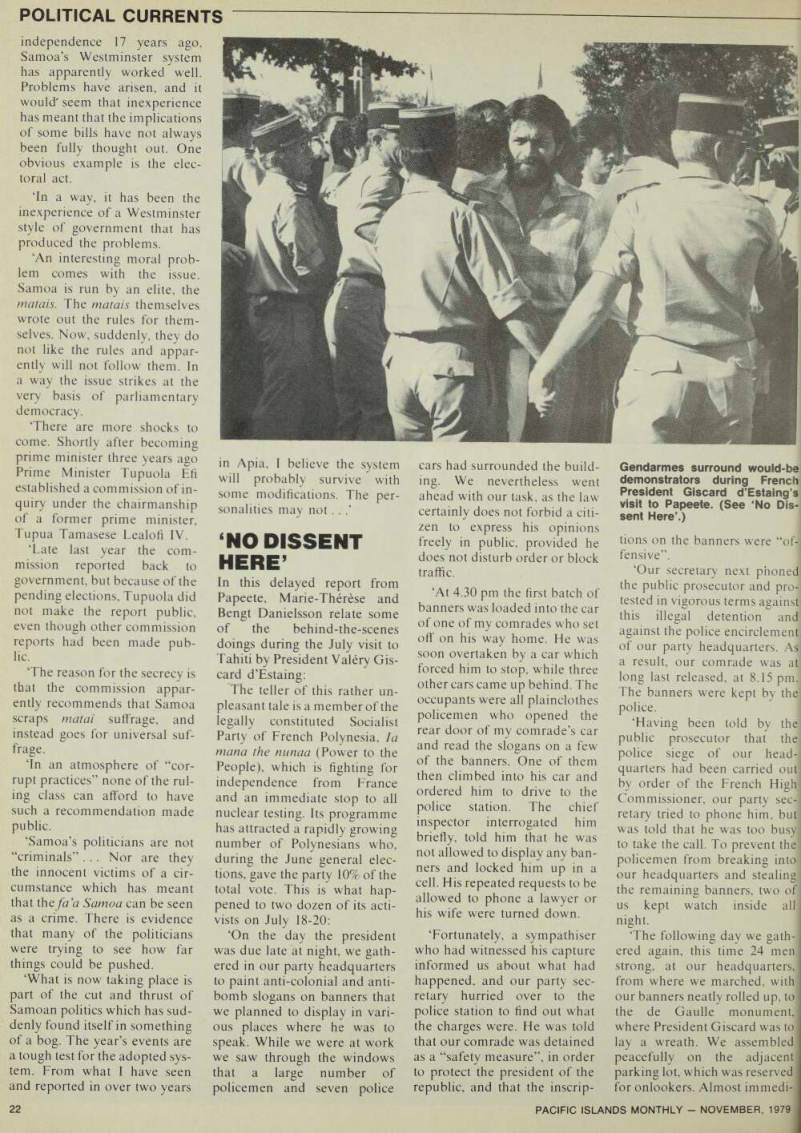
Western Samoa’s independence celebrations, 1962 ... after 17 years, second thoughts on some institutions.
independence 17 years ago, Samoa’s Westminster system has apparently worked well.
Problems have arisen, and it would' seem that inexperience has meant that the implications of some bills have not always been fully thought out. One obvious example is the elec toral act. ‘ln a way, it has been the inexperience of a Westminster style of government that has produced the problems.
‘An interesting moral prob
lem comes with the issue.
Samoa is run by an elite, the matais. The matais themselves wrote out the rules for them selves. Now, suddenly, they do not like the rules and appar ently will not follow them. In a way the issue strikes at the very basis of parliamentary
democracy.
‘There are more shocks to
come. Shortly after becoming
prime minister three years ago Prime Minister Tupuola Efi established a commission of in
quiry under the chairmanship
of a former prime minister, Tupua Tamasese Lealofi IV. ‘Late last year the com mission reported back to government, but because of the
pending elections, Tupuola did
not make the report public, even though other commission reports had been made pub lic. ‘The reason for the secrecy is that the commission appar ently recommends that Samoa scraps matai suffrage, and instead goes for universal suf
frage.
‘ln an atmosphere of “cor rupt practices” none of the rul ing class can afford to have such a recommendation made public. ‘Samoa’s politicians are not “criminals” ... Nor are they the innocent victims of a cir cumstance which has meant that the fa’a Samoa can be seen as a crime. There is evidence that many of the politicians were trying to see how far
things could be pushed.
‘What is now taking place is part of the cut and thrust of Samoan politics which has sud denly found itself in something of a bog. The year’s events are a tough test for the adopted sys tem. From what I have seen and reported in over two years
in Apia, I believe the system will probably survive with some modifications. The per
sonalities may not. ..’
‘No Dissent
Here’
In this delayed report from Papeete, Marie-Therese and Bengt Danielsson relate some of the behind-the-scenes
doings during the July visit to
Tahiti by President Valery Gis
card d’Estaing;
The teller of this rather un pleasant tale is a member of the legally constituted Socialist Party of French Polynesia, la mana the nunaa (Power to the People), which is fighting for independence from France and an immediate stop to all nuclear testing. Its programme has attracted a rapidly growing number of Polynesians who, during the June general elec tions, gave the party 10% of the total vote. This is what hap pened to two dozen of its acti vists on July 18-20: ‘On the day the president was due late at night, we gath ered in our party headquarters to paint anti-colonial and anti bomb slogans on banners that we planned to display in vari ous places where he was to speak. While we were at work we saw through the windows that a large number of
policemen and seven police
cars had surrounded the build ing. We nevertheless went ahead with our task, as the law certainly does not forbid a citi zen to express his opinions freely in public, provided he does not disturb order or block traffic. ‘At 4.30 pm the first batch of banners was loaded into the car of one of my comrades who set off on his way home. He was soon overtaken by a car which forced him to stop, while three other cars came up behind. The occupants were all plainclothes
policemen who opened the
rear door of my comrade’s car and read the slogans on a few of the banners. One of them then climbed into his car and ordered him to drive to the police station. The chief
inspector interrogated him
briefly, told him that he was not allowed to display any ban ners and locked him up in a cell. His repeated requests to be allowed to phone a lawyer or his wife were turned down.
‘Fortunately, a sympathiser
who had witnessed his capture informed us about what had happened, and our party sec retary hurried over to the police station to find out what the charges were. He was told that our comrade was detained as a “safety measure”, in order to protect the president of the republic, and that the inscrip
tions on the banners were “of-j fensive”. ‘Our secretary next phoned] the public prosecutor and pro ] tested in vigorous terms against this illegal detention and
against the police encirclement
of our party headquarters. As a result, our comrade was at long last released, at 8.15 pm.
The banners were kept by the
police.
‘Having been told by the public prosecutor that the] police siege of our head-] quarters had been carried out by order of the French High Commissioner, our party sec-j retary tried to phone him, but] was told that he was too busy] to take the call. To prevent the
policemen from breaking into]
our headquarters and stealing
the remaining banners, two of us kept watch inside all
night.
‘The following day we gath-;
ered again, this time 24 men strong, at our headquarters, from where we marched, with our banners neatly rolled up, to the de Gaulle monument, where President Giscard was to lay a wreath. We assembled peacefully on the adjacent parking lot, which was reserved for onlookers. Almost immedi
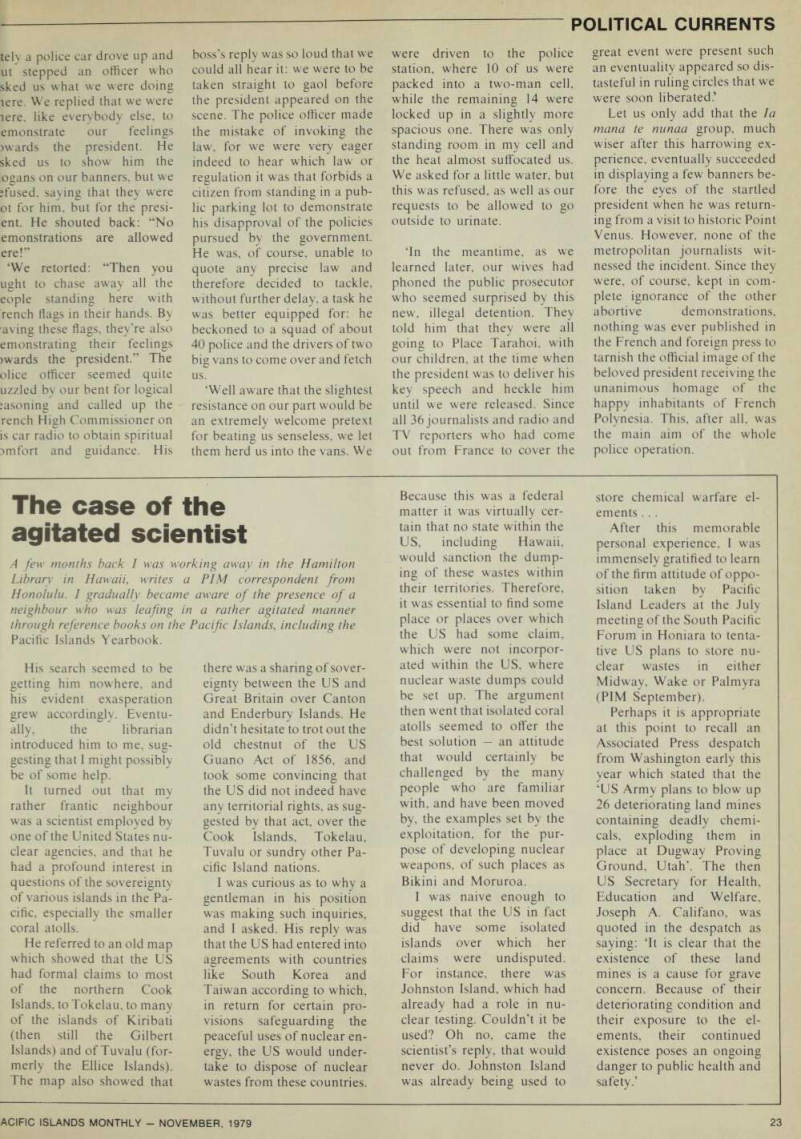
Gendarmes surround would-be demonstrators during French President Giscard d’Estaing’s visit to Papeete. (See ‘No Dis sent Here’.)
tely a police car drove up and ut stepped an officer who sked us what we were doing lere. We replied that we were tere. like everybody else, to emonstrate our feelings
awards the president. He
sked us to show him the ogans on our banners, but we ffused, saying that they were ot for him, but for the presient. He shouted back: “No emonstrations are allowed ere!” ‘We retorted: “Then you ught to chase away all the eople standing here with rench flags in their hands. By
aving these flags, they’re also
emonstrating their feelings
>wards the president.” The
olice officer seemed quite
uzzled by our bent for logical
masoning and called up the rench High Commissioner on is car radio to obtain spiritual
Dmfort and guidance. His
boss’s reply was so loud that we could all hear it: we were to be taken straight to gaol before the president appeared on the scene. The police officer made the mistake of invoking the law, for we were very eager indeed to hear which law or regulation it was that forbids a citizen from standing in a pub lic parking lot to demonstrate his disapproval of the policies
pursued by the government.
He was, of course, unable to quote any precise law and therefore decided to tackle, without further delay, a task he was better equipped for: he beckoned to a squad of about 40 police and the drivers of two big vans to come over and fetch us. ‘Well aware that the slightest resistance on our part would be an extremely welcome pretext for beating us senseless, we let them herd us into the vans. We
were driven to the police station, where 10 of us were packed into a two-man cell, while the remaining 14 were locked up in a slightly more spacious one. There was only standing room in my cell and the heat almost suffocated us.
We asked for a little water, but this was refused, as well as our requests to be allowed to go outside to urinate. ‘ln the meantime, as we learned later, our wives had
phoned the public prosecutor
who seemed surprised by this
new, illegal detention. They
told him that they were all going to Place Tarahoi, with our children, at the time when the president was to deliver his key speech and heckle him until we were released. Since all 36 journalists and radio and TV reporters who had come out from France to cover the
great event were present such an eventuality appeared so dis tasteful in ruling circles that we were soon liberated.’
Let us only add that the la mana te nunaa group, much wiser after this harrowing ex
perience, eventually succeeded
in displaying a few banners be fore the eyes of the startled president when he was return ing from a visit to historic Point Venus. However, none of the
metropolitan journalists wit
nessed the incident. Since they were, of course, kept in com plete ignorance of the other abortive demonstrations, nothing was ever published in the French and foreign press to tarnish the official image of the
beloved president receiving the
unanimous homage of the happy inhabitants of French Polynesia. This, after all, was the main aim of the whole
police operation.