PNG’s ‘Rooney
pp. 17-19 · Read in the full issue

Affair’: A mix-up of two issues
Angus Smales in Port Moresby reviews the constitutional crisis vhich has shaken Papua New Guinea since July, and is far from iaving worked itself out yet. He sees the crisis as basically involving wo distinct issues, which regrettably have become ‘completely nixed up with one another ’.
Vly Dear Chief Justice .. .’ •egan the Papua New Guinea ustice Minister, Mrs Rooney, i a letter she wrote to the "hief Justice Sir William Pren ice. The date was July 11 this ear. In the months since then lie letter has become a centre
iece of political controversy,
nd the constitutional clash it as created is still unresolved in lany essential issues.
It initiated a clash of con epts over the relationship be veen the government and the idiciary, and the chain of vents which it started has in luded the resignation of five
jdges, the gaoling and
ngaoling of a minister of tate, and now it has produced erhaps a question mark over ic role and future of the ju iciary. And somewhere in California the bearded, be
pectacled, political scientist
'ho unwittingly triggered the
ntire tangle is about to write book on what he describes as he need for a miracle if emocracy is to be preserved in NG’.
Now I don’t necessarily gree with his remarks, but that olitical scientist is Dr Ralph Temdas, who modestly told a
leeting of Port Moresby
Rotary Club shortly before he was expelled from PNG that he has something of a reputation for ‘giving governments a bit of a jolt’. Dr Premdas had six years in PNG as a university lecturer, and government and opposition alike found him a
helpful honorary adviser for
a while, anyway. But in June he had his residence permit re voked. He was accused by the Prime Minister, Mr Somare, of meddling in affairs of govern ment and of undermining the sovereignty of PNG national ism.
He lost a ministerial appeal, but he successfully applied to the National Court to remain in Port Moresby while he pur
sued a legal appeal. His appeal
(which he subsequently lost)
was preceded by Mrs Rooney’s
famous letter to Sir William Prentice, a letter which she cir culated very widely at the time.
In the letter Mrs Rooney asserted the right of the government to deport whom it liked, she criticised the court for intervening in a matter which ‘is a sole prerogative of government’ and she rounded off her remarks with a little homily to the judges to use
‘greater discretion in making
their decisions’.
In many respects it was a naive letter and it could have been a thoughtless mistake all this was argued later in court but it disturbed Sir William because of its circu lation and because of the notion it contained that the state could direct the courts.* Mrs Rooney wouldn’t with draw it, and in open court Sir William disclosed it (and the
subsequent correspondence)
and then, as he put it, ‘invited the government to defend the constitution and the courts’.
The inference was clear some form of government in itiative was necessary to with draw the letter, apologise, and reassert the concept of the independence of the courts.
Mr Justice Pritchard, who had granted a breathing space to Dr Premdas in the first place, resigned and wrote a stern letter to Mrs Rooney in
doing so.
But the days passed, the government took no action, and Mrs Rooney dug in her heels. She was quoted in the media as ‘having no confidence
in foreign judges who are only
interested in administering foreign laws’. This was a direct reference to the fact that so far PNG has none of its own nationals on the bench. Seven of its judges are Australian and the eighth is a Briton.
Eventually the parliamen
tary opposition initiated an action to gaol Mrs Rooney and those who ‘abetted her’ for unconstitutionally inter
fering with the independence
of the courts.
The Public Prosecutor, Mr
Egan, intervened by right, and
then proceeded with a Su preme Court notice of motion alleging three counts of con
temp against Mrs Rooney.
By a four to one majority, Mrs Rooney was found guilty and she was gaoled for eight months. Mr Justice Kearney
dissented by proposing dis
missal of one of the charges and proposing a total fine equivalent to 400 Kina on the other two.
Hardly was Mrs Rooney in gaol and indeed there was considerable sympathy for her even from her detractors than the government got her out again. The Prime Minister, Mr Somare, who had assumed the Justice portfolio, exercised a constitutional and criminal code process freeing her on li
cence, although not nullifying
the conviction and the sen tence.
Now whatever may be the rights or wrongs of what has
happened, the judges saw
themselves in a situation where they had gone to great lengths to demonstrate the indepen dence of the courts only to have the end result effectively and somewhat emotionally nega ted by the state.
In addition they had under
gone an experience suggesting
that in some matters at least the government is no longer interested in wanting an
independent judiciary.
In the upshot, four of them the Chief Justice, Sir William Prentice, the Deputy Chief Justice, Mr Justice Raine, Mr Justice Wilson, and Mr Justice Saldanha fol lowed Mr Justice Pritchard’s course by resigning. The three
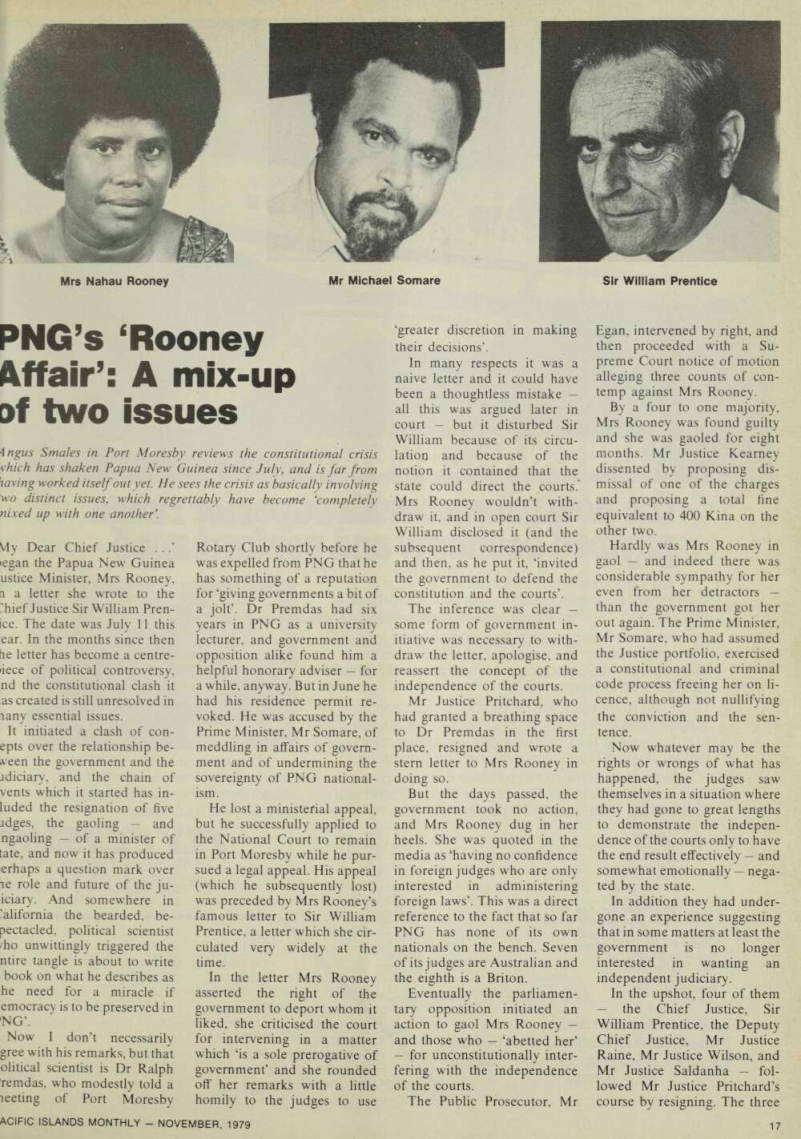
Mrs Nahau Rooney
Mr Michael Somare
Sir William Prentice
judges who did not resign were Mr Justice Kearney, Mr Justice Greville Smith and Mr Justice Andrew.
Although the issues involved in the contempt hearing against Mrs Rooney are complex and
wide-ranging, the political
issues stand out very clearly.
From the prime minister down there seems to have been
a genuine inability to appreci
ate the real distinction between executive and judicial powers, although this system was freely chosen at independence and it was written into the PNG con stitution.
The current government atti tude appears to rest on what can be described as a distinct cultural gap between Mr Somare’s society and the socie ties which developed a rather precise system of judicial sep aration. The suitability of the
system for PNG’s requirements
may well be open to serious question, and the present
controversy in fact highlights
this situation.
But what has happened is that the argument about the suitability of the situation is being confused today with the arguments about what has hap pened to Mrs Rooney.
When Mrs Rooney’s letter vas first disclosed, the solution vould have been so simple if
;he government had recognised
;he issues, but the government xmtinued to think in terms of thrashing out a precedent’. But the government wasn’t power less to legitimately make its points about Dr Premdas, either, as we shall see shortly.
The judges indeed are foreign in terms of citizenship.
There is no denying that this is
a regrettable situation. But
PNG itself gave them the con stitution and the laws under
which they operate and
charged them by oath to follow these principles. This is the point which Mr Damien Kereku made so well the other day. Much of the emotional ar gument in this issue has claimed that the legal system used by PNG is a foreign con cept or a hangover from
colonialism or some equally
emotive background situation.
There may well be much val idity in this argument, but there
is one very important point
which appears to have been
largely overlooked. When Mrs Rooney wrote to the judges, she was indeed cutting across a line of separation which under the present constitution and structure she had no right to cross.
But this doesn’t mean that a government to use a rather blunt way of putting it is ‘at the mercy’ of its judiciary.
Everything that Mrs Rooney
wanted to achieve could have been engineered as a concept within the law by taking the matter to parliament and get ting parliament to make appro
priate legislation. ‘The power
lies with the people’ says the constitution. Parliament is their forum, and parliament makes the rules for the judges.
This is what a democratic Westminster Parliament sys tem is all about to use the ideas of the people and their elected representatives to lay down the rules about the sort of controls that you want in
your society. (You also deter mine the sort of society that you want, but here I am refer ring specifically to controls and checks in any national situation which may arise.) I’d like to look, too, at what I think is another over-emotive issue concerned in this situ ation. My wife expressed sym pathy to a Papua New Guinean lawyer the other day over the fact that Mrs Rooney had been gaoled. What she said had nothing to do with the legal issues involved, but no one likes to see people go to gaol over issues of society rather than over issues of what per haps we could call vice.
Now we were quite upset by the lawyer’s answer. He said
‘your people put her in gaol’.
If this highlights one thing, it highlights the urgent need to
phase Papua New Guinean
judges into the system as soon as possible. If an intelligent lawyer who thinks that white
judges applied some law of their own, then the country indeed is heading along a sorry road.
I might add, too, that the judges themselves have been aware of this need for a long time, and there is no shortage of material on record about their attempts to achieve a planned phasing out of re
sponsibilities.
The position now is that two different issues are being cri ticised and two different issues
are being questioned in public.
But sadly these two issues are
being completely mixed up
with each other. The first issue is whether or not PNG is at the mercy of some foreign imported law which is quite unsuitable for a Melanesian so ciety. There is much to support this argument, but I don’t think the structure is necessarily as foreign as some people believe.
It’s not as foreign as they be lieve if parliament is used properly and if urgent steps are taken to train in Papua New Guinea judges. It’s not the structure so much but the laws within that structure which per haps need very close atten tion.
The second issue and this is certainly the stronger in terms of public criticism is that the government has inter vened in a manner which appears to negate what the court hearing was all about. It’s intervened in a matter concern ing the separation of executive and judicial functions. Many of the critics say it has flown in the face of its own laws. In fact the process used to free Mrs Rooney was designed to allow the release of long-term pris oners slightly ahead of time to help their rehabilitation.
Of course Mrs Rooney should never have gone to
gaol.
But the real tragedy was that she and the government fol lowed an illegitimate course to achieve a result which could have been achieved quite legi
timately through parliament.
The echoes of her letter will take a long time to die away, but in the meantime PNG appears to be courting trouble
by claiming allegiance to one
system and sometimes practis
ing another.
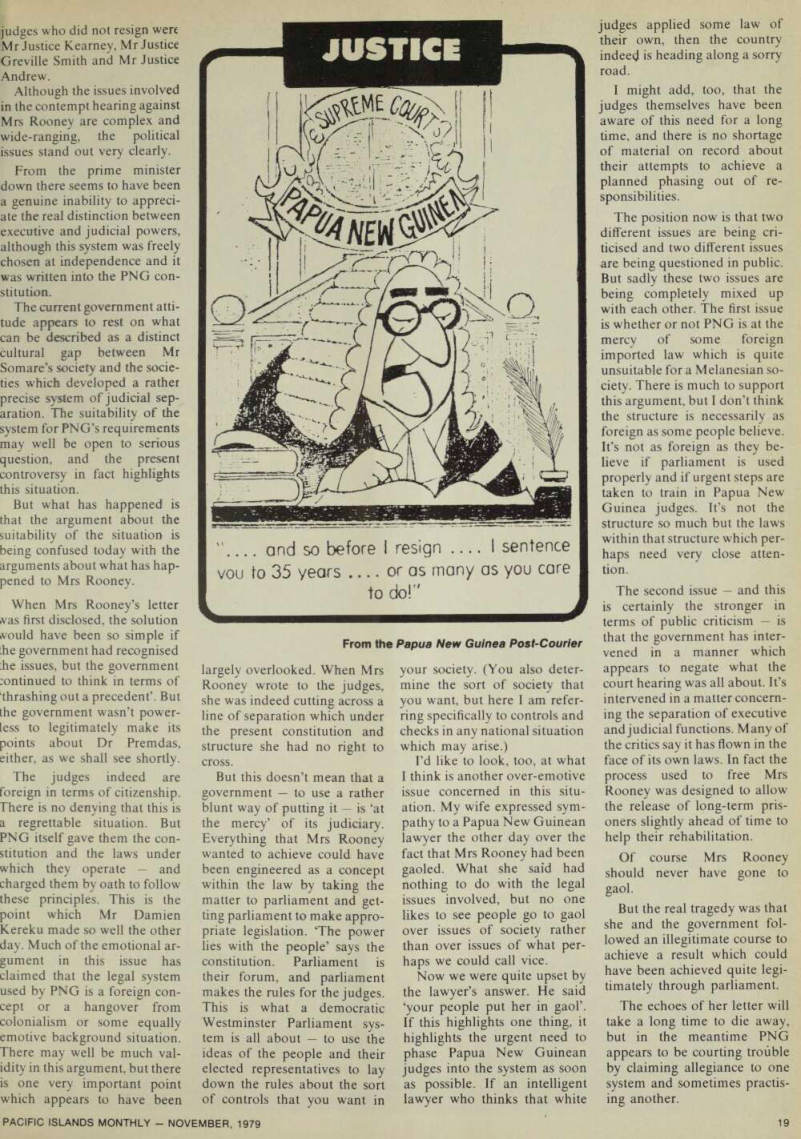
From the Papua New Guinea Post-Courier