The Pacific in Australia
pp. 31-34 · Read in the full issue


The opening of a Trade Com mission for the South Pacific in Sydney is a timely and appro priate opportunity to take a closer look at the prospects for increased exports from the Pa cific Island countries to Aus tralia as well as at the problems confronting the new office and the exporters trying to achieve
that goal.
In recent years much has been said at all levels politi cal, official, business and aca demic about the need for and desirability of increased trade between the Pacific nations and Australia and New
Zealand. Of necessity and
possibly even wisely, the de bate has until recently been conducted at the general level,
focusing on principles rather
than detailed specifies.
As a result, there is, I believe, a broad measure of agreement that the expansion of trade and business opportunities, the finding of new markets, the creation or safeguarding of full dt relatively unhindered access to such markets, and the development of new and
expansion of existing industries
are today an absolute necessity if the relatively small and
extremely dispersed Pacific
community is to realise its quite real and legitimate de
sires for development.
There has also been general acceptance at most levels par ticipating in the debate that little can or will be achieved by a blinkered discussion on the
development of trade purely in the context of the present nature and make-up of the economies of the southwest Pa cific countries.
Thus it has become quite clear that if the development aims and desires are to be realised, debate and action must encompass the whole gamut of economic activity: trade, investment and indus trial development. Herein lie both the basis for success and the possible cause for tem
porary disappointment.
Let me be quite clear on two points. Firstly, I firmly believe
in the prospects of trade development to the benefit of all in and on the rim of the Pa cific, not only because I feel there is wide acceptance of the principles involved but also be cause, very significantly, there is developing a strong feeling of unity and unanimity among Pacific Island countries as to
where their real interests in the long run lie: together they prosper, divided they do not.
Secondly, I equally firmly believe that to expect instant success in respect of each and every attempt is to ignore the fact that the transition from agreement on general prin ciples to significantly expanded exports by individual countries and industries is a time-taking process which begins with get ting people interested in look ing at an area, project or opportunity, which proceeds through stages of detailed study, negotiation and market
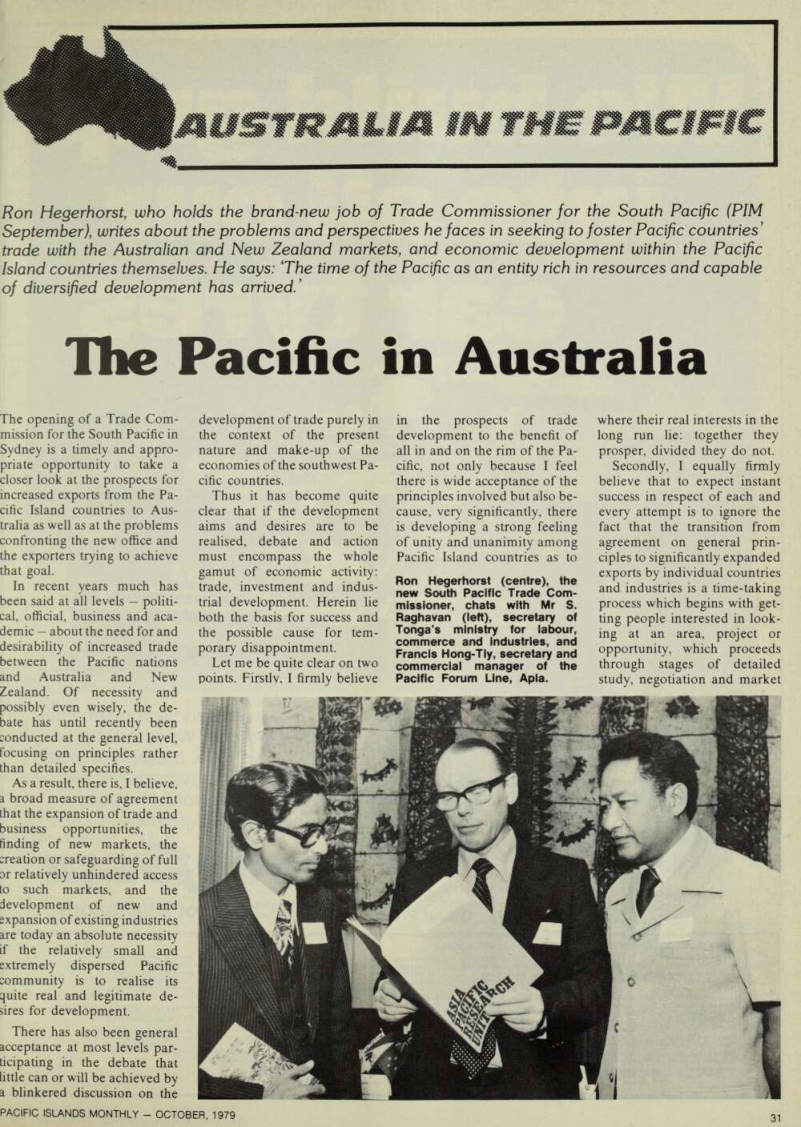
Ron Hegerhorst (centre), the new South Pacific Trade Com missioner, chats with Mr S.
Raghavan (left), secretary of Tonga’s ministry for labour, commerce and industries, and Francis Hong-Tly, secretary and commercial manager of the Pacific Forum Line, Apla.
exploration, and ends when the button is finally pushed and the output is being loaded on to the vessels which carry it over seas.
The Pacific people and their leaders have lived with the al leged disadvantages of the Pa cific for many years. For a long time it has been argued that industrial development is not a way of life for the Pacific, that the Pacific has no resources to develop, that it is not suited to adapt to the ways of the devel oped world which nevertheless influenced it. Often, perhaps, this negative attitude on the part of policy-makers was simply the result of narrow thinking or a wish to keep the Pacific ‘unspoiled’. At times this attitude was adopted be cause it suited those who used it. Rarely did one hear mention of the obvious truth that a rich customer is a bigger and better customer.
Now the alleged disadvan
tages are no longer accepted as
inevitable. Today they are
more of a challenge: ways must be actively found to turn the disadvantages of the past into
prospects for development.
There is evidence that indus trial development can be bene ficial and successful if pursued with good sense and a co ordinated approach. The time of the Pacific as an economic entity rich in resources and
capable of diversified develop
ment has arrived.
Ec »nomic development and the expansion of trade interact: the latter both leads to and re mits from the former. To bring to full fruition the possibilities for trade expansion it will be accessary to examine the sub let in the widest possible con
text. Geographically, the
development of industries and exports will be influenced by: • the scope for expanded
ntra-regional trade;
• the extent to which mar kets can be found in Australia md New Zealand; and • penetration of markets urther afield.
Bach one of these is important, t is clear that:
• expanded intra-regional
rade provides evidence of the
Pacific’s desire to achieve a measure of self-reliance; • expanded trade with Aus tralasia acknowledges historic links, proximity and economic
interdependence; and
• expanded trade with dis tant markets indicates proof that there is awareness of the need to avoid the all-eggs-in one-basket problem. It would also be a clear indication that the Pacific approached its
development process sensibly
without undue reliance on the Australian market and with due regard to efficient Aus
tralian industry.
Conceptually, too, the development of industries and trade must be examined in the
widest possible context: pri
mary products, mineral com
modities, processed products
and manufactures. In doing so, the Pacific Island countries would recognise the need for diversification of their econ omies, their export destinations and the sources of their
imports.
The general scenario has thus been set on the basis of which businessmen and inves tors can test not only their own ideas and plans but also those with which Pacific govern ments and business people will confront them. The question may therefore be asked: What has the Pacific region to offer the Australian investor, indus trialist, businessman?
Firstly, the region contains
important resources the development of which is encouraged, desired and feas ible. Secondly, the expansion of agricultural, marine and extraction industries and in creased local processing of their outputs is in line with the priorities declared by most Pa cific governments and offers
good long-term prospects for
investor and host country alike.
Thirdly, Pacific Island coun tries actively encourage, as a matter of general policy, investment in competitive
import replacement industries,
and offer various forms of sup port to those who clearly need assistance to overcome initial
problems or disadvantages.
If one looks at the existing
industry scene in the Pacific re gion it becomes apparent that those industries which have
acknowledged and adjusted to
the prevailing local circum stances, are in the longer term the most steadily successful.
They have not come in on the basis of unduly high short-term expectations, but looked at their markets for their develop ment potential rather than immediate return. They too will be the beneficiaries of
export development, having
first secured a sound home base.
Where then, do we go from here? What must be done to achieve the twin objectives of increased trade and diversified industrial development? The action is twofold: create aware ness and a suitable climate.
To create a suitable climate to enable Pacific Island coun tries to build on their present rather small and narrow econ omic bases is a task they cannot perform alone. Assistance is needed in the form of joint government action to open up markets away from their small domestic outlets. It is gratifying
to be able to note that action has already begun to establish a framework to provide oppor tunities for Pacific products in the Australian (and New Zealand) markets, the aim being to achieve over as wide a range as possible progress
ively duty-free and unrestric
ted access.
The other, very essential, task is to create in the business community of Australia a high level of awareness of and con fidence in the Pacific region as a supplier of resources, a sound haven for investment and a suitable location for industrial development activity. This is a task for which the Pacific, its governments and represen
tatives carry primary responsi
bility themselves. It is good to note that on this front also action has begun.
The region is moving in the right direction. Now the momentum must be main tained. This can be best done by a realistic and positive ap proach to both objectives and
problems, together with co
operative and co-ordinated action. Do it our way: the friendly Pacific way.
Seminar got
down to
tin tacks
Business and government del egations from the Cook Islands, Fiji, Tonga and West ern Samoa took part in an August trade and investment drive directed at the Australian market.
Their activity was part of the South Pacific Business Development Seminar the first event of its kind con ducted by the Asia Pacific Re search Unit at a Sydney hotel.
About 50 Australian business men and women paid to attend the seminar. Aus tralian companies were found, with a few exceptions, to have a general lack of knowledge about the SPEC nations.
Australian companies re sponded with most interest to Island proposals for business projects in food processing, fish canning, cut flowers, coconut timber utilisation, coconut oil supply and resource-based industries.
Negotiations were started i n t o a f ru j t an( j vegetable can nery, roof shingle and furniture production, dried banana supply to Sydney health food
shops, Australian supply of
coconut oil processing equip
ment, and cassava flour supply to a snack food company, The seminar also identified products which would not find a ready market in Australia, These included lower quality handicrafts, recorded music cassettes with Island music ‘strange’ to Australian ears, and ballet shoes, Island representatives were ur g ed to make direct contact with the Sydney market, and ta ke a first-hand look at what Australians want to buy before undertaking a costly sales drive Said ApRU director for Aus . tralia Bob Thompson: ‘There are four mi|lion peop)e in Syd . ney. That is seven times the entire population of Fiji, and one of the largest markets any where in the world. Goods that find a ready market in Sydney will be saleable anywhere in the world, subject to price con siderations.’