The ‘Malays’
pp. 83-84 · Read in the full issue
Yesterday
Of Rabaul
Minority groups the result of turn-of-the-century colonial immigration schemes to fill gaps in the workforce exist in today’s Papua New Guinea. Easily the largest Asian group is the Chinese who play a prominent role in the business life of the community. Much less is heard of the ‘ Malays’ de scendants of Ambonese people from the Moluccas in eastern Indonesia, and other Indonesians who were brought in to fill the clerical and supervisory gaps in the agriculture orientated economy of German New Guinea at the turn of the century. Dr Slamet Roosman, senior lecturer in Indonesian studies at the University of Papua New Guinea, reports on the Ambonese-Malays of Rabaul.
Up to 200 Indonesian descend ants now in their third gener ation live in Rabaul, capital of East New Britain Province.
Commonly referred to as ‘Malays’, they are a mixed race group who, before the Pacific War, confined themselves to a sector of the town known locally as ‘Malaytown’.
As a result of saturation Al lied bombing of Japanese occupied Rabaul, the town was reduced to rubble and Malay town today is recognisable only by its street boundaries and a few shanty-type structures which were rebuilt after the war. Malaytown’s former resi dents are now scattered in and around the town.
The history of Rabaul’s Malays goes back to the Ger man occupation of New Guinea (1880-1914), when inspired by the Dutch example of the ‘culture system’ in Indonesia the Germans attempted to transform the Ga zelle Peninsula into a big business enterprise.
The Gazelle Peninsula was then sparsely populated, and as
the indigenous people living
in a subsistence economy
resented working regularly for
long hours under a disciplined system, the Germans decided to import Pacific Islanders Micronesians, Guamanians and Polynesians to work as indentured labourers. Chinese were also imported as manual labourers for the German plan tations. Later, the hard
working and thrifty Chinese
freed themselves from the labour contract and established
themselves as independent
shopkeepers.
Christian Ambonese who were then categorised as ‘Malays’ were also recruited at the East Indonesian port of Ambon in the Moluccas. The first Ambonese to arrive in Rabaul were mostly bachelors.
They were posted to Kavieng where they married New Guinean women who accom panied their husbands when they were transferred back to Rabaul by the German companies.
The Ambonese were re cruited for clerical work or to supervise labourers working in
the plantations. Having always
been dependent on salaries and wages, the Ambonese and their descendants did not manage to engage themselves in private business but have continued to be employed in the business sector. The Germans probably chose the Ambonese for this administrative work because they were literate and spoke Dutch, a language closely re lated to German.
The recruitment of Indo nesians among whom were Ambonese started as early as 1885. The initial number of 37 grew rapidly to 100-125 by 1889. Largescale recruitment of foreign Asian labour Malays and Chinese began in 1890 after the economic activities of the German New Guinea Company had been taken over by the German col onial government. In 1892 the total figure of these alien workers in Kaiser Wilhelmsland (practically all
Australian Naval and Military
Expeditionary Forces
ANMEF, ‘there were 1452 Chinese residents, but no sep arate figure was given for the Malays who were probably in cluded in this one’. The 1966 census indicated that in the three largest urban centres Port Moresby, Lae and Rabaul the proportion'of mixed-race people was highest in Rabaul, with 41.3 persons per 1000 people against 12.1 in Port Moresby and 10.7 in Lae. The national figure was 1.4.
The Rabaul figure can be ascribed to the early European
plantation development in the
area during which considerable numbers of Chinese and
Malays were imported as
indentured labourers, many of whom intermarried with the
local population.
During the German and Australian administration the Ambonese were classified as ‘non-indigenous natives’. How ever, unlike New Guineans, they were allowed to consume liquor with the permission of the superintendent and were exempt from the provisions of the labour ordinance which
permitted corporal punish
ment for special breaches of ‘discipline’. Salhuteru Sr, a
first-generation Ambonese
old-timer in Rabaul who has been living in New Guinea for more than 45 years told me that ‘the discriminative restric tions enforced by the Germans since their presence in New Guinea, and later continued by
of New Guinea) was 1842 (757 Malays and 1085 Chinese).
Thereafter their numbers declined. In 1894 there were 431 Malays and 519 Chinese, and in 1898 208 Malays and 167 Chinese. After 1888 most immigrant Malays were ac
companied by their women
folk. In 1896, for instance, there were 157 women among the 414 Malays.
Records indicate that in 1914 there were 1609 foreign labourers in New Guinea comprising 1377 Chinese, 163 Malays, 36 Chamorros, 25 South Sea islanders and eight Indians. Under the provisions of a German Imperial Ordinance of November 9, 1900, ‘members of foreign coloured tribes resident in Ger man colonies were legally natives’.
In September 1914 the development of the Chinese
community had numerically
and economically submerged
the Malays who were then employed as clerks and trading company workers. With 163 people, the Malays formed the third largest alien group in the Bismarck Archipelago, about half of them living in the Malay part of Rabaul. There was a strong contingent of Ambonese among them.
According to the first census in February 1917, taken by the
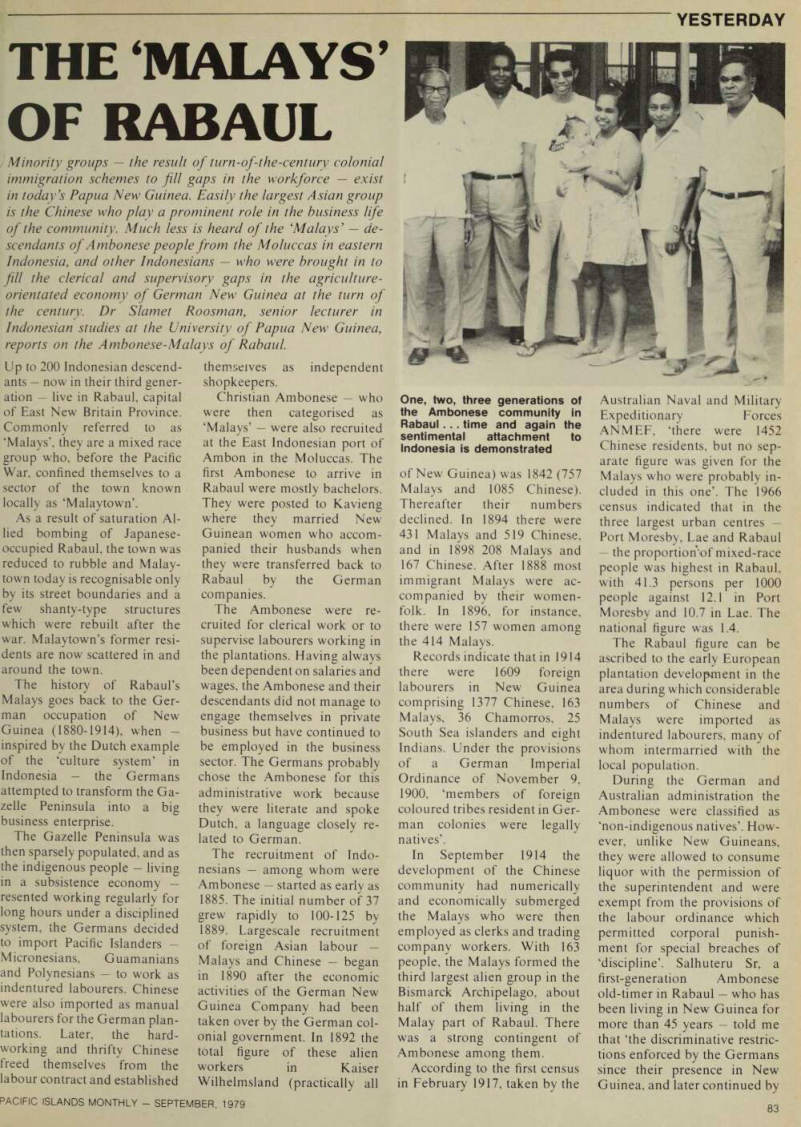
One, two, three generations of the Ambonese community in Rabaul ... time and again the sentimental attachment to Indonesia is demonstrated
the Australians, which were ap
plied to non-Europeans with
respect to their salaries, social
gatherings and drinking rights
in Rabaul, did not seem to be
strictly imposed on the
Ambonese group. The salary scale, for instance, was below the Europeans’ but above the locals’.’
In the fifties non-European and non-Melanesian groups started to establish their own clubs, among them the Chinese Taiping Club which was soon followed by the mixed-race Kambiu Club and the Ambonese Club. The different groups were asserting them selves as independent social groups in the Rabaul com munity. These moves were partly as a reaction against the
long-standing discriminative
policies pursued by both the German and Australian ad ministrations in New Guinea.
However, the development should mainly be seen as an as pect of growing group awareness and a desire for recognition of their group identity as their social and economic status in Rabaul
community grew.
These clubs are situated within the peripheries of Rabaul’s business centre, which is usually referred to as ‘Chinatown’, and provide their members with an after-work place for relaxation. For sev eral years now the clubs have catered not only for their own members but also for people of other racial extractions. Aus tralians, Germans and Papua New Guinean Tolais are now welcome in the clubs.
While drinking liquor was
prohibited to the local people, it was never strictly imposed on
the small Ambonese group, who reportedly, were even al lowed to enter the European clubs. The Ambonese showed me an old yellowed photo graph in which Rabaul Ambonese were dressed in light tropical suits with ties and shoes.
When, in 1953, the Aus tralian Government extended the possibility of Australian
citizenship through naturalis
ation to the mixed-race people of New Guinea, almost all Ambonese opted for Aus tralian citizenship. Henceforth their orientation was directed towards Australia: they sent their children there for edu cation and many bought houses in Australia to which to retire.
Until Papua New Guinea’s
independence in September
1975 they enjoyed a social and political status which was lower than the Australian’s but higher than the Papua New Guinean’s.
The Ambonese in Rabaul represent a close-knit group, unlike the mixed-race people in Port Moresby who have dispersed among other groups.
Second-generation Ambonese
tended to marry within their own group while, nowadays, quite a number of third generation Ambonese are mar ried to Australians. Otherwise, they associate freely with Europeans, Chinese and Melanesians.
Some can now rank them selves in the ‘middle-class’ in Papua New Guinea, their life style imitating much of that of
the average Australian expatri ate living in Papua New
Guinea. They wear European
dress, have cars and live comfortably in houses with accessories such as telephones, refrigerators and hot water sys tems. They eat European and Asian food as well as the daily Melanesian fare of kaukau (sweet potato), yam, taro and plantain. Their sports include Australian rugby and soccer
and they fish Melanesian-style
with throw-nets. They have
picnics on week-ends, enjoying
food prepared in a mumu, the traditional Melanesian earth oven. Although they have gen erally received Western edu
cation, they speak mainly in
pidgin.
All that is left of their Indonesian identity is their
pride in calling themselves
‘Ambonese’ and carrying Ambonese surnames such as Wattimena, Leimena, Siloy, Tahiya, Latumahina and Salhuteru; their Moluccan drinking songs; and their ability to prepare favourite Ambonese dishes.
First-generation and only a
few second-generation
Ambonese in Rabaul speak Moluccan-Malay or bahasa Indonesia (Indonesia’s national language). But their sentimen tal attachment to their ances tral homeland is, time and again, demonstrated when ships with Ambonese crew members aboard, call into Rabaul harbour. The Ambonese community in town invites the sailors ashore and entertains them in their club.
As Papua New Guinea’s independence approached, a
common feeling of insecurity
arose among the mixed-race
people and Chinese in Papua New Guinea that ‘there would be an upsurge of animosity, directed against non- Melanesians’. This caused a number of them to move to Australia and buy houses and businesses there.
As their suspicion turned out to be unfounded, most re turned to Papua New Guinea
after realising that, despite
having Australian passports, Papua New Guinea where they were born and raised was ‘so much more familiar than anywhere else’.
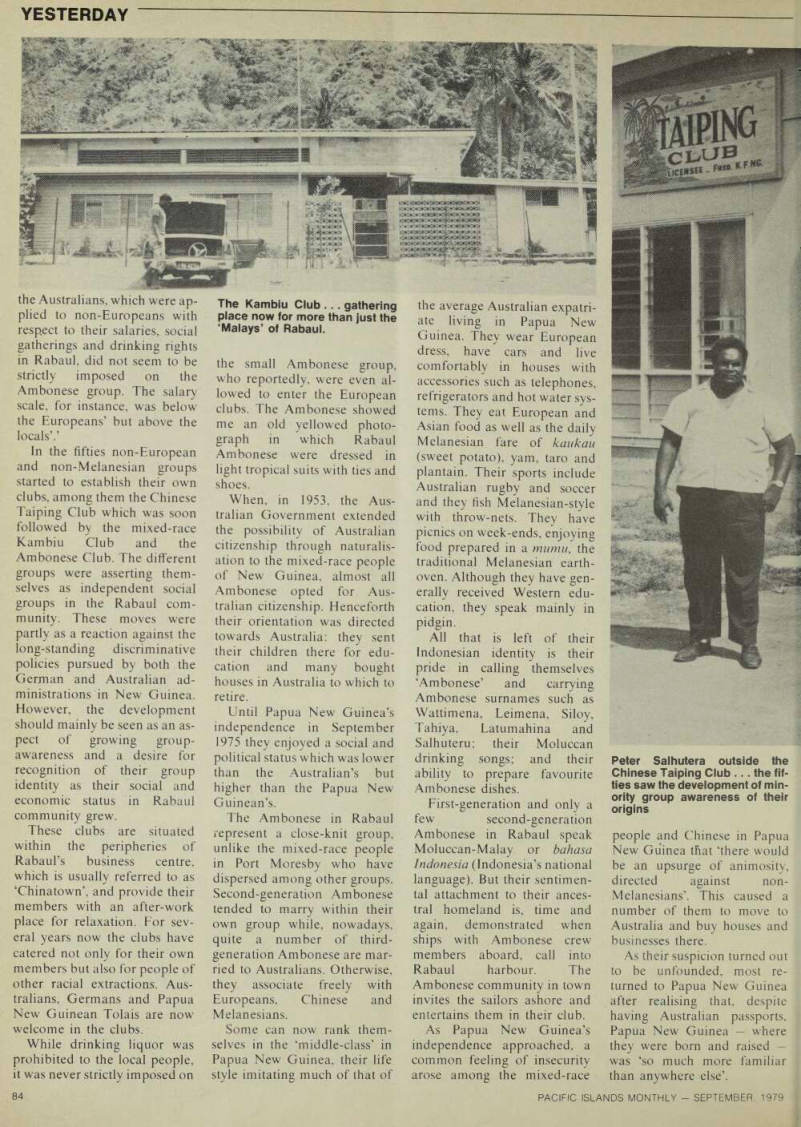
The Kambiu Club ... gathering place now for more than just the Malays’ of Rabaul.
Peter Salhutera outside the Chinese Taiping Club ... the fif ties saw the development of min ority group awareness of their
origins