are rearing Papua
p. 87 · Read in the full issue
Afterthoughts With Percy Chatterton
[?]ooze and money are rearing Papua New Guinea opart
is now 16 years since the situation in which non-nationals in apua New Guinea were allowed to drink intoxicating beverages hile nationals were forbidden to do so became untenable and as abandoned. At the time there were dire predictions about e horrors which would ensue when Papua New Guineans were lowed to drink, but they were not immediately fulfilled. On e whole, the people took their new freedom quietly and exer
ted it reasonably.
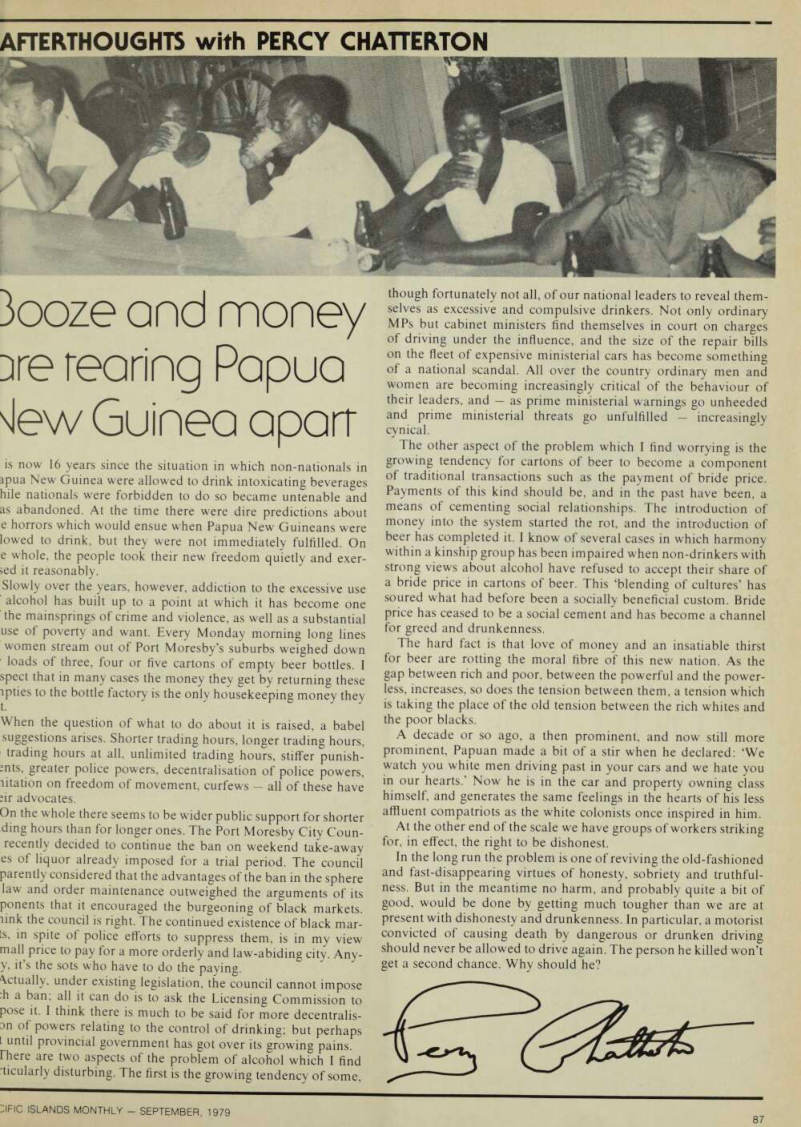
Slowly over the years, however, addiction to the excessive use alcohol has built up to a point at which it has become one the mainsprings of crime and violence, as well as a substantial use of poverty and want. Every Monday morning long lines women stream out of Port Moresby’s suburbs weighed down loads of three, four or five cartons of empty beer bottles. I sped that in many cases the money they get by returning these ipties to the bottle factory is the only housekeeping money they When the question of what to do about it is raised, a babel suggestions arises. Shorter trading hours, longer trading hours, trading hours at all, unlimited trading hours, stiffer punish ;nts, greater police powers, decentralisation of police powers, litation on freedom of movement, curfews all of these have fir advocates.
On the whole there seems to be wider public support for shorter ding hours than for longer ones. The Port Moresby City Coun recently decided to continue the ban on weekend take-away es of liquor already imposed for a trial period. The council parently considered that the advantages of the ban in the sphere law and order maintenance outweighed the arguments of its ponents that it encouraged the burgeoning of black markets, link the council is right. The continued existence of black mar ts, m spite of police efforts to suppress them, is in my view mall price to pay for a more orderly and law-abiding city. Any y, it s the sots who have to do the paying.
Actually, under existing legislation, the council cannot impose h a ban; all it can do is to ask the Licensing Commission to pose it. I think there is much to be said for more decentralis -3n of powers relating to the control of drinking; but perhaps t until provincial government has got over its growing pains, fhere are two aspects of the problem of alcohol which I find licularly disturbing. The first is the growing tendency of some,
though fortunately not all, of our national leaders to reveal them selves as excessive and compulsive drinkers. Not only ordinary MPs but cabinet ministers find themselves in court on charges of driving under the influence, and the size of the repair bills on the fleet of expensive ministerial cars has become something of a national scandal. All over the country ordinary men and women are becoming increasingly critical of the behaviour of their leaders, and as prime ministerial warnings go unheeded and prime ministerial threats go unfulfilled - increasingly
cynical.
The other aspect of the problem which I find worrying is the growing tendency for cartons of beer to become a component of traditional transactions such as the payment of bride price.
Payments of this kind should be, and in the past have been, a means of cementing social relationships. The introduction of money into the system started the rot, and the introduction of beer has completed it. I know of several cases in which harmony within a kinship group has been impaired when non-drinkers with strong views about alcohol have refused to accept their share of a bride price in cartons of beer. This ‘blending of cultures’ has soured what had before been a socially beneficial custom. Bride price has ceased to be a social cement and has become a channel for greed and drunkenness.
The hard fact is that love of money and an insatiable thirst for beer are rotting the moral fibre of this new nation. As the gap between rich and poor, between the powerful and the power less, increases, so does the tension between them, a tension which is taking the place of the old tension between the rich whites and the poor blacks.
A decade or so ago, a then prominent, and now still more prominent, Papuan made a bit of a stir when he declared: ‘We watch you white men driving past in your cars and we hate you in our hearts.’ Now he is in the car and property owning class himself, and generates the same feelings in the hearts of his less affluent compatriots as the white colonists once inspired in him.
At the other end of the scale we have groups of workers striking for, in effect, the right to be dishonest.
In the long run the problem is one of reviving the old-fashioned and fast-disappearing virtues of honesty, sobriety and truthful ness. But in the meantime no harm, and probably quite a bit of good, would be done by getting much tougher than we are at present with dishonesty and drunkenness. In particular, a motorist convicted of causing death by dangerous or drunken driving should never be allowed to drive again. The person he killed won’t get a second chance. Why should he?