Sailing through
pp. 80-81 · Read in the full issue
time with David Lewis
The Voyaging Stars - Secrets of the Pacific Island Navigators by Davis Lewis. Published by Collins, Sydney and London. 1978 $ A 8.95.
Over the past decade David Lewis has revived ancient
myths and legends of seafaring
in the Pacific by precept and
practice, by research and by
writing. His previous book on the same subject. We, the Navigators, was a big-seller. The Voyaging Stars contains much material from his previous writings. Lewis writes well and
uses very good photographs
and clear diagrams to illustrate the historical background of canoes and methods of navi-
gation.
The primitive arts of sea-
manship and navigation used
two and three thousand years ago have practical uses today in remote parts of the Islands, and, despite modifications derived from European vessels from 1500 onward, details of
early boatbuilding linger on.
Being an experienced
yachtsman, David Lewis gives
us reliable observations of the manner in which canoes of various types and sizes are sailed and steered. He has sailed in many of them in open ocean in all weathers. His accounts of the ancient types of navigation without instruments, still being used, are very convincing. A lot written on
this subject, often by
Americans and New Zealanders, has made unsubstandated claims of unbelievable
accuracy of steering, position-
finding and landfalls achieved,
precision claimed to be greater than that achieved by modern European vessels. But that was before David Lewis came
along. Basing his writings on
facts and observation. Lewis offers proof that long distance navigation over the open ocean without chart, compass, or sex tant, was practicable by tra ditional methods he found still in use, or at least still remem bered by a few guardians of the esoteric secrets of their ances tors.
Lewis’ involvement in the subject is told in a happy blend
of history, legend, research,
theory and personal anecdote, The story covers a very wide canvas of space and time, all in a book of 208 pages without any signs of pressure or strain to achieve the impossible. But, of course, this remarkable author is no stranger to the im possible, as most of his projects seem to have been against all the odds, Lewis writes about several systems of traditional navi gation: the use of rising and setting stars for steering a known course; the location of an island by getting the correct star in the zenith, at the same
time correcting course by
closely observing swell and
currents; achieving landfall by
observing the colour of clouds over an island while still up to 50 kilometres distant and out of sight of land, and by watching
land-based birds flying out to sea at dawn and returning at dusk.
The methods of teaching these arts sometimes involved the use of aids, one form of which became known as the ‘stick-chart’ of the Marshall Islands. This taught, and later reminded, the navigator of the pattern made by the ocean swell when its direction had been deflected by an island out of sight, and by the combi nation of different swells as well as reflected swells and waves from an island. Another
device, probably unique, was
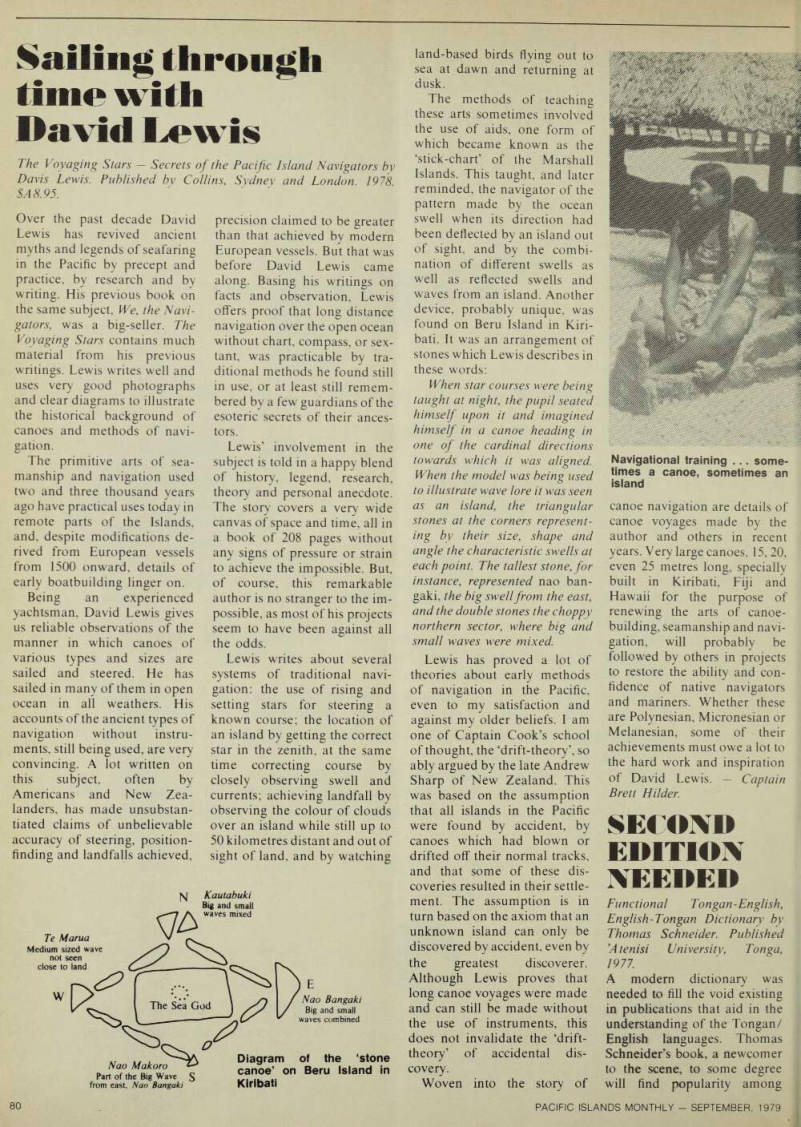
found on Beru Island in Kiri bati. It was an arrangement of stones which Lewis describes in these words: When star courses were being taught at night, the pupil seated himself upon it and imagined himself in a canoe heading in one of the cardinal directions towards which it was aligned.
When the model was being used to illustrate wave lore it was seen as an island, the triangular stones at the corners represent ing by their size, shape and angle the characteristic swells at each point. The tallest stone, for instance, represented nao ban gaki, the big swell from the east, and the double stones the choppy northern sector, where big and small waves were mixed.
Lewis has proved a lot of theories about early methods of navigation in the Pacific, even to my satisfaction and against my older beliefs. I am one of Captain Cook’s school of thought, the ‘drift-theory’, so
ably argued by the late Andrew
Sharp of New Zealand. This was based on the assumption that all islands in the Pacific were found by accident, by canoes which had blown or drifted off their normal tracks, and that some of these dis coveries resulted in their settle ment. The assumption is in turn based on the axiom that an unknown island can only be discovered by accident, even by the greatest discoverer.
Although Lewis proves that long canoe voyages were made and can still be made without the use of instruments, this does not invalidate the ‘drift theory’ of accidental dis covery.
Woven into the story of
canoe navigation are details of canoe voyages made by the author and others in recent years. Very large canoes, 15,20, even 25 metres long, specially built in Kiribati, Fiji and Hawaii for the purpose of renewing the arts of canoe
building, seamanship and navi
gation, will probably be
followed by others in projects to restore the ability and con fidence of native navigators and mariners. Whether these are Polynesian, Micronesian or Melanesian, some of their achievements must owe a lot to the hard work and inspiration of David Lewis. Captain Brett Milder.
Second
Edition
Needed
Functional Tongan- English, English-Tongan Dictionary by Thomas Schneider. Published *A tenisi University, Tonga, 1977.
A modem dictionary was needed to fill the void existing in publications that aid in the
understanding of the Tongan/
English languages. Thomas
Schneider’s book, a newcomer to the scene, to some degree will find popularity among
Navigational training ... some
times a canoe, sometimes an island
those wishing to expand their knowledge of either language, although I doubt if it fills that void in its present form.
The dictionary is divided into three sections: Ton
gan/English, English/Tongan
and a specialised vocabulary
with 25 sub-sections under headings such as, medicine, bi
ology, engineering, electronics,
fishing, law, etc. Indeed a great deal of thought and consider ation have gone into the publi cation and the reader will find it an easy reference.
As mentioned in the fore word, 2000 most frequent Ton gan words are used, yet in the English/Tongan section, half of the months of the year, and a couple of days of the week, are not listed at all. Schneider goes on to say that the dic
tionary was compiled under
extreme time pressure and financial strain, and it is quite probable that it contains many errors. A dictionary would be better not published if pre pared under these conditions.
The production of the dic tionary is quite poor, with the printing the main offender.
Schneider’s dictionary is cer tainly no ‘Oxford’, yet it is an honest attempt to satisfy a real need. Hopefully a second edition will tidy up the errors and omissions, do away with the excuses, and improve on
the printing quality. Then
Schneider will have a first class
publication.
With all its faults, it is still a worthwhile publication, and due credit should be given to Thomas Schneider for doing something constructive in this neglected area. - Fatal Moun
gaafi Slender.
whom:
For The
Ke4 Oku
Record collectors of South Pa cific music will find Polynesian Dances of Bel lona (Mungiki) Solomon Islands a valuable ad dition to their disc racks. An eight page folder with the disc gives adequate details of the re lated geographical, historical and musical background to the songs.
The record highlights a pocket of Polynesian culture in
Books
Melanesian surrounds where the singers have the gift of maintaining a high level of vocal presentation while danc ing. Reproduction of the music of such a mobile team of artists in stereo has been admirably achieved by Jane Mink Rossen and Hugo Zemp without any loss of song quality as the per formers move to and from the
microphones.
Sea sagas predominate in the collection which can reach back 600 years and rhythmic accompaniment comes mainly from hand clapping or a sound ing board (papa) beaten by an alternate two-handed drum
ming action.
The collectors of these dance songs have generously, but cor rectly, recorded the names of the Bellonese people who gave a range of assistance to making such a project possible. How ever, credit is primarily due to the elders of not only these Bellonese, but all Pacific Islanders who have tenaciously preserved their traditional music against a host of introduced prohibitions and detractions. National indepen dence has also been a great incentive for Pacific Islanders wishing to preserve their
soundways.
Support for the production and distribution of the disc has come from well-established folk music institutes in Europe and America and it is presented for sale as number FE 4274 by Ethnic Folkways Records. —
Ray Sheridan.