The Japanese
pp. 65-67 · Read in the full issue
French Polynesia
The Japanese are comingbut when?
The Japanese remain some thing of a mystery to the Polynesians of Tahiti, writes Marie-Therese Danielsson.
They certainly have no stereo type, either positive or nega tive.
Between 1911 and 1935 a number of Japanese workers
were engaged for phosphate
mining on Makatea in the Tuamotu group but their num bers never exceede i 250 and they were not allowed to visit other islands.
The war came and went and
Polynesians were only told
about the Japanese enemy never saw him and the propaganda image of the kamikaze warrior quickly faded.
The arrival of the first
Japanese fishing boats, quite
predictably, created some resentment. There were fears that French Polynesian oceans would be fished out, there have been frequent incursions which have gone unpunished
by foreign fishing boats, and
the fears have heightered.
But when it comes to the impact of the individual Japanese fisherman who comes in to Papeete for rest and rec reation? Really! There is none.
So many thousands of
foreigners, all strangers, pul
sate through the streets of Papeete, fill its bars and clubs at night, that a few dozen Japanese sailors who are not
big spenders anyway are
barely noticed.
Japanese tourists in Tahiti when they are able to get here do not receive much more attention except that they usually turn up in tour groups which, of course, need some
organising.
The first organised effort to
bring Japanese hoh iaymakers
to Papeete was ma< e in April 1974 when Air France began a Tokyo-Papeete service. In that year Air France brought in 5202 Japanese, most of them
honeymooners who, above all, wanted to be left alone. By and large the Japanese seemed to converge on the huge hotel at Borabora.
Local tourist agencies had barely got around to supplying these youthful tourists with what they wanted most a chapel where they could get married again according to ‘native custom’ when Air
France dropped its Tokyo-
Papeete-Lima (Peru) service.
It wasn’t that Air France
wasn’t getting satisfactory
loadings. It was simply an economy move to help pay for its losses on the newly introduced Concorde services from Europe.
That happened in January 1977, a time when Japanese investors were seriously interested in hotel develop ment.
A Japanese company has even bought the site of the for mer Hotel Taaone, just outside Papeete, but after a few years of inconclusive negotiations it was more or less forced to sell the site to the Pirae munici pality.
There also was a lot written and talked about a 500-room
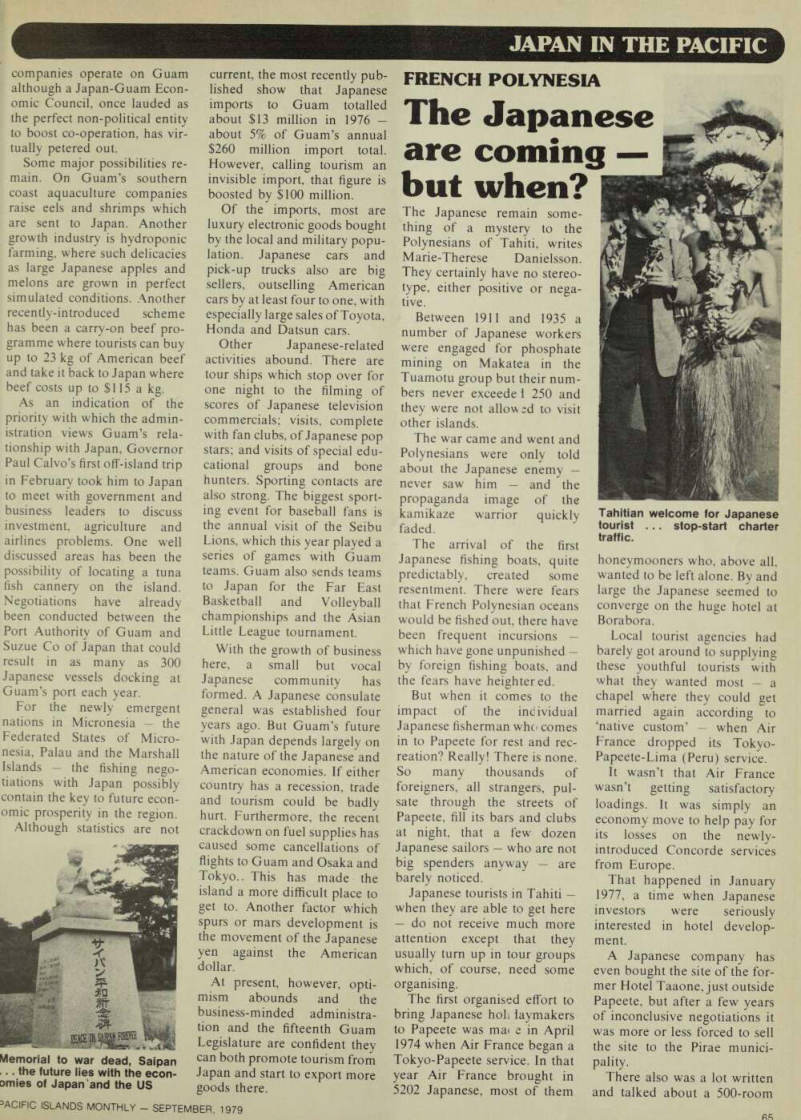
Tahitian welcome for Japanese tourist ... stop-start charter traffic.
complex to be built next to the Atimaono golf course. The idea was to encourage Japanese golf fanatics, sick of barely being able to squeeze on to their own fairways at home, to come to the wide open spaces of Tahiti. Although that scheme did not get off the ground it has not been forgot ten and it will be revived if ever French Polynesia wins control of civil aviation. At the mo ment all decisions rest with Paris.
There was something of a breakthrough on the tourist front this year when Japan Air Lines organised charters through Hawaii. But the results were disappointing. Of 19 an ticipated charters in April and
May, only 13 arrived, bringing
about 1500 tourists. It had been hoped they would stay 5-7
days; instead they stayed only
4-5 days.
A second charter season
September-October was
being discussed by JAL and the local tourist bureau.
Japanese tourists to French Polynesia numbered 3311 in 1973, 5202 in 1974, 4792 in 1975,4114 in 1976,2739 in 1977 and 2181 last year.
While Japanese visitors are few and far between, there’s plenty of evidence of Japanese technology and it shows viv
idly in import-export figures.
Last year Japanese sales to
French Polynesia were valued
at SAII.I million against
French Polynesia sales to
lapan of $648 112. In the pre vious year Japanese sales were 510.2 million and French Polynesia sales only $69 460.
Lhe improvement in French
Polynesia’s performance last
was a result of much larger ;ales of cultured pearls to
lapan.
Cars, trucks, tractors and notorcycles head the list of apanese imports. But, in these
French Polynesia imports from Japan
categories, total sales dropped from $3.6 million in 1977 to $2.7 million last year. Against 198 Japanese cars imported in 1977, only 91 were imported last year. Comparable figures for trucks and motorcycles were 645 (360) and 421 (175)
respectively.
It seemed that the 1977 in fatuation with cheaper Japanese vehicles gave way in 1978 to a return to favour of more expensive French vehicles. As well, the French vehicle trade in Papeete is much better organised than for other vehicles.
Sales of Japanese electrical and electronic goods are increasing, up from $l.B million in 1977 to $2.2 million last year. Sound equipment and musical instrument sales of $530 000 in 1977 increased to $670 000 last year. Photo graphic equipment remained steady with sales $585 000 in 1977 and $5BO 000 last year.
The 2113 Japanese cameras imported in 1977 represented 57% of all camera imports.
Japanese textiles are becom ing more popular and food
imports, mostly canned fish,
are growing.
Most Japanese goods are
brought to Papeete by
Japanese vessels. In 1977 14 vessels delivered about 3800 tonnes and loaded about 1700 t. Last year, eight vessels delivered about 19001 and loaded about 1500 t.
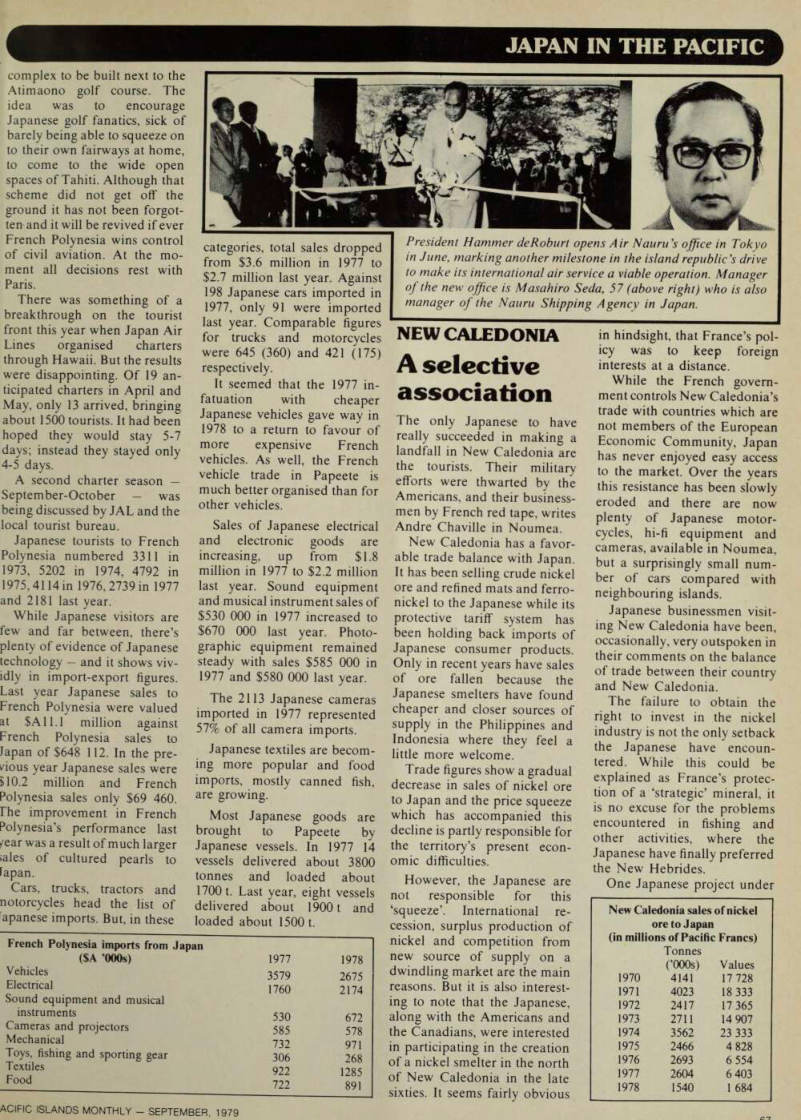
President Hammer deßoburt opens Air Nauru’s office in Tokyo in June, marking another milestone in the island republic’s drive to make its international air service a viable operation. Manager of the new office is Masahiro Seda, 57 (above right) who is also manager of the Nauru Shipping Agency in Japan.
($A ’Ooos)
1977 1978 Vehicles 3579 2675 Electrical 1760 2174 Sound equipment and musical instruments 530 672 Cameras and projectors 585 578 Mechanical 732 971
Toys, fishing and sporting gear
306 268 Textiles 922 1285 Food 722 891