A selective
pp. 67-69 · Read in the full issue
New Caledonia
A selective association
The only Japanese to have really succeeded in making a landfall in New Caledonia are the tourists. Their military efforts were thwarted by the Americans, and their business men by French red tape, writes Andre Chaville in Noumea.
New Caledonia has a favor able trade balance with Japan.
It has been selling crude nickel ore and refined mats and ferro nickel to the Japanese while its protective tariff system has been holding back imports of Japanese consumer products.
Only in recent years have sales of ore fallen because the Japanese smelters have found cheaper and closer sources of supply in the Philippines and Indonesia where they feel a little more welcome.
Trade figures show a gradual decrease in sales of nickel ore to Japan and the price squeeze which has accompanied this decline is partly responsible for the territory’s present econ omic difficulties.
However, the Japanese are not responsible for this ‘squeeze’. International re
cession, surplus production of
nickel and competition from new source of supply on a dwindling market are the main reasons. But it is also interest ing to note that the Japanese, along with the Americans and the Canadians, were interested in participating in the creation of a nickel smelter in the north of New Caledonia in the late sixties. It seems fairly obvious
in hindsight, that France’s pol
icy was to keep foreign
interests at a distance.
While the French govern ment controls New Caledonia’s trade with countries which are not members of the European
Economic Community, Japan
has never enjoyed easy access to the market. Over the years this resistance has been slowly eroded and there are now plenty of Japanese motor cycles, hi-fi equipment and cameras, available in Noumea, but a surprisingly small num ber of cars compared with
neighbouring islands.
Japanese businessmen visit ing New Caledonia have been, occasionally, very outspoken in their comments on the balance of trade between their country and New Caledonia.
The failure to obtain the right to invest in the nickel industry is not the only setback the Japanese have encoun tered. While this could be explained as France’s protec tion of a ‘strategic’ mineral, it is no excuse for the problems encountered in fishing and other activities, where the Japanese have finally preferred the New Hebrides.
One Japanese project under
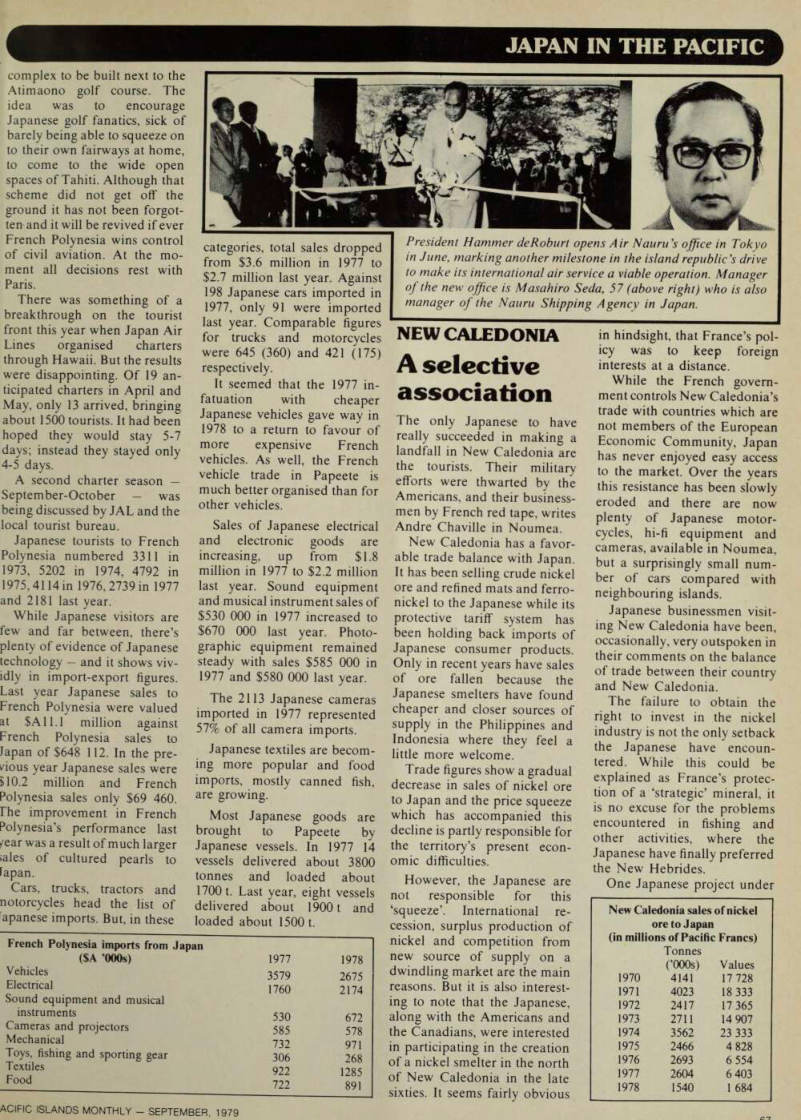
New Caledonia sales of nickel ore to Japan (in millions of Pacific Francs)
Tonnes (’000s) Values 1970 4141 17 728 1971 4023 18 333 1972 2417 17 365 1973 2711 14 907 1974 3562 23 333 1975 2466 4 828 1976 2693 6 554 1977 2604 6 403 1978 1540 1 684
way in New Caledonia, Mitsu bishi’s eucalyptus oil pro duction, has been set back by a bush-fire which wiped out a large part of the plantation.
As a French territory, New Caledonia’s economy is in fact an element of the total national resources. When the trading balance is unfavourable, France pays the bill; when exports go up, France collects
the foreign exchange. Thus,
from France’s point of view.
New Caledonia is just a small part of total trade with
Japan.
For the same reasons. New Caledonia does not seek Japanese investments. The French authorities, without
openly discouraging foreign
investment, prefer to see their own companies active in the
territory.
Meanwhile, the Japanese are
becoming an important el
ement in the territory’s tourist trade. The weekly flight be tween Tokyo and Noumea was paying dividends until the DC 10 problems, and the French Bureau of Tourism’s agency in Toyko was working on selling the territory. Because of the costly ceremonies of a Japanese wedding, many have been flying to Noumea for a
wedding and honeymoon.
New Caledonia has also been favoured, because of its lagoons and blue skies, for
shots for Japanese fashion
magazines and leaflets for Japanese cosmetic manufac turers.
The casino is also a popular
attraction and Japanese players
gamble heavily. Miss New
Caledonia 1978 received, as part of her prize, a trip to
Tokyo.
The conclusion is obvious: in New Caledonia, the yen is very popular but under strict con trol.
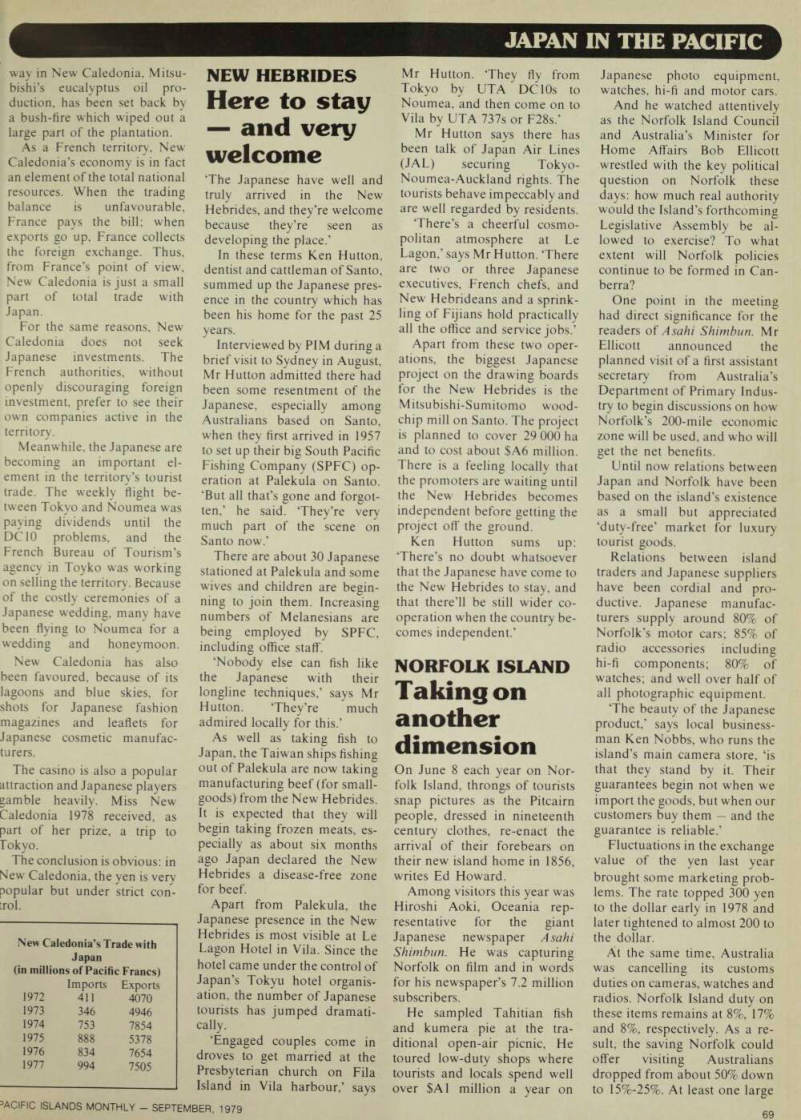
New Caledonia’s Trade with Japan (in millions of Pacific Francs)
Imports Exports
1972 411 4070 1973 346 4946 1974 753 7854 1975 888 5378 1976 834 7654 1977 994 7505