been better
pp. 61-65 · Read in the full issue

Guam
Ties never been better
Three hours south of Tokyo by air, the American territory of Guam has has a love-hate re lationship with Japan for much of the twentieth century, writes Paul Addison from Agana.
Occupied by Japan between
1941 and 1944 Guam has long since buried most of the sores which festered during that viol
ent period.
Today the productive re
lationship between the two countries has never been stronger. The realisation by most Guamanians that Japanese influence on the
island is financially rewarding
to both parties has spawned a string of joint business oper ations which rank among Guam’s most successful ven tures.
Nowhere is the Japanese in fluence so strong as in the island’s tourist industry.
Japanese tourists constitute the bulk of visitors to Guam. More than 150 000 a year have vaca tioned on Guam in the past five years and their spending estimated at SUSIOO million in 1978 boosts Government of Guam taxes as well as employ ment and island leisure activi ties. Without Japanese tourists Guam today would have no major hotels on Turnon Bay and perhaps a third of the businesses would leave.
Says Martin Pray, outgoing
general manager of the Guam visitors Bureau: Guam is one of Japan’s oldest post-war des tinations 12 years and re newed enthusiasm for Guam is probably, like the fashion industry, based on the benefits of dusting off an oldie but goodie and putting it back on the front shelf. Let there be no mistake. Japan has been and always will remain the prime market for tourists to Guam.’
According to recent stat istics, some 20% of total government revenues are generated by the tourism
industry, mostly from Japan.
Japanese visitors are largely
honeymooners here for three
nights and four days, and single
young persons seeking fun and sun on this tropical island. Dur ing the day they sit on beaches on Turnon Bay, tour the island in air conditioned buses owned by Japanese companies and visit duty free shops where shop assistants are required to speak Japanese.
In these 30 and 40 luxury shops the tourist can buy such goods as Christian Dior,
Givenchy, Nancy Greer
women’s clothing, fashionable accessories by Gucci, Charles Jourdin and Roberta Di Camerio, and top quality fragrances from Chanel, Hermes, Nina Ricci and Madame Rochas. Others visit
out-of-the-way sights on ‘Pa
cific Safari’ jeeps, such as the jungle cave where Shoichi Yokoi of the Japanese Imperial Army hid for 33 years after the war. Still others go their own way, renting mopeds and ve hicles from Nippon Rent-A-
Car and Japan Rent-A-Car.
The latter is a division of Fukada Enterprises which also runs a marriage service for Japanese tourists.
Most of Guam’s major luxury hotels are partly-owned by the Japanese. Even their names the Okura and Dai Ichi, for instance reflect their ethnic origin. The tourists arrive from Osaka and Japan on daily Japan Air Lines and Pan American flights filled by a small cadre of wholesale tour companies such as Diamond Tour, JALPAK, Look-JTB,
Mach, Toptour, Holiday Tour
and Japan Creative Tours.
Their interests are catered to by a Japan-Guam Tourism Com mittee formed in November 1976. Guam Visitors Bureau also has maintained a fully staffed office in Tokyo for more than three years.
In the past 12 months Guam’s hotels have reported occupancy rates of more than 70% and increased profi
tability.
Besides the tourist industry a number of Japanese
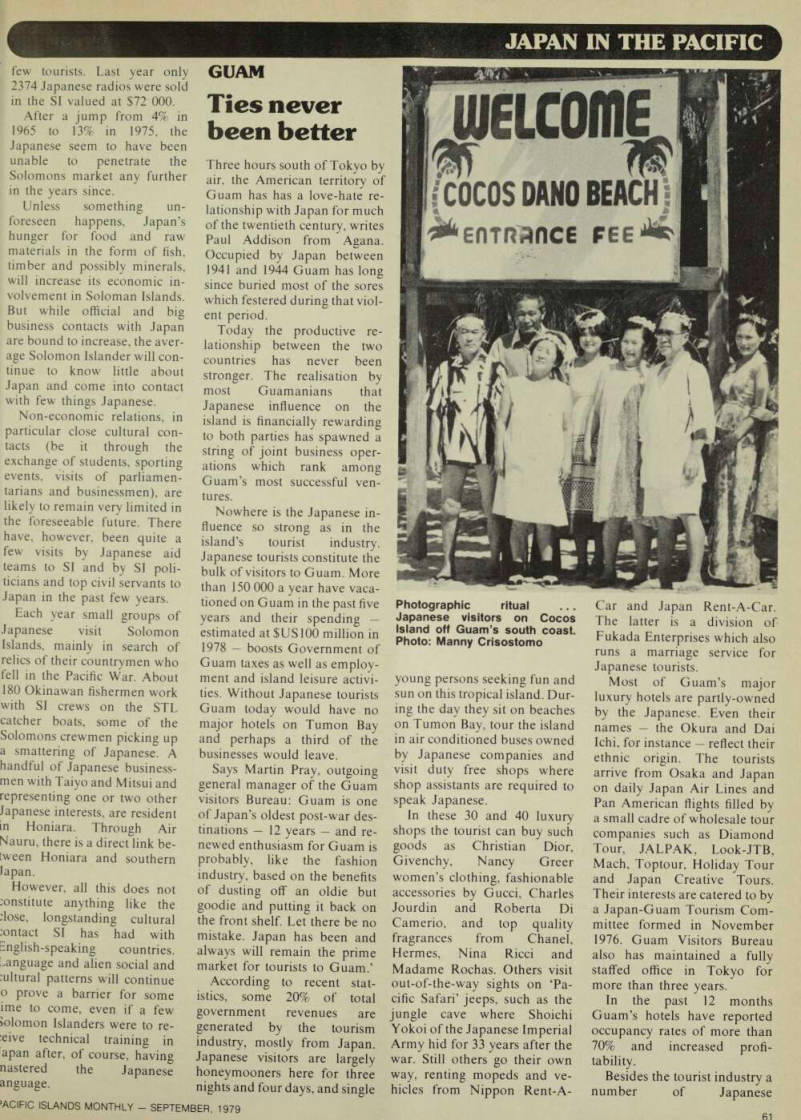
Photographic ritual Japanese visitors on Cocos Island off Guam’s south coast.
Photo: Manny Crisostomo
companies operate on Guam although a Japan-Guam Econ omic Council, once lauded as the perfect non-political entity to boost co-operation, has vir tually petered out.
Some major possibilities re main. On Guam’s southern coast aquaculture companies raise eels and shrimps which are sent to Japan. Another
growth industry is hydroponic
farming, where such delicacies as large Japanese apples and melons are grown in perfect simulated conditions. Another
recently-introduced scheme
has been a carry-on beef pro gramme where tourists can buy up to 23 kg of American beef and take it back to Japan where beef costs up to $ll5 a kg.
As an indication of the priority with which the admin istration views Guam’s rela tionship with Japan, Governor Paul Calvo’s first off-island trip in February took him to Japan to meet with government and business leaders to discuss investment, agriculture and airlines problems. One well discussed areas has been the possibility of locating a tuna fish cannery on the island.
Negotiations have already been conducted between the Port Authority of Guam and Suzue Co of Japan that could result in as many as 300 Japanese vessels docking at Guam’s port each year.
For the newly emergent nations in Micronesia the Federated States of Micro nesia, Palau and the Marshall Islands the fishing nego tiations with Japan possibly contain the key to future econ omic prosperity in the region.
Although statistics are not
current, the most recently pub lished show that Japanese imports to Guam totalled about $l3 million in 1976 about 5% of Guam’s annual $260 million import total.
However, calling tourism an invisible import, that figure is boosted by $lOO million.
Of the imports, most are luxury electronic goods bought by the local and military popu lation. Japanese cars and pick-up trucks also are big sellers, outselling American cars by at least four to one, with especially large sales of Toyota, Honda and Datsun cars.
Other Japanese-related activities abound. There are tour ships which stop over for one night to the filming of scores of Japanese television commercials; visits, complete with fan clubs, of Japanese pop stars; and visits of special edu cational groups and bone hunters. Sporting contacts are also strong. The biggest sport ing event for baseball fans is the annual visit of the Seibu Lions, which this year played a series of games with Guam teams. Guam also sends teams to Japan for the Far East Basketball and Volleyball championships and the Asian Little League tournament.
With the growth of business here, a small but vocal Japanese community has formed. A Japanese consulate general was established four years ago. But Guam’s future with Japan depends largely on the nature of the Japanese and American economies. If either country has a recession, trade and tourism could be badly hurt. Furthermore, the recent crackdown on fuel supplies has caused some cancellations of flights to Guam and Osaka and Tokyo.. This has made the island a more difficult place to get to. Another factor which spurs or mars development is the movement of the Japanese yen against the American dollar.
At present, however, opti mism abounds and the business-minded administra tion and the fifteenth Guam
Legislature are confident they
can both promote tourism from Japan and start to export more goods there.
Memorial to war dead, Saipan ... the future lies with the econ omies of Japan and the US