Co-Operation
pp. 56-61 · Read in the full issue

Solomon Islands
Fishing The Pivot
Of Growing
Co-Operation
Japan has been a major export market for Solomon Islands copra since 1963 and for timber since the late sixties. Sizable direct Japanese investment began in the early seventies but Tokyo's official aid programme started only last year, writes Irene Hawkins in Honiara.
Since its inception in late 1972, Solomon Taiyo Limited (STL), a fishing and canning company jointly owned by the Solomon Islands Government and the Taiyo fishing group, has un doubtedly been the pivot of
Japanese-Solomon Islands
economic relations. Not only has it accounted for over a quarter of all the archipelago’s exports in recent years, it also represents a major chunk of foreign investment (in the order of SSI 7 million in long and short term funds from
Japan).
STL plays an important role in both local food supplies and the innovation of local fishing methods. As one of the biggest employers in the country, with around 800 Solomon Islanders on its payroll, the company has paid over $3 million in both wages and export duties in the past three years. In return for a 25% government stake (which the Government has recently increased to 49%) STL enjoys exclusive fishing rights in the Solomon Islands 12-mile zone, particularly the fish-rich ‘Slot’ between the two chains of islands. Working relations bet wen the STL partners have
been generally good.
Last year the STL catcher fleet of more than 20 boats, manned by a mixed crew of Okinawans and Solomon Islanders, caught 18 200 tonnes of mainly skipjack tuna. Over the past three years, catches
averaged 14 5001 annually.
About 75% of the catches have been sold as frozen fish, mainly to American canneries in American Samoa, Guam, Puerto Rico and the United States. However, last year the export of frozen fish was an up hill job because of the world wide fish glut. With the price
per tonne of frozen fish drop ping from an average of $620 in 1977 to only $5OO last year, STL made a big loss as did
many fishing companies
around the world.
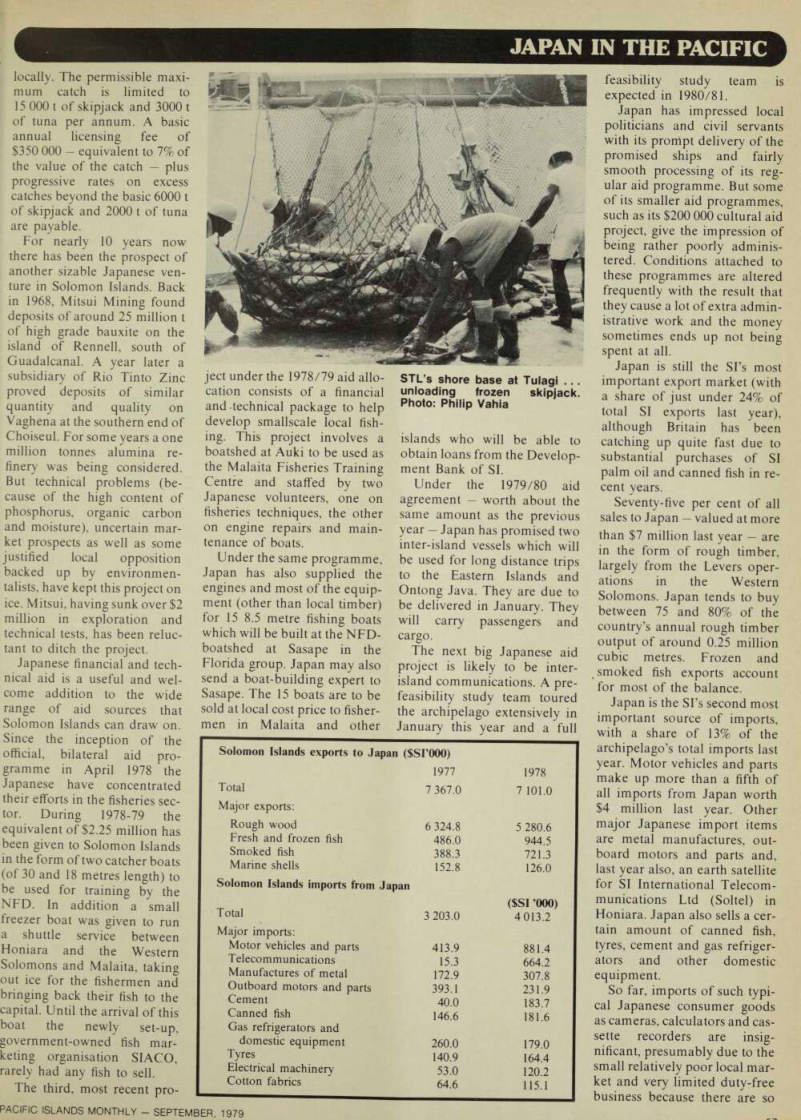
In the face of declining sales to its traditional markets for frozen fish, STL tried to push sales to Japan. It almost doubled its sale of frozen fish to Japan (to nearly $1 million) and smoked over 1000 t of fish, which it sells as arabushi in Japan. At the same time STL processed about 1800 t of raw fish in its cannery at Tulagi in the Florida Islands.
This year STL hopes to run the cannery nearer to its full ca
pacity, processing 2500-2800 t
of raw fish. Unlike raw fish prices, those for canned fish, which goes largely to European consumers, have remained .(and are likely to remain) stable.
The company is expecting a
better performance this year and hopes to wipe out some of its accumulated losses, its expanded catcher fleet of 25 boats (two were recently given under Japanese aid to the National Fisheries Develop ment Company which operates the boats and sells the catch to STL) should haul in around 21 000 t of fish. The world mar ket price for raw fish is expected to recover by about $6O per tonne.
A small part of the fish that was sent to Japan last year was
high ms7?/m/-quality tuna that
had been caught by longlining,
a fishing method new to Solomon Islands that STL introduced last September. If this pilot project continues to bring in good catches the company hopes for about 700 t of yellowfin and big-eye tuna this year the Japanese mar ket could become an
increasingly important outlet
for Solomon Island fish.
The next few years also are likely to see the construction of a second, modern cannery, probably four times the size of the Tulagi plant, at Noro, an
important new development
area with a deep water harbour in the Western Solomons on New Georgia Island. The final
feasibility study for this project
was due to be submitted to the government at the end of July.
Noro has already got substan tial freezing facilities and
serves as a second shore base besides Tulagi. For some time now the company has been looking at possible sites for a third shore base. But a survey of the Shortlands for this pur pose has proved this area not
commercially viable.
After negotiations in May, STL’s partners decided to put their company on a firmer financial basis in preparation for its expansionary plans. Its share capital was doubled to $2 million with the Government
Shareholding Agency increas
ing its stake to 49%. STL has also undertaken to speed up the training of Solomon Islanders in order to localise more senior positions in STL as well as improve living con ditions of employees.
It is envisaged that by 1982, when the present joint venture agreement expires, STL should have expanded the catcher fleet to 35 boats in conjuction with the NFD. Eleven of the boats would be owned by STL, another 10 by NFD, which will build and operate the boats, use STL shore facilities and sell its fish to STL. There should also be four freezer-catcher boats, owned either by STL or NFD, while the remaining 10 boats would be on charter.
In close co-operation with the NFD (in which STL holds a 25% stake) and the Japanese Government, STL is playing a pivotal role in establishing a
flourishing locally-owned fish
ing industry, where local
fishermen, partly trained by
STL and Japanese experts, sent under Japanese aid, will fish from modern locally-built boats.
Solomon Islands is fortunate to own one of the richest fish ing grounds in the Pacific and the government is trying to ensure that these riches are first
and foremost exploited by
locaL fishermen, NFD and
Stl.
Last September it signed a fisheries licensing agreement with Japan, under which Japanese catcher boats (other than STL) are allowed to catch only surplus fish over and above what can be caught
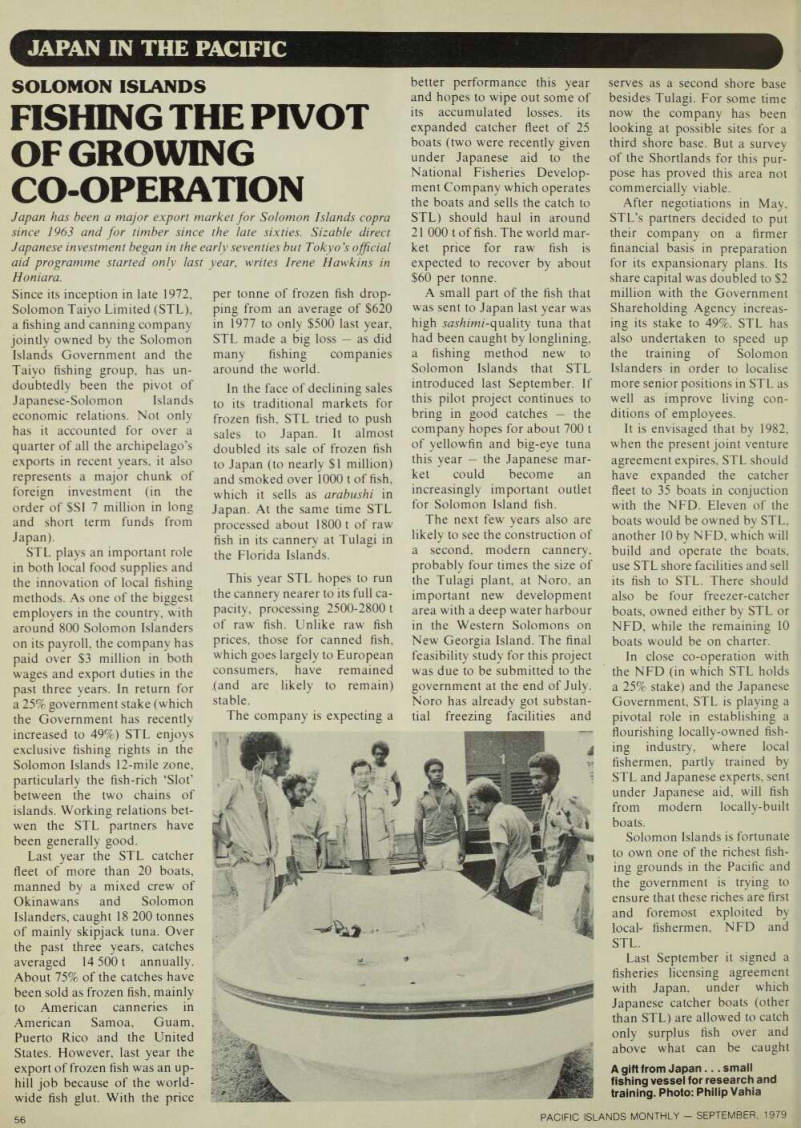
A gift from Japan...small fishing vessel for research and training. Photo: Philip Vahia
locally. The permissible maxi
mum catch is limited to 15 000 t of skipjack and 3000 t of tuna per annum. A basic annual licensing fee of $350 000 equivalent to 7% of the value of the catch plus progressive rates on excess catches beyond the basic 6000 t of skipjack and 2000 t of tuna are payable.
For nearly 10 years now there has been the prospect of another sizable Japanese ven ture in Solomon Islands. Back in 1968, Mitsui Mining found deposits of around 25 million t of high grade bauxite on the island of Rennell, south of Guadalcanal. A year later a subsidiary of Rio Tinto Zinc
proved deposits of similar
quantity and quality on
Vaghena at the southern end of Choiseul. For some years a one million tonnes alumina re
finery was being considered.
But technical problems (be cause of the high content of
phosphorus, organic carbon
and moisture), uncertain mar ket prospects as well as some
justified local opposition
backed up by environmen talists, have kept this project on ice. Mitsui, having sunk over $2 million in exploration and technical tests, has been reluc tant to ditch the project.
Japanese financial and tech nical aid is a useful and wel come addition to the wide range of aid sources that Solomon Islands can draw on.
Since the inception of the official, bilateral aid pro gramme in April 1978 the Japanese have concentrated their efforts in the fisheries sec tor. During 1978-79 the equivalent of $2.25 million has been given to Solomon Islands in the form of two catcher boats (of 30 and 18 metres length) to be used for training by the NFD. In addition a small freezer boat was given to run a shuttle service between Honiara and the Western Solomons and Malaita, taking out ice for the fishermen and bringing back their fish to the capital. Until the arrival of this boat the newly set-up, government-owned fish mar
keting organisation SIACO,
rarely had any fish to sell.
The third, most recent pro-
ject under the 1978/79 aid allo cation consists of a financial and technical package to help develop smallscale local fish ing. This project involves a boatshed at Auki to be used as the Malaita Fisheries Training Centre and staffed by two Japanese volunteers, one on fisheries techniques, the other on engine repairs and main tenance of boats.
Under the same programme, Japan has also supplied the engines and most of the equip ment (other than local timber) for 15 8.5 metre fishing boats which will be built at the NFD boatshed at Sasape in the Florida group. Japan may also send a boat-building expert to Sasape. The 15 boats are to be sold at local cost price to fisher men in Malaita and other
islands who will be able to obtain loans from the Develop ment Bank of SI.
Under the 1979/80 aid agreement worth about the same amount as the previous year Japan has promised two inter-island vessels which will be used for long distance trips to the Eastern Islands and Ontong Java. They are due to be delivered in January. They will carry passengers and cargo.
The next big Japanese aid project is likely to be inter island communications. A pre
feasibility study team toured
the archipelago extensively in
January this year and a full
Solomon Islands exports to Japan (SSI’OOO)
Solomon Islands imports from Japan
feasibility study team is
expected in 1980/81.
Japan has impressed local
politicians and civil servants with its prompt delivery of the
promised ships and fairly
smooth processing of its reg ular aid programme. But some of its smaller aid programmes, such as its $2OO 000 cultural aid
project, give the impression of
being rather poorly adminis
tered. Conditions attached to these programmes are altered frequently with the result that they cause a lot of extra admin istrative work and the money sometimes ends up not being spent at all.
Japan is still the Si’s most important export market (with a share of just under 24% of total SI exports last year), although Britain has been catching up quite fast due to substantial purchases of SI palm oil and canned fish in re cent years.
Seventy-five per cent of all sales to Japan valued at more than $7 million last year are in the form of rough timber, largely from the Levers oper ations in the Western Solomons. Japan tends to buy between 75 and 80% of the country’s annual rough timber output of around 0.25 million cubic metres. Frozen and , smoked fish exports account for most of the balance.
Japan is the Si’s second most
important source of imports,
with a share of 13% of the
archipelago’s total imports last
year. Motor vehicles and parts make up more than a fifth of all imports from Japan worth $4 million last year. Other
major Japanese import items
are metal manufactures, out board motors and parts and, last year also, an earth satellite for SI International Telecom munications Ltd (Soltel) in Honiara. Japan also sells a cer tain amount of canned fish, tyres, cement and gas refriger ators and other domestic
equipment.
So far, imports of such typi
cal Japanese consumer goods
as cameras, calculators and cas sette recorders are insig nificant, presumably due to the small relatively poor local mar ket and very limited duty-free business because there are so
STL’s shore base at Tulagi ... unloading frozen skipjack.
Photo: Philip Vahia
1977 1978 Total 7 367.0 7 101.0
Major exports:
Rough wood
6 324.8 5 280.6 Fresh and frozen fish 486.0 944.5 Smoked fish 388.3 721.3 Marine shells 152.8 126.0
Total 3 203.0
(Ssi ’000)
4 013.2
Major imports:
Motor vehicles and parts 413.9 881.4 Telecommunications 15.3 664.2 Manufactures of metal 172.9 307.8 Outboard motors and parts 393.1 231.9 Cement 40.0 183.7 Canned fish 146.6 181.6 Gas refrigerators and
domestic equipment
260.0 179.0
Tyres
140.9 164.4
Electrical machinery
53.0 120.2 Cotton fabrics 64.6 115.1
few tourists. Last year only 2374 Japanese radios were sold in the SI valued at $72 000.
After a jump from 4% in 1965 to 13% in 1975, the Japanese seem to have been unable to penetrate the Solomons market any further in the years since.
Unless something un
foreseen happens, Japan’s
hunger for food and raw materials in the form of fish, timber and possibly minerals, will increase its economic in volvement in Soloman Islands.
But while official and big business contacts with Japan are bound to increase, the aver age Solomon Islander will con tinue to know little about Japan and come into contact
with few things Japanese.
Non-economic relations, in particular close cultural con tacts (be it through the
exchange of students, sporting
events, visits of parliamen tarians and businessmen), are likely to remain very limited in the foreseeable future. There have, however, been quite a few visits by Japanese aid teams to SI and by SI poli ticians and top civil servants to Japan in the past few years.
Each year small groups of Japanese visit Solomon Islands, mainly in search of relics of their countrymen who fell in the Pacific War. About 180 Okinawan fishermen work with SI crews on the STL catcher boats, some of the Solomons crewmen picking up
a smattering of Japanese. A
handful of Japanese business
men with Taiyo and Mitsui and representing one or two other Japanese interests, are resident
in Honiara. Through Air
Nauru, there is a direct link be tween Honiara and southern
Japan.
However, all this does not
institute anything like the
dose, longstanding cultural
contact SI has had with
English-speaking countries,
language and alien social and cultural patterns will continue o prove a barrier for some ime to come, even if a few Jolomon Islanders were to re
vive technical training in
apan after, of course, having
nastered the Japanese
anguage.