Just A Decade
pp. 47-53 · Read in the full issue


Papua New Guinea
And Nippon
Looms Large
If ever there was a revolution in every aspect of an international relationship, the link between Papua New Guinea and Japan pro vides it, writes Angus Smales in Port Moresby. Out of isolation came involvement in a war, then a time of withdrawal and suspicion, and now today's situation where Japan is one of PNG's most impor tant diplomatic and trading partners.
Forty years ago, each country meant nothing to the other.
What little trade existed was via Australia, and old records indicate the presence of one solitary Japanese in the total population of PNG.
Thirty-seven years ago, with the Pacific War in full swing, thousands of Japanese occu pation troops dug into PNG with an avalanche of materials and equipment, some of which continues to turn up even today in old caves and hideouts.
In the years which followed, and up to about 15 years ago, the name ‘Japan’ still conjured up uneasiness and as far as Australians in PNG were con cerned a bitter opposition towards opening new doors or lowering war-induced bar riers.
Even a Japanese salvage
team which in those days cleared wartime wrecks from PNG’s northern harbours had to live in isolation behind locked gates at Rabaul because
of public feeling.
And then came the short
years of change. Today Japan
is PNG’s second-largest trading partner after Australia and its capital and expertise are linked with 15 major national investment and development
projects.
Company executives from both countries swap business cards essential for any deal ings on the Japanese scene as they entrench Japanese in volvement in PNG, and Japanese tourists, often in
unwieldy groups, hurry
through PNG with cameras, questions and an air of orderly confusion.
Japan has all but pushed UK
and Australia out of the vehicle and electrical appliance mar kets in PNG. As a result, some thing like 19 cars and trucks in every 20 on PNG roads are now Japanese, and the elec trical appliance sales although more difficult to estimate with accuracy are
probably approaching a similar
proportion.
In the domestic electronics market radios, record players, amplifiers, tape equip ment and associated gear Japan has virtually pushed out every other supplying country
ending a long reign by Aus
tralian and European sup
pliers.
In commercial electronics and communications, par ticularly with the growth of computer and data services, European, US and some Aus tralian equipment still holds a solid share of the market. But Japan is making inroads there, too.
A recent order was for the supply of new-generation elec tronic teletype equipment for the PNG Telecom authorities, taking over from Australian and French equipment.
The newest field in which Japan is making inroads on what has been an Australian and European market is the supply of industrial machinery
and equipment, together with
tools and power equipment in all trades.
On the buying side, Japan is PNG’s biggest customer for exports of copper ore, unpro cessed copra, crayfish, prawns, marine shell, sawn timber, unmilled logs and timber
chip.
A full statistical history of
the growth of Japanese trade with PNG is difficult to com pile because in many records until a few years ago Japan was
simply lumped among ‘other
countries’.
The involvement just wasn’t big enough to rate a separate mention by country. This in itself highlights the revolution which has taken place and which has occurred in not much more than a decade. So
ciological, diplomatic and cul
tural relations have been just as much a part of the revolution as trade relations.
PNG and Japan each main tain an embassy in the other’s country. Koichiro Yamaguchi is Japanese ambassador to PNG and Tony Ferapo is PNG ambassador to Japan.
PNG foreign affairs officials describe the Japanese desk as one of the busiest because of the growth of links between the two countries.
Japan and PNG do not see themselves as regional partners although each recognises a
special relationship, largely
based on two-way trade.
If Japan identified itself with Asia it would not be surprising to see closer formal links established with PNG because
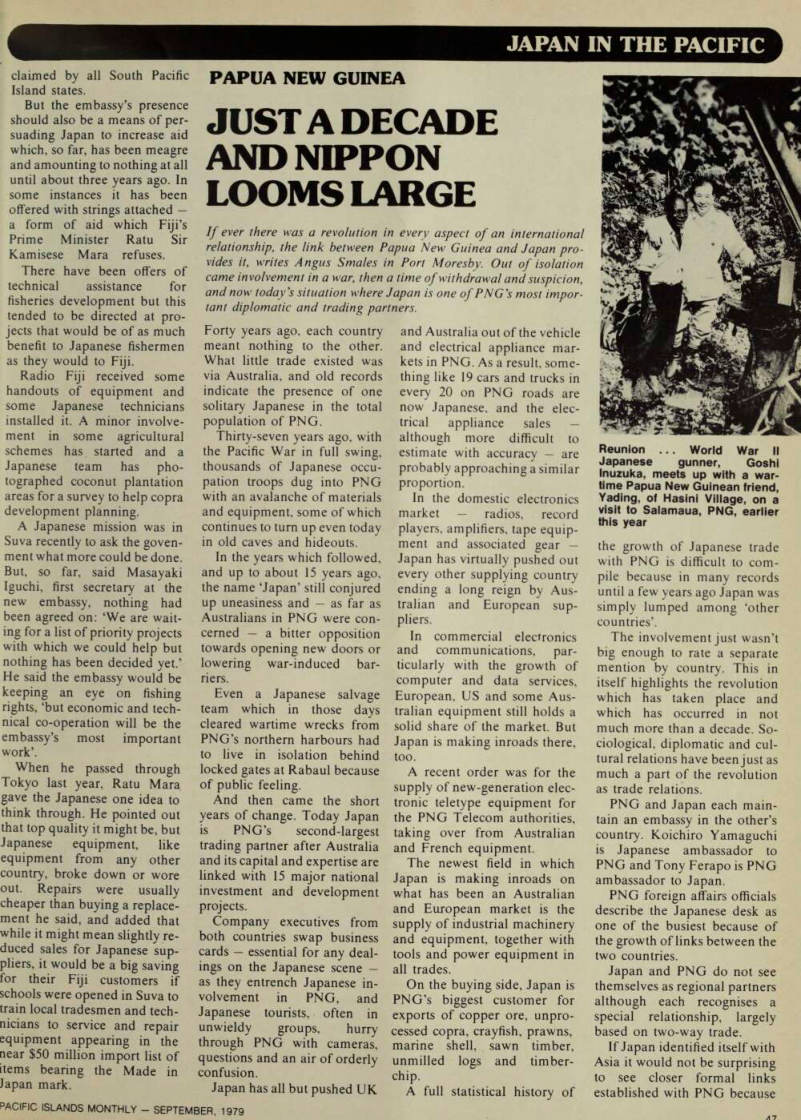
Reunion ... World War II Japanese gunner, Goshi Inuzuka, meets up with a war time Papua New Guinean friend, Yading, of Hasini Village, on a visit to Salamaua, PNG, earlier this year
of PNG’s own interest in being a Pacific-Asia ‘bridge’.
But it is quite clear from Japanese policies in a number of subtle ways that it does not identify itself with Asia, and its policies towards PNG are very much those of a stand-alone nation.
Apart from direct trade and transport agreements of an ‘op erational’ nature, the two coun tries do not share international treaty links or international bloc affiliations. But in many respects this situation tends to simplify those arrangements which they do make.
Japan is going through a
period of creating greater in volvement in Pacific Island countries, partly in a spirit of Pacific responsibilities and
partly for trading reasons.
PNG has become one of the principal centres of focus in this move.
One feature of the relation ship is particularly evident, and that is that Japan is the more active in searching for new av enues of involvement.
An organisation known as the Japan PNG Goodwill So-
Arrivals in PNG
Japanese citizens in PNG on a longterm basis number 270 including diplomatic staff, businessmen and employees of Japanese or joint venture firms and their families.
ciety exists, but it is essentially
a Japanese society looking to
PNG rather than a reciprocal society looking in both direc tions.
This in no way undermines its altruism or its value, but is
significant in illustrating the
differing roles played by the two countries in their relation
ship.
The Goodwill Society is a non-official body but it has the approval of both governments
through their foreign minis
ters.
It exists to establish ‘the
deepest friendship, goodwill
and co-operation’ between such widely-divergent groups in each country as ‘government officials and boy scouts’, as well as many others in be tween. It also plans to exchange works of art and artifacts be tween the two countries.
The total number of Japanese living in PNG is now approaching 300, made up of embassy officials, government
representatives, business
executives and skilled tech nicians and operatives.
Unlike many Australians, New Zealanders, Britons and Filipinos, the Japanese are not recruited by PNG interests for PNG jobs but are specifically sent to PNG positions by
parent companies in Japan.
Their work ranges through commerce, shipping, fisheries and the timber, mechanical, electrical and air-conditioning industries.
Japanese shipping lines and
the PNG national airline Air
Niugini provide the transport
links between PNG and Japan, although there is no shipping passenger trade.
The agreement under which Air Niugini flies to Japan is somewhat contentious from the PNG outlook because the flight has to terminate at Kagoshima in the southwest and not at Tokyo.
Japan at present won’t ap prove the final gloss which would allow Air Niugini’s once-a-week service to turn around at Tokyo, and there has been political criticism in Port
Moresby over the arrange ment.
The agreement provides for an ultimate option in which Japan could operate a PNG service but this has not yet been taken up. Any relaxation
allowing Air Niugini into
Tokyo is not likely until Japan decides it wants a share of the PNG route.
The service is heavily util ised and one of its interesting aspects has been the build-up
of freight particularly for
Japanese-made spare parts on delivery to PNG.
On the shipping lanes Japan operates general cargo ships, some linked with Australian routes, but it also has specialised bulk carriers on the run.
One is engaged solely on the Bougainville Island run carry ing ore from the big open pit
copper mine operated by
Bougainville Copper Ltd.
Others are used to carry timber and logs from New Britain and to carry wood-chip from the
mill at Madang operated by
Jant Pty Ltd.
Specialised vehicle carriers also have been used on the PNG route, allowing cars to be driven straight out from below deck on a retractable bow ramp.
Australia, Japan, UK and the US are the four overseas countries with substantial pri vate sector investment in PNG.
Because of its historical and continued links with PNG, Australia is by far the biggest investor and is estimated to exceed five times over the total investment of all other coun tries combined.
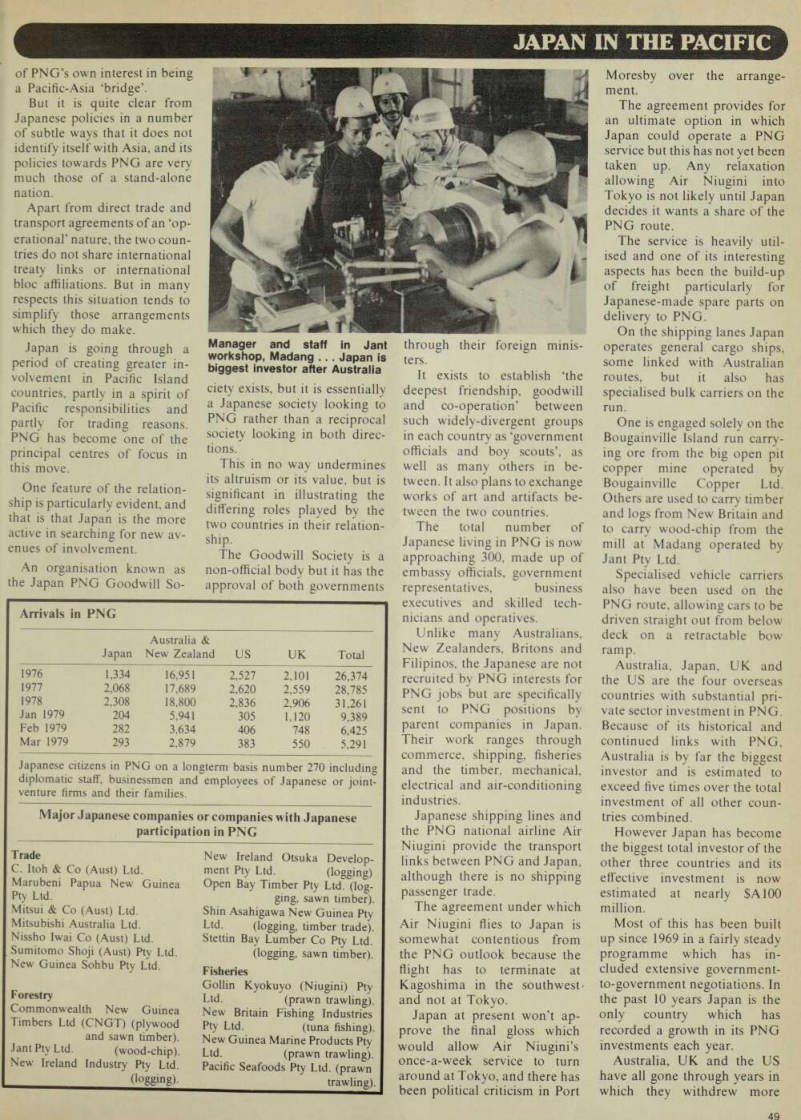
However Japan has become the biggest total investor of the other three countries and its effective investment is now estimated at nearly SAIOO million.
Most of this has been built up since 1969 in a fairly steady programme which has in cluded extensive government to-government negotiations. In the past 10 years Japan is the only country which has recorded a growth in its PNG investments each year.
Australia, UK and the US have all gone through years in which they withdrew more
Manager and staff In Jant workshop, Madang ... Japan is biggest investor after Australia
Japan Australia & New Zealand US UK Total 1976 1,334 16,951 2,527 2,101 26,374 1977 2,068 17,689 2,620 2,559 28,785 1978 2,308 18,800 2,836 2,906 31,261 Jan 1979 204 5,941 305 1,120 9,389 Feb 1979 282 3,634 406 748 6,425 Mar 1979 293 2,879 383 550 5,291
Major Japanese companies or companies with Japanese participation in PNG Trade New Ireland Otsuka Develop- C. Itoh & Co (Aust) Ltd. ment Pty Ltd. (logging) Marubeni Papua New Guinea Open Bay Timber Pty Ltd. (log- Pty Ltd. ging, sawn timber).
Mitsui & Co (Aust) Ltd.
Shin Asahigawa New Guinea Pty Mitsubishi Australia Ltd.
Ltd. (logging, timber trade).
Nissho Iwai Co (Aust) Ltd.
Stettin Bay Lumber Co Pty Ltd.
Sumitomo Shoji (Aust) Pty Ltd. (logging, sawn timber).
New Guinea Sohbu Pty Ltd.
Fisheries Forestry Commonwealth New Guinea Gollin Kyokuyo (Niugini) Pty Ltd. (prawn trawling).
New Britain Fishing Industries Timbers Ltd (CNGT) (plywood Pty Ltd. (tuna fishing). and sawn timber).
New Guinea Marine Products Pty Jant Pty Ltd. (wood-chip).
Ltd. (prawn trawling).
New Ireland Industry Pty Ltd.
Pacific Seafoods Pty Ltd. (prawn (logging). trawling).
capital than they invested
(although over the 10-year
period they each showed a sub stantial net growth).
In 1975, the year that PNG became independent, there was an overall reduction of $25 million in overseas capital invested in PNG, largely
through withdrawals by Aus
tralian and US interests. In the same year however Japan increased its investment by about $7 million.
Investment income payable out of PNG to Japanese interests is now estimated to be running at $5 million a year. (The estimate for Australian
Investment in PNG
From Private Overseas Investment issued August 3, 1978, by Bureau of Statistics of PNG.
interests is $6O million.) Japanese capital in PNG tends to be more ‘formal’ than
longstanding Australian capi
tal. A big proportion of Japanese funds is invested in
major lately-approved ven
tures in which the government itself is a shareholder, thus exposing the capital to govern ment scrutiny, approval and in volvement.
Under PNG’s investment structure this difference has no
practical significance or not
today, anyway but the
Japanese themselves regard
this as an added measure of se
curity.
Japan shares exactly the
same conditions, controls and guarantees as other countries with regard to capital invested in PNG it has neither con cessions nor discriminatory re strictions.
Although Japanese invest
ment is extensive and is increasing it is not spread widely and is generally con
fined to major developmental
spheres where Japan has
proven specialised skills.
All aspects of the timber
industry are major investment
areas for Japan, and there is Japanese timber money on the south coast of the PNG main land, inland at Bulolo, at sev eral points on the north coast and on New Britain and New Ireland.
The investment covers the whole range of the timber
industry in general logging
and reafforestation, in milling for export and local markets, in
wood-chip production and in
veneer and plywood manufac ture.
There’s even a chopsticks
export industry using offcuts
from Klinkii pine plywood timber at the Japanese controlled Commonwealth New Guinea Timbers plant at Bulolo.
Fisheries is another major Japanese investment area in PNG, but a firm distinction is drawn between two completely
differing types of operation.
One is the high-intensity fishing of PNG waters under licence, mainly for tuna, in which PNG has the potential to earn revenue from Japan in lic ence fees and royalties. Last year alone through an arrange ment of this nature Japan paid PNG $1.25 million in licences plus royalties on the catch.
But government-to-govern
ment negotiations bogged
down over a renewal of the ar rangement, with Japan want ing a lower access price because of a claimed recession in the fisheries product mar ket.
The situation remains stalemated, and PNG sends out periodic Defence Force patrols to ensure that Japanese fleets are not poaching. So far the Japanese behaviour has been
exemplary.
PNG deliberately wants to keep the conditions tough be cause it is looking to the day when it can operate its own tuna catch fleet.
The second type of fisheries
operation is where Japanese
investment and expertise is used to establish a local indus try with PNG equity involve ment. Pilot schemes have
already been operated, some
including fish canning, and the PNG Government expects a big expansion in the next four years.
The major problem facing
PNG is to assure its own coastal village communities that their traditional fishing rights will not be infringed or coastal waters denuded.
The big Sohbu Trading Cor poration of Japan is a major investor in PNG with interests in timber and fisheries, mainly in partnership with the govern ment. Its big automated timber mill at Open Bay in New Bri tain was burnt down in July, and about $4 million will be spent in a rebuilding pro gramme.
Japan is involved in light
industry through an air
conditioning venture in a part nership between Daikin and the locally-owned PNG Associated Industries of Port Moresby.
Although Japan dominates PNG sales of automotive, elec tronic, time-keeping and cam era industry products its local investment in these areas is not significant except for some light industrial services. This is because of a deliberate policy of non-involvement in market ing and servicing where local franchises can handle the re
quirements.
Where major Japanese inter national product names are concerned this has tended to keep Japanese investment to liaison-type activities, backed
up by sponsored training pro
grammes for PNG technicians and officials.
Japan invested a one-third share in a major feasibility
study into the hydro-electric
potential of the Purari River in southern PNG. Any eventual development of the scheme is almost certain to include
Japanese participation, and
there is a possibility that Japan could be an industrial customer for the available power if the scheme is implemented.
Japan attempted to gain a foothold in the palm oil indus try in PNG but its expertise proved insufficient and the PNG Government cancelled an agreement under which Japanese interests were to establish an expressing mill and palm oil estate.
Japan provides two types of direct aid to PNG as part of an established policy of assistance to developing countries. One is the provision of concessional
loans for development projects
where the projects themselves require approval but the direc tion of expenditure is generally untied. The other is a pro gramme of technical assistance which can involve training or financial aid, but which is gen erally tied to Japanese involve ment in the approved schemes.
Under the loan programme, PNG recently received a $17.5 million soft loan from Japan to be spent over this year and the next five years. The loan itself
Klinkii pine ready for shipment from Bulolo ... now a Japanese operation
Japan
Australia UK
Usa
Others Total Year
ending
June 30 1971 43 821 106 374 4040 34 290 (’000s PNG Kina) 4114 192 639 1972 2821 81 486 65 736 17 491 2295 169 829 1973 6631 4358 19 876 5451 1654 29 254 1974 1983 80 758 60 935 51 987 526 74 314 1975 5595 18 028 10 298 8082 1211 27 050 1976 1752 29 586 4286 12 501 1645 24 768 1977 1887 5387 1608 6696 21 234 22 822
will operate over 30 years at only 3% annual interest and with a 10-year grace period be fore repayments begin. It is being co-financed by the Asian
Development Bank.
It was approved through the PNG budget and will be used
for an important hydro-electric
project on the Warangoi River just outside Rabaul in East New Britain Province.
All procurement arrange ments in applying the money are untied, except that the expenditure cannot be in socialist countries.
Japanese and PNG officials
are already investigating
another loan under similar concessional terms, and poss
ibly slightly larger.
In accepting Japanese tech
nical aid as distinct from development loans PNG has found some difficulty in find ing projects which are suited to its own requirements while also filling the need for Japanese in volvement.
However about 30 Papua New Guineans are undergoing.
or about to undergo, technical training courses in Japan and two Japanese experts are invol ved in fisheries training aid in
Png.
PNG has found language difficulties create problems for some trainees going to Japan, but in general the foreign office and the government regard the scheme as valuable and work
ing satisfactorily.
Japan is also about to involve PNG in its Overseas
Co-operation Volunteers
(OCV) scheme, a similar oper ation to Australian Volunteers Abroad and the US Peace
Corps.
In total trade figures, Japan is now PNG’s second trading partner after Australia. But in terms of exports Japan is PNG’s best customer by far, and the value of what PNG sells to Japan is three times greater "than what it buys.
This point is often overlooked by critics who claim that aggressive Japanese marketing has been allowed to encroach excessively on the
‘traditional’ PNG market.
One product alone has cre ated PNG’s favourable trade balance with Japan, and that is copper ore from the Bougain ville Copper Ltd mine.
At the moment PNG sales to Japan are running at about $l9O million and Japan’s sales to PNG at $65 million.
Japanese sales to PNG are rising at a fairly steady 3% a year. The trend of values in PNG sales to Japan is harder to define because it relies to such a big extent on the often variable international copper market. The present value of PNG copper ore sales to Japan is running at $l4O million a year.
PNG’s second-biggest ex port to Japan is a wide range of products from the timber industry from raw logs to veneer - worth about $25 million.
The remaining major export
earnings are from copra, coffee beans, crayfish, prawns and fish. There are minor earnings from crocodile skins, car
damon seeds, cocoa beans, palm oil and marine shell.
More than half of PNG’s $65-million-dollar annual pur chases from Japan is made up of motor vehicles and some machinery. The total amount involved in these purchases on the most recent annual figures was $37 million. PNG’s roads are now almost completely taken over by Japanese ve hicles.
The second big area of Japanese sales is in manufac
tured goods amounting to just
over $l2 million. The principal goods in this category are radio and audio equipment, watches and clocks, cameras, electronic equipment and some electrical
appliances.
PNG also buys from Japan foodstuffs valued at $lO million.
Port Moresby foreign affairs
officials say that Japan is obviously seeing PNG as an
increasingly important Pacific
market, and that the volume of inquiries at the PNG embassy
in Japan is steadily increasing.