About To Turn?
pp. 41-47 · Read in the full issue

Fiji
Is The Tide
Japanese goods are pouring into Fiji at an accelerating rate, writes Robert Keith-Reid in Suva. And Japanese tourists in the past two years have begun to arrive in something more than a trickle. But largescale Japanese investment, which five years ago seemed imminent, has not materialised.
Sales of Japanese goods now represent 25% of all imports but Fiji’s sales to Japan con tinue to be virtually non existent. The sirqple reason has been that Fiji had very little that Japan wanted. But there is reason to believe the tide is about to turn.
Japan opened an embassy in Suva this year and now appears prepared to extend economic aid on a fairly significant scale.
This, along with a Japan Air Lines (JAL) service through Nadi to New Zealand begin ning in April next year, is giv ing Japanese investors food for
thought, especially those who
bought land in Fiji in the early seventies with a view to utilis ing it as resort development.
Fishing and the supply of cameras, transistor radios, tape recorders and various other electrical and optical knick knacks, were the means by which Japan began to make its presence felt in Fiji in the early sixties.
The Pacific Fishing Com pany (PAFCO), set up by C
Itoh and Co Ltd of Osaka and Nichiryo Ltd of Tokyo, opened a fish freezing factory at Levuka in 1963 to handle fish landed by Asian tuna boats.
Five years ago, under official pressure, they sold the Fiji Government a 25% share of Pafco and built a cannery next to the freezers. Another company, Toyo Seikan Kaisha Ltd, arrived at Levuka at that time and opened a can manufacturing company in which the government took a 20% share. Today the cannery is handling more than 6000 tonnes of fish, mostly tuna, each year, and exports mainly to North America and Europe, have shot up in three years from nothing to an estimated $F 15 million this year.
While deep sea tuna con tinues to be supplied by Asian vessels, shallow water skipjack tuna are being caught by a Fiji Government-owned fleet that is being built up with the object of supplying most of the can
nery’s needs.
Fiji’s duty free shops have
been good to Japanese manufacturers since the early sixties, in 1978 Japan supplied about $lB million worth of electronic, photographic and
electrical luxury goods, includ
ing cameras ($l.l million), watches ($2 million), radios ($2.5 million), tape recorders ($1.3 million) and record players ($l.l million).
But these lines no longer dominate the range of goods supplied. Japan is now the source of motor vehicles a market which it completely dominates and a vast range of other goods.
Total imports to Fiji were worth $47.8 million in 1978, more than double the value a decade ago, putting Japan in third place, after Australia and New Zealand, as a supplier.
Vehicle imports were valued at $10.9 million including 877 pri vate cars ($2.7 million) and trucks and vans ($4 million).
Other major imports in
cluded canned fish (3.3 million), chemicals and fer tilisers (5.4 million), steel, iron and other metal plates, tubes, wiring and metal tools and pro ducts ($8.6 million), other elec trical equipment ($1 million), and textiles ($2.8 million).
But, in reverse, the figures are sad. Fiji’s exports to Japan last year were valued at a mere $241 000, a figure that has not changed much in years. It involves small amounts of fish,
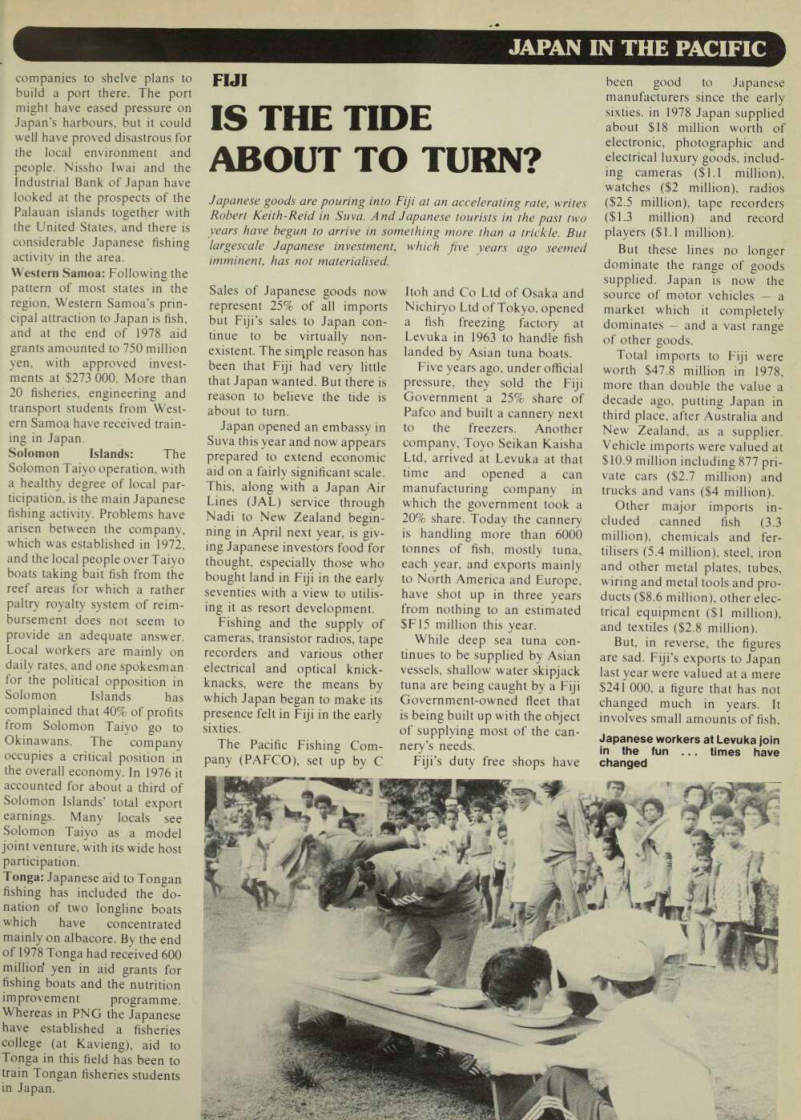
Japanese workers at Levuka join in the fun ... times have changed
fish meal, pearl, trochus and turtle shell, and a small amount of timber.
Japan has been an occasional customer for sugar but it has been years since the Fiji industry has had any to spare after meeting contracts with regular customers. In any
case, Japanese refineries prefer
to buy more cheaply else where.
The government has not complained about the trade gap because Fiji just hasn’t got much to offer. But, in the eight ies, it hopes the picture will
change quite dramatically.
Since the late sixties the government has been busy planting more than 50 000 hec tares of Caribbean pine forest.
A source of logs, pulp, and chip already, these forests will start to mature early in the eighties at a time when a shortage of softwoods is forecast in Asian
countries, particularly Japan.
Japanese timber companies
already are showing interest.
Official hopes are that with
Japan’s help, pine will rapidly
evolve into a trade worth almost as much as Fiji’s $lOO million a year sugar industry.
Fiji’s attitude to the
Japanese is friendly nowadays.
In World War II Fijian soldiers fought Japanese troops in the Solomon Islands and war bit terness lasted until the late fif ties. In those days Japanese fishermen were liable to be beaten up if caught alone in Suva at night.
That has all changed.
Japanese fishing boats are wel come as a source of business worth several million dollars a year for local ship repair yards and provisioning merchants.
Crewmen are now offered a beer in a pub instead of a clenched fist.
In Levuka, Japanese chil dren school with local children and local men have been to sea in Japanese fishing boats or on courses with the cannery’s
parent companies in Japan.
Judo is a local craze initiated
by Japanese fishermen. Fam
iliarity with Japanese brand
names and the advertising
material accompanying them
has done much to help the
people of Fiji satisfy their curi
osity about the people from the
islands 10 000 km to the north.
Hearing of massive Japanese investment in Hawaii and of the thousands of free-spending Japanese tourists visiting there, Fiji’s mood was of happy an ticipation when several Japanese companies moved to establish themselves in the Fiji tourist resort scene in the early and mid-seventies.
Sixty Japanese companies,
most of them big names, set up Todeco (Fiji) Ltd for invest ment in a wide field of activi ties in Fiji and the South Pacific. Todeco talked of re sorts, shipbuilding, agriculture,
forestry, fishing and manufac
turing.
But, so far, all that it has done is to buy the 120-room Mana Island Resort hotel just off Nadi airport. Much of Mana’s business now involves Japanese tourists who come in on charter flights which JAL started experimentally, for short seasons, two years ago.
Three years ago, Taisei, one
of Japan’s biggest construction
companies, paid about $5 million for a half-share of Pacific Harbour, a 7000-acre section of freehold land, mostly
swamp, at Deuba, 50 km from Suva. An 1100-acre first phase was completed at Pacific Har bour by Southern Pacific Properties Ltd (SPP), a company which since 1978 has been controlled by Saudi Arabian tycoon Adnan Kahshoggi. SPP and Taisei have set up SPP-Taisei Ltd to
develop the remaining 6000
acres but have not taken this
plan beyond the drawing board
stage.
At about the time of Taisei’s arrival, Fuji Kon Fiji Ltd, con
trolled by another Japanese
consortium, signed up with the American promoters of the Denarau Island resort project near Nadi airport for partici pation in a $2O million hotel as a neighbour to a 300-room re sort opened in 1976. But, again, nothing has eventuated.
One reason is difficulty about fresh water supplies, a problem which won’t be solved until a government water reser voir scheme is completed three or four years from now. But the main reason is that, like Taisei and Todeco, Fuji Kon has had second thoughts about the timing of major involvement in Fiji. It wants to be sure of trans port between Tokyo and Nadi in the shape of Japan Air Lines before it puts the big money down. JAL’s firm decision to
start flying to Nadi as a sched uled operator from April next year was announced only in July this year.
Taisei’s resident manager at Pacific Harbour, Tak Hasegawa, commented: ‘Now that they are coming here there could be a change in tourism.
It has been growing, but slowly, and so far we have not been
doing much. Just marking
time.’ JAL was the key which would turn and get things mov ing, he said.
It wasn’t until JAL began charter flights to Nadi in 1976 that the presence of Japanese tourists became noticeable at all. DCBs, carrying about 140 passengers, flew in for ‘seasons’ of about 10-15 flights. The number grew steadily and about 6000 Japanese each spent an average of a week in
Fiji last year, mostly taking in
Mana Island and a couple of other resorts, including Pacific Harbour.
Makoto Ikeda, resident in Fiji for nine years as a tour business representative, says the JAL charters have worked up repeat custom already. ‘About 40 people from each series come back the following year. It’s a good sign,’ he said. ‘Most of the traffic is young
couples and young single
women who want beaches, a good hotel, and sightseeing and not much more. Some com plain that there’s nothing to buy here. They don’t want Japanese stuff. They want ex
pensive foreign brands that
they can’t get at home.
JAL’s decision to open a reg ular all-year-round service has prompted one Japanese com pany to inquire about opening a Japanese restaurant at Pacific Harbour. That, says Mr Ikeda, is a small hint of the shape of things to come.
Outside of trade and fishing,
Fiji’s dealing with Japan
amounted to next to nothing in any other area until the open ing of an embassy in
January.
In Fiji’s view, Japan’s motive in opening the embassy is chiefly to preserve the right of its fishing fleets to work in re
gions they had fished freely
until the declaration of 200-mile economic zones, now
Judo enthusiasts Tek Hasegawa (left) and Viliame Takayawa with new judo mat... a present from Mr Hasegawa’s company, SPP- Taisei
claimed by all South Pacific Island states.
But the embassy’s presence should also be a means of per suading Japan to increase aid which, so far, has been meagre and amounting to nothing at all until about three years ago. In some instances it has been offered with strings attached a form of aid which Fiji’s Prime Minister Ratu Sir Kamisese Mara refuses.
There have been offers of technical assistance for fisheries development but this tended to be directed at pro jects that would be of as much benefit to Japanese fishermen as they would to Fiji.
Radio Fiji received some handouts of equipment and some Japanese technicians installed it. A minor involve ment in some agricultural schemes has started and a Japanese team has pho tographed coconut plantation areas for a survey to help copra
development planning.
A Japanese mission was in Suva recently to ask the goven ment what more could be done.
But, so far, said Masayaki Iguchi, first secretary at the
new embassy, nothing had
been agreed on: ‘We are wait ing for a list of priority projects with which we could help but nothing has been decided yet.’
He said the embassy would be keeping an eye on fishing rights, ‘but economic and tech nical co-operation will be the embassy’s most important work’.
When he passed through Tokyo last year, Ratu Mara gave the Japanese one idea to think through. He pointed out that top quality it might be, but
Japanese equipment, like
equipment from any other country, broke down or wore
out. Repairs were usually
cheaper than buying a replace ment he said, and added that
while it might mean slightly re
duced sales for Japanese sup pliers, it would be a big saving for their Fiji customers if schools were opened in Suva to train local tradesmen and tech nicians to service and repair equipment appearing in the near $5O million import list of items bearing the Made in Japan mark.