Japanese fishermen
pp. 40-41 · Read in the full issue
Economic zones Japanese fishermen on to a new tack
From the turn of the century the Japanese fishing industry has pushed the slogan ‘From the coast to offshore, and from offshore to the distant seas\ But these days the distant seas are usually the offshores of other countries, writes Wayne Brittenden.
By the end of last year most of the world’s littoral nations had either already established 200 nautical mile zones, or were in the throes of doing so. The moves affected about 40% of
Japan’s annual catch. Only
about 3% of Japan’s total haul comes from open waters out side either its own or some
other country’s jurisdiction.
The giant Japanese fishing
companies are now shifting
their emphasis from fishing to
trading, involving massive
injections of capital and tech
nology.
The establishment of the 200-mile zones, industrial pol lution in domestic coastal waters, and the rising price of
fresh fish, have resulted in a sharp increase in marine pro duct imports from the develop ing Asian and Pacific nations, including frozen shrimp and tuna which are sometimes re exported to the industrialised world. Cheaper varieties are likely to be canned and sent back to the Pacific, and
attempts to develop a taste for canned fish are reflected in a donation by Japan earlier this year to Tonga and Western Samoa of a consignment of canned tuna valued at about a million yen.
Lately there has been a drop in the export of Japanese mar ine products largely due to the new strategy of investing over seas in joint ventures with local
capital, or by setting up
independent companies. Even
with partial ownership in such overseas operations the
Japanese firm is apparently
exempt from any obligation to report to the Japanese authori ties. The goods are exported di rectly to other countries and can provide a cover for profits.
One established example is Japan’s trout and salmon exports: most are despatched from Japanese fishing and
trading companies based in
North America.
The greatest number of
Japanese-related fishing cor
porations is in Asia and the Pa cific, where there were 99 at last count, compared with 45 in North America, 20 in Africa and four in Europe. Several methods of investment are
involved, including outright
purchase with no strings
attached.
However, the general pat tern is for Japanese interests to exercise control over the ad
vanced equipment they
introduce, such as refrigeration and transport plant. This often has a tendency to distort the host country’s domestic indus try and established distribution patterns.
The Southeast Asia Fishery
Development Centre, in which more than 500 million yen has been invested, exemplifies fisheries development as a
Japanese national policy.
Established in 1968 by the Southeast Asia economic ministers’ conference as a means of providing technical aid to developing countries, the centre has concentrated on off shore resources and profi tability. The value of the
technical training is question
able since no survey of in digenous fishing or the social and economic structures of the countries concerned has ever been made.
While the governments of the Pacific, like those else where, are benefiting and will benefit from permitting
Japanese investment in joint
ventures because of the boost to their foreign exchange hold ings, increases in fishing pro
ductivity and profitability for
some local businessmen, the advantages to the local indus try itself are not always so clear.
The shape of
Japanese aid
In this rundown on Japanese aid to a number of Pacific Island countries and territories, Wayne Brittenden’s report shows that fish, fish, fish and once again fish is the domi nant theme.
Micronesia: Most of Japan’s aid grants have been for con sumer items, medical products
and maritime industry equip
ment. Last year the usually easy-going Palauans forced a consortium of Japanese, American and Iranian
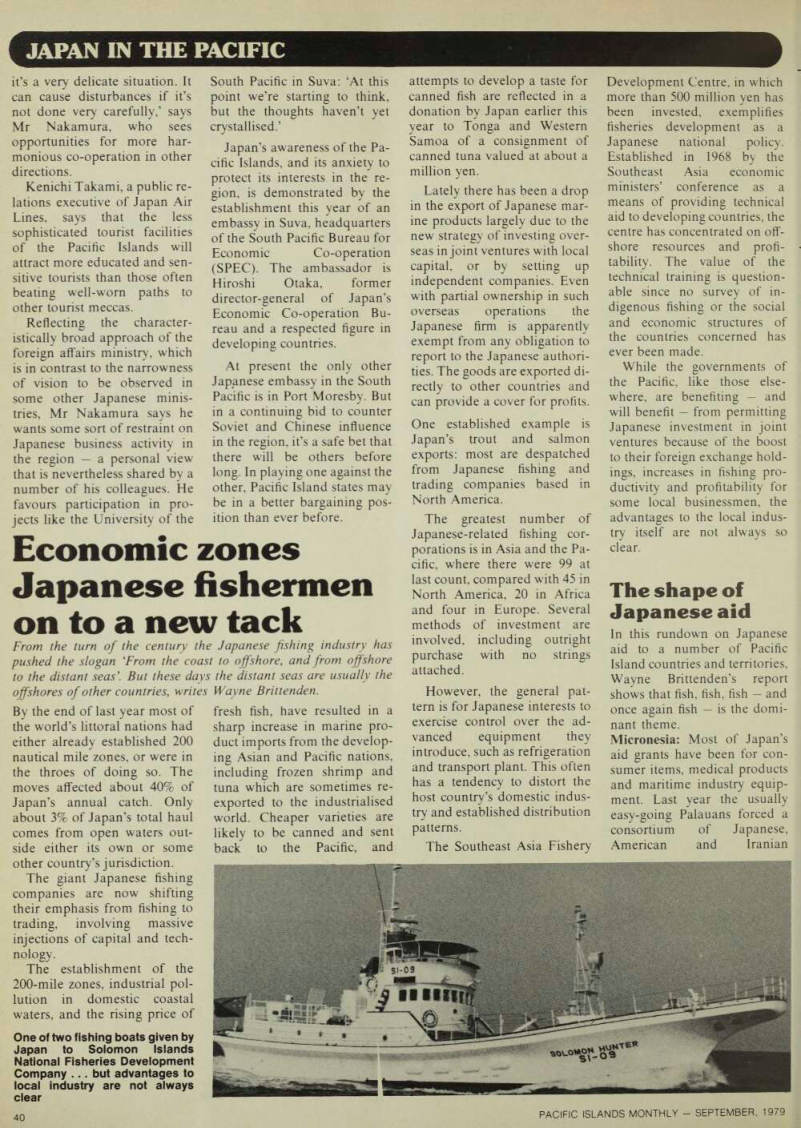
One of two fishing boats given by Japan to Solomon Islands National Fisheries Development Company ... but advantages to local industry are not always clear
companies to shelve plans to build a port there. The port might have eased pressure on Japan’s harbours, but it could well have proved disastrous for the local environment and people. Nissho Iwai and the Industrial Bank of Japan have looked at the prospects of the Palauan islands together with the United States, and there is
considerable Japanese fishing
activity in the area.
Western Samoa: Following the pattern of most states in the
region. Western Samoa’s prin
cipal attraction to Japan is fish, and at the end of 1978 aid grants amounted to 750 million yen. with approved invest ments at $273 000. More than 20 fisheries, engineering and transport students from West ern Samoa have received train
ing in Japan.
Solomon Islands: The
Solomon Taiyo operation, with
a healthy degree of local par ticipation, is the main Japanese
fishing activity. Problems have
arisen between the company, which was established in 1972, and the local people over Taiyo boats taking bait fish from the reef areas for which a rather paltry royalty system of reim bursement does not seem to
provide an adequate answer.
Local workers are mainly on daily rates, and one spokesman for the political opposition in Solomon Islands has complained that 40% of profits from Solomon Taiyo go to Okinawans. The company occupies a critical position in the overall economy. In 1976 it accounted for about a third of Solomon Islands’ total export
earnings. Many locals see
Solomon Taiyo as a model joint venture, with its wide host
participation.
Tonga: Japanese aid to Tongan fishing has included the do nation of two longline boats which have concentrated mainly on albacore. By the end of 1978 Tonga had received 600 million* yen in aid grants for fishing boats and the nutrition
improvement programme.
Whereas in PNG the Japanese have established a fisheries college (at Kavieng), aid to Tonga in this field has been to train Tongan fisheries students in Japan.