People
pp. 32-34 · Read in the full issue

Ron Hegerhorst, 51, has been appointed Trade Com missioner for the South Pacific, a position created under the auspices of the South Pacific Bureau of Economic Co operation (SPEC) to help Pa cific Island countries improve their trade. Mr Hegerhorst is operating out of an office in Papua New Guinea House,
Sydney.
The new post arises from a
promise made by Australian
Prime Minister Malcolm Fraser to the South Pacific Forum meeting in Niue last year. At the time Mr Fraser said the commission would identify products from Island countries of the Forum which could be
successfully exported to Aus
tralia. It would also provide commercial information and
practical expertise to help the
South Pacific Islands in
marketing their products. It
will be funded by Australia to the tune of up to $l5O 000 a year for an initial five-year
period.
Running the commission with Mr Hegerhorst will be a trade development officer from the Pacific, and two
locally employed staff.
Mr Hegerhorst is no stranger to the Islands. He was formerly first assistant secretary of trade and economic relations in the PNG Department of Foreign Affairs and Trade. He worked in PNG for nine years on secondment from the Aus tralian public service.
An Australian Information Service release says that Dutch born Mr Hegerhorst first came to Australia in 1960. It quotes him as saying; ‘My first job in Brisbane was selling advertise ments for the pink pages in the telephone book, which was a useful introduction to the Aus tralian business world.’
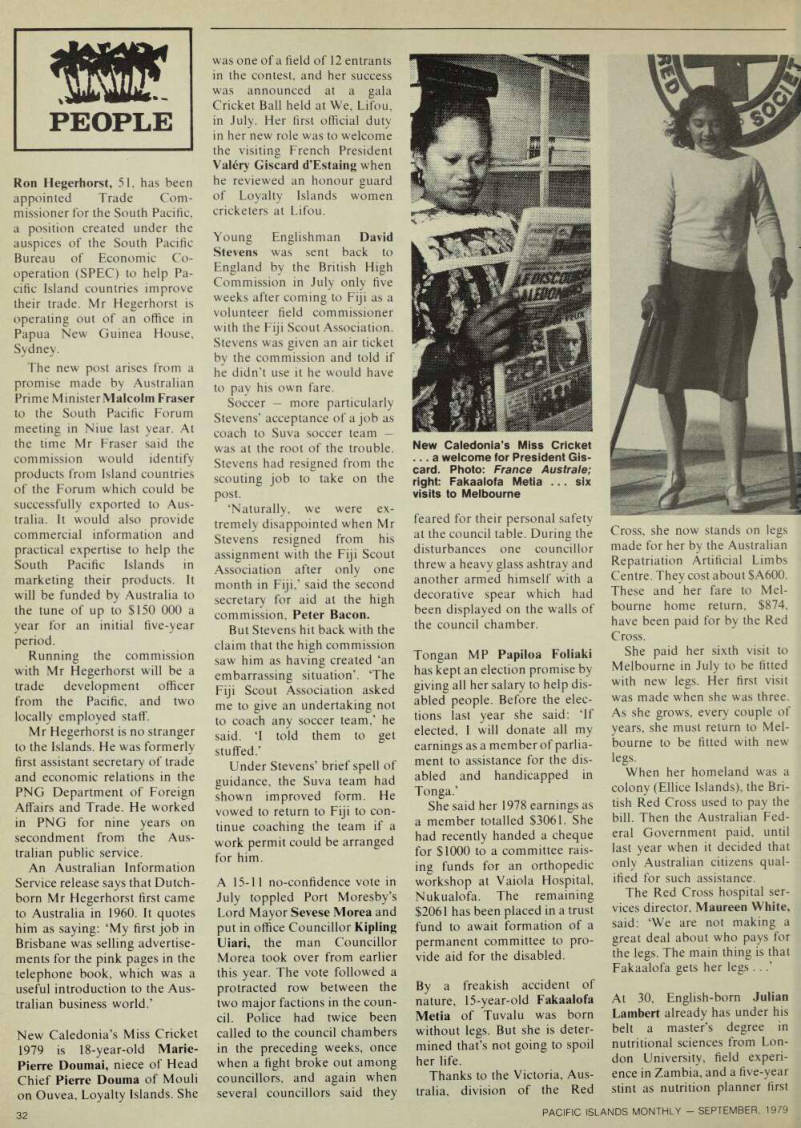
New Caledonia’s Miss Cricket 1979 is 18-year-old Marie- Pierre Doumai, niece of Head Chief Pierre Douma of Mouli on Ouvea, Loyalty Islands. She
was one of a field of 12 entrants in the contest, and her success was announced at a gala Cricket Ball held at We, Lifou, in July. Her first official duty in her new role was to welcome the visiting French President Valery Giscard d’Estaing when he reviewed an honour guard of Loyalty Islands women cricketers at Lifou.
Young Englishman David Stevens was sent back to
England by the British High
Commission in July only five weeks after coming to Fiji as a volunteer field commissioner with the Fiji Scout Association.
Stevens was given an air ticket by the commission and told if he didn’t use it he would have to pay his own fare.
Soccer more particularly Stevens’ acceptance of a job as coach to Suva soccer team was at the root of the trouble.
Stevens had resigned from the scouting job to take on the post. ‘Naturally, we were ex
tremely disappointed when Mr
Stevens resigned from his assignment with the Fiji Scout Association after only one month in Fiji,’ said the second secretary for aid at the high commission. Peter Bacon.
But Stevens hit back with the claim that the high commission saw him as having created ‘an embarrassing situation’. ‘The Fiji Scout Association asked me to give an undertaking not to coach any soccer team,’ he said. T told them to get stuffed.’
Under Stevens’ brief spell of guidance, the Suva team had shown improved form. He vowed to return to Fiji to con tinue coaching the team if a work permit could be arranged for him.
A 15-11 no-confidence vote in
July toppled Port Moresby’s
Lord Mayor Sevese Morea and put in office Councillor Kipling Uiari, the man Councillor Morea took over from earlier this year. The vote followed a protracted row between the two major factions in the coun cil. Police had twice been called to the council chambers in the preceding weeks, once when a fight broke out among councillors, and again when several councillors said they
feared for their personal safety at the council table. During the disturbances one councillor
threw a heavy glass ashtray and
another armed himself with a decorative spear which had been displayed on the walls of the council chamber.
Tongan MP Papiloa Foliaki has kept an election promise by giving all her salary to help dis abled people. Before the elec tions last year she said; Tf elected, I will donate all my earnings as a member of parlia ment to assistance for the dis abled and handicapped in
Tonga.’
She said her 1978 earnings as a member totalled $3061. She had recently handed a cheque for $lOOO to a committee rais ing funds for an orthopedic
workshop at Vaiola Hospital,
Nukualofa. The remaining $2061 has been placed in a trust fund to await formation of a permanent committee to pro vide aid for the disabled.
By a freakish accident of nature, 15-year-old Fakaalofa Metia of Tuvalu was born without legs. But she is deter mined that’s not going to spoil her life.
Thanks to the Victoria, Aus tralia, division of the Red
Cross, she now stands on legs made for her by the Australian Repatriation Artificial Limbs Centre. They cost about SA6OO.
These and her fare to Mel bourne home return, $874, have been paid for by the Red Cross.
She paid her sixth visit to Melbourne in July to be fitted with new legs. Her first visit was made when she was three.
As she grows, every couple of years, she must return to Mel bourne to be fitted with new
legs.
When her homeland was a colony (Ellice Islands), the Bri tish Red Cross used to pay the bill. Then the Australian Fed eral Government paid, until last year when it decided that
only Australian citizens qual
ified for such assistance.
The Red Cross hospital ser vices director, Maureen White, said: ‘We are not making a great deal about who pays for the legs. The main thing is that Fakaalofa gets her legs...’
At 30, English-born Julian Lambert already has under his belt a master’s degree in nutritional sciences from Lon
don University, field experi
ence in Zambia, and a five-year stint as nutrition planner first
New Caledonia’s Miss Cricket ... a welcome for President Gis card. Photo: France Australe; right: Fakaalofa Metia ... six visits to Melbourne
with the Health Department and then with the National Planning Office in Port
Moresby, Papua New
Guinea.
Soon to head home for a break before taking up yet another appointment some where in the Third World, he spoke to PIM about his time in PNG and enthusiasm was the keynote of his remarks.
Said he: T very much doubt if I could have worked in a more interesting country at a more interesting time. I came to PNG just a year before independence. We were able to do things that would be just about inconceivable in a country like the UK or Aus tralia. For example, we devel oped a national food and nutrition policy in the space of just one year. A job like that would take five years at least in the UK or Australia. ‘PNG was the first country in the world to prohibit the free sale of infant feeding bottles and teats. These are now only available on prescription from a pharmacy. It’s a well-known fact that bottle-feeding of infants in a developing country is a very dangerous exercise. It is not only beyond the means of most families, but is a chronic source of gastro enteritis and similar dis orders.
‘The prohibiting legislation
was introduced in Port Moresby two years ago. Before it came into force 35% of infants in Moresby were arti ficially fed, and of those 75% were either clinically or sub clinically malnourished. At the beginning of this year a follow-up survey was made.
Only 12% of infants were being artificially fed, and of these only about 35% were clinically or sub-clinically malnourished.
This is not that much higher than the underlying malnu trition rate of the population as a whole.’
Mr Lambert is pleased, too, that the job he’s quitting has been ‘localised’. Taking his place is a Papua New Guinean woman in her late twenties, Margaret Nakikus, who holds a post-graduate degree in nutrition from London Univer sity. ‘She’ll do a great job,’ said Julian Lambert.
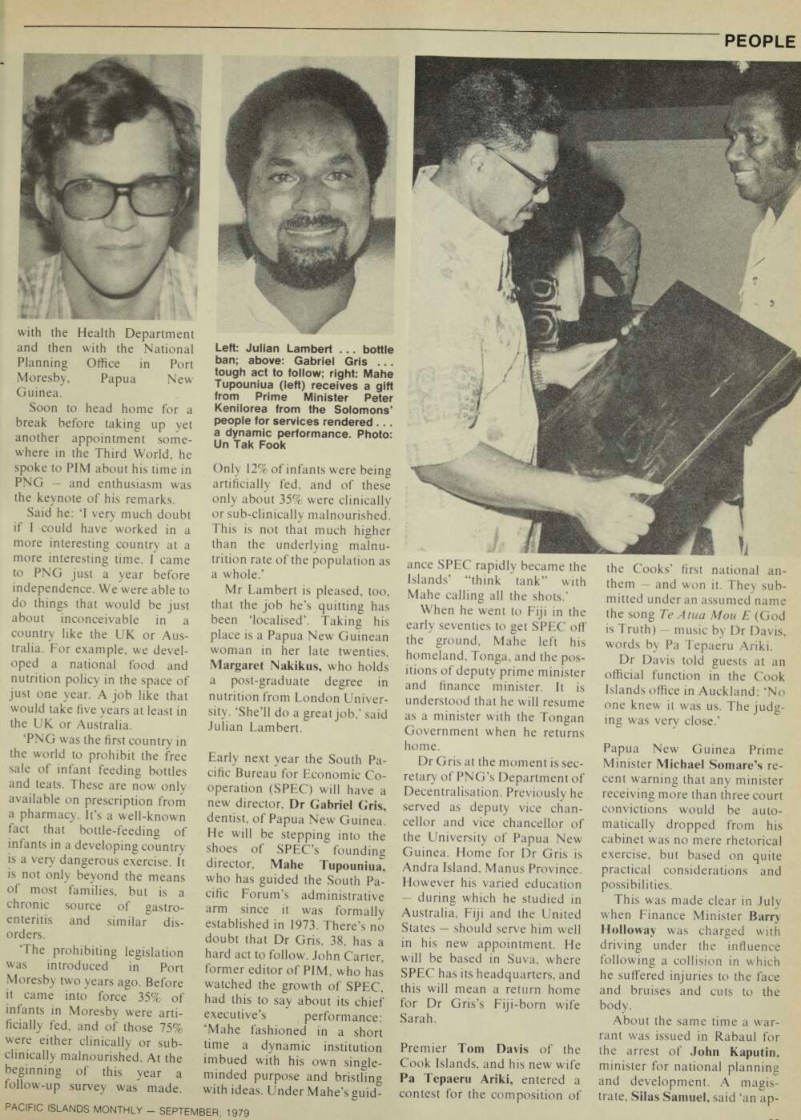
Early next year the South Pa cific Bureau for Economic Co operation (SPEC) will have a new director. Dr Gabriel Gris, dentist, of Papua New Guinea.
He will be stepping into the shoes of SPEC’s founding director, Mahe Tupouniua, who has guided the South Pa cific Forum’s administrative arm since it was formally established in 1973. There’s no doubt that Dr Gris, 38, has a hard act to follow. John Carter, former editor of PIM, who has watched the growth of SPEC, had this to say about its chief executive’s performance: ‘Mahe fashioned in a short time a dynamic institution imbued with his own single minded purpose and bristling with ideas. Under Mahe’s guid-
ance SPEC rapidly became the Islands’ “think tank” with Mahe calling all the shots.’
When he went to Fiji in the early seventies to get SPEC off the ground, Mahe left his homeland, Tonga, and the pos itions of deputy prime minister and finance minister. It is understood that he will resume as a minister with the Tongan Government when he returns home.
Dr Gris at the moment is sec retary of PNG’s Department of Decentralisation. Previously he served as deputy vice chan cellor and vice chancellor of the University of Papua New Guinea. Home for Dr Gris is Andra Island, Manus Province.
However his varied education - during which he studied in Australia, Fiji and the United States should serve him well in his new appointment. He will be based in Suva, where SPEC has its headquarters, and this will mean a return home for Dr Gris’s Fiji-born wife Sarah.
Premier Tom Davis of the Cook Islands, and his new wife Pa Tepaeru Ariki, entered a contest for the composition of
the Cooks’ first national an them and won it. They sub mitted under an assumed name the song Te Atua Mou E (God is Truth) - music by Dr Davis, words by Pa Tepaeru Ariki.
Dr Davis told guests at an official function in the Cook Islands office in Auckland: ‘No one knew it was us. The judg ing was very close.’
Papua New Guinea Prime Minister Michael Somare’s re cent warning that any minister receiving more than three court convictions would be auto
matically dropped from his
cabinet was no mere rhetorical exercise, but based on quite practical considerations and possibilities.
This was made clear in July when Finance Minister Barry Holloway was charged with driving under the influence following a collision in which he suffered injuries to the face and bruises and cuts to the
body.
About the same time a war rant was issued in Rabaul for the arrest of John Kaputin. minister for national planning
and development. A magis
trate. Silas Samuel, said ‘an ap
Left: Julian Lambert ... bottle ban; above: Gabriel Gris ... tough act to follow; right: Mahe Tupouniua (left) receives a gift from Prime Minister Peter Kenilorea from the Solomons’ people for services rendered ... a dynamic performance. Photo: Un Tak Fook
parent mix-up’ had caused the issue of the arrest warrant. But he ordered Mr Kaputin to appear on August 8 to face charges of assault and having used insulting words in an incident at Kulau Lodge, a beachside restaurant in Rabaul.
PNG’s leader Somare flew to Honolulu in July to recuper ate from an illness which had affected him for the previous six weeks. He had been suffer
ing from crippling inflam
mation of the joints of both legs, and his general health was affected. Deputy PM and Foreign Minister Ebia Olewale was acting prime minister in his absence.
Fiji trade unionist Apisai Tora has failed in a bid to get com
pensation amounting to
SF69 500 for the losses he suf fered through a trial and 159
days of imprisonment in
1977-78 following his convic tion under the Sugar Industry Act. He was later cleared on appeal. Mr Tora’s claim was debated in parliament on the motion of Ratu Osea Gavidi, who said that in the absence of
a comprehensive scheme of compensation Mr Tora’s case should be regarded as ‘excep tional’. He had lost three stone in weight while in custody and at the time of the trial he was ‘extremely ill’ and his wife was left at home alone to look after two young children. During his imprisonment she gave birth to their third child. Opposing the motion, the attorney-general, Sir John Faivey, said that Mr Tora had never been convicted ‘other than by the due process of law’. ‘He did what he was charged with. He was acquitted on a matter of law, not on a matter of fact.’ Ratu Osea called for a division in which 23 government members voted against the motion, four oppo sition members voted for, and
12 MPs, mostly opposition
members, abstained.
Dr Ankin Swamy has taken up duties as director of the Centre for Applied Studies in Development at the University of the South Pacific, Suva.
After completing his doctorate on ‘transmission of noise characteristics into aircraft structures’ in 1973, Dr Swamy
returned from the United Kingdom in 1973 to become chief education officer (tech nical) with the Fiji ministry of education. The following year he became principal of the Derrick Technical Institute and deputy secretary (technical), posts he held until his new appointment.
Des Clifton Bassett, who left Papua New Guinea in 1974 after spending more than 30 years in the country, has started the Niugini Advisory and Ser vice Centre in Sydney to assist Australians with business links in Papua New Guinea. Mr Clifton Bassett joined the PNG administration after serving with Australian defence forces
during the war, eventually
being replaced, on his
retirement, as district com missioner in Madang by Ben son Gegeyo.
The new chairman of the Maori and South Pacific Arts Council in New Zealand is Archdeacon King! Ihaka of Auckland. Archdeacon Ihaka is also chairman of the New
Zealand Polynesian Festival Committee. The council, which is a result of legislation passed last year, will assist Maori and South Pacific arts with grants and subsidies and will work with educational institutions and broadcasting bodies to promote Maori and Island cul ture.
After eight years ?n the Cook Islands Premier’s Department, Gordon Sawtell has moved into Internal Affairs to establish and head a Protocol Depart ment.
Australian diplomat Greg Urwin has been appointed act ing secretary of foreign affairs in Western Samoa. He had pre viously been acting Australian high commissioner in Apia.
Another Australian, Terry Goggin, has left Apia to take up a senior post with the Aus tralian embassy in Peking. Mr Goggin was for two years act ing secretary to the Western Samoa Government. He has been succeeded in this post by Vitolio Lui, until recently head of the foreign aid division.