ageing boats
pp. 46-48 · Read in the full issue
Fiji
Planes take over from ageing boats
Airstrips are mushrooming all
over Fiji at an unprecedented rate, writes Robert Keith-Reid in Suva. It’s a mark of the government’s determination to ensure that worn-out ships are replaced by aircraft as the main mode of inter-island travel in
Fiji’s 350-island archipelago.
As well as new airstrips, established ones are being upgraded. And, along with all this, the nation’s two major air services, Air Pacific and Fiji Air, are involved in re equipment programmes. A
change in their roles is also
occurring.
Air Pacific, whose roots go back to 1951, is reorganising itself to concentrate mainly on
carrying South Pacific regional
and long distance international traffic, handing over its dom
estic Fiji operation to Fiji
Air.
Other commercial operators in Fiji are two small seaplane services, mainly aimed at tour ist traffic, and a helicopter company which is busy at all sorts of work survey, con struction, photography, min eral exploration, and other tasks for government and pri vate clients.
The airstrip building pro
gramme was promised in the early seventies but there was not a great deal of action until this year when European Econ omic Community aid money became available. The money came at a time when the government had just finished dealing with the aftermath of hurricane damage. A sideview of this work was just how valu able strategically-placed air strips would be in helping to assess damage, distribute relief supplies and to organise recon struction of shattered villages.
The first new airstrips opened in Fiji after many years of inactivity were on Lakeba and Gau Islands two years ago.
Fijians on both these islands
immediately adopted Fiji Air’s
twin engine Islanders as their preferred means of island hop ping, doing their best to avoid
travelling on decrepit, slow,
unreliable, uncomfortable and
only slightly less expensive
inter-island ships.
Lakeba and Gau are big, important islands, and the air strips soon proved to govern ment officials that what once took weeks to do by boat could be done in a matter of days by
flying.
Another reason for the government’s upsurge of en thusiasm for a comprehensive inter-island air network is the
thought that pilots making
scheduled flights to remote islands can work in with a national surveillance system for spotting foreign vessels fishing within Fiji’s 200 nauti cal mile economic resources zone.
Since Lakeba and Gau be
came operational, gravel strips
averaging 760 metres and suit able for most light planes and heavier STOL types have been built at Ovalau, Vanua Balavu and Bua. New private strips have been established at Wakaya, Laucala and Rabi Islands. Under construction are strips at Ono-i-Lau and Rotuma. Work is expected to start within 18 months on strips on Kadavu, Moala, Kabara and Cicia. More are to be built at sites not yet selected.
At home the government is firm in its intent, fully realising its obligations to the public, the tourist industry and overall economic needs. But on the in ternational front Fiji’s own civil aviation plans have been thrown into confusion in recent months by the chaotic changes in trans-Pacific fare patterns
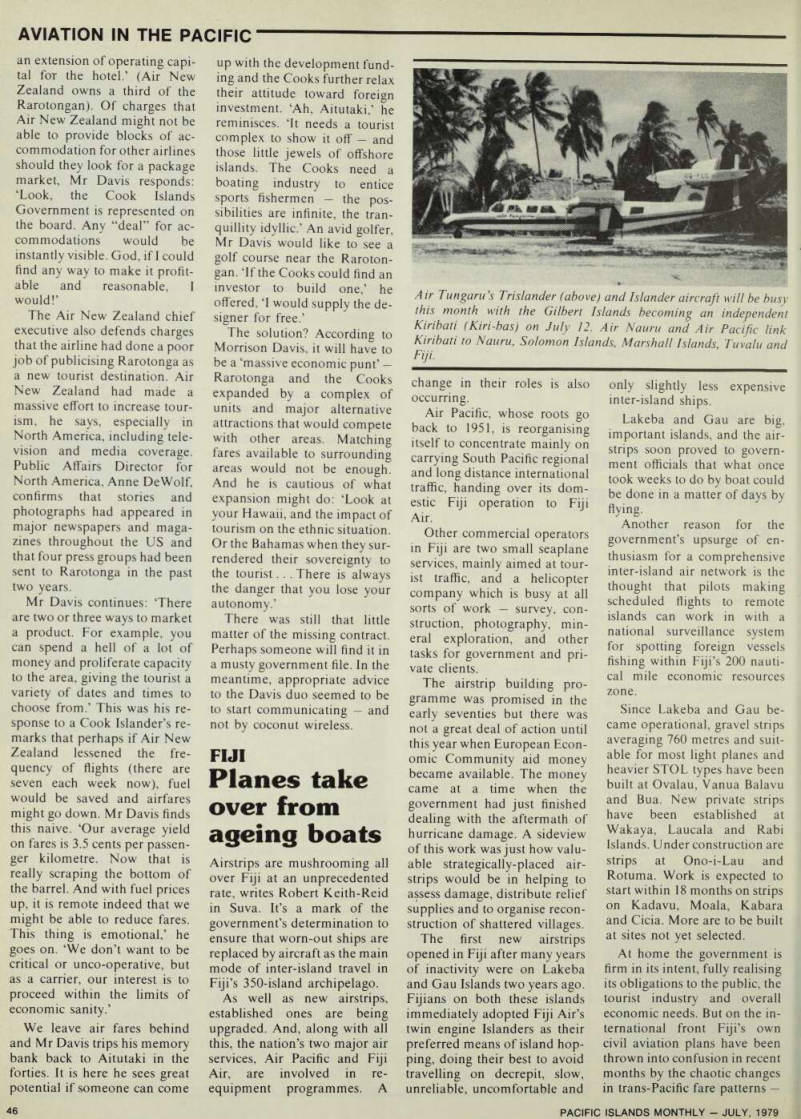
Air Tungaru’s Trislander (above) and Islander aircraft will be busy this month with the Gilbert Islands becoming an independent Kiribati (Kiri-bas) on July 12. Air Nauru and Air Pacific link Kiribati to Nauru, Solomon Islands, Marshall Islands, Tuvalu and Fiji.
actual, promised and threa tened.
The government has also been alarmed at the decision by Qantas to overfly Fiji on flights to and from North America and by indications that other major international operators may curtail their ser vices to or through Fiji. Any reduction of flights affects the tourist industry and cuts land ing fee revenue needed for the upkeep and improvement of Nadi international airport.
At the time the air fares rev olution broke, Fiji had just concluded satisfactory talks with the United States and was planning more with New Zealand and Australia. Air Pa cific was thinking in terms of
leasing DCBs, Boeing 7075,
even wide-body DC 10s, to handle planned long range ser vices to Honolulu, Sydney and Melbourne by the end of the year. These plans have now been shelved indefinitely. ‘We’re marking time now,’ said Air Pacific’s general manager
Captain Alan Bodger. ‘Until
fares are sorted out and
stabilised it is difficult to
plan.’
To Air Pacific, it now seems that the lower excursion fares being touted will make it unprofitable to acquire old DCBs or 707 s as it had first envisaged. The next step, after Air Pacific’s short-haul BAG 1-1 Is, will probably be a wide bodied jet, possibly of a type still on some American or
European drawing board. In
the meantime Air Pacific will make do with the 1-1 Is.
Air Pacific, owned by a con sortium of the Fiji Govern
ment (75%), Qantas, Air New Zealand and the governments of Tonga, Western Samoa, Solomon Islands, Kiribati and Nauru, has a fleet of three 1-1 Is, two 40-seat HS74Bs and two Trislanders. It has a staff of more than 500 and a route network of 22 000 kilometres.
BAG 1-1 Is fly from Fiji to Auckland, Brisbane, Nuku alofa, Honiara, Vila, Noumea, Apia and Pago Pago. The HS74Bs run internally (Suva, Nadi and Labasa) and service Tuvalu and Kiribati to the north of Fiji. The Trislanders, carrying 15 passengers, operate from Nausori to Bua, Savusavu and Taveuni.
The Trislanders will be sold when Fiji Air takes over the Savusavu and Taveuni services in September, and be replaced by two SFI million 18-seat Brazilian Bandeirantes which will be used for the Suva-Nadi and Suva-Labasa shuttle ser vices, and to the island of Rotuma to the northwest when an airstrip is opened at the end of the year. They will also be used to Tuvalu and as back-up for other international ser vices.
If an option on two more Bandeirantes is taken up next year or in 1981, the HS74Bs will probably be sold.
After showing $3 million in
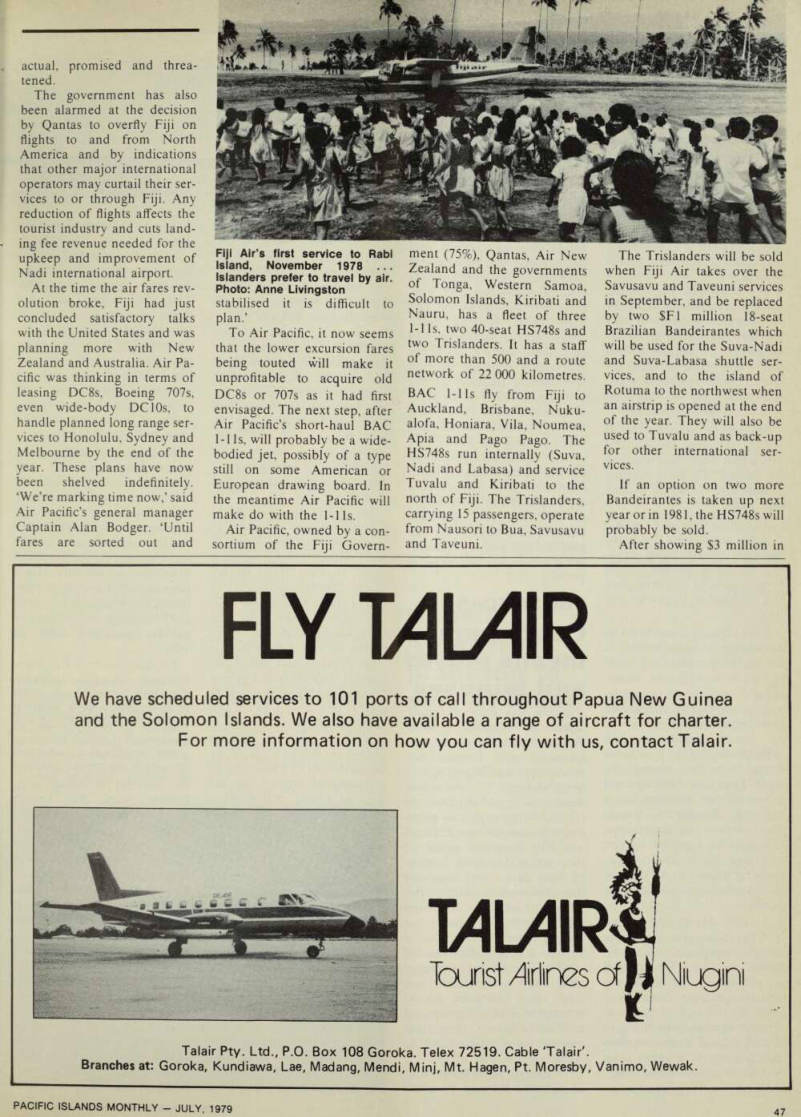
Fiji Air’s first service to Rabi Island, November 1978 ...
Islanders prefer to travel by air.
Photo: Anne Livingston
losses between 1972 and 1976, Air Pacific made a $626 000 profit in the year ended March 1978 when it carried 282 777 revenue passengers and flew two million tonne kilometres of cargo.
Fiji’s air negotiations with New Zealand and Australia are expected to boost passenger traffic from these countries.
The general feeling is that the BAC 1-1 Is will be kept full and busy and comfortable profit earners.
The deal with the United States allows Air Pacific to fly to Hawaii, Majuro in the Marshall Islands and to two cit ies on the US mainland. De cisions are yet to be made on how to exploit these new rights.
Almost certainly the long hops
will be on ice indefinitely.
Meanwhile Air Pacific is talking to Qantas about a deal in which it would buy space on
the Boeing 747 s the Australian
airline runs between Sydney and Nadi.
To some extent. Air Pacific’s regional services are tied to the outcome of air rights nego tiations with Islands neigh bours, anxious to strengthen the position of their own air lines.
After early days in which Fiji Air went close to bankruptcy it is now firmly established. Prof itable since 1976, its share holders include the govern ment (nearly 25%). Hawker de Havilland Australia and about
30 private companies and
individuals. In May it took de livery of its first 19-seat 200 series Twin Otter which joined a fleet of four Islanders and a five-seat Beechcraft Baron.
The company also maintains a Queenair for a marine salvage company under an arrange ment by which Fiji Air can use the Queenair as back-up when needed.
In 1977 Air Pacific carried 37 000 passengers on these routes compared with the 39 800 carried by Fiji Air on all its routes and the 50 000 the smaller operator carried last year. By the end of this year Fiji Air expects to be flying to the islands of Koro and Ono and possibly to Kadavu if an airstrip is completed in time.
Fiji Air in May began nego
tiations to lease two amphib ians, a Mallard and a Widgeon, from a New Zealand company.
These should be in service by the end of the year, catering for outer island hotels and islands not yet with airstrips.
Fiji Air general manager Martin Tyler said the decision to buy the $5OO 000 Twin Otter was made because of the need for equipment with a much
bigger carrying capacity and
higher speed than the nine-seat Islanders in view of the expan sion facing the company. Fuel costs were another factor. The Twin Otter, burning much
cheaper jet fuel and carrying 19
passengers, was a much better proposition than the aviation fuel-burning Islander. By the end of next year Fiji Air plans to have two more Twin Otters and to have sold its Islanders while keeping the Baron.
Although still carrying about
$4O 000 in accumulated losses
from early days, Fiji Air paid
a 5% dividend to shareholders in 1977 and 1978. Revenue passed $1 million for the first time last year and expenditures left it with an $B3 000 operating profit.