'strangers’
pp. 45-46 · Read in the full issue
Cook Islands
A 'lost’ contract and passing 'strangers’
Confusion. Despair. Just two of the ingredients in a rather unhappy state of affairs which exists oxer aviation between the Cook Islands and New Zealand. Sheree Lipton, in Honolulu, recently inter viewed the two main figures in this confrontation Cook Islands Premier Dr Tom Davis and his Air New Zealand namesake, chief executive and general manager Morrison Davis.
The combatants are now in their respective corners: Cooks Premier Tom Davis in his
tropically-heated government
office in Rarotonga; Air New Zealand’s Morrison Davis but toned up in an Auckland win ter. It is all very civil. There’s no slanging match. Not even direct combat between the two gentlemen. But the issue is grave and communications seem to have broken down.
I met them both in Hawaii recently. Dr Davis was in town, resting after an intensive three country Pacific tour exploring the possibility of a triangular
package tour with Rarotonga
at the apex. Morrison Davis turned up two days later.
Tiare tahiti flower behind his ear, the premier asks: ‘Where is the contract? No one seems to have a copy of it in Raro
tonga.’
He is talking about an agree ment between the former Cooks administration of Sir
Albert Henry and the New Zealand Government, made about 1969. Rumour has it that it gives exclusivity to Air New Zealand for 21 years to fly to and from Rarotonga. What’s on his mind, really, are the pre sent air fares. ‘They are just too high,’ he says. ‘How can we compete when airlines such as Continental offer far more
appetising packages and lower
airfares to countries with
higher mileage break
downs ...’ (Continental, for example, offers a standby fare to Nadi, Fiji, from Honolulu a distance of 5000 km for SUSIOO one way year round; Air New Zealand round-trip tickets from Honolulu to Raro tonga, for example, a distance, return, of about 9300 km, is a minimum of $432 on budget fares involving restrictions such as 30 day advance pur chase, and travel date uncon firmed until a week or two
before departure.
Dr Davis says his concern is for the ‘little people’ of Raro tonga those who wanted to get in on the expected tourist boom, who wanted the expected overflow from the
sparkling Rarotongan Hotel,
opened in 1977, which now has, with a new extension, 151 rooms. Unfortunately, the Rarotongan is running at around 50% capacity most of the time. The balance of 380 rooms in Rarotonga are cer
tainly not getting the
occupancy anticipated for them. Loans are due now and concern is mounting all round
in Rarotonga.
Dr Davis feels there is little co-ordination of Air New Zealand flights and poor pro motion of Rarotonga as a tour ist destination. ‘lf ANZ would lower its fares, we could really tie in with Honolulu or Van couver to Rarotonga ... we could do an interesting tour with perhaps a triangular desti
nation including Apia and
Pago Pago!
Two days later I arrange an interview with Morrison Davis, Air New Zealand’s chief, who
by coincidence is passing
through Hawaii on his way back to Auckland. Mr Davis has been with Air New Zealand since 1941 and has spent time in the Cook Islands in his days as a traffic super visor in the late forties. In the sixties he was an adviser to government in determining when the Rarotonga airport would be constructed and its feasibility. He has watched with a critical eye the outlay of SNZ4 million for the airport construction and the current annual expenditure of around $5OO 000 for its maintenance.
I ask him where the contract is. “We don’t have it,’ he replies, and explains that the agreement was between the two governments, not Air New Zealand and the ‘government of the day’ as he calls it. He re calls, however, that it was a
relatively simply understand
ing. The New Zealand Govern ment agreed to realign and reconstruct the necessary strip to accommodate jet aircraft and, in return, for 21 years after the signing of the contract, New Zealand would have ‘special privileges in terms of
determination of carriers’. He continues: i share the prem ier’s distress that it has not de veloped in the way I had
hoped. We are sympathetic
with the Cooks’ needs in trans port and tourism development ... Pan Am and UTA do have landing rights into Rarotonga.
We have never imposed restric tions on the American car rier.’
What about lower fares, should Pan Am, or perhaps Continental wish to fly into Rarotonga? ‘The agreement with the United States,’ Mor rison Davis replies, ‘is that both administrations will agree with the level of fares that both their carriers apply for. We’re losing money on it hand over foot we’ve just gone to our board for
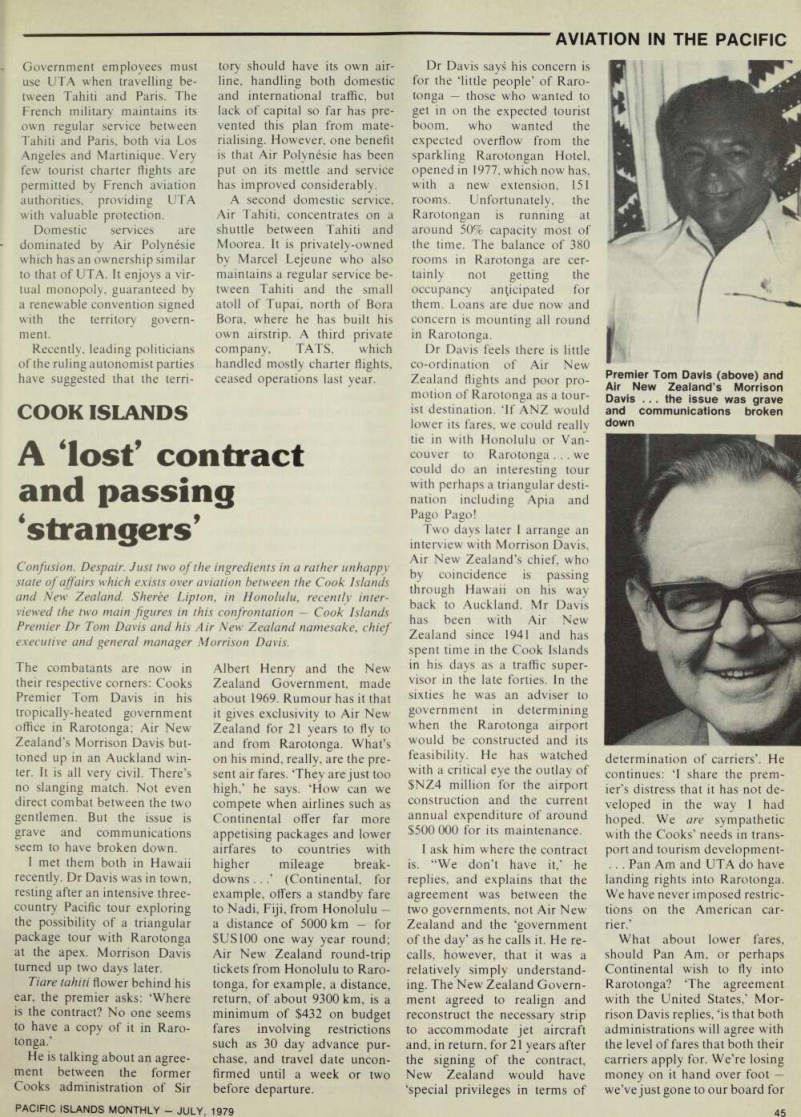
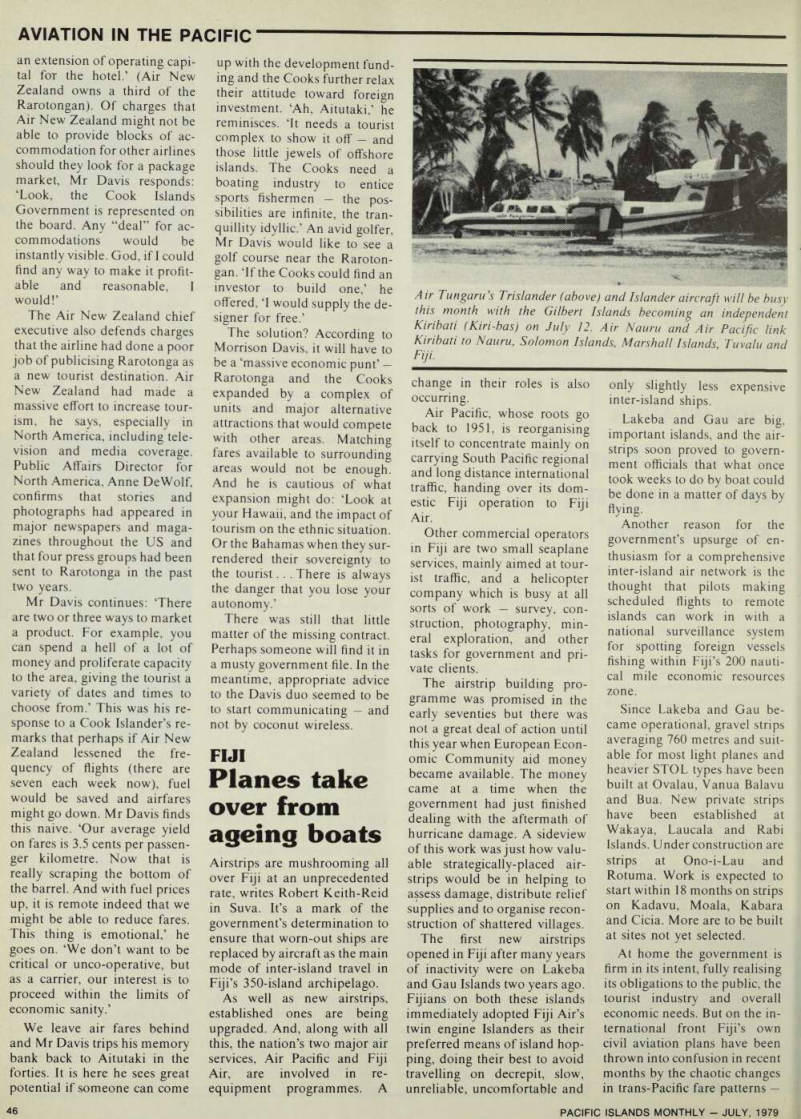
Premier Tom Davis (above) and Air New Zealand’s Morrison Davis ... the issue was grave and communications broken down
an extension of operating capi tal for the hotel.’ (Air New Zealand owns a third of the
Rarotongan). Of charges that
Air New Zealand might not be able to provide blocks of ac commodation for other airlines should they look for a package market, Mr Davis responds; ‘Look, the Cook Islands Government is represented on the board. Any “deal” for ac commodations would be instantly visible. God, if I could find any way to make it profit able and reasonable, I would!’
The Air New Zealand chief executive also defends charges that the airline had done a poor
job of publicising Rarotonga as
a new tourist destination. Air New Zealand had made a massive effort to increase tour ism, he says, especially in North America, including tele vision and media coverage.
Public Affairs Director for North America, Anne DeWolf, confirms that stories and photographs had appeared in major newspapers and maga zines throughout the US and that four press groups had been sent to Rarotonga in the past two years.
Mr Davis continues: ‘There are two or three ways to market a product. For example, you can spend a hell of a lot of money and proliferate capacity to the area, giving the tourist a variety of dates and times to choose from.’ This was his re sponse to a Cook Islander’s re marks that perhaps if Air New Zealand lessened the fre quency of flights (there are seven each week now), fuel would be saved and airfares might go down. Mr Davis finds this naive. ‘Our average yield on fares is 3.5 cents per passen ger kilometre. Now that is really scraping the bottom of the barrel. And with fuel prices up, it is remote indeed that we might be able to reduce fares.
This thing is emotional,’ he goes on. ‘We don’t want to be critical or unco-operative, but as a carrier, our interest is to proceed within the limits of
economic sanity.’
We leave air fares behind and Mr Davis trips his memory bank back to Aitutaki in the forties. It is here he sees great potential if someone can come
up with the development fund ing and the Cooks further relax their attitude toward foreign investment. ‘Ah, Aitutaki,’ he reminisces. ‘lt needs a tourist complex to show it off - and those little jewels of offshore islands. The Cooks need a
boating industry to entice
sports fishermen the pos sibilities are infinite, the tran quillity idyllic.’ An avid golfer, Mr Davis would like to see a golf course near the Raroton gan. ‘lf the Cooks could find an investor to build one,’ he offered, i would supply the de signer for free.’
The solution? According to Morrison Davis, it will have to be a ‘massive economic punt’
Rarotonga and the Cooks expanded by a complex of units and major alternative attractions that would compete with other areas. Matching fares available to surrounding areas would not be enough.
And he is cautious of what expansion might do: ‘Look at your Hawaii, and the impact of tourism on the ethnic situation.
Or the Bahamas when they sur rendered their sovereignty to the tourist... There is always the danger that you lose your
autonomy.’
There was still that little matter of the missing contract.
Perhaps someone will find it in a musty government file. In the meantime, appropriate advice to the Davis duo seemed to be to start communicating and not by coconut wireless.