means pluses
pp. 48-49 · Read in the full issue
The Samoas
Continental means pluses and minuses
Aviation was once a simple affair in Western Samoa.
Polynesian Airlines chugged
backward and forward be tween Apia and Pago Pago in
neighbouring American
Samoa, using ancient Dakotas (DC3s), happy to pick up what ever business Air New Zealand and Pan American cared to drop off in American Samoa.
In those days it was what air line accountants called the ‘ethnic market’ Samoans either going overseas or
coming home.
Now it’s very different. A combination of new manage ment, new government and fresh ideas has given a new concept to what airlines mean to Western Samoa: they mean money, writes Mike Field in
Apia.
To the symbol of Polynesian at Faleolo, Western Samoa’s
international airport, have been added those of South Pa cific Islands Airways (SPIA), Air Pacific, Air Nauru and Air New Zealand. SPIA is a Pago Pago-based outfit which shuttles between the two Samoas and provides an island
hop service down through
Tonga to Nukualofa. Air Pa cific flies in twice a week from Suva and Air Nauru drops in on Saturdays. Air New Zealand serves Faleolo twice a week, calling once a week at Tafuna international airport in American Samoa.
Divided Samoa gives rise to the unfortunate situation of having two international air ports within 150 km of each other, between them serving about 200 000 passengers a year. Tafuna, a long, solid mili tary airport, can take the
heavyweight jumbo and wide
bodies of Pan American, Air New Zealand and now Con tinental. Faleolo is not geared for anything bigger than a Boe ing 737 or a BAC 1-11 but still it’s a busy airport.
National pride in Western Samoa has played a part in the establishment of Faleolo as an international airport but the hope of a cold cash profit is
more significant.
Most Western Samoans who travel do so to New Zealand.
They used to go to Tafuna on Polynesian and then take Air New Zealand to Auckland.
Today, almost all fly direct to New Zealand from Faleolo.
Prime Minister Tupuola Efi’s government and the new management of Polynesian under Terry Betham realised that both country and airline could save, even make money, if American Samoa was by passed. Probably they would have liked to have left Air New Zealand out as well but, bilat eral air agreements being what
they are. that was not poss ible.
So. for a year now, Samoans have been able to fly between Western Samoa and New Zealand four times a week, two flights by Air New Zealand, two by Polynesian. Both use the same 737, Polynesian char tering the aircraft from Air New Zealand. As well as
increasing Polynesian’s rev
enue, an added bonus is that more of the money earned stays in Western Samoa.
Earlier this year Polynesian was toying seriously with the idea of buying its own 737 but when it was announced that Continental would be coming into the South Pacific and new cheap fares were to be introduced it decided to defer a decision to see how things panned out. However, in May it took the plunge and ordered a 737, leasing a jet until its
delivery sometime early in
1981.
Looking in other directions, Polynesian is keen to expand.
Already it flies to Niue and the Cook Islands once a week. It wants to extend to Tahiti. For this service it would either use a 737 (if it decides to buy) or its two HS-7485. The Tahiti ser vice depends on current nego tiations with the French Government.
So far, the service to Raro tonga in the Cooks has cost money. However, this is one of the areas that Continental’s coming to the South Pacific could be of benefit to Polynesian. Continental would bring in passengers from the outside and Polynesian, being the only airline serving the bet ter part of Polynesia from within the region, could take them on from there.
Within Western Samoa, Polynesian operates daily flights between the two main islands, Upolu and Savai'i, using two Britten Norman
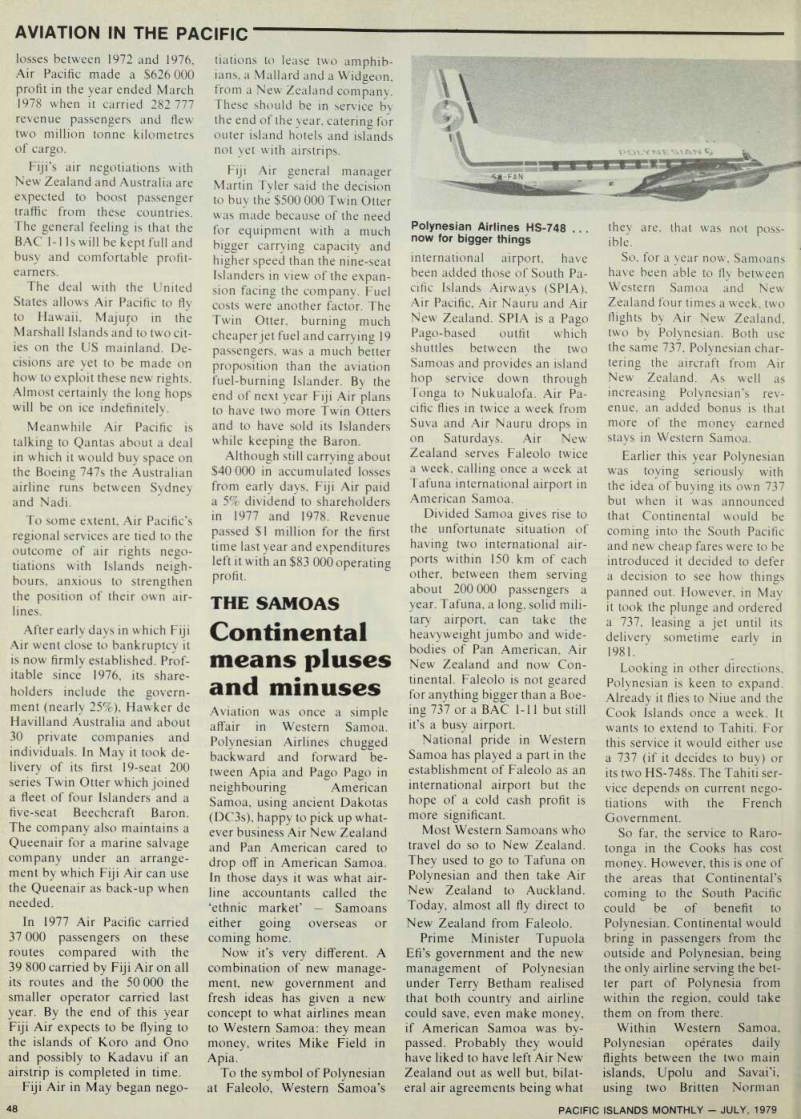
Polynesian Airlines HS-748 ... now for bigger things
Islanders and one of Australia’s Nomads.
SPIA makes its money out of short flights, using the popular 18-seat Twin Otter. It has two of these operating on a daily shuttle between the two Samoas. Owned by a group of Pago Pago businessmen SPIA also plays a vital role in linking the Tongan islands and pro vides the only service to the re mote Manu’a Islands in eastern American Samoa.
For American Samoans, Continental’s coming is a boon.
The main traffic out of this US territory is northbound an ethnic market to Hawaii and California. Over the past two years Pan American the only line on that route until May has been cutting back its ser vices: first it dropped to two a week, then one.
The American Samoa Government lobbied strongly the US Civil Aeronautics Board (CAB) for an improve ment in services. At one point SPIA seemed on the verge of chartering a 737 to operate to Hawaii via Christmas Island.
However, approval to Con tinental to come in made this unnecessary. CAB also has granted rights to two other air lines to operate into Pago Pago from the US mainland but they
have not indicated yet if they will take them up.
Continental’s days are yet young but both SPIA and
Polynesian expect to profit
from its five services a week. In the past, tourists have been frustrated by arriving in Island capitals and then discovering that there were scheduled flights to nowhere. That has changed and now they can get around on a pre-planned route in a specific time and take advantage of special tourist fares on selected routes, for example, Samoa to Niue to Tonga to Fiji and back to Samoa.
Pago Pago’s lack of holiday accommodation means there will certainly be an overflow of the several hundred tourists Continental drops off each week at Tafuna. Apia should be able to mop up its share of them.
Nowadays, while the ethnic market is no smaller in the Samoas, the tourist traffic is much bigger and carriers are spending money on image pro motion to grab a share of it.
Continental is doing its bit by routing passengers onto re gional carriers. Air New Zealand, on the other hand, views airlines like Polynesian as competition, and this atti tude has led to delicate politi cal situations.
Western Samoa and New Zealand had long, detailed and tough negotiations before the direct Apia-Auckland service was agreed to. Samoa, with few skilled negotiators, feels itself at a disadvantage in such nego tiations.
With the passing of passen-
ger shipping and with Samoans loving to travel it’s not surpris ing that aviation is a hot politi cal issue in Apia. People are intensely interested in the cost of flying to themselves. The Apia government is keen to give the people as cheap a deal as possible but, at the same time, it is faced with the reality of operating costs. One un pleasant fact which has made itself clear is that 737 s are just not suitable for low budget fares, particularly in the light of Polynesian’s limited mileage.
There’s no way it can use one route to subsidise another.
It is on the Samoa-New Zealand run that Polynesian faces the biggest threat to its existence. That’s the bread and butter route. If Polynesian falls by the wayside, would Con tinental step in to provide a regular service for the Western Samoa market? Unlikely.
There’s no doubt, aviation is a high risk venture for the Western Samoas of this world.
While big airlines lodge bulk orders, Polynesian orders one aircraft at $l2 million knowing full well that last year its total export earnings were only $8 million.
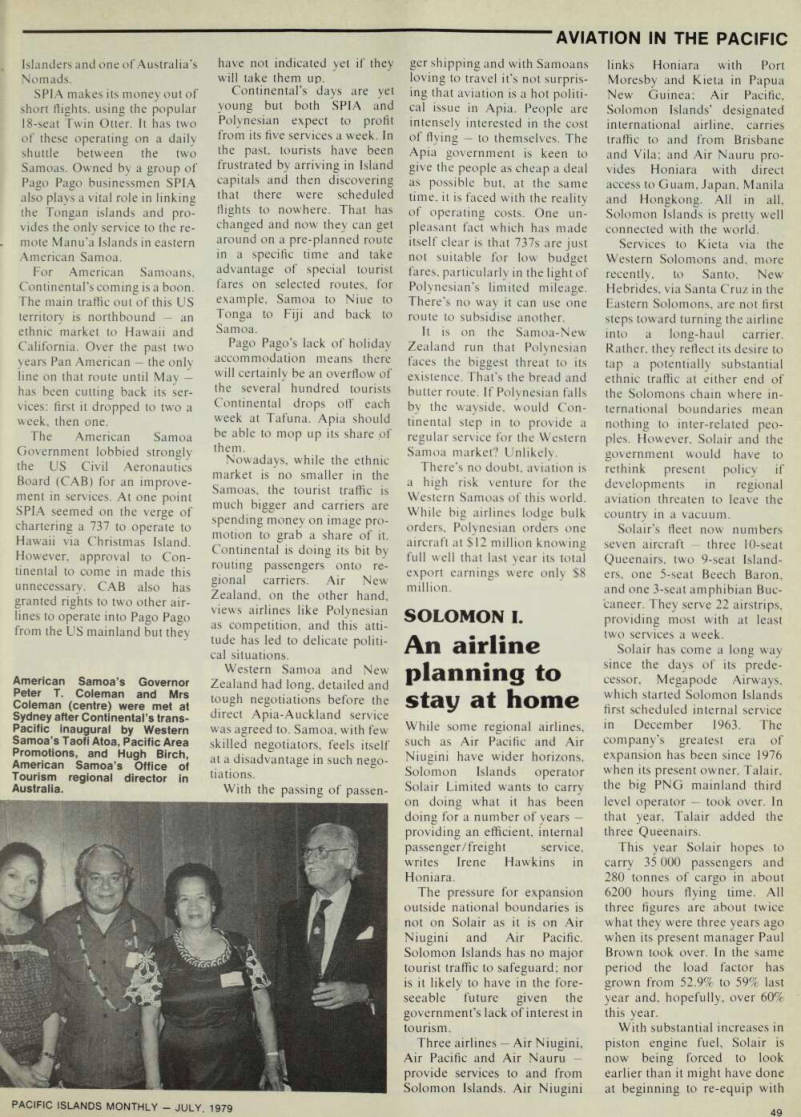
American Samoa’s Governor Peter T. Coleman and Mrs Coleman (centre) were met at Sydney after Continental’s trans pacific inaugural by Western Samoa’s Taofi Atoa, Pacific Area Promotions, and Hugh Birch, American Samoa’s Office of Tourism regional director in Australia.