Big Terms For
pp. 27-32 · Read in the full issue

Political
Currents
Papeete ‘Eight’
Although sentenced in February to a 10-year-term to be served in French prisons (PIM April), the Tahitian independence fighter Charlie Ching was very much present in people’s minds during a more recent trial in Papeete, write Marie-Therese and Bengt Danielsson. Before the court were the eight inmates of the territorial prison who organised a bloody riot in January 1978 (PIM April 1978). From beginning to end, the 37-year-old ringleader.
Manuel (‘Manu’) Tauhiro. and his seven much younger fellow defendants, echoed the accu sations of Charlie Ching and his Toto tupuna ‘liberation army’ that France is poisoning the whole population with its nuclear tests and maintaining an old-fashioned colonial rule against the will of the
Polynesian people.
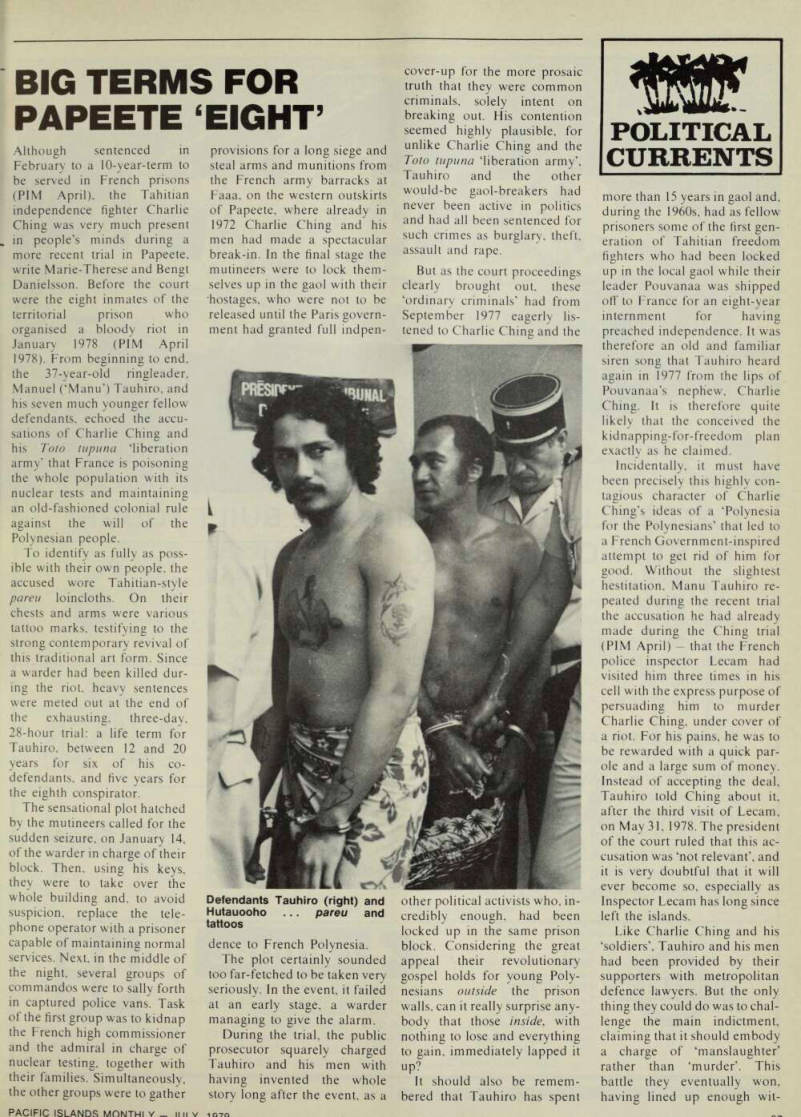
To identify as fully as poss ible with their own people, the accused wore Tahitian-style pareu loincloths. On their chests and arms were various tattoo marks, testifying to the strong contemporary revival of this traditional art form. Since a warder had been killed dur ing the riot, heavy sentences were meted out at the end of
the exhausting, three-day,
28-hour trial: a life term for Tauhiro, between 12 and 20 years for six of his co defendants, and five years for
the eighth conspirator.
The sensational plot hatched by the mutineers called for the sudden seizure, on January 14. of the warder in charge of their block. Then, using his keys, they were to take over the whole building and, to avoid suspicion, replace the tele phone operator with a prisoner capable of maintaining normal services. Next, in the middle of the night, several groups of commandos were to sally forth in captured police vans. Task of the first group was to kidnap the French high commissioner and the admiral in charge of
nuclear testing, together with
their families. Simultaneously, the other groups were to gather
provisions for a long siege and
steal arms and munitions from the French army barracks at Faaa, on the western outskirts of Papeete, where already in 1972 Charlie Ching and his men had made a spectacular break-in. In the final stage the mutineers were to lock them selves up in the gaol with their hostages, who were not to be released until the Paris govern ment had granted full indpen-
dence to French Polynesia.
The plot certainly sounded too far-fetched to be taken very seriously. In the event, it failed at an early stage, a warder managing to give the alarm.
During the trial, the public prosecutor squarely charged Tauhiro and his men with having invented the whole story long after the event, as a
cover-up for the more prosaic truth that they were common criminals, solely intent on breaking out. His contention
seemed highly plausible, for
unlike Charlie Ching and the Toto tupuna ‘liberation army’, Tauhiro and the other would-be gaol-breakers had never been active in politics and had all been sentenced for such crimes as burglary, theft, assault and rape.
But as the court proceedings
clearly brought out, these
‘ordinary criminals’ had from
September 1977 eagerly lis
tened to Charlie Ching and the
other political activists who, in credibly enough, had been locked up in the same prison block. Considering the great appeal their revolutionary gospel holds for young Poly nesians outside the prison walls, can it really surprise any body that those inside , with nothing to lose and everything to gain, immediately lapped it up?
It should also be remem bered that Tauhiro has spent
more than 15 years in gaol and, during the 19605, had as fellow prisoners some of the first gen eration of Tahitian freedom fighters who had been locked up in the local gaol while their leader Pouvanaa was shipped off to France for an eight-year internment for having
preached independence. It was
therefore an old and familiar siren song that Tauhiro heard again in 1977 from the lips of Pouvanaa’s nephew, Charlie Ching. It is therefore quite likely that the conceived the
kidnapping-for-freedom plan
exactly as he claimed.
Incidentally, it must have been precisely this highly con tagious character of Charlie Ching’s ideas of a ‘Polynesia for the Polynesians’ that led to a French Government-inspired attempt to get rid of him for
good. Without the slightest
hestitation. Manu Tauhiro re peated during the recent trial the accusation he had already made during the Ching trial (PIM April) that the French
police inspector Lecam had
visited him three times in his cell with the express purpose of persuading him to murder Charlie Ching, under cover of a riot. For his pains, he was to be rewarded with a quick par ole and a large sum of money.
Instead of accepting the deal, Tauhiro told Ching about it, after the third visit of Lecam, on May 31, 1978. The president of the court ruled that this ac cusation was ‘not relevant’, and it is very doubtful that it will ever become so, especially as Inspector Lecam has long since left the islands.
Like Charlie Ching and his ‘soldiers’, Tauhiro and his men had been provided by their supporters with metropolitan defence lawyers. But the only thing they could do was to chal lenge the main indictment, claiming that it should embody
a charge of ‘manslaughter’
rather than ‘murder’. This battle they eventually won, having lined up enough wit
Defendants Tauhiro (right) and Hutauooho ... pareu and tattoos
- nesses to prove that the original intent of the mutineers was simply to overpower the first warder who came into their block in the afternoon of the fateful day, January 14, 1978.
Unfortunately, this happened to be Pau Hoatua, a real giant, who resisted so forcefully that they felt obliged to beat him unconscious with their trun cheons, which consisted of wooden table legs. Eventually Pau, who, ironically, was the kindest and best liked of all the warders, died from the savage beating.
During the trial, the mutineers all expressed great regret at having ‘accidentally’ killed Pau. This of course could be interpreted as merely an attempt to get off with lighter sentences. However, the mov ing appeals they made in the courtroom to Pau’s widow,
imploring her forgiveness, cer
tainly had the ring of sincerity.
In their final statements, made just before the jury began its
five-hour-long deliberations,
the defendants also seemed to speak more from their hearts than during their previous de
positions. The question they all
asked was whether it was less criminal to kill people slowly with radioactive poison than to
despatch somebody quickly in
an ambush.
One of the defendants, who had refused legal assistance, read a very well chosen passage from the Bible, the Epistle to the Romans VII: 15-25. In the end, however, he too agreed to sign the common appeal to a higher French court, on the grounds that the sentences handed down corresponded to the abandoned charge of mur der and were thus too heavy for the actual indictment of man
slaughter.
Just for the record, it should be noted that the defence law yers had at the outset strongly protested, in what has now be come standard procedure at all trials, at the very strange way justice is administered in
French Polynesia.
Not only are the jurors fewer in number than in France three instead of nine but they are drawn exclusively from the ranks of French and part- French businessmen and government officials, who con
stitute only a small minority of the population, which is 75% Polynesian. To top it all, if a juror is too busy or too scared to do his duty, all he incurs is a fine of a few dollars. At the recent trial, for example, no fewer than nine of the 36 jurors on the panel decided to stay at home, thus restricting the choice available to the pros ecutor and the defence law yers.
The present writers are grati fied that following the recent case, their repeated criticisms of this anachronistic, colonial type justice have at last achieved some result. The local news media recently an nounced that French
Polynesia’s deputies to the
National Assembly in Paris, and a delegation of the terri torial assembly, have taken the matter up with the French minister of justice. The minis ter, much surprised that the century-old system is no longer
acceptable, has promised to
give it the attention it de serves.
Blather On
Barter?
Claims by Bruce Beetham, leader of New Zealand’s Social Credit League, about con clusion of a trade barter deal between Solomon Islands and New Zealand (PIM June) have been branded as ‘transparent politicking of a rather feeble nature’ by New Zealand Prime Minister Robert Muldoon, writes William Gasson from
Wellington.
‘I have received a statement from Solomon Islands Prime Minister Peter Kenilorea
strongly denying Mr Beetham’s
claim that a shipment of Solomon Islands timber consti tutes a new form of trade on a barter basis,’ said Mr Muldoon in a press statement. ‘Mr Kenilorea says the an nouncement by Mr Beetham of the supposed trade deal is “a disturbing state of affairs”, be cause as far as he is concerned, as leader of the Solomon Islands Government, he was never aware of any such trade. ‘Despite the Social Credit claim that Mr Kenilorea sup ported this form of trade. Mr Kenilorea says that it was never
discussed with him personally as prime minister by anyone from overseas.’
As a footnote Mr Muldoon assured Mr Beetham that trade between Solomon Islands and New Zealand was on ‘an excellent footing’, and was con tinuing to grow on normal commercial terms.
Social Credit’s economic spokesman L. W. Hunter claimed in response to the Muldoon statement that Mr Kenilorea had discussed the trade deal with a Social Credit member, Maurice Kenny, who had been responsible for co ordinating the deal. It involved Solomon Islanders selling hardwoods to New Zealand and using money from the sale to buy New Zealand goods,
including milling equipment,
beer, onions and processed
foods. No foreign exchange
was to be involved.
Vila Gaoling
A Protest
The gaoling of Australian businessman David Neave in Vila, New Hebrides, on mu nitions, firearms and drugs charges (PIM June) has brought a vehement protest from fellow Australian Ken Hutton, former member of the New Hebrides Advisory Coun cil, dentist, planter, and long time resident of the island of Santo.
In a letter to the Australian consul in Vila, Bill Fisher, cop ies of which have been sent to other addressees, including PIM, Mr Hutton writes: ‘There are as far as I know two companies who have the right to import arms and ammu nition into the group. I do not know the situation in Vila, but neither of the branches of the companies in Santo has had stocks for years. I am advised by the merchandise manager of one of the companies that they have been applying for permits to import for over two years, but these have gone unan swered by the residencies.
Further, on the rare occasions when stocks do appear, they find their way on to the black market. The balance of the car tridges sold in this town are smuggled. And no wonder. A packet of .22 cartridges costs
about SA2 at the source. The duty is 154% plus 3FNH per round. In the case of military calibre the rate of duty is 200%.
So much for cartridges legally imported, at a rate of duty which encourages people to smuggle them. Even the cus toms department considers this to be extraordinary. ‘Where then are these car tridges used, the legal and il legal ones? I suppose there would be 10 000 head of cattle killed in the Northern and Central No 2 Districts each year, to say nothing of pigs, pigeons and flying foxes. As a planter I am forced to buy car tridges on the black market for the legitimate use of knocking cattle in my slaughter house. I pay 500 FNH per packet of 50 rounds as a rule. I am advised by the captain of an island
trading ship that they fetch
1500 NHF in the outer islands.
This then is the motive behind the smuggling of cartridges, a good turn of profit, and not the
sinister motives suggested by
such journals as Noumea’s France Australe and Vila’s
Nabanga, whose hysterical
treatment of the subject sought to make a political issue out of something which was simply a commercial venture. David Neave is not a revolutionary or
insurrectionist, as they would like their readers to think. ‘lncidentally, I can buy car tridges at four or five outlets in Santo, and I have never bought a packet of cartridges from David Neave.’
On the firearms charge, Mr Hutton wrote: ‘The blow-up by the press on the number of rifles found at David’s house was certainly designed to de fame him. To anyone who knows David this is not surpris ing. David is a gun buff, he is an amateur gunsmith, has an extensive library on guns and their history and has constantly been engaged over the years in
fixing, derusting and blueing
guns for his friends . . . This as pect of his character was of
course overlooked by Nabanga.
All they could do was remind their readers that David was a candidate in the municipal elections on a ticket of the National Party (former name
of today’s Vanuaaku Party
PIM), undoubtedly a heinous sin in the eyes of Nabanga. ‘As I see it the only sin David committed was to get caught how many others are in the same business and have avoided detection? What about the rumour that the brother of a minister was found at Bauer Field importing a tin of lollies.
which proved to be a tin of car tridges? I would like to know if there is any substance in that story. And what about a certain vessel that makes regular calls to these waters, and has an extraordinary arms list... It would also be interesting to see the prominent names on a list of clients who habitually pur chase cartridges on the black market pour la chasse. Are they too guilty of crime?’
On the reference to cannabis in the charges, Mr Hutton wrote: T suppose the people who wrote the newspaper articles would be too ignorant to know that cannabis grows wild in the Santo bush.
Finally, on the legal aspects of David Neave’s case, Mr Hut ton wrote: ‘As a Britisher I also protest against the draconian legal sys tem which we currently all live under. For years we fondly thought we had the best of two worlds, British justice and French cuisine and God help us, we used to say, if it was ever reversed. ‘But apparently we have had a reversal of the legal system under the new interim law re form, a matter in which we had no voice or protest. Having been weaned on the British sys tem, to suddenly find oneself under the Napoleonic code as applied to French colonies is a grave shock to one’s system. To think that a Britisher is “guilty until proved innocent” and can be put away in prison for a maximum of two months with out contact with the outside world, except for his lawyer and his consul, at the pleasure of the procurator-general, is unbelievable. ‘Furthermore I understand that the warrant to search my business premises in Santo, issued because of my associ ation with David, was given by the British judge on the appli cation of the procurator general and without reference to the British police force, who were then asked to conduct the search. Has the British police
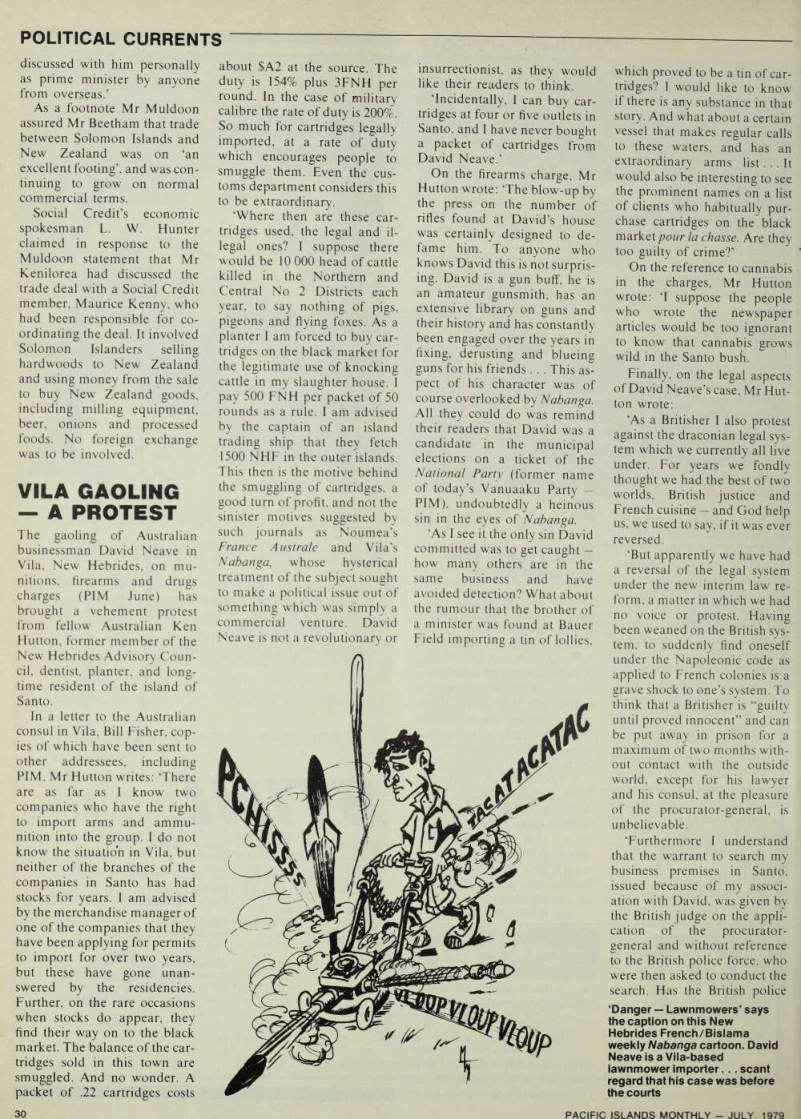
'Danger-Lawnmowers’ says the caption on this New Hebrides French/Bislama weekly Nabanga cartoon. David Neave is a Vila-based lawnmower importer ... scant regard that his case was before the courts
force been completely emas culated? ‘I have the uneasy feeling that anyone politically motiva ted could “salt” anyone’s home with a few rounds of ammu nition and a handful of canna bis seeds, then stir up sufficient
hysteria through the gutter
press, so that any one of us could find himself in prison at the pleasure of the procurator general for a period of two months. In my view a trial by the media is nauseating and alien to British justice.’
Heroin War
On Guam
News that Guam’s heroin kings have drawn up a ‘hit list’ to murder top government officials is the latest in a long series of events here which have highlighted the power
and danger of drug trafficking
in the Pacific, writes Paul Addison from Agana.
Last year on Guam, drug related murders claimed the lives of more than 15 persons, including two Japanese tour ists. This year, with many top heroin dealers behind bars, Guam’s overcrowded prison has seen the brunt of the action
and the virtually bankrupt
government has provided few remedies to quell the exposive situation.
In a May 7 letter to A 1 Pan gelinan, director of Guam’s bureau of the budget, Attorney-General Kenneth North made an almost desper ate plea for money to hire prison guards. ‘At the present time I am fighting a war,’ Mr North wrote. ‘The major heroin traf fickers are on the defensive and are planning to kill several
high-ranking government
officials in retaliation. There is a battle raging for control of the department of corrections prisoners or guards.’ He added: ‘Time is of the essence.
Heroin dealers do not deal through a myriad of bureau
cratic steps. They merely
obtain a weapon and kill some body. I am not overly dramatis ing. The situation is critical
today.’
In the past six months the prison dangers have been illus trated by a continuing saga of
murders, beatings, escapes and arrests.
For the small group of prison officials, life has been a con stant battle to man the prison and keep the inmates in line. In February, Governor Paul M.
Calvo appointed hard-liner James Miles as director of the department of corrections, an appointment which brought applause from some quarters and fear of further troubles from others.
Mr Miles, 43. an army vet eran, has planned no-nonsense stances on discipline, parole and prison gangs. Of the more than 120 inmates, he said re cently, he thought it would be possible to rehabilitate 75% if conditions could be improved.
His planned disciplines include
military crewcuts, roll-calls and
platoon drills.
To many, the problems that now exist within the prison are testimony that many of the top drug traffickers are in fact be hind bars. They point out that
so far this year there have been few drug-related murders on the island and that robberies and violent crimes have fallen
dramatically.
However, optimistic con clusions that trafficking has dried up were temporarily muted with the May 16 arrest of a family of four, including a 51-year-old woman, for pos
sessing heroin. When police
raided the Dededo store and home of the Shimizu family they found five bundles of her oin. SUS3OO worth of mari juana, numerous barbiturates
and amphetamines, three fully
loaded unregistered rifles and more than $6OOO in cash.
Although police officers say they think they have captured one of the few remaining high level dealers on the island, they cautiously acknowledge that the heroin scene is far from dead on once idyllic Guam.
Governor Paul M. Calvo ... put ting a hard-liner in charge of the gaol