Court ruling puts
pp. 32-34 · Read in the full issue

Tupuola in a fix
The recent decision by the chief justice of Western Samoa voiding four election results on the grounds of ‘bribery’ and
‘treating’ is having widespread
repercussions in Western Samoa’s political life, writes Felise Va’a in Apia.
In the first place, the de cision has meant the loss of parliamentary seats for three of Prime Minister Tupuola’s sup porters. This in turn has led to a situation where, at the time of writing, a minority govern ment is ruling the country.
Tupuola’s supporters in parlia ment now number 21 against 22 for the Human Rights Pro tection Party headed by Vaai Kolone.
In the second place, Chief Justice Bryan Nicholson’s de cision has created a precedent which will bind future courts, and. therefore, future styles of
political campaigning.
Since independence in 1962, the supreme court, last court of resort for election matters, has taken a wary approach to the position of custom and tra dition in the electoral process.
Many election petitions have
come before it seeking nullifi cation of election results on the grounds that bribery and treat ing, both against the electoral act of 1963, had taken place.
Invariably, the court has ruled that since it did not know enough about Samoan customs and traditions it was not in a position to rule on the com plaints, and ended up dismiss ing the petitions. In effect, what the supreme court was doing was side-stepping the issue at least for the time being. With out some deep thinking, it was not in a rush to create a precedent which would be binding on future courts.
That was the position until May of this year when Mr Nicholson brought down his epoch-making decision. From now on, Samoan custom can no longer be used as an excuse for giving out sums of money and gifts of food during election time, a period vaguely defined as beginning at least three weeks before the voting date.
The court will still consider custom justifiable if such cus tom is something that people have been used to for many, many years, and have come to expect. But anything over and above that is likely to be con strued as bribery and treat
ing.
No doubt, the supreme court’s decision is a reflection of continuing public concern over the huge sums of money and food expended for politi cal campaign purposes. Costs of campaigning in Samoa are getting so high they are dis couraging many able potential candidates, and are leading to abuse and corruption of Samoan customs and tra ditions. The latest court de cision, therefore, will probably mean that in future only a fool hardy candidate will give out money and food during cam paign time, and it may be hoped that the man or woman with ability to persuade will carry the day.
The candidates who have lost their seats are: Letiu Tamatoa, minister of economic development, Muliaga Vena, George Lober. and Leota Pita.
By-elections are now sched uled for Saturday, August 18.
As thing now stand, it is not yet certain when the new parlia ment will meet in view of the minority status of government.
If the by-elections result in a majority for the opposition party, then Tupuola will be in deep trouble.
Ringing In
The Fsm
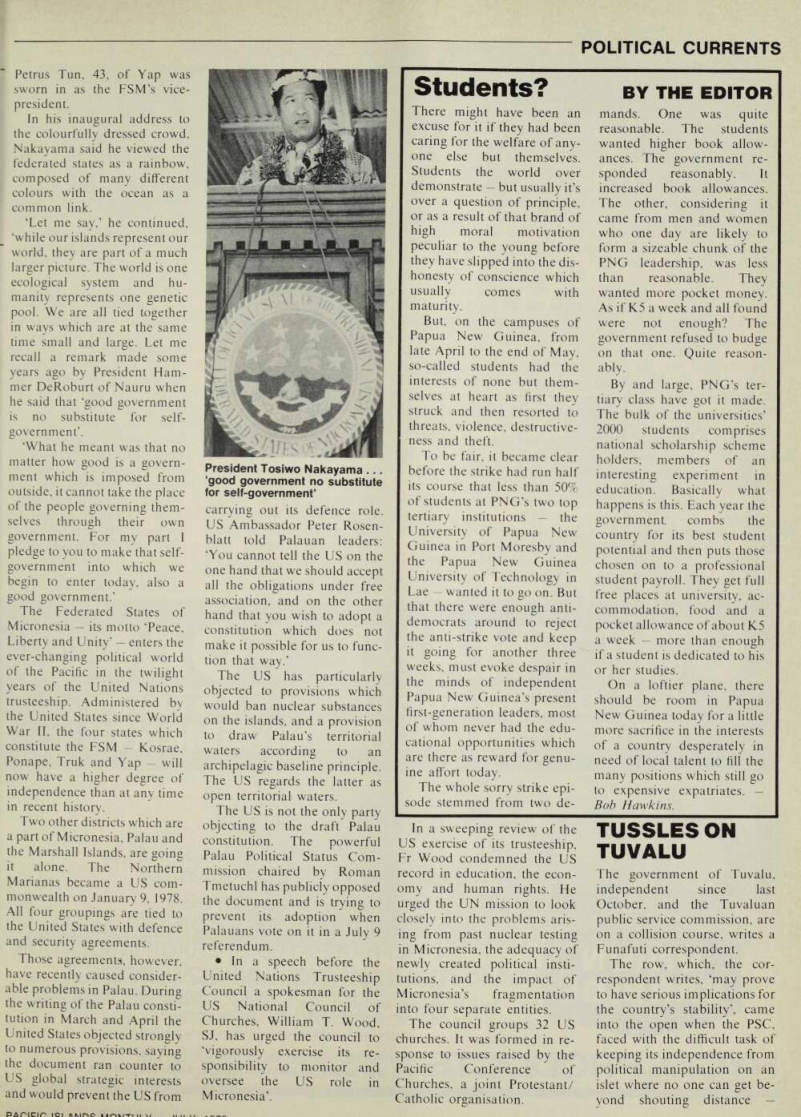
The Pacific’s newest political entity, the Federated States of Micronesia, came of age on May 15 when Tosiwo Nakayama, 47, of Truk, was sworn in as its first president, writes Paul Addison from Guam. As 1500 persons from throughout Micronesia and the Pacific watched, Nakayama received the oath of office from new speaker Bethwel Henry, 45, in a simple ceremony in the capital of Ponape, Kolonia.
Petrus Tun, 43, of Yap was sworn in as the FSM’s vice president.
In his inaugural address to the colourfully dressed crowd, Nakayama said he viewed the federated states as a rainbow, composed of many different colours with the ocean as a common link. ‘Let me say,’ he continued, ‘while our islands represent our world, they are part of a much larger picture. The world is one ecological system and hu manity represents one genetic pool. We are all tied together in ways which are at the same time small and large. Let me recall a remark made some years ago by President Ham mer Deßoburt of Nauru when he said that ‘good government is no substitute for self government’. ‘What he meant was that no matter how good is a govern ment which is imposed from outside, it cannot take the place of the people governing them selves through their own government. For my part I pledge to you to make that self government into which we begin to enter today, also a good government.’
The Federated States of Micronesia - its motto ‘Peace, Liberty and Unity’ - enters the ever-changing political world of the Pacific in the twilight years of the United Nations
trusteeship. Administered by
the United States since World War 11. the four states which constitute the FSM - Kosrae, Ponape, Truk and Yap - will now have a higher degree of independence than at any time in recent history.
Two other districts which are a part of Micronesia, Palau and the Marshall Islands, are going it alone. The Northern Marianas became a US com monwealth on January 9, 1978.
All four groupings are tied to the United States with defence and security agreements.
Those agreements, however, have recently caused consider able problems in Palau. During the writing of the Palau consti tution in March and April the
United States objected strongly
to numerous provisions, saying the document ran counter to
US global strategic interests
and would prevent the US from
carrying out its defence role.
US Ambassador Peter Rosen blatt told Palauan leaders: ‘You cannot tell the US on the one hand that we should accept all the obligations under free association, and on the other hand that you wish to adopt a constitution which does not make it possible for us to func tion that way.’
The US has particularly objected to provisions which would ban nuclear substances on the islands, and a provision to draw Palau’s territorial waters according to an
archipelagic baseline principle.
The US regards the latter as open territorial waters.
The US is not the only party objecting to the draft Palau constitution. The powerful Palau Political Status Com mission chaired by Roman Tmetuchl has publicly opposed the document and is trying to prevent its adoption when Palauans vote on it in a July 9 referendum. • In a speech before the United Nations Trusteeship Council a spokesman for the US National Council of Churches, William T. Wood, SJ, has urged the council to ‘vigorously exercise its re sponsibility to monitor and oversee the US role in Micronesia’.
In a sweeping review of the US exercise of its trusteeship, Fr Wood condemned the US record in education, the econ omy and human rights. He urged the UN mission to look closely into the problems aris ing from past nuclear testing in Micronesia, the adequacy of
newly created political insti
tutions, and the impact of
Micronesia’s fragmentation
into four separate entities.
The council groups 32 US churches. It was formed in re sponse to issues raised by the Pacific Conference of Churches, a joint Protestant/
Catholic organisation.
Tussles On
Tuvalu
The government of Tuvalu, independent since last October, and the Tuvaluan public service commission, are on a collision course, writes a Funafuti correspondent.
The row, which, the cor respondent writes, ‘may prove to have serious implications for the country’s stability’, came into the open when the PSC, faced with the difficult task of keeping its independence from political manipulation on an islet where no one can get be yond shouting distance
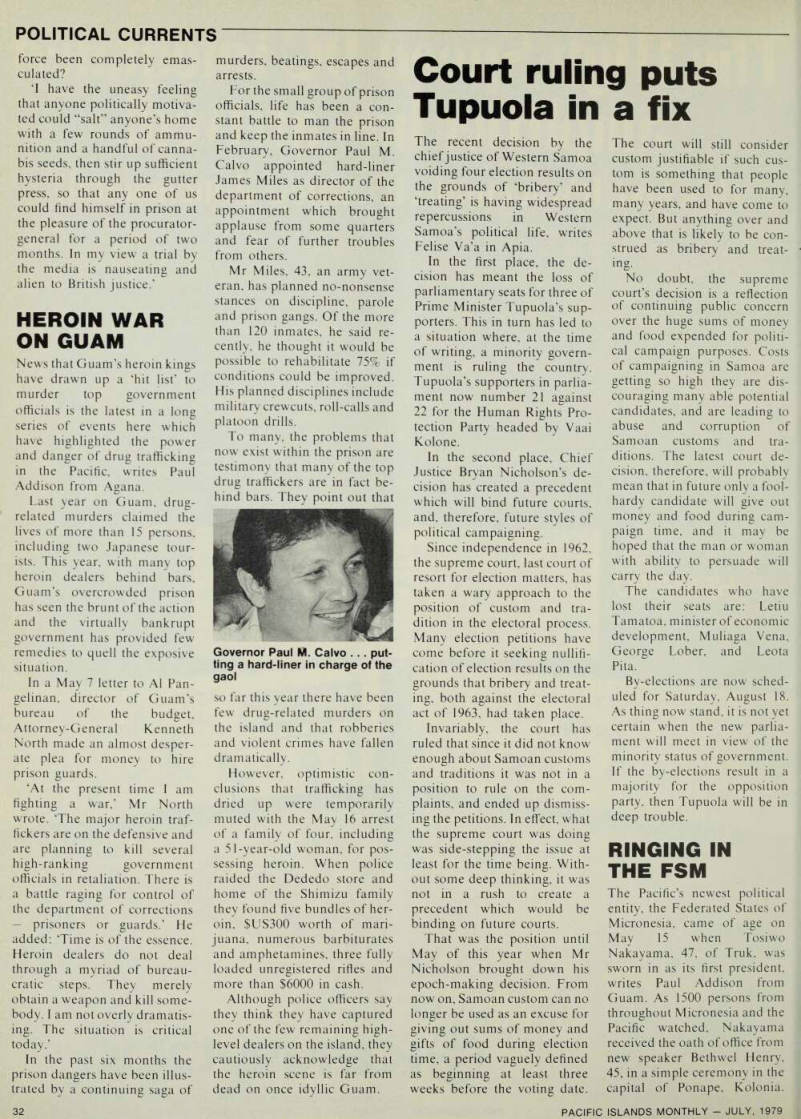
President Tosiwo Nakayama ...
'good government no substitute for self-government'
unless he leaves rejected government recommendations to sack an agricultural assistant and to make an appointment to a new post of senior education officer.
Secretary to Government lonatana lonatana, an ex police officer, insisted that the PSC should support govern ment recommendations and followed up that unconven tional stand with a request for the resignation of the members of the commission.
The commission members
didn’t budge even though they
endured a humiliating face-to face confrontation with the cabinet, which was meeting the commissioners for the first time as the PSC. Cabinet voiced its stern disapproval of the PSC’s decisions but kept off the business of resignation.
There the matter rests for the time being. Governor- General F. Penitala Teo is rumoured to be upset over the whole thing and is thinking of
resigning.
The question on everyone’s
lips is ‘Who controls whom?’
The PSC will possibly face criticism, probably justified, of
paying too much attention to such trivialities as the dismissal of a junior public servant. It might reverse its decision on this without losing too much face or undermining the PSC’s role.
There should be a breathing space for all those involved, and spectators too, to consider the implications of a govern ment-ridden commission and resultant possibilities. There are not many people around with the experience needed to do a PSC job, but the feeling’s there that the government, the governor-general and the cabi net, not to mention the sec retary to government, should maintain the independence and integrity of the com mission. Failing that, the com mission will become a rubber stamp and the public service will be left wide open to abuse of all kinds ‘jobs for the boys’, and what have you.
Though the governor general is not compelled by the terms of the constitution to up hold the accepted principle of acting in accordance with the advice rendered by the PSC, he is expected to uphold its de
cisions, as he is to assent to
parliamentary legislation.
There’s one piquant aspect to the whole thing. Whether or not he knows it, the career of the secretary to government is at the whim, not of the cabinet or of the governor-general, but of the PSC. This is a point some people believe the PSC has just woken up to.
Si: Caring
For An Image
Solomon Islands MPs are cast ing around for ways of ensur ing that an independent outside body determines their working conditions, and at the same time takes care of the problem of their public ‘image’, writes George Atkin from Honiara.
Prime Minister Peter Kenilorea late in May piloted through the house a Parliamentary (Conditions of Service) Commission Bill which will set up a body of three members, none a poli tician, who will be appointed by Governor-General Bad deley Devesi. Its main task will be to look into parliamen
tarians’ salaries, allowances
during parliamentary sittings,
accommodation for their fam ilies while parliament is in session, and general conditions of service.
Arguing against the bill. Op position Leader Batholomew Ulufa’alu said it would lead to duplication and waste of scarce resources. He said parliamen tarians could best deal with their own affairs because they understood their situation best.
It was Willie Betu, leader of the independent group, who showed most sensitivity to the ‘image’ problem of MPs. Sup porting the bill, he said he
hoped that an independent
body dealing with MPs’ con ditions of service ‘would stop people calling us all sorts of names and accusing us of only doing things for our own ends’.
Then, setting his sights higher still, he voiced the hope that the commission would see that
‘proper publicity’ is given
about parliamentarians. ‘All the publicity we get from the press is the kind that disap points our families,’ said Mr Betu.