for ‘Tulagi’
pp. 16-22 · Read in the full issue


Tropicalities
High seas trial
The patrol craft Tulagi , presented by the Australian Government to the govern ment of Solomon Islands as an independence gift and in the framework of Australia’s de fence co-operation programme with the South Pacific, began its new life in high adven ture.
Due to the lack of a crane on Honiara’s wharf strong enough to lift the 46-tonne craft off the deck of a freighter, this pre ferred method of getting it to its new home had to be passed up and the Tulagi made the 3400 nautical mile Sydney- Honiara trip under its own power.
The trip included a tough bout with Cycline Stan in the region of Thursday Island, a three-day stay in Port Moresby (during which the de Havilland Marine-built Tulagi was put through its paces for the ben efit of watching Papua New Guinea officials), and a tri umphal arrival right on time at Honiara.
Crew for the delivery voyage included two Solomon Islanders, Metcalfe Pitiposa and Joshua Kalevalka. who ex perienced a dose of on-the-job training that will no doubt stand them in good stead for years to come.
The Tulagi will be used by Solomon Islands police for fisheries protection and mari time surveillance patrols in coastal and inter-island waters in the Solomons. The vessel will be crewed by experienced mariners who have been re cruited into the police force for the purpose.
In addition to the patrol boat. Australia is supplying enough spare parts for the boat for two years, training in Aus tralia for five Solomon Islands maintenance personnel, and expert advice during the first three months of the boat’s op erations.
A thousand people turned
up to watch the hand-over cer emony conducted by Aus tralian High Commissioner John Melhuish.
Some back, but
more to come
Responding to an appeal by
the Papua New Guinea Government, museums and collectors in Australia and the United States have returned thousands of dollars worth of tribal artifacts to PNG.
Ceremonial masks, weapons, carvings and re ligious figures in stone and wood are among items re turned. Some were found in Adelaide. South Australia, under an old house which had
once been occupied by a family
with business connections in PNG. Others were returned by descendants of an early
missionary.
But PNG authorities believe
there are still scores of valuable items which represent missing examples of PNG culture which should be in PNG.
Some of the biggest collec tions are known to be in Ger many because of the intense scientific and anthropological
interest shown by Germany
when it became the first coloniser of the northern sec tion of PNG nearly a century ago.
The PNG plea for return of artifacts was repeated at the 1978 general conference of the United Nations Scientific and
Cultural Organisation
(UNESCO) in Paris in November. The PNG del egates also presented a list of
projects for possible UNESCO
assistance.
The country has already received nearly K.l million from UNESCO and related
agencies for cultural projects.
The 1978 PNG submissions
placed greater emphasis than
in the past on science and tech
nology.
Whoppers which
didn’t get away
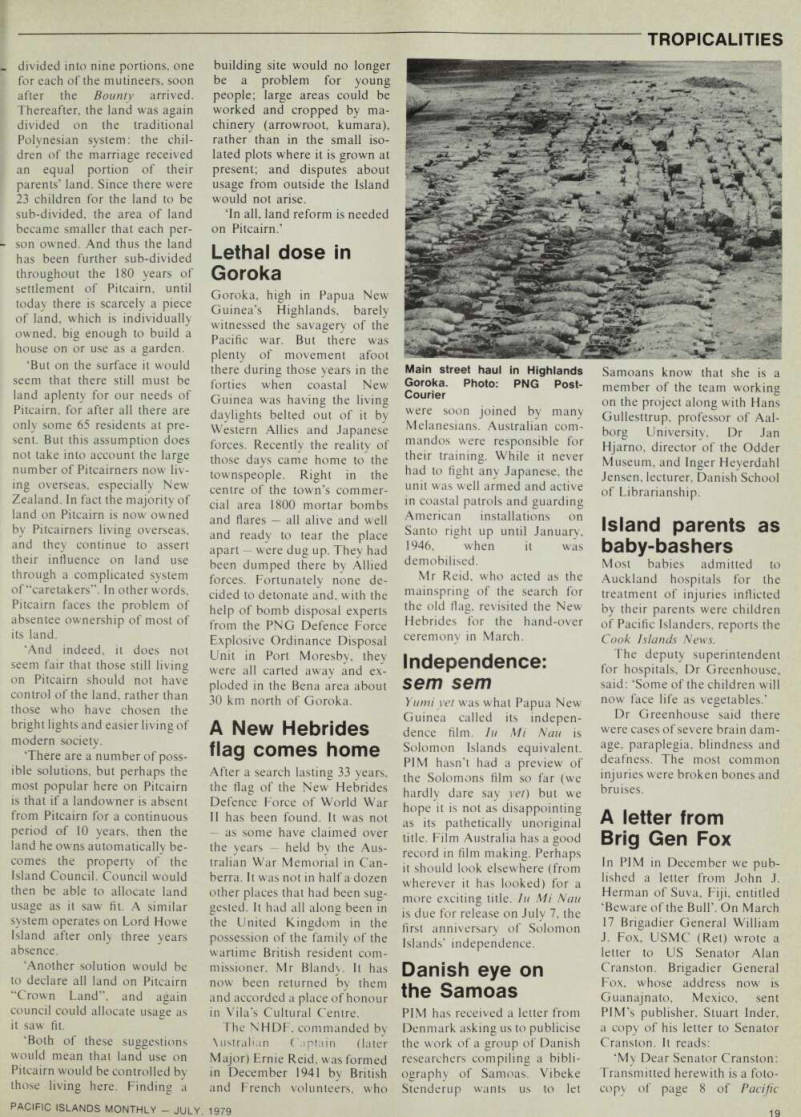
Seeing is believing. In just 90
minutes, off Queen Elizabeth Drive. Suva, Thomas Garnett.
Rusiate Geneva. Rafaele Muanivalu and Joe Banivalu. netted 45 huge saqa (bull nosed trevally). Anyone stand
ing at the waterfront at the Grand Pacific Hotel or Travelodge could have watched the performance.
Franciscans
make a film
A 30-minute colour film, Man Bilong Ol Pipal , has been made for the Franciscan Order of
Missions, Aitape, Papua New
Guinea. Written and directed by Victor Carell, the highly effective 16 mm film was com missioned by the Franciscans.
Mr Carell said the aim was to inspire high school students in
particular to become priests
and teachers in their own country to be leaders in the whole of PNG, not just on a local basis. The film is now being shown in many areas of PNG. with emphasis on the high schools.
‘Land reform’ is
Pitcairn’s cry
Revolution on Pitcairn Island?
Well, no, not quite. But...let the editor of the monthly news sheet Pitcairn Miscellany ex
plain:
Land ownership and control has undoubtedly been the major cause of discontent, rev olution and war throughout
history. And although Pitcairn
is on the brink of neither a war nor a revolution there are rum blings of discontent about the present state of land control
and ownership.
‘Historically, Pitcairn was
Tom Garnett and bumper haul at Suva. Photo: Anne Livingston; left: Prime Minister Kenilorea at the Tulagi’s helm. Photo: Stan Schaetzel
divided into nine portions, one for each of the mutineers, soon after the Bounty arrived.
Thereafter, the land was again divided on the traditional Polynesian system: the chil dren of the marriage received an equal portion of their parents’ land. Since there were 23 children for the land to be sub-divided, the area of land became smaller that each per son owned. And thus the land has been further sub-divided throughout the 180 years of settlement of Pitcairn, until
today there is scarcely a piece
of land, which is individually owned, big enough to build a house on or use as a garden. ‘But on the surface it would seem that there still must be land aplenty for our needs of Pitcairn, for after all there are only some 65 residents at pre sent. But this assumption does not take into account the large number of Pitcairners now liv
ing overseas, especially New
Zealand. In fact the majority of land on Pitcairn is now owned
by Pitcairners living overseas,
and they continue to assert their influence on land use
through a complicated system
of “caretakers”. In other words, Pitcairn faces the problem of absentee ownership of most of its land. ‘And indeed, it does not seem fair that those still living on Pitcairn should not have control of the land, rather than those who have chosen the
bright lights and easier living of
modern society.
‘There are a number of poss ible solutions, but perhaps the most popular here on Pitcairn is that if a landowner is absent from Pitcairn for a continuous period of 10 years, then the land he owns automatically be comes the property of the Island Council. Council would then be able to allocate land usage as it saw fit. A similar system operates on Lord Howe Island after only three years absence. ‘Another solution would be to declare all land on Pitcairn “Crown Land”, and again council could allocate usage as it saw fit. ‘Both of these suggestions would mean that land use on Pitcairn would be controlled by those living here. Finding a
building site would no longer be a problem for young people; large areas could be worked and cropped by ma chinery (arrowroot, kumara), rather than in the small iso lated plots where it is grown at present; and disputes about usage from outside the Island would not arise. ‘ln all, land reform is needed on Pitcairn.’
Lethal dose in
Goroka
Goroka, high in Papua New Guinea’s Highlands, barely witnessed the savagery of the Pacific war. But there was plenty of movement afoot there during those years in the forties when coastal New Guinea was having the living daylights belted out of it by Western Allies and Japanese forces. Recently the reality of those days came home to the
townspeople. Right in the
centre of the town’s commer cial area 1800 mortar bombs and flares all alive and well and ready to tear the place apart were dug up. They had been dumped there by Allied forces. Fortunately none de cided to detonate and, with the help of bomb disposal experts from the PNG Defence Force
Explosive Ordinance Disposal
Unit in Port Moresby, they were all carted away and ex ploded in the Bena area about 30 km north of Goroka.
A New Hebrides
flag comes home
After a search lasting 33 years, the flag of the New Hebrides Defence Force of World War 11 has been found. It was not as some have claimed over the years held by the Aus tralian War Memorial in Can berra. It was not in half a dozen other places that had been sug gested. It had all along been in the United Kingdom in the possession of the family of the wartime British resident com missioner. Mr Blandy. It has now been returned by them and accorded a place of honour in Vila’s Cultural Centre.
The NHDF, commanded by Australian Captain (later Major) Ernie Reid, was formed in December 1941 by British and French volunteers, who
Samoans know that she is a member of the team working on the project along with Hans
Gullesttrup, professor of Aal
borg University, Dr Jan
Hjarno, director of the Odder
Museum, and Inger Heyerdahl
Jensen, lecturer, Danish School
of Librarianship.
Island parents as
baby-bashers
Most babies admitted to Auckland hospitals for the treatment of injuries inflicted by their parents were children of Pacific Islanders, reports the Cook Islands News.
The deputy superintendent
for hospitals. Dr Greenhouse, said: ‘Some of the children will now face life as vegetables.’
Dr Greenhouse said there were cases of severe brain dam age, paraplegia, blindness and deafness. The most common injuries were broken bones and bruises.
A letter from
Brig Gen Fox
In PIM in December we pub lished a letter from John J.
Herman of Suva, Fiji, entitled ‘Beware of the Bull’. On March 17 Brigadier General William J. Fox, USMC (Ret) wrote a letter to US Senator Alan Cranston. Brigadier General Fox, whose address now is Guanajnato, Mexico, sent PlM’s publisher. Stuart Inder, a copy of his letter to Senator Cranston. It reads: ‘My Dear Senator Cranston: Transmitted herewith is a foto copy of page 8 of Pacific
were soon joined by many Melanesians. Australian com mandos were responsible for their training. While it never had to fight any Japanese, the unit was well armed and active in coastal patrols and guarding American installations on Santo right up until January, 1946, when it was demobilised.
Mr Reid, who acted as the mainspring of the search for the old flag, revisited the New Hebrides for the hand-over ceremony in March.
Independence:
sem sem Yumi yet was what Papua New Guinea called its indepen dence film, hi Mi Nan is Solomon Islands equivalent.
PIM hasn’t had a preview of the Solomons film so far (we hardly dare say yet) but we hope it is not as disappointing
as its pathetically unoriginal
title. Film Australia has a good record in film making. Perhaps it should look elsewhere (from wherever it has looked) for a more exciting title. In Mi Nan is due for release on July 7, the first anniversary of Solomon
Islands’ independence.
Danish eye on
the Samoas
PIM has received a letter from Denmark asking us to publicise the work of a group of Danish researchers compiling a bibli ography of Samoas. Vibeke Stenderup wants us to let
Main street haul in Highlands Goroka. Photo: PNG Post- Courier
Islands Monthly of December 1978. I wish to invite your attention to the article entitled ‘Beware of the Bull' by a John L. Herman of Suva, Fiji Islands. I am unaware of Mr Herman’s status in relation to the Fijian Government, but I think your office should ascer tain if he represents the views and attitude of that govern ment in the matter of ‘foreign aid'. If he does I can see how the United States Government can save millions of dollars for the tax payers of our country of which I am one. Will you please keep me advised or your findings and action taken? ‘PS: I served with the US Marines on the islands of the Pacific in 1942-43 and I happen to know that those islands were mighty happy to get all the foreign aid possible on any terms and it was expensive aid as many a wounded Marine can tell. They may have forgot ten but many of us have not.’
The Cockney
of Fanning
Does anyone remember ‘Cock ney’ Chandler, the Fanning Island cable hand who was handyman out there about 50 years ago? The one who had an ‘ell of a time with his h’s and a’s? True to his London upbringing, he had a ready wit, and succeeded in placing his h’s and a’s in the wrong place, writes Sherman Lee Pompey.
Cockney at one time said in London he had been a ‘heggler’. When asked what a heggler was, he replied it was a man who ’awked heggs from door to door. He stated that Hyde Park in London was full of hashes and helms.
Once when the cable station superintendent had trouble with his septic tank, he called Cockney to fix it. His diagnosis was that it was due to ‘hair in the pipe and not ’air on your ’ead but the hatmosphere’.
While on Fanning, there was a man there named Munn and somehow a feud had devel oped between him and Cock ney Chandler. Once Munn chased Chandler and threat ened to kill him. Cockney escaped into Robert Bruce Scott’s room. It became such a well established feud that they
had to transfer Munn off the island.
Cockney made his own out rigger canoe, which was quite a feat, and it was all bound up. without using a nail in the con struction. They had a launch ing ceremony and as the craft slipped into the still waters of the lagoon, he remarked: ‘There she goes, and she won’t leak a “heggup” full.’ Cockney added a bit of humour to life on the island, and with his one solitary tooth looked a fear some customer. In fact he was a very human and kindly man.
Life was never the same on
Fanning after Cockney left.
Blowing cold
on ‘Hurricane’
The US magazine Newsweek was not over-impressed with Dino de Laurentiis’ SUS 22 million extravaganza. Hur ricane. Set in Pago Pago (but actually filmed in Borabora) the film is a substantially revamped version of John Ford’s 1937 epic of the same name.
Newsweek critic David Ansen writes: ‘There is one tor rid love affair and one bang-up hurricane in Hurricane and it would have helped the film plenty if one had anything to do with the other. As things stand or topple the climac
tic storm serves not so much to resolve the tempestuous affair between a hot-blooded Bos tonian (Mia Farrow) and a hot blooded Samoan (Dayton Ka’Ne) as to bail out of it. . . ‘On a purely sensuous level.
Hurricane is frequently arrest ing and sometimes down right sexy. Director Jan Troell (The Emigrants) has a pleasing eye, and with the natural beauty of the island and the
wizardry of production de
signer Danilo Donati and cine
matographer Sven Nykvist to
aid him, the movie is con sistently handsome. But it’s a humourless, bubble-headed affair, as dramatically under fed as it is visually over-ripe.
"In the tropics,” warns Trevor Howard, as a tippling Irish priest, “take passion in small doses and always with a grain of salt.” One doesn’t expect the lovers to heed his advice, but Troell and Semple have ignored him at their own peril.
At the end. Hurricane is simply washed away in a high tide of
romantic inanity.’
The gentle art of
donning pareu
‘Just imagine she is wearing nothing on top.’ There is dead silence as everyone concen trates on imagining, writes Helen Rousseau in Sydney. ‘Then you just pull the material this way,’ the male Tahitian voice continues, to a gasp from
onlookers as he passes the cloth between the girl’s legs. ‘And finally you tie it this way.’ The surprised model wonders: ‘Are you sure it will really stay up?’ as the colourful piece of pareu is tied across her hips. A smile of delighted confidence beams from the face of Sacha as he stands aside to receive the en thusiastic praise of his audi ence.
Sacha had come all the way from Ouvea, in New Caledonia’s Loyalty Islands, to show Sydney-siders how to dress in relaxed, yet imaginat ive styles, to really catch the mood for enjoying his special piece of paradise the 25 km of white sand and ever changing blues of the lagoon on Ouvea, Caledonia’s only coral atoll.
An expensive Chinese- Tahitian, Sacha describes him self as the entertainer cum-cook-cum-decorator at the only visitor accomodation on the island the 15 thatched bungalows of the Relais d’Ouvea. In response to a ques tion, he solemnly promises that yes, upon request, he is ready to tie the pareu for any lady guests at the resort, any time.
Using just a straight piece of
fabric, and taking only a couple on minutes each time, Sacha demonstrates half a dozen dif ferent ways of wearing the in
credibly versatile Polynesian
pareu.
The men are not forgotten, either. On Sydney television Sacha expertly ties a brief pareu on well-known football star Russell Fairfax. Sporting fans are promised a sight to look forward to when, after a bit of coaxing, the Australian football hero promises: if we make the grand final I’ll run out in one.’
Radio Australia
boosts output
Radio Australia has boosted its output to the Islands through two new 100 kW transmitters at Shepparton, Victoria which began work in early May. The ABC’s acting director of over seas services, Errol Hodge, said that changes would enable the transmission of a clearer, strong signal, less susceptible to interference.
‘Cockney’ Chandler of Fanning ... the heggler’s son