Becoming
pp. 13-15 · Read in the full issue

That Word ‘Fijian’
What About
One First?
Fijian specialist in human communication, Laz Vusoniwailala, writes from Seattle, USA, where he is continuing his studies. His subject: the vexed question of a common name for the members of the multi-racial society of Fiji.
The subject of a ‘common name' for the people of Fiji (PIM February) has been a
touchy topic in Fiji whenever
it has cropped up in recent years. It arose out of the appar ent need of some people,
mostly non-indigenous. to
identify themselves with Fiji.
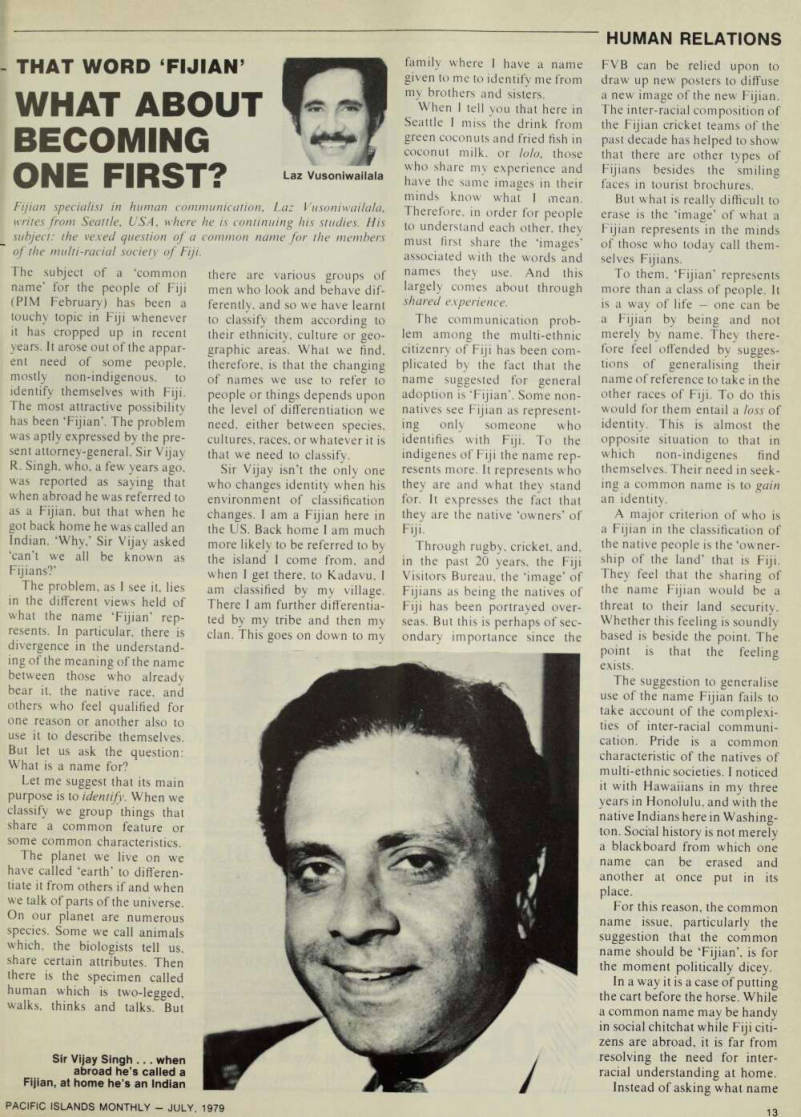
The most attractive possibility has been ‘Fijian’. The problem was aptly expressed by the pre sent attorney-general. Sir Vijay R. Singh, who, a few years ago, was reported as saying that when abroad he was referred to as a Fijian, but that when he got back home he was called an Indian. ‘Why,’ Sir Vijay asked ‘can’t we all be known as
Fijians?’
The problem, as I see it, lies in the different views held of what the name ‘Fijian’ rep resents. In particular, there is divergence in the understand ing of the meaning of the name between those who already bear it. the native race, and others who feel qualified for one reason or another also to use it to describe themselves.
But let us ask the question; What is a name for?
Let me suggest that its main purpose is to identify. When we classify we group things that share a common feature or some common characteristics.
The planet we live on we have called ‘earth’ to differen tiate it from others if and when we talk of parts of the universe.
On our planet are numerous species. Some we call animals which, the biologists tell us, share certain attributes. Then there is the specimen called human which is two-legged, walks, thinks and talks. But
there are various groups of men who look and behave dif ferently, and so we have learnt to classify them according to their ethnicity, culture or geo graphic areas. What we find, therefore, is that the changing of names we use to refer to
people or things depends upon
the level of differentiation we need, either between species, cultures, races, or whatever it is that we need to classify.
Sir Vijay isn’t the only one who changes identity when his environment of classification changes. I am a Fijian here in the US. Back home I am much more likely to be referred to by the island I come from, and when I get there, to Kadavu. I am classified by my village.
There I am further differentia ted by my tribe and then my clan. This goes on down to my
family where I have a name given to me to identify me from my brothers and sisters.
When I tell you that here in Seattle I miss the drink from green coconuts and fried fish in coconut milk, or 1010, those who share my experience and have the same images in their minds know what 1 mean.
Therefore, in order for people to understand each other, they must first share the ‘images’ associated with the words and names they use. And this
largely comes about through
shared experience.
The communication prob lem among the multi-ethnic citizenry of Fiji has been com plicated by the fact that the name suggested for general adoption is ‘Fijian’. Some non natives see Fijian as represent
ing only someone who
identifies with Fiji. To the indigenes of Fiji the name rep resents more. It represents who they are and what they stand for. It expresses the fact that they are the native ‘owners' of
Fiji.
Through rugby, cricket, and.
in the past 20 years, the Fiji Visitors Bureau, the ‘image’ of Fijians as being the natives of Fiji has been portrayed over seas. But this is perhaps of sec
ondary importance since the
Human Relations
FVB can be relied upon to draw up new posters to diffuse anew image of the new Fijian.
The inter-racial composition of the Fijian cricket teams of the past decade has helped to show that there are other types of Fijians besides the smiling faces in tourist brochures.
But what is really difficult to erase is the ‘image’ of what a Fijian represents in the minds of those who today call them selves Fijians.
To them, ‘Fijian’ represents more than a class of people. It is a way of life -one can be a Fijian by being and not merely by name. They there fore feel offended by sugges tions of generalising their name of reference to take in the other races of Fiji. To do this would for them entail a loss of identity. This is almost the opposite situation to that in which non-indigenes find themselves. Their need in seek ing a common name is to gain
an identity.
A major criterion of who is a Fijian in the classification of the native people is the ‘owner ship of the land’ that is Fiji.
They feel that the sharing of the name Fijian would be a threat to their land security.
Whether this feeling is soundly based is beside the point. The point is that the feeling exists.
The suggestion to generalise use of the name Fijian fails to take account of the complexi ties of inter-racial communi cation. Pride is a common characteristic of the natives of multi-ethnic societies. I noticed it with Hawaiians in my three years in Honolulu, and with the native Indians here in Washing ton. Social history is not merely a blackboard from which one name can be erased and another at once put in its
place.
For this reason, the common name issue, particularly the suggestion that the common name should be ‘Fijian’, is for
the moment politically dicey.
In a way it is a case of putting the cart before the horse. While a common name may be handy in social chitchat while Fiji citi zens are abroad, it is far from resolving the need for inter racial understanding at home.
Instead of asking what name
Laz Vusoniwailala
Sir Vijay Singh ... when abroad he’s called a Fijian, at home he’s an Indian
would best describe them all. the country’s main ethnic groups should be seeking ways
whereby they will begin to feel
and think as one people. The fact that there is not yet any agreement over a common name simply indicates that there is not yet a common Fiji consciousness, the thoughts of Prime Minister Ratu Kamisese Mara on a coalition govern ment for Fiji (PIM May) merit serious consideration by those who wish well for the country’s multi-racial future.
It is important that moves in this direction be made now, while Fiji is still governed by a political party whose policy during the past 10 years has in cluded the building of Fiji into a model plural society. This policy has not been pursued without political risks, as the shock outcome of the April 1977 election indicated.
My subjective analysis is that
the average Fijian is not fully committed to multi-racialism.
He entertains the belief that his quality of life would be better if he did not have to compete so hard with people he sees as
‘intruders’ in order to survive in his own country. I expect this sentiment to intensify over the next quarter-century as more and more educated Fijians find fewer and fewer job opportuni ties, with a rising population and a job market that is grow
ing only slowly. Matters will
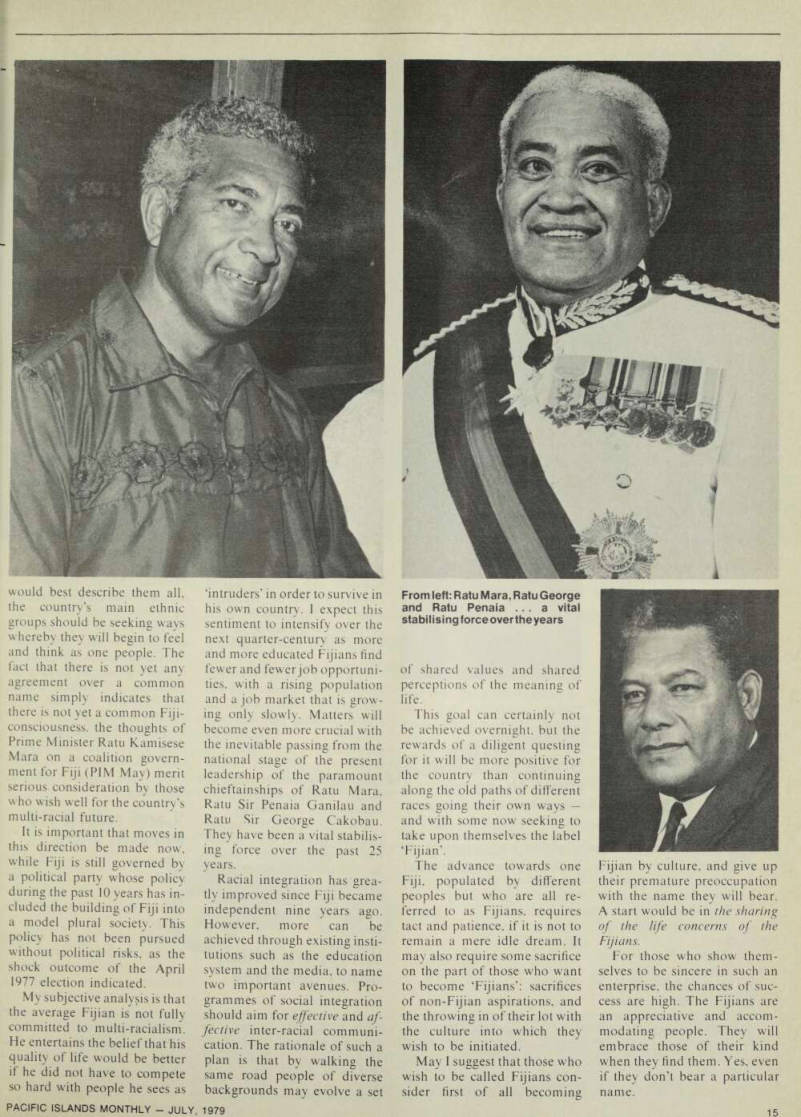
become even more crucial with the inevitable passing from the national stage of the present leadership of the paramount chieftainships of Ratu Mara, Ratu Sir Penaia Ganilau and Ratu Sir George Cakobau.
They have been a vital stabilis ing force over the past 25 years.
Racial integration has grea tly improved since Fiji became independent nine years ago.
However, more can be
achieved through existing insti
tutions such as the education system and the media, to name two important avenues. Pro grammes of social integration should aim for effective and af fective inter-racial communi cation. The rationale of such a plan is that by walking the same road people of diverse backgrounds may evolve a set
of shared values and shared perceptions of the meaning of life.
This goal can certainly not be achieved overnight, but the rewards of a diligent questing for it will be more positive for the country than continuing along the old paths of different races going their own ways and with some now seeking to take upon themselves the label ‘Fijian’.
The advance towards one
Fiji, populated by different
peoples but who are all re ferred to as Fijians, requires tact and patience, if it is not to remain a mere idle dream. It may also require some sacrifice on the part of those who want to become ‘Fijians’; sacrifices of non-Fijian aspirations, and the throwing in of their lot with the culture into which they wish to be initiated.
May I suggest that those who wish to be called Fijians con sider first of all becoming
Fijian by culture, and give up their premature preoccupation with the name they will bear.
A start would be in the sharing
of the life concerns of the
Fijians.
For those who show them selves to be sincere in such an enterprise, the chances of suc cess are high. The Fijians are an appreciative and accom
modating people. They will
embrace those of their kind when they find them. Yes, even if they don’t bear a particular name.
From left: Ratu Mara, Ratu George and Ratu Penaia ... a vital stabilising force over the years