watering party
pp. 70-71 · Read in the full issue
Yesterday
Massacre of the watering party
When explorer Alvaro de Mendaha’s two-vessel expeditionary force sailed into Solomon Islands waters in 1568, Spain was on the brink of one of its ‘worst single tragedies in the annals of Spanish exploration ’ writes Dr Andre Gschaedler, professor of history at Salem College, West Virginia, US. Dr Gschaedler, drawing on the manuscripts of the late Father Celsus Kelly, and his own research, describes the ‘ Massacre of the Watering Party’. He writes: ‘Father Kelly’s work is a lasting contribution to the knowledge of Spanish enterprise in the ocean and to Pacific history in general. ’
Why did the Spaniards, who had their hands full with the Americas, launch two ships into the immensity of the South Pacific? We have there a com bination of circumstances: a story that an Inca ruler had brought back gold from some Pacific islands and the desire of the government of Peru to get rid of idle people who were
causing a problem.
Whatever the reason, two ships, the Los Reyes and the Todos Santos were pre pared for a voyage into the unknown. The Spanish docu ments edited by Father Kelly present information to my
knowledge never published be
fore.
The two ships weighed anchor in Callao, Peru, on November 19, 1567. On board were about 160 men. Captain general was Alvaro de Men dana, nephew of Lope Garcia de Castro, governor of Peru.
He was only 25 years old.
Pedro Sarmiento de Gamboa, supposed to be in charge of navigation and about 10 years older, was later to become famous in the annals of Spanish America. He was re sponsible for the capture of the last descendant of the Inca
imperial family (who was
executed) and for an attempt to fortify the Straits of Magellan to prevent a recurrence of Francis Drake’s intrusion in what had been for many years a ‘Spanish lake’. Among others were Hernan Gallego, chief pilot, and Pedro de Ortega, commander of the soldiers, from whom we have the name Guadalcanal after Ortega’s hometown in Spain.
On the way to the Solomons only two islands or islands clus ters were sighted; the Ellice Islands (now Tuvalu) and either Ontong Java or Ron
cador. The religious Spaniards
called the first Island of Jesus and the second Candlemas
Shoals. The latter were sighted on February 1, 1568. There after, signs of a major land mass became more and more
frequent. Finally, on February
7, land was sighted which looked limitless from a dis tance. The approach was dif ficult because of reefs. Prayers were said by the Franciscan frairs to implore the help of God in their predicament. A passage was found and the ships anchored in what Men dana called Port of the Star because the planet Venus appeared on that day. The land was called Santa Ysabel (now Isabel).
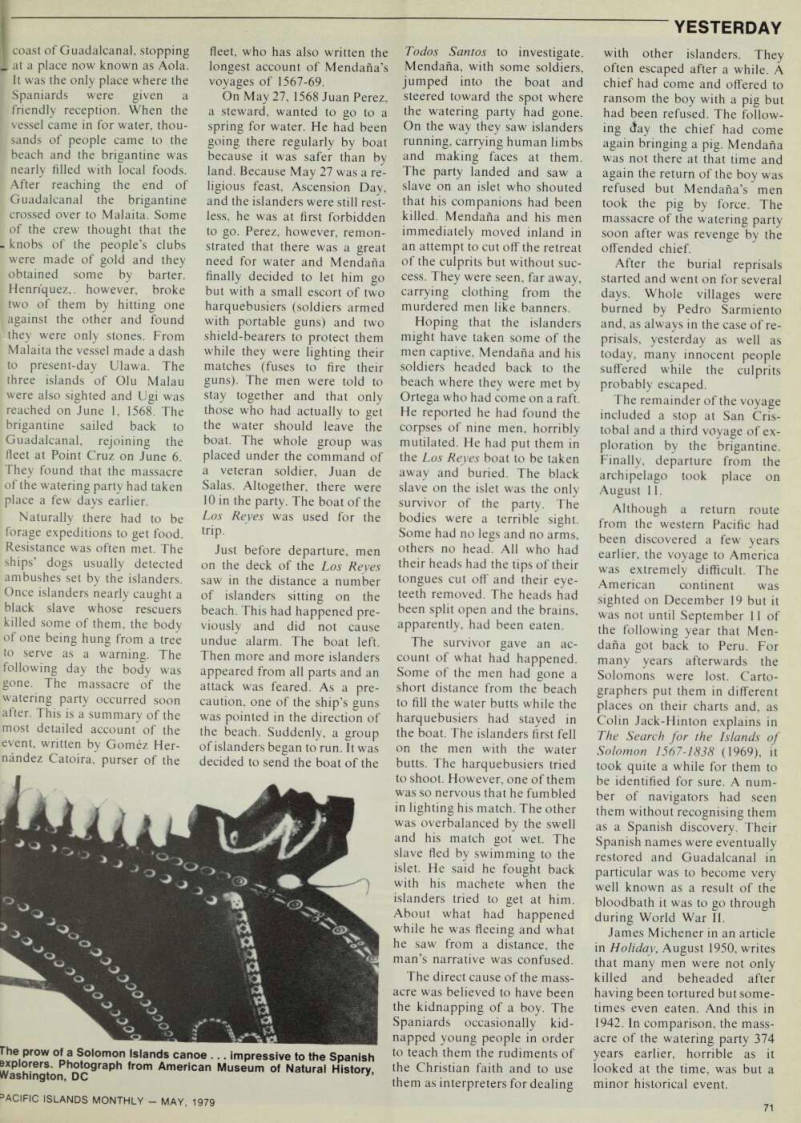
Mendana and his men stayed on Santa Ysabel from February 8 to May 8. This was the best period of their stay in the Solomons despite a few skirmishes with the inhabi tants. The travellers were struck by the beauty of the canoes that paddled around the vessels. They were shaped like crescent moons and inlaid with mother-of-pearl. On several occasions the Spaniards cap tured canoes and held on to them until the islanders had complied with some request, usually to give food.
Friendship was sealed be tween Mendana and a local chief called Bilebanara, or just Bile as the Spaniards came to call him. Bile was an imposing man. He had a headdress of white and black feathers and wore a variety of other orna ments. For some time the new comers were able to obtain food from the islanders. But there was not enough to feed so many men for such a long period of time. The need to get food in order to save the stores of the ships for the return voy age led to a number of unfor tunate incidents.
While on Santa Ysabel, the Spaniards conducted several expeditions inland. The most important was led by Ortega early in March 1568 and re sulted in the difficult ascent of the middle range of Santa Ysabel. That was when they found they were on an island, not a continent. (Years later, Quiros did not have the same
opportunity in Espiritu Santo
and he died believing he had reached the edge of a great continent, if not a continent
itself, and a number of people after him believed the same.) During their stay on Santa Ysabel, Mendaha and his men became acquainted with the products of the land and with some customs of the Melanes ians whom they called Indians.
The ships had had trouble get ting into port and could not be
used safely for exploration
close to coasts. A brigantine was built, able to carry 30 men.
On April 7, 1568 under the command of Pedro de Ortega and with Hernan Gallego as pilot, the little vessel left on its first voyage. It was during the voyage that the Spaniards made their first landing on Guadalcanal (spelt Guadal canar in some manuscripts).
After the return of the brig antine, Mendana decided to have the whole fleet sail to Guadalcanal because it seemed more promising than Santa Ysabel. The two gal leons, followed by the brigan tine, weighed anchor on May 8, 1568 and reached Guadalcanal a week later. It was found that the Lunga River, explored by the brigantine, was not as good a shelter as another river nearby which was called Rio Gallego. This today is the Matanikau River which be came famous during the Guadalcanal campaign of 1942. The landing was near Point Cruz, a name which has been preserved. It was a good location and is today the site of Honiara, capital of Solomon Islands.
After mass, the Franciscan friars with the expedition de cided to erect a cross on the summit of a hill as a symbol that Christianity had arrived.
On the way down the Spanish party was attacked by the islanders. A fight ensued and one of the chiefs was killed.
After that, intercourse with the islanders of Guadalcanal was
always, with one exception,
troubled by skirmishes. This was during the second voyage of the brigantine which had left for further exploration on May 19.
This time the men were under the command of Her nando Henriquez. Control of
navigation was again entrusted
to Gallego. The brigantine went east along the northern
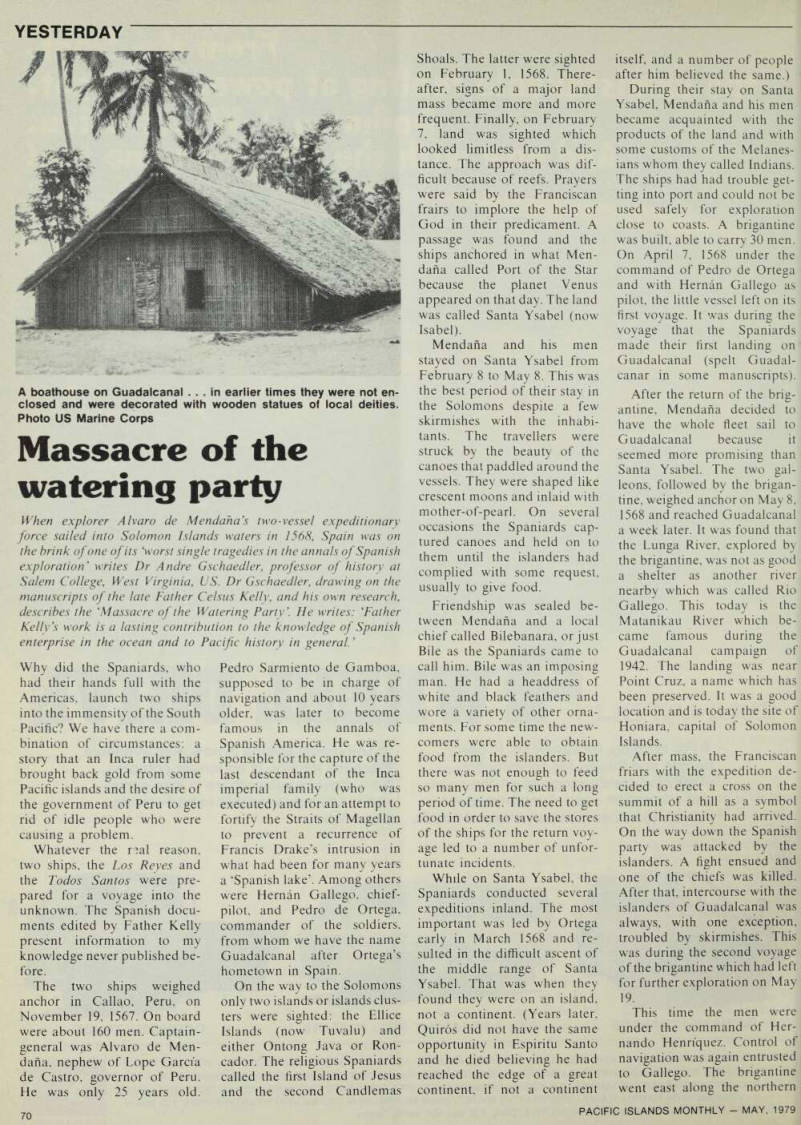
A boathouse on Guadalcanal ... In earlier times they were not en closed and were decorated with wooden statues of local deities.
Photo US Marine Corps
I coast of Guadalcanal, stopping X at a place now known as Aola.
It was the only place where the
• Spaniards were given a
[ friendly reception. When the I vessel came in for water, thou sands of people came to the beach and the brigantine was nearly filled with local foods.
After reaching the end of Guadalcanal the brigantine crossed over to Malaita. Some ! of the crew thought that the - knobs of the people’s clubs were made of gold and they obtained some by barter.
Henriquez,. however, broke two of them by hitting one against the other and found they were only stones. From Malaita the vessel made a dash to present-day Ulawa. The three islands of Olu Malau were also sighted and Ugi was reached on June 1, 1568. The brigantine sailed back to Guadalcanal, rejoining the fleet at Point Cruz on June 6.
They found that the massacre of the watering party had taken place a few days earlier.
Naturally there had to be forage expeditions to get food.
Resistance was often met. The
ships’ dogs usually detected
ambushes set by the islanders.
Once islanders nearly caught a black slave whose rescuers killed some of them, the body of one being hung from a tree to serve as a warning. The
following day the body was
gone. The massacre of the watering party occurred soon after. This is a summary of the most detailed account of the event, written by Gomez Her nandez Catoira, purser of the
fleet, who has also written the longest account of Mendana’s voyages of 1567-69.
On May 27, 1568 Juan Perez, a steward, wanted to go to a spring for water. He had been
going there regularly by boat
because it was safer than by land. Because May 27 was a re ligious feast, Ascension Day, and the islanders were still rest less, he was at first forbidden to go. Perez, however, remon strated that there was a great need for water and Mendana finally decided to let him go but with a small escort of two harquebusiers (soldiers armed with portable guns) and two shield-bearers to protect them while they were lighting their matches (fuses to fire their guns). The men were told to stay together and that only those who had actually to get the water should leave the boat. The whole group was placed under the command of a veteran soldier, Juan de Salas. Altogether, there were 10 in the party. The boat of the Los Reyes was used for the
trip.
Just before departure, men on the deck of the Los Reyes saw in the distance a number of islanders sitting on the beach. This had happened pre viously and did not cause undue alarm. The boat left.
Then more and more islanders appeared from all parts and an attack was feared. As a pre caution. one of the ship’s guns was pointed in the direction of the beach. Suddenly, a group of islanders began to run. It was decided to send the boat of the
Todos Santos to investigate.
Mendana, with some soldiers, jumped into the boat and steered toward the spot where the watering party had gone.
On the way they saw islanders
running, carrying human limbs
and making faces at them.
The party landed and saw a slave on an islet who shouted that his companions had been killed. Mendana and his men immediately moved inland in an attempt to cut off the retreat of the culprits but without suc cess. They were seen, far away,
carrying clothing from the
murdered men like banners.
Hoping that the islanders might have taken some of the men captive, Mendana and his soldiers headed back to the beach where they were met by Ortega who had come on a raft.
He reported he had found the corpses of nine men, horribly mutilated. He had put them in the Los Reyes boat to be taken away and buried. The black slave on the islet was the only survivor of the party. The bodies were a terrible sight.
Some had no legs and no arms, others no head. All who had their heads had the tips of their tongues cut off and their eye teeth removed. The heads had been split open and the brains, apparently, had been eaten.
The survivor gave an ac count of what had happened.
Some of the men had gone a short distance from the beach to fill the water butts while the
harquebusiers had stayed in
the boat. The islanders first fell on the men with the water butts. The harquebusiers tried to shoot. However, one of them was so nervous that he fumbled in lighting his match. The other was overbalanced by the swell and his match got wet. The slave fled by swimming to the islet. He said he fought back with his machete when the islanders tried to get at him.
About what had happened while he was fleeing and what he saw from a distance, the man’s narrative was confused.
The direct cause of the mass acre was believed to have been the kidnapping of a boy. The
Spaniards occasionally kid
napped young people in order to teach them the rudiments of the Christian faith and to use them as interpreters for dealing
with other islanders. They often escaped after a while. A chief had come and offered to ransom the boy with a pig but had been refused. The follow ing day the chief had come
again bringing a pig. Mendana
was not there at that time and again the return of the boy was refused but Mendana’s men took the pig by force. The massacre of the watering party soon after was revenge by the offended chief.
After the burial reprisals started and went on for several
days. Whole villages were
burned by Pedro Sarmiento and, as always in the case of re prisals, yesterday as well as
today, many innocent people
suffered while the culprits
probably escaped.
The remainder of the voyage included a stop at San Cris tobal and a third voyage of ex
ploration by the brigantine.
Finally, departure from the
archipelago took place on
August 11.
Although a return route from the western Pacific had been discovered a few years earlier, the voyage to America was extremely difficult. The American continent was sighted on December 19 but it was not until September 11 of the following year that Men dana got back to Peru. For many years afterwards the Solomons were lost. Carto graphers put them in different places on their charts and, as Colin Jack-Hinton explains in The Search for the Islands of Solomon 1567-1838 (1969), it took quite a while for them to be identified for sure. A num ber of navigators had seen them without recognising them as a Spanish discovery. Their
Spanish names were eventually
restored and Guadalcanal in particular was to become very well known as a result of the bloodbath it was to go through during World War 11.
James Michener in an article in Holiday, August 1950, writes that many men were not only killed and beheaded after having been tortured but some times even eaten. And this in 1942. In comparison, the mass acre of the watering party 374 years earlier, horrible as it looked at the time, was but a minor historical event.
The prow of a Solomon Islands canoe ... impressive to the Spanish explorers. Photograph from American Museum of Natural History, Washington, DC