Mick Leahy
p. 68 · Read in the full issue
Deaths
of Islands People
explorer
Michael James Leahy died at Zenag, 80 kilometres from Lad, in the Morobe Province, Papua New Guinea (PIM, April). It was fitting that ‘Mick’ Leahy should have passed on at Zenag, where he and his wife Jeanette had battled since 1946 to build up a thriving farming and grazing property. But that he died at Zenag was a sad thing, too, for Mick had been embroiled for many years in a fierce dispute with the govern ment over the question of com pensation for land at Baiune granted to him under a title later held by the courts to be defective.
All the Irish and there was a lot in Mick was aroused and instead of accepting the cash settlement offered by the government he hung on, demanding a review. Old hands were not surprised: that is what they would have expected of Mick. But time ran out.
Mick Leahy was born in Toowoomba, Queensland, on February 28, 1901, and edu cated there at Christian Brothers College. In turn, he became a clerk, cane-cutter
and timber-getter before going
to the Mandated Territory of New Guinea in 1926 following the discovery of gold at Edie Creek.
Mick failed to find his for tune on the Creek few did but in April 1930 he was com missioned by the Morobe Dis trict Miners’ Association to prospect the then unknown country at the head of the Ramu River where Ned Rowlands was known to be ‘on
gold’.
The epic journey that Leahy
then made with his mate, Mick Dwyer, and their 16 armed car riers, from the Upper Ramu right across the mainland to the Papuan coast at Port Romilly on the mouth of the Purari
River, has become legend. And with good reason. Before this walk, the interior was popu larly supposed to be a waste land of mountain and forest, inhabited if at all by scat tered bands of nomads. Leahy
and Dwyer proved the theory
false. They encountered thou sands of people where none was supposed to exist. This heartland was in fact heavily populated by virile tribes of warriors,- living in a mighty series of grassed, inter
montane valleys the High
lands provinces of today’s
Papua New Guinea, contain-
ing almost half of the nation’s
population.
In 1933, the famous expedi
tion led jointly by Mick Leahy
and Assistant District Officer J.
L. Taylor of the Mandated Ter
ritory Administration, through
the great valley of the Wahgi to Mount Hagen and beyond, defined the extent of the High
lands population, and captured
the imagination of the world.
Mick and his brother, Danny, spent most of the remaining years of the thirties mining gold near Mount Hagen, while two other Leahy brothers, Paddy and Jim, stayed on in the Morobe goldfield.
Mick made a number of lesser journeys, including a cel
ebrated expedition with Paddy
into what was then known as Kukukuku country, beyond the Watut River, in 1931, look ing for gold, financed as in 1933 by the Wau company, New Guinea Goldfields Ltd.
They were attacked by tribes men one misty dawn. Mick was
knocked senseless by a blow from a stone club and Paddy was twice arrowed before he succeeded in rallying the ter rified carriers and driving off the Kukukuku.
The interior of New Guinea was a wild and savage place in the thirties. A great deal of blood was shed by the prospec tors, patrol officers and police as the Highlands were explored and the rule of law extended among those warring tribes.
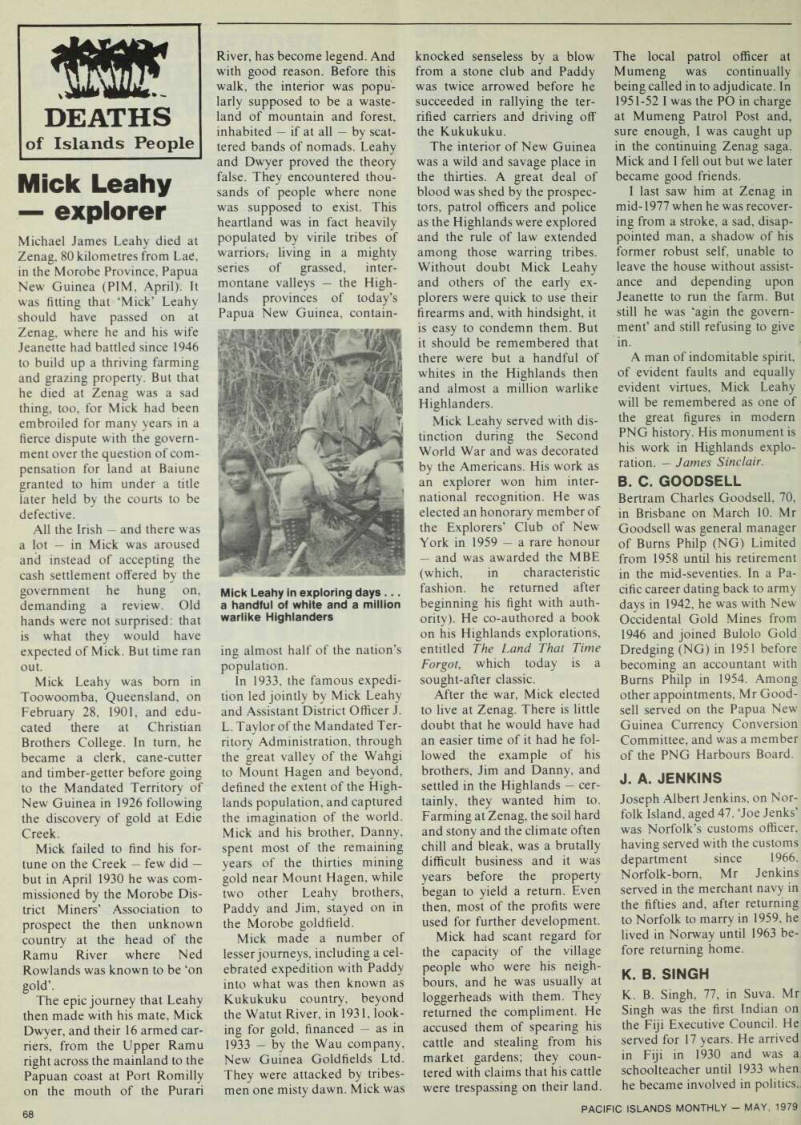
Without doubt Mick Leahy and others of the early ex plorers were quick to use their firearms and, with hindsight, it is easy to condemn them. But it should be remembered that there were but a handful of whites in the Highlands then and almost a million warlike
Highlanders.
Mick Leahy served with dis tinction during the Second World War and was decorated by the Americans. His work as an explorer won him inter national recognition. He was elected an honorary member of the Explorers’ Club of New York in 1959 a rare honour and was awarded the MBE (which, in characteristic fashion, he returned after beginning his fight with auth ority). He co-authored a book
on his Highlands explorations,
entitled The Land That Time Forgot, which today is a
sought-after classic.
After the war, Mick elected to live at Zenag. There is little doubt that he would have had an easier time of it had he fol lowed the example of his brothers, Jim and Danny, and settled in the Highlands cer tainly, they wanted him to.
Farming at Zenag, the soil hard and stony and the climate often chill and bleak, was a brutally difficult business and it was years before the property began to yield a return. Even then, most of the profits were used for further development.
Mick had scant regard for the capacity of the village people who were his neigh bours, and he was usually at
loggerheads with them. They
returned the compliment. He accused them of spearing his cattle and stealing from his
market gardens; they coun
tered with claims that his cattle were trespassing on their land.
The local patrol officer at
Mumeng was continually
being called in to adjudicate. In 1951-52 I was the PO in charge at Mumeng Patrol Post and, sure enough, I was caught up in the continuing Zenag saga.
Mick and I fell out but we later became good friends.
I last saw him at Zenag in mid-1977 when he was recover ing from a stroke, a sad, disap pointed man, a shadow of his former robust self, unable to leave the house without assist ance and depending upon Jeanette to run the farm. But still he was ‘agin the govern ment’ and still refusing to give in.
A man of indomitable spirit, of evident faults and equally evident virtues, Mick Leahy will be remembered as one of the great figures in modern PNG history. His monument is his work in Highlands explo ration. James Sinclair.
B. C. Goodsell
Bertram Charles Goodsell, 70, in Brisbane on March 10. Mr Goodsell was general manager of Burns Philp (NG) Limited from 1958 until his retirement in the mid-seventies. In a Pa cific career dating back to army days in 1942, he was with New Occidental Gold Mines from 1946 and joined Bulolo Gold Dredging (NG) in 1951 before becoming an accountant with Burns Philp in 1954. Among other appointments, Mr Good sell served on the Papua New Guinea Currency Conversion Committee, and was a member of the PNG Harbours Board.
J. A. Jenkins
Joseph Albert Jenkins, on Nor folk Island, aged 47. ‘Joe Jenks’ was Norfolk’s customs officer, having served with the customs department since 1966.
Norfolk-born, Mr Jenkins served in the merchant navy in the fifties and, after returning to Norfolk to marry in 1959, he lived in Norway until 1963 be fore returning home.
K. B. Singh
K. B. Singh, 77, in Suva. Mr Singh was the first Indian on the Fiji Executive Council. He served for 17 years. He arrived in Fiji in 1930 and was aj schoolteacher until 1933 whem he became involved in politics-
Mick Leahy in exploring days ... a handful of white and a million warlike Highlanders