Promising
pp. 73-75 · Read in the full issue
Trade
Winds
Agriculture
Pitfalls In A
Promising
Solomons Scene
In production terms, the agricultural outlook for Solomon Islands in a variety of sectors is promising. But a Honiara correspondent, in this survey, warns of the dangers of a dual economy in which smallholders are neglected at the expense of a concentrated wealthy commercial sector.
Solomon Islands is on the verge of another major though long-term expansion in its agricultural sector. Under a re cent provisional agreement with the government, the big Unilever Group, the country’s largest producer of coconuts and timber, has promised to plant or replant over the next 10 years more than 14 000 acres with high-yielding hybrid coconuts as well as 3 000 acres of cocoa. The government is going to be a partner in this
development, providing 40% of
the capital of Lever Solomons Limited.
The government already has major shareholdings together with foreign investors in palm oil, rice and tuna fishing and
processing and is increasingly
feeling the benefits of these joint ventures which have been set up since the beginning of the seventies.
Gross domestic product (GDP) in real terms grew at an annual rate of more than 7% between 1973 and 1977, and at a satisfactory 3.9% even after allowing for rapid population growth. The joint ventures have helped to strengthen the country’s trade position though less so last year than in a
bumper 1977.
Due to somewhat weaker
export prices, especially for
fish, the value of most of the key agricultural exports was not quite as high as in 1977.
But, thanks to rapidly expand ing palm oil production, total exports increased by SSI 1.2
million to slightly over $3O million last year. In 1973 Solomon Islands exports totalled less than $9 million.
Solomon Islands’ agricul ture, which accounts for 60% of monetary GDP, has been, and will continue to be, very much the engine of economic growth.
Progress toward fulfilling sev
eral of the government’s prin cipal goals in the agricultural sector, as laid down in the cur rent 1975-1979 development plan, has been encouraging.
Apart from export growth, a
high degree of self-sufficiency
for the main foodstuffs has been achieved, several thou sand jobs have been created and government revenue has increased.
The various ventures have also made Solomon Islands much less dependent on copra and a good deal more diver sified. While copra accounted for more than 90% of all exports in the middle sixties, its share has now dropped to only about a quarter, running neck and neck with fish exports.
Timber follows closely behind as the third most important
source of foreign exchange,
while palm oil now contributes 16% of export earnings a share that is likely to increase over the next few years.
Development in the fishing
sector has been truly spec tacular in recent years, thanks to a joint venture between the
big Japanese fishing group
Taiyo and government. In 1973 a joint tuna fishing and can-
ning operation was set up at the old pre-war capital, Tulagi. p r ; rtr p i -r , • Prior to Solomon Taiyo Limited s establishment, Solomon
Islanders caught fish only by
traditional spear and handline methods for their own consumption and not even enough for that purpose, as sizable fish imports indicated. In 1978 STL caught 15 712
tonnes, mainly skipjack tuna,
More than 80% of the catch was sold as fresh or frozen fish, primarily to canneries in American Samoa, Puerto Rico and on the US mainland. Most of the remainder was canned at Tulagi with some of it also being smoked as arabushi for the Japanese market. Fish imports into the Solomon
Islands have virtually stopped
now - The company employs about
1000 people, mainly Solomon
Islanders. Its fleet of more than 20 catcher boats (16 chartered) operates out of two bases, one at Tulagi and a more recentlyestablished one at Noro in New Georgia. While the company has so far not been successful in finding a suitable third base,
its three-year pilot project for
longline fishing to tap the rich resources of big- ‘ye and yellowfin tuna has shown promising results since its
inception in September 1978.
Depending on the outcome of
a feasibility study, to have been submitted to the government last month, it is also thinking of building a second, modern cannery, perhaps at Noro, with at least three times the capacity of the Tulagi plant (which can process about 3 000 t a year).
Even on the present scanty knowledge of the Solomons’ tuna fish resources, it is reckoned that annual catches could easily be doubled to 30 000 t. The next few years will see not only a major
expansion in STL’s operations,
with the number of company boats increasing to 11 and the total fleet possibly to 35 by 1982. Simultaneously there will be a major build-up of a national fishing fleet. With the help of a $3.25 million loan from the Asian Development Bank, the new National Fish
eries Development Company
(NFD) will construct 10 ferro cement skipjack tuna catcher boats and acquire 20 bait catching boats. The catcher boats will either be chartered to, or fish in close co-operation with, STL, which will be re sponsible for the marketing of the catch and the training of local fishermen, aided by sub stantial Japanese financial and
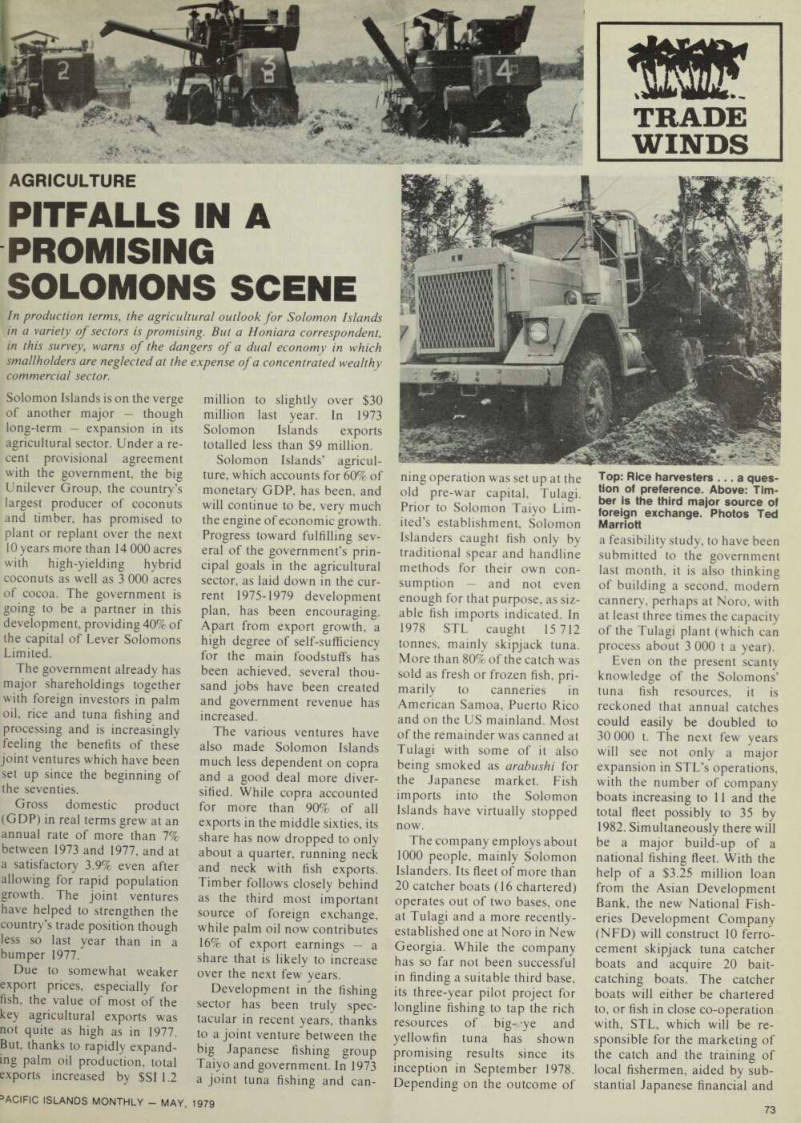
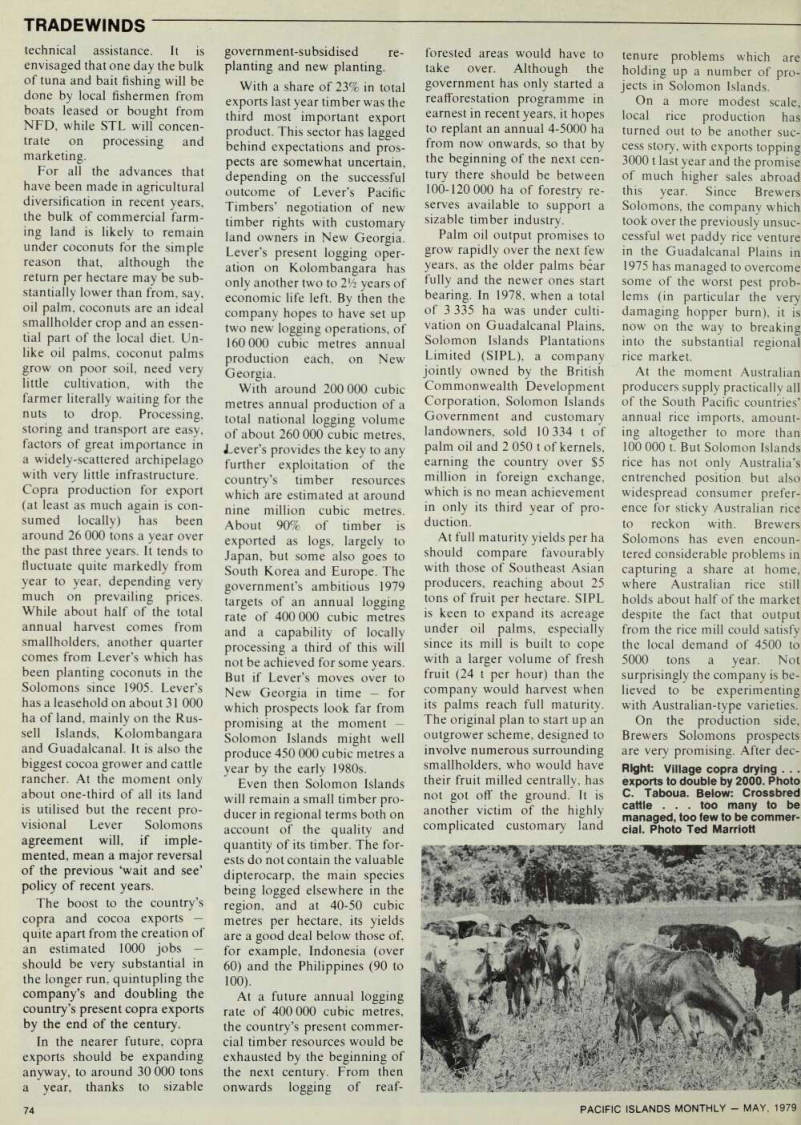
Top: Rice harvesters ... a ques tion of preference. Above: Tim ber is the third major source of foreign exchange. Photos Ted Marriott
technical assistance. It is envisaged that one day the bulk of tuna and bait fishing will be done by local fishermen from boats leased or bought from NFD, while STL will concen trate on processing and
marketing.
For all the advances that have been made in agricultural diversification in recent years, the bulk of commercial farm ing land is likely to remain under coconuts for the simple reason that, although the return per hectare may be sub stantially lower than from, say, oil palm, coconuts are an ideal smallholder crop and an essen tial part of the local diet. Un like oil palms, coconut palms grow on poor soil, need very little cultivation, with the farmer literally waiting for the
nuts to drop. Processing,
storing and transport are easy, factors of great importance in
a widely-scattered archipelago
with very little infrastructure.
Copra production for export
(at least as much again is con sumed locally) has been around 26 000 tons a year over the past three years. It tends to
fluctuate quite markedly from
year to year, depending very
much on prevailing prices.
While about half of the total annual harvest comes from smallholders, another quarter comes from Lever’s which has been planting coconuts in the Solomons since 1905. Lever’s has a leasehold on about 31 000 ha of land, mainly on the Rus sell Islands, Kolombangara and Guadalcanal. It is also the biggest cocoa grower and cattle rancher. At the moment only about one-third of all its land is utilised but the recent pro visional Lever Solomons agreement will, if imple mented, mean a major reversal of the previous ‘wait and see’ policy of recent years.
The boost to the country’s copra and cocoa exports quite apart from the creation of an estimated 1000 jobs should be very substantial in the longer run, quintupling the
company’s and doubling the
country’s present copra exports by the end of the century.
In the nearer future, copra exports should be expanding anyway, to around 30 000 tons a year, thanks to sizable
government-subsidised re
planting and new planting.
With a share of 23% in total exports last year timber was the third most important export product. This sector has lagged behind expectations and pros pects are somewhat uncertain, depending on the successful outcome of Lever’s Pacific Timbers’ negotiation of new timber rights with customary land owners in New Georgia.
Lever’s present logging oper ation on Kolombangara has only another two to 2Vi years of economic life left. By then the company hopes to have set up two new logging operations, of 160 000 cubic metres annual production each, on New
Georgia.
With around 200 000 cubic metres annual production of a total national logging volume of about 260 000 cubic metres, fever’s provides the key to any further exploitation of the country’s timber resources which are estimated at around nine million cubic metres.
About 90% of timber is
exported as logs, largely to
Japan, but some also goes to South Korea and Europe. The government’s ambitious 1979 targets of an annual logging rate of 400 000 cubic metres and a capability of locally processing a third of this will not be achieved for some years.
But if Lever’s moves over to New Georgia in time for which prospects look far from promising at the moment Solomon Islands might well produce 450 000 cubic metres a year by the early 1980 s.
Even then Solomon Islands will remain a small timber pro ducer in regional terms both on account of the quality and quantity of its timber. The for ests do not contain the valuable
dipterocarp, the main species
being logged elsewhere in the region, and at 40-50 cubic metres per hectare, its yields are a good deal below those of, for example, Indonesia (over 60) and the Philippines (90 to 100).
At a future annual logging rate of 400 000 cubic metres, the country’s present commer cial timber resources would be exhausted by the beginning of the next century. From then onwards logging of reaf
forested areas would have to take over. Although the government has only started a reafforestation programme in earnest in recent years, it hopes to replant an annual 4-5000 ha from now onwards, so that by the beginning of the next cen tury there should be between 100-120 000 ha of forestry re serves available to support a sizable timber industry.
Palm oil output promises to grow rapidly over the next few years, as the older palms bear fully and the newer ones start bearing. In 1978, when a total of 3 335 ha was under culti vation on Guadalcanal Plains, Solomon Islands Plantations Limited (SIPL), a company jointly owned by the British
Commonwealth Development
Corporation, Solomon Islands Government and customary landowners, sold 10 334 t of palm oil and 2 050 t of kernels, earning the country over $5
million in foreign exchange,
which is no mean achievement in only its third year of pro duction.
At full maturity yields per ha should compare favourably with those of Southeast Asian
producers, reaching about 25
tons of fruit per hectare. SIPL is keen to expand its acreage
under oil palms, especially
since its mill is built to cope with a larger volume of fresh fruit (24 t per hour) than the company would harvest when its palms reach full maturity.
The original plan to start up an outgrower scheme, designed to involve numerous surrounding smallholders, who would have their fruit milled centrally, has not got off the ground. It is another victim of the highly complicated customary land
tenure problems which are holding up a number of pro jects in Solomon Islands.
On a more modest scale, local rice production has turned out to be another suc cess story, with exports topping 3000 t last year and the promise of much higher sales abroad this year. Since Brewers Solomons, the company which took over the previously unsuc cessful wet paddy rice venture in the Guadalcanal Plains in 1975 has managed to overcome some of the worst pest prob lems (in particular the very damaging hopper burn), it is now on the way to breaking into the substantial regional rice market.
At the moment Australian
producers supply practically all
of the South Pacific countries’ annual rice imports, amount ing altogether to more than 100 000 t. But Solomon Islands rice has not only Australia’s entrenched position, but also widespread consumer prefer ence for sticky Australian rice to reckon with. Brewers Solomons has even encoun tered considerable problems in capturing a share at home, where Australian rice still holds about half of the market despite the fact that output from the rice mill could satisfy the local demand of 4500 to 5000 tons a year. Not surprisingly the company is be lieved to be experimenting with Australian-type varieties.
On the production side, Brewers Solomons prospects are very promising. After dec-
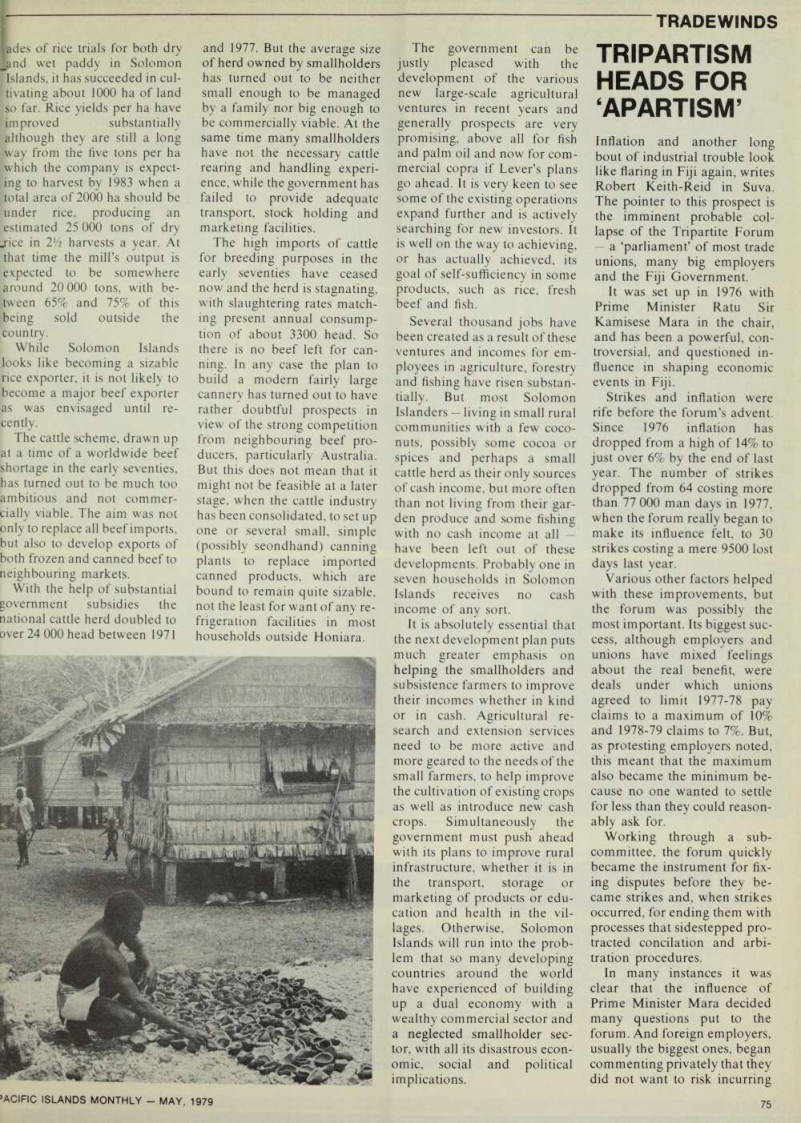
Right: Village copra drying ...
exports to double by 2000. Photo C. Taboua. Below: Crossbred cattle ... too many to be managed, too few to be commer cial. Photo Ted Marriott
lades of rice trials for both dry jand wet paddy in Solomon Islands, it has succeeded in cul tivating about 1000 ha of land so far. Rice yields per ha have
improved substantially
although they are still a long way from the five tons per ha which the company is expect ing to harvest by 1983 when a total area of 2000 ha should be under rice, producing an estimated 25 000 tons of dry jice in 2Vi harvests a year. At that time the mill’s output is expected to be somewhere around 20 000 tons, with be tween 65% and 75% of this being sold outside the country.
While Solomon Islands looks like becoming a sizable rice exporter, it is not likely to become a major beef exporter as was envisaged until re
cently.
The cattle scheme, drawn up at a time of a worldwide beef shortage in the early seventies, has turned out to be much too ambitious and not commer cially viable. The aim was not
only to replace all beef imports,
but also to develop exports of both frozen and canned beef to
neighbouring markets.
With the help of substantial government subsidies the national cattle herd doubled to over 24 000 head between 1971
and 1977. But the average size of herd owned by smallholders has turned out to be neither small enough to be managed by a family nor big enough to be commercially viable. At the same time many smallholders have not the necessary cattle
rearing and handling experi
ence, while the government has failed to provide adequate transport, stock holding and
marketing facilities,
The high imports of cattle for breeding purposes in the early seventies have ceased now and the herd is stagnating, with slaughtering rates match ing present annual consump tion of about 3300 head. So there is no beef left for can ning. In any case the plan to build a modern fairly large cannery has turned out to have rather doubtful prospects in view of the strong competition from neighbouring beef pro ducers, particularly Australia, But this does not mean that it might not be feasible at a later stage, when the cattle industry has been consolidated, to set up one or several small, simple
(possibly seondhand) canning
plants to replace imported
canned products, which are bound to remain quite sizable, not the least for want of any re frigeration facilities in most households outside Honiara.
The government can be
justly pleased with the
development of the various
new large-scale agricultural
ventures in recent years and generally prospects are very promising, above all for fish and palm oil and now for com mercial copra if Lever’s plans go ahead. It is very keen to see some of the existing operations expand further and is actively searching for new investors. It is well on the way to achieving, or has actually achieved, its goal of self-sufficiency in some products, such as rice, fresh beef and fish.
Several thousand jobs have been created as a result of these ventures and incomes for em
ployees in agriculture, forestry
and fishing have risen substan tially. But most Solomon Islanders living in small rural communities with a few coco nuts, possibly some cocoa or spices and perhaps a small cattle herd as their only sources of cash income, but more often than not living from their gar den produce and some fishing with no cash income at all have been left out of these
developments. Probably one in
seven households in Solomon Islands receives no cash income of any sort.
It is absolutely essential that the next development plan puts much greater emphasis on helping the smallholders and subsistence farmers to improve their incomes whether in kind or in cash. Agricultural re search and extension services need to be more active and more geared to the needs of the small farmers, to help improve the cultivation of existing crops as well as introduce new cash crops. Simultaneously the government must push ahead with its plans to improve rural infrastructure, whether it is in the transport, storage or marketing of products or edu cation and health in the vil lages. Otherwise, Solomon Islands will run into the prob lem that so many developing countries around the world
have experienced of building
up a dual economy with a wealthy commercial sector and a neglected smallholder sec tor, with all its disastrous econ omic, social and political
implications.