Take one large
p. 63 · Read in the full issue
scale map of the Pacific...
War in the Pacific by John Win ton. Published by Hutchinson Group (Australia). $A 14.45.
This is a fascinating study of a subject difficult to cover com " pletely in one volume. But the brevity of the work is more than compensated for by an impeccable sense of fairness to the commanders on both sides, and a careful allotment of space to forces and events in order of their importance. The author is fairer on those Japanese admirals who did not
produce resounding victories
than were the Imperial naval staff whose unforgiving atti tudes were reminiscent of the Royal Navy in the nineteenth century. As most Japanese
plans provided for resounding
victories, it is not surprising that there was a higher turn over of fleet commanders than in the United States navy.
The wealth of technical detail on the capabilities of vessels, and the very nature of the task of moving fleets over the vast Pacific as described in the narrative, prompt me to recommend that this book be read with a large-scale map of the Pacific and relevant copies of Jane’s Fighting Ships within reach (an arrangement which I was unhappily able to bring about).
The overwhelming truth which emerges from this book is that naval power will always be the dominant factor in the Pacific security, and it is as im portant today as it was then for governments to appreciate this fact. Seaborne air power not only continues to form a major part of the forward de ployment policy of the United States Pacific forces but also represents America’s (and by implication ANZUS’) most effective counterforce capa bility. Australia’s decision to scrap her one remaining air craft carrier might well hold serious consequences for her naval power in the future.
Although the author does not make a point of saying so,
even a quick glance at his description of the Japanese commanders and their de cisions will reveal to the reader the vast differences, and even some parallels, between the Japanese and Western make ups. The apparently conflicting sides to Admiral Yamamoto’s character, one side which singled out US carriers as the primary target, and the other which longed for a big gun battle, are perfectly normal for a Japanese gentleman in a so ciety which believes that in order to be a whole person, one must be the result of conflicting forces. The belief that one’s manner of dying can validate one’s entire life gave the Tokko Tai pilots a death which can be likened to an oriental
Gotterdammerung.
Debunking is a besetting sin of our age and it is fortunate that Mr Winton does not share this fault when he deals with the American and Allied com manders. Even the most mod est little triumphs of the Royal Navy come in for a mention in what was tantamount to an American war. America’s awe some industrial might and her wonderful ‘can do’ spirit (so
often mistaken by Anglophiles
for boasting) combine to make the United States a devastating enemy. Field-Marshal Lord Montgomery once wrote that his first piece of advice to any would-be strategist is ‘Never march on Moscow’; he should have added ‘and never declare war on the United States unless you suffer from a death wish’.
Mr Winton devotes a chap ter to Pearl Harbour and coldly adds up the credit and debit accounts for both sides (an ad mirable approach which mani fests itself throughout the work). However, one cannot
help feeling a little disap
pointed that he did not (or was not permitted to) devote simi lar chapters to the events im
mediately preceding Pearl
Harbour, and the outlook after
Japan’s surrender.
Both periods probably hold
as many, if not more, valuable lessons for those of us who were born after 1945, as do the political and naval strategies of the period. For example, no one could have predicted in 1941 that the day would come when Japan would consume every six hours her total oil stocks at the time of the attack on Pearl Harbour.
A serious diplomatic blun der over the way the American ultimatum was delivered has been suggested as the cause of Japan’s reluctance to reply with a counter-proposal for, where the US ultimatum demanded, among other things, the with drawal of all Japanese forces from China, it was not speci fied whether this should in clude Manchuria which, up until that time, has been the scene of extensive Japanese investment and colonisation. It has been suggested that the American ambassador was saving this classification as a trade-off against any counter
proposals from the Japanese
foreign ministry.
A sinister turn of events which followed Japan’s sur render was the occupation of the Kurile Islands to the north by the Soviet Union; as the growth of Soviet sea power continues to cause anxiety among the ANZUS naval plan ners, we may well grow to miss a firmer hand at Tokyo Bay in 1945 HRH Prince Tupouto’a,
Crown Prince of the Kingdom of
Tonga and the country’s assist
ant secretary for foreign affairs.
The views expressed in the re view are his own and do not re flect any ‘official line ’ of the Tongan Government.
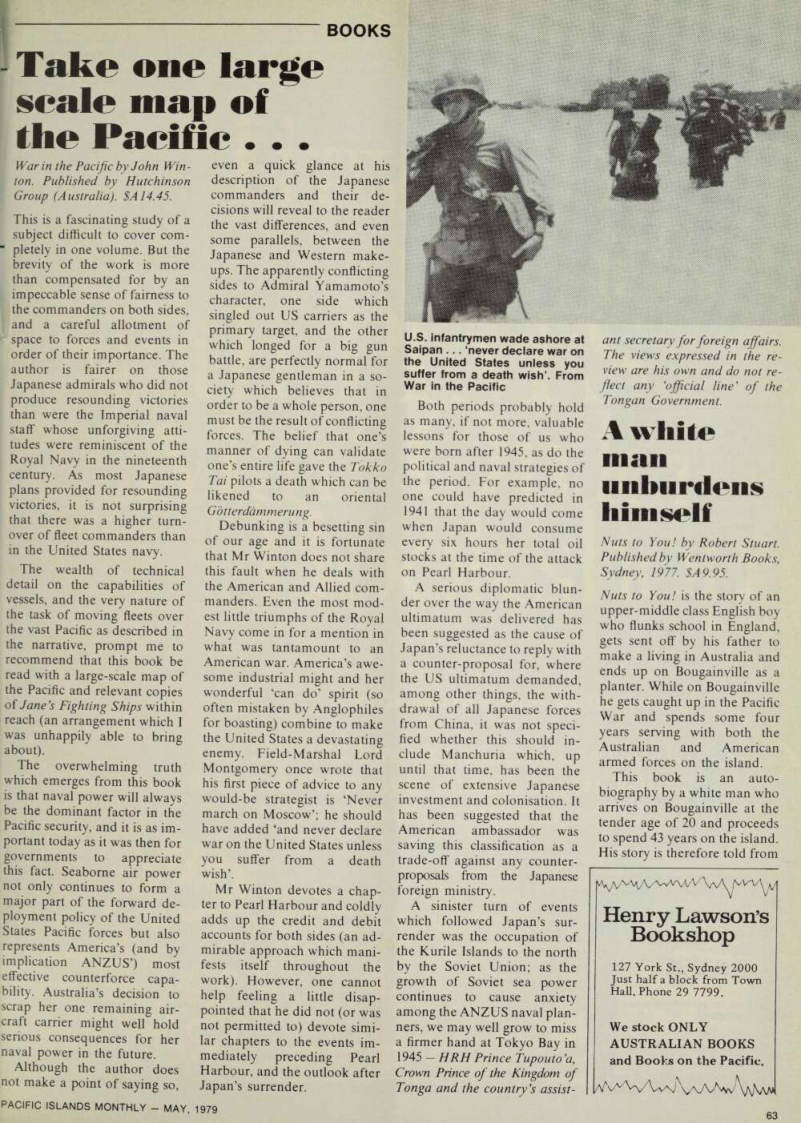
U.S. infantrymen wade ashore at Saipan ... ‘never declare war on the United States unless you suffer from a death wish'. From War in the Pacific