Journey With
p. 61 · Read in the full issue
Books
A Polynesian
Pith And Wit
A History of the Pacific from
the Stone Age to the Present
Day by Glen Barclay. Published
by Sidgwick and Jackson, Lon don, 1979. $A 14.95.
Dr Barclay’s book is something of a tour de force, at least in or ganisational terms. Even allowing for the gran diloquence of the title the book in fact is largely confined to the Polynesian Islands he
has accomplished a daunting
task in compressing the com plex and colourful interactions of a thousand years into some 230 highly readable pages.
More than that, he has skilfully inserted Pacific Islands’ history into the relevant world context in a manner which is both per tinent and revealing.
Throughout he has main tained a fine but judicious bal ance between objectivity and an unsentimental empathy
with his Polynesian subjects.
Only at one point, in fact, when he is discussing operations in the Pacific theatre of World War 11, did this reviewer feel that Barclay had lost touch with his central concerns.
This is essentially and unashamedly a narrative his
tory. Its theme, insofar as it may be said to have one, is simply that Polynesians are a creative, intelligent and adven turous people who, after cen turies spent in fashioning an accommodation with their varied environments, met a challenge in European tech nological power with which they could not cope; thrown into chaos and confusion, and for a time threatened with total extinction, they recovered and, by dint of shrewdness and pol itical skill, managed to survive and even to prosper. One of the features of the book is the con fidence with which Dr Barclay handles the variety in Polynesian cultural systems and their ecological bases.
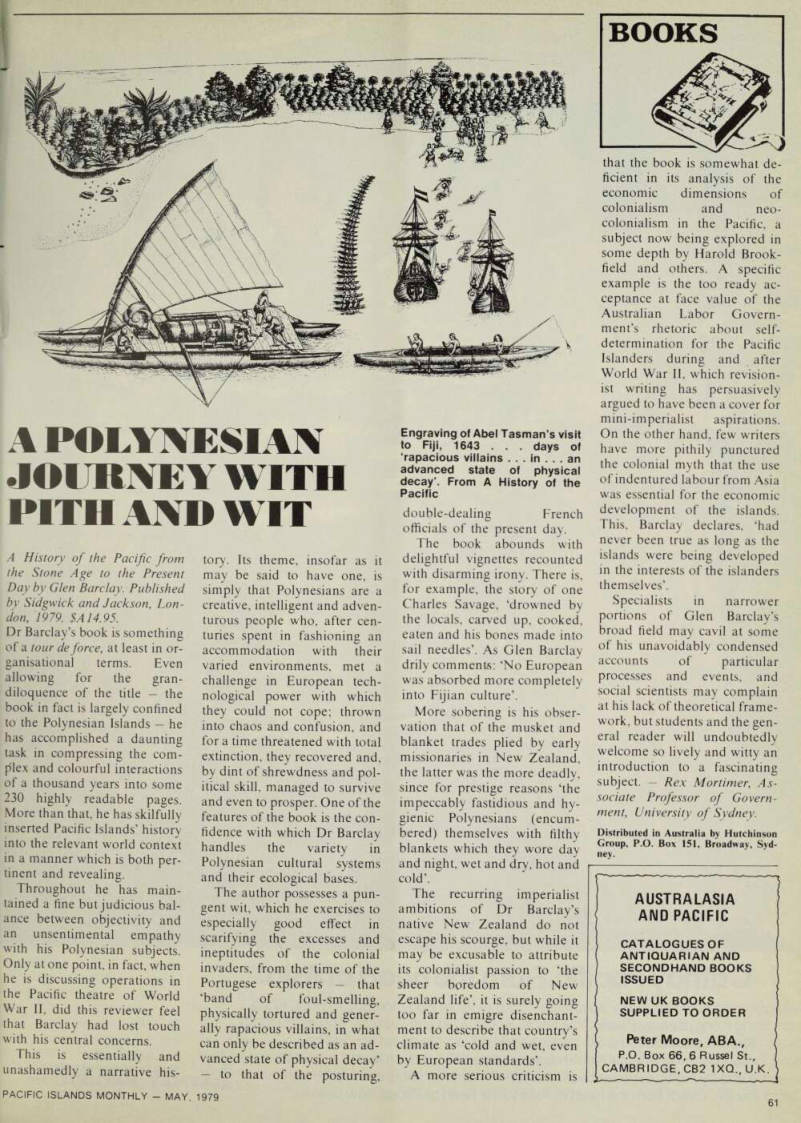
The author possesses a pun gent wit, which he exercises to especially good effect in scarifying the excesses and ineptitudes of the colonial invaders, from the time of the Portugese explorers that ‘band of foul-smelling, physically tortured and gener ally rapacious villains, in what can only be described as an ad vanced state of physical decay’ - to that of the posturing,
double-dealing French
officials of the present day.
The book abounds with
delightful vignettes recounted
with disarming irony. There is, for example, the story of one Charles Savage, ‘drowned by the locals, carved up, cooked, eaten and his bones made into sail needles’. As Glen Barclay
drily comments: ‘No European
was absorbed more completely into Fijian culture’.
More sobering is his obser vation that of the musket and blanket trades plied by early missionaries in New Zealand, the latter was the more deadly, since for prestige reasons ‘the impeccably fastidious and hy gienic Polynesians (encum bered) themselves with filthy blankets which they wore day and night, wet and dry, hot and cold’.
The recurring imperialist
ambitions of Dr Barclay’s native New Zealand do not escape his scourge, but while it may be excusable to attribute its colonialist passion to ‘the sheer boredom of New Zealand life’, it is surely going too far in emigre disenchant ment to describe that country’s climate as ‘cold and wet, even by European standards’.
A more serious criticism is
that the book is somewhat de ficient in its analysis of the economic dimensions of colonialism and neo colonialism in the Pacific, a subject now being explored in some depth by Harold Brook field and others. A specific example is the too ready ac ceptance at face value of the Australian Labor Govern ment’s rhetoric about self determination for the Pacific Islanders during and after World War 11, which revision
ist writing has persuasively
argued to have been a cover for
mini-imperialist aspirations.
On the other hand, few writers have more pithily punctured the colonial myth that the use of indentured labour from Asia was essential for the economic development of the islands.
This, Barclay declares, ‘had never been true as long as the
islands were being developed
in the interests of the islanders themselves’.
Specialists in narrower
portions of Glen Barclay’s
broad field may cavil at some of his unavoidably condensed accounts of particular processes and events, and social scientists may complain at his lack of theoretical frame work, but students and the gen eral reader will undoubtedly welcome so lively and witty an introduction to a fascinating subject. - Rex Mortimer, As
sociate Professor of Govern
ment, University of Sydney.
Distributed in Australia by Hutchinson Group, P.O. Box 151, Broadway, Syd ney.
Engraving of Abel Tasman’s visit to Fiji, 1643 ... days of rapacious villains ... in ... an advanced state of physical decay’. From A History of the Pacific