duty free
pp. 54-60 · Read in the full issue


Tropicalities
Meli kills more
than 50 Fijians
Cyclone Meli they used to call them hurricanes (with far more feeling) crashed
through Fiji’s southern islands
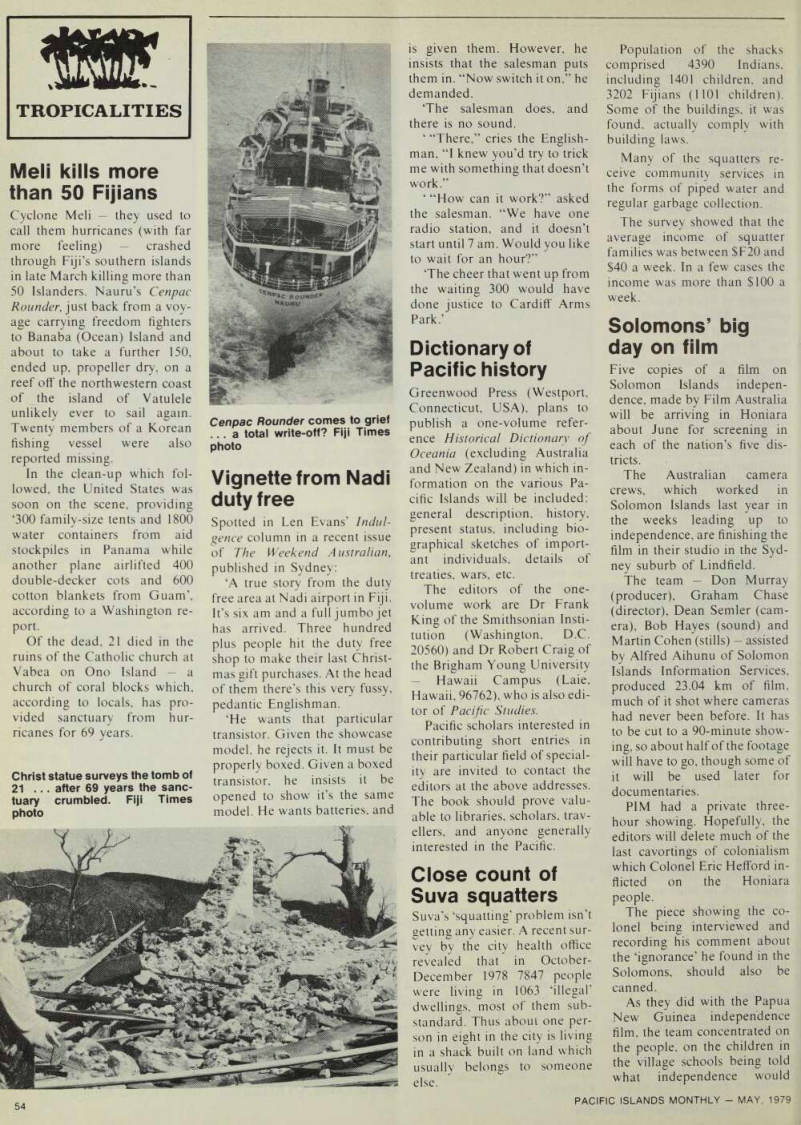
in late March killing more than 50 Islanders. Nauru’s Cenpac Rounder, just back from a voy
age carrying freedom fighters
to Banaba (Ocean) Island and about to take a further 150, ended up, propeller dry, on a reef off the northwestern coast of the island of Vatulele unlikely ever to sail again.
Twenty members of a Korean fishing vessel were also
reported missing.
In the clean-up which fol lowed, the United States was soon on the scene, providing ‘3OO family-size tents and 1800 water containers from aid stockpiles in Panama while another plane airlifted 400 double-decker cots and 600 cotton blankets from Guam’, according to a Washington re port.
Of the dead, 21 died in the ruins of the Catholic church at Vabea on Ono Island a church of coral blocks which, according to locals, has pro vided sanctuary from hur ricanes for 69 years.
Vignette from Nadi
duty free
Spotted in Ten Evans’ Indul gence column in a recent issue of The Weekend Australian,
published in Sydney:
‘A true story from the duty free area at Nadi airport in Fiji.
It’s six am and a full jumbo jet has arrived. Three hundred plus people hit the duty free shop to make their last Christ mas gift purchases. At the head of them there’s this very fussy,
pedantic Englishman.
‘He wants that particular transistor. Given the showcase model, he rejects it. It must be properly boxed. Given a boxed transistor, he insists it be opened to show it’s the same model. He wants batteries, and
is given them. However, he insists that the salesman puts them in. “Now switch it on,” he demanded. ‘The salesman does, and there is no sound. ‘ “There,” cries the English man, “I knew you’d try to trick me with something that doesn’t work.” ‘“How can it work?” asked the salesman. “We have one radio station, and it doesn’t start until 7 am. Would you like to wait for an hour?” ‘The cheer that went up from the waiting 300 would have done justice to Cardiff Arms Park.’
Dictionary of
Pacific history
Greenwood Press (Westport, Connecticut, USA), plans to publish a one-volume refer ence Historical Dictionary of Oceania (excluding Australia and New Zealand) in which in formation on the various Pa cific Islands will be included:
general description, history,
present status, including bio
graphical sketches of import
ant individuals, details of treaties, wars, etc.
The editors of the one volume work are Dr Frank King of the Smithsonian Insti tution (Washington, D.C. 20560) and Dr Robert Craig of
the Brigham Young University
Hawaii Campus (Laie, Hawaii, 96762), who is also edi tor of Pacific Studies.
Pacific scholars interested in contributing short entries in their particular field of special ity are invited to contact the editors at the above addresses.
The book should prove valu able to libraries, scholars, trav ellers, and anyone generally interested in the Pacific.
Close count of
Suva squatters
Suva’s ‘squatting’ problem isn’t
getting any easier. A recent sur vey by the city health office revealed that in October- December 1978 7847 people were living in 1063 ‘illegal’ dwellings, most of them sub standard. Thus about one per son in eight in the city is living in a shack built on land which usually belongs to someone else.
Population of the shacks comprised 4390 Indians, including 1401 children, and 3202 Fijians (1101 children).
Some of the buildings, it was
found, actually comply with
building laws.
Many of the squatters re ceive community services in the forms of piped water and
regular garbage collection.
The survey showed that the average income of squatter families was between SF2O and $4O a week. In a few cases the income was more than $lOO a week.
Solomons’ big
day on film
Five copies of a film on Solomon Islands indepen dence, made by Film Australia will be arriving in Honiara about June for screening in each of the nation’s five dis tricts.
The Australian camera crews, which worked in Solomon Islands last year in the weeks leading up to
independence, are finishing the
film in their studio in the Syd ney suburb of Lindfield.
The team Don Murray (producer), Graham Chase (director). Dean Semler (cam era), Bob Hayes (sound) and Martin Cohen (stills) assisted by Alfred Aihunu of Solomon Islands Information Services, produced 23.04 km of film, much of it shot where cameras had never been before. It has to be cut to a 90-minute show ing, so about half of the footage will have to go, though some of it will be used later for documentaries.
PIM had a private three hour showing. Hopefully, the editors will delete much of the last cavortings of colonialism which Colonel Eric Hefford in flicted on the Honiara
people.
The piece showing the co lonel being interviewed and recording his comment about the ‘ignorance’ he found in the Solomons, should also be canned.
As they did with the Papua New Guinea independence film, the team concentrated on the people, on the children in the village schools being told what independence would
Christ statue surveys the tomb of 21 ... after 69 years the sanc tuary crumbled. Fiji Times photo
Cenpac Rounder comes to grief ... a total write-off? Fiji Times photo
I mean, on village elders discuss ing plans for local celebrations [ on The Day’, and on the actual i celebrations in various places when that day came includ
[ ing Honiara.
What the film tries to do is to bring out a feeling of national unity and to impress f on the people that on July 7 they became ‘first-class people instead of being second-class for the 85 years of colonialism,’ , as one Solomon Islander put it.
What the film does is to demonstrate that the Islanders should have been left to I organise the celebrations in Honiara instead of importing a
pensioned-off military
brasshat whose ideas have never left the barrack square!
Okuk makes his
presence felt
Government and opposition leaders got together recently in a rare display of co-operation in the new format of the Papua New Guinea Parliament since the deposition of Sir Tei Abal as opposition leader and the rise to prominence of National
Party leader lambakey Okuk.
The issue under scrutiny was the one which has been
increasingly worrying to PNG
over the past two or three years law and order. It can be broken simply into two areas tribal fighting and urban lawlessness, the latter much
more disturbing.
Prime Minister Michael Somare and Mr Okuk along
with Highlands provincial
leaders got together in Port Moresby for two days of talks,
concentrating on the High
lands law and order problem.
A similar conference with Port Moresby as focus appears in order.
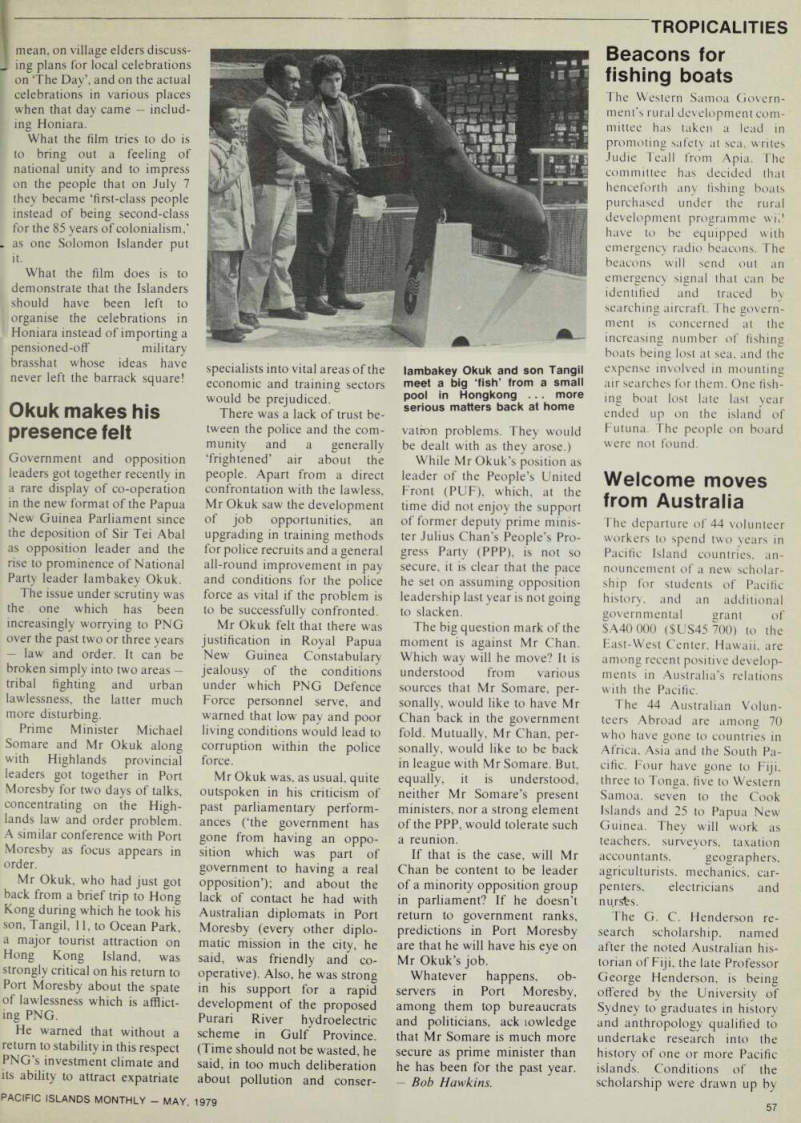
Mr Okuk, who had just got back from a brief trip to Hong Kong during which he took his son, Tangil, 11, to Ocean Park, a major tourist attraction on
Hong Kong Island, was
strongly critical on his return to Port Moresby about the spate of lawlessness which is afflict
ing PNG.
He warned that without a return to stability in this respect PNG’s investment climate and its ability to attract expatriate
specialists into vital areas of the economic and training sectors would be prejudiced.
There was a lack of trust be tween the police and the com munity and a generally ‘frightened’ air about the people. Apart from a direct confrontation with the lawless, Mr Okuk saw the development of job opportunities, an
upgrading in training methods
for police recruits and a general all-round improvement in pay and conditions for the police force as vital if the problem is to be successfully confronted.
Mr Okuk felt that there was justification in Royal Papua New Guinea Constabulary jealousy of the conditions under which PNG Defence Force personnel serve, and warned that low pay and poor living conditions would lead to corruption within the police force.
Mr Okuk was, as usual, quite outspoken in his criticism of past parliamentary perform ances (‘the government has gone from having an oppo sition which was part of government to having a real opposition’); and about the lack of contact he had with Australian diplomats in Port
Moresby (every other diplo
matic mission in the city, he said, was friendly and co operative). Also, he was strong in his support for a rapid development of the proposed Purari River hydroelectric scheme in Gulf Province. (Time should not be wasted, he said, in too much deliberation about pollution and conser
vatron problems. They would
be dealt with as they arose.) While Mr Okuk’s position as leader of the People’s United Front (PUF), which, at the time did not enjoy the support of former deputy prime minis ter Julius Chan’s People’s Pro gress Party (PPP), is not so secure, it is clear that the pace he set on assuming opposition leadership last year is not going to slacken.
The big question mark of the moment is against Mr Chan.
Which way will he move? It is understood from various sources that Mr Somare, per sonally, would like to have Mr Chan back in the government fold. Mutually, Mr Chan, per sonally, would like to be back in league with Mr Somare. But, equally, it is understood, neither Mr Somare’s present ministers, nor a strong element of the PPP, would tolerate such a reunion.
If that is the case, will Mr Chan be content to be leader of a minority opposition group in parliament? If he doesn’t return to government ranks,
predictions in Port Moresby
are that he will have his eye on Mr Okuk’s job.
Whatever happens, ob servers in Port Moresby, among them top bureaucrats
and politicians, ack lowledge
that Mr Somare is much more secure as prime minister than he has been for the past year.
Bob Hawkins.
Beacons for
fishing boats
The Western Samoa Govern ment’s rural development com mittee has taken a lead in promoting safety at sea. writes Judie Teall from Apia. The committee has decided that henceforth any fishing boats purchased under the rural development programme wii! have to be equipped with emergency radio beacons. The beacons will send out an emergency signal that can be identified and traced by searching aircraft. The govern ment is concerned at the
increasing number of fishing
boats being lost at sea, and the expense involved in mounting air searches for them. One fish ing boat lost late last year ended up on the island of Futuna. The people on board were not found.
Welcome moves
from Australia
The departure of 44 volunteer workers to spend two years in Pacific Island countries, an nouncement of a new scholar ship for students of Pacific history, and an additional governmental grant of SA4O 000 (SUS4S 700) to the East-West Center. Hawaii, are among recent positive develop ments in Australia’s relations with the Pacific.
The 44 Australian Volun teers Abroad are among 70 who have gone to countries in Africa, Asia and the South Pa cific. Four have gone to Fiji, three to Tonga, five to Western Samoa, seven to the Cook Islands and 25 to Papua New Guinea. They will work as teachers, surveyors, taxation
accountants, geographers,
agriculturists, mechanics, car penters, electricians and nursbs.
The G. C. Henderson re search scholarship, named after the noted Australian his torian of Fiji, the late Professor
George Henderson, is being
offered by the University of Sydney to graduates in history and anthropology qualified to undertake research into the history of one or more Pacific islands. Conditions of the scholarship were drawn up by
lambakey Okuk and son Tangil meet a big ‘fish’ from a small pool in Hongkong ... more serious matters back at home
Professor Henderson, who died in 1944. Financed by a bequest he made to the University of Sydney, it is worth 5A4500 a year for two. possibly three years. Details are available from the registrar of the
university.
The Australian Government announced the additional grant to the East-West Center to provide fellowships for men and women from Asian and Pacific countries to take part in East-West Center pro grammes. The cheque was handed over to East-West Center president Dr Everett
Kleinjans by Australian Sena
tor John Knight, an East-West Centre alumnus, and W. C.
Rowe, Australian consul general in Honolulu.
Happy day for
all in Tahiti
Such a huge, gay and colourful crowd as gathered on Point Venus, Tahiti, on March 5 has probably not been seen since the first Protestant missionaries disembarked there in 1797, write Marie-Therese and Bengt Danielsson from Papeete. It was precisely this historical event that was commemorated by this great pageant, 182 years later. About 3000 members of the local Protestant church took part, and there were as many onlookers.
Favoured by perfect sunny
weather, the celebration bore
eloquent testimony to the
vitality of the Evangelical
Church of French Polynesia which, since 1963, has been
completely self-governing and
which now has its own body of Polynesian pastors. Even if
most of the parishioners who made the pilgrimage to this holy spot were middle-aged or older, there was a surprisingly large number of young men and women among them, bely ing the widespread notion that the local churches are fighting a losing battle against the attractions of the bars, night clubs, movie theatres, res taurants and sports clubs.
The lapse of time between the first arrival of the gospel and its 1979 re-enactment could be measured in two ways. First, the present-day church leaders are much less doctrinaire than their prede cessors. The new ecumenical spirit that has swept the world since World War II has taken firm hold on the minds of local Protestant church leaders.
Guess who was sitting there in the front row at the celebration
with Evangelical Church Presi dent Marurai? None other than the Catholic Bishop Michel Coppenrath who, moreover, in a speech, saluted the Protestant achievement. However, while
Bishop Coppenrath was there.
Adventist and Mormon church leaders, persisting in their ada mant exclusivist stand, were not.
The second way of measur ing the time lapse was to observe the general mood of the celebration the whole day was one of gaiety, a radical change from the austerity and gloom that characterised the Calvanistic missionaries sent out from Europe in the past.
Incidentally, the church mem bers who enacted the disem barkation on the black sand of Matavai were all Polynesians!
They were dressed in perfect
eighteenth-century British
style, coats, wigs. Mother Hub bard dresses and all. When they met the Pomare chiefs there was an amusing little scene with everybody
unabashedly cracking jokes in
Tahitian and English. Another
example of the light-hearted
spirit of the day occurred when one of the organisers suddenly shouted over the loudspeaker
to a European photographer,
who was wearing only a swim suit: ‘Hi, you there, your ances tors taught us to dress properly.
So don’t come here naked like
a savage!’
It is to be hoped that this church pageant will become an annual event. If it is as well done as it was this year, it will undoubtedly not only serve to bolster the faith and further the ecumenical movement, but will also serve as a tourist attrac tion. perhaps even taking the place of the July 14 festival
which is sadly degenerating
into a purely commercial show,
completely lacking the spon
taneity of the re-enactment we witnessed this year.
A close look at
PNG high schools
A study recently completed by
the Educational Research Unit,
University of Papua New
Guinea, examines four factors which have often been suspected to give students an
advantage in high schools.
Students from church agency schools are thought to get bet ter grade 10 results than those from government schools, boys are thought to do better than girls, boarders better than day students, and urban students better than rural students.
The grade 10 mid-year rating examination results for nearly 1800 students were examined to see whether these expec tations were true. It was found that boys are better at math ematical and scientific thinking than girls but not at English, that boarders do better at all these tests than day students, that urban students are only
better at English language
skills, and that church schools do significantly better at all three.
Combinations of these four factors taken together advan tage or handicap students in unexpected ways. Best of all are day girls at urban church schools, and worst are day girls at rural church schools. These results could not be accounted for by differences among the schools studied in terms of class
size, proportion of expatriate
staff, or the experience of the staff. The ability of the students selected into high school could not be examined, but if it is assumed that this does not dif fer too widely, it appears that the schools themselves are re sponsible for the quality of the results they achieve.
New school ferry
for Tokelau
An aluminium ferry for Tokelau is being built in West ern Samoa, writes Judie Teall from Apia. More than eight metres long, it will be used to carry school children between two islets of Fakaofe.
It replaces a New Zealand built craft which was found un suitable for work among the atolls. The new ferry, designed
by United Nations Develop
ment Programme expert Arild Overa, will have shallow draft and an inboard motor. It will also have protection from coral heads. It can carry 45 children. 35 adults, or five tonnes of copra, according to need.
The original ferry, built in 1975. has never been used. A familiar sight riding at anchor
Above: Well-dressed ‘mis sionaries’ meet ‘King Pomare’ and ‘aides’ ... fun-filled Point Venus re-enactment. Bengt Danielsson photo
in Apia harbour, she has be come affectionately known to locals as ‘The African Queen’.
A mini-boom in
feature films
While the project for a new Bounty mutiny film still foun ders (PIM April), hopes are high for new feature film pro jects under way in Papua New Guinea and Western Samoa.
The PNG Office of Infor mation is now in the editing stages of a feature tentatively titled Maribe. It will not be the first made in the country this was Wokabout Bilong Tonten but no PNG nationals were involved in its production.
With Maribe it is different.
The script was written by John Himugo, an economics student at the University of PNG. Star ring in it are nationals Anton Sil, Anita Toro and Gundu
Raka-Kagl.
The two-hour film, spon sored by the Office of Environ ment and Conservation, sets out to dramatise the effect of
faulty family planning and the
results of people moving from villages to big towns. It was shot mainly at Karida in the
Southern Highlands.
Producer-director is Alan Harkness. Cameramen are
Roger Palai and Philip
Uram.
Philip Julius, production as sistant, reports that most of the wardrobe for the actors came off the backs of local sightseers, of whom there were many.
Philip says: ‘One of the spots a shirt or a dress suitable for one of the characters and suddenly the owner is bereft.
But no one is unhappy because the owner soon receives new items of clothing to replace the old.’
Maribe is expected to be fin
ished by July.
In Western Samoa, New Zealand movie-makers have been out in force auditioning local people for roles in a SNZ23O 000-budget colour film version of Albert Wendt’s novel, Sons for the Return Home.
Interviewed by the Samoa
Times, director Paul Maunder said that Wendt’s powerful novel would not be undergoing any bowdlerisation or ‘Hollywoodisation’. Its anti establishment attitudes to racism, church, family and so ciety in general would not be mellowed out or sweetened.
Maunder said he hoped the social commentary in Sons would have an effect on the social context of modern Polynesia. He said an honest and intelligent analysis of the
racial and cultural clashes in the Islands would lead to greater understanding between the various ethnic groups.
Footnote: The same issue of the Samoa Times reported that an Australian company is plan ning a film on the legendary ‘Queen Emma’.
The film will be based on a book by Australian author
Geoffrey Dutton.
Above: Noah Giali (camera), Rober Palai (boom) and Alan Harkness on location at Pari; right: Anita Toro as Maribe’s wife Sulabaia ... a comment on PNG’s problems