unburdens
pp. 63-64 · Read in the full issue
A white man unburdens himself
Nuts to You! by Robert Stuart.
Published by Wentworth Books, Sydney, 1977. $ A 9.9 5.
Nuts to You! is the story of an
upper-middle class English boy
who flunks school in England, gets sent off by his father to make a living in Australia and ends up on Bougainville as a
planter. While on Bougainville
he gets caught up in the Pacific War and spends some four years serving with both the Australian and American armed forces on the island.
This book is an auto biography by a white man who arrives on Bougainville at the tender age of 20 and proceeds to spend 43 years on the island.
His story is therefore told from
a white planter’s point of view a factor which immediately puts me against the attitude prevalent in the book.
The author, Robert Stuart, leaves England in 1921, attends
the Hawkesbury Agricultural
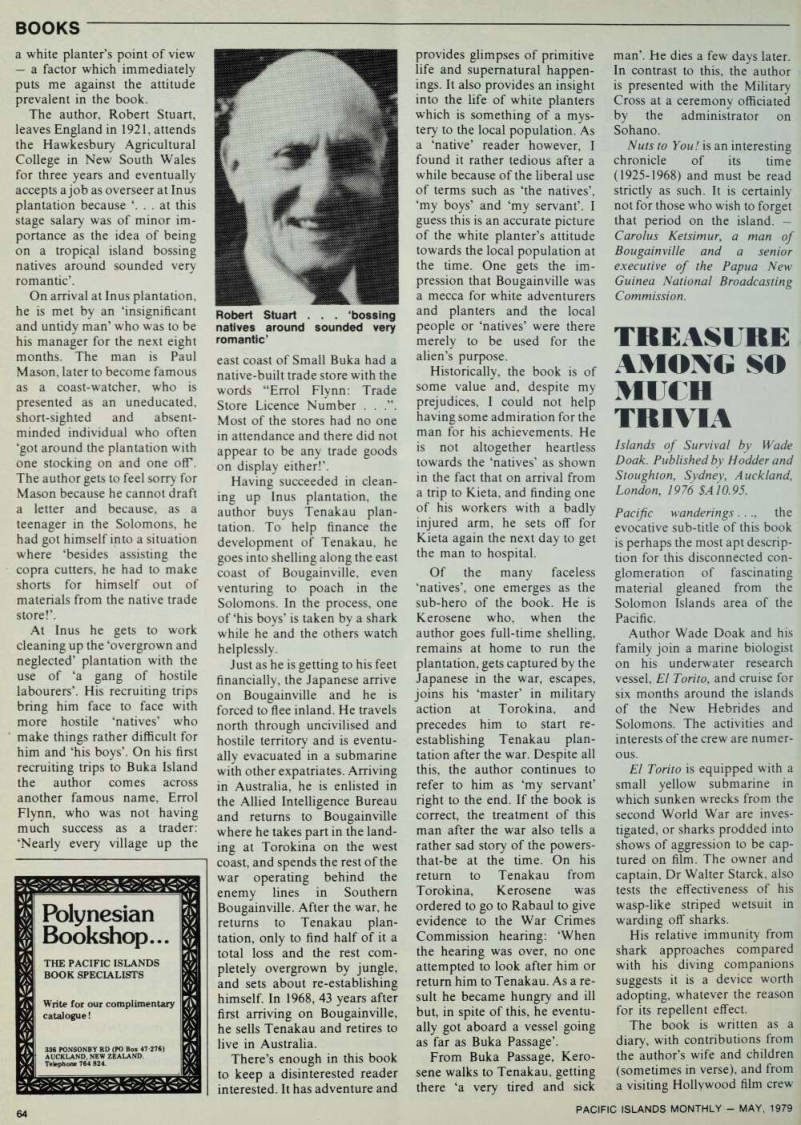
College in New South Wales for three years and eventually accepts a job as overseer at Inus plantation because ‘. . . at this stage salary was of minor im portance as the idea of being on a tropical island bossing natives around sounded very romantic’.
On arrival at Inus plantation, he is met by an ‘insignificant and untidy man’ who was to be his manager for the next eight months. The man is Paul Mason, later to become famous as a coast-watcher, who is presented as an uneducated, short-sighted and absent minded individual who often ‘got around the plantation with one stocking on and one off.
The author gets to feel sorry for Mason because he cannot draft a letter and because, as a teenager in the Solomons, he had got himself into a situation where ‘besides assisting the copra cutters, he had to make shorts for himself out of materials from the native trade store!’.
At Inus he gets to work cleaning up the ‘overgrown and
neglected’ plantation with the
use of ‘a gang of hostile
labourers’. His recruiting trips
bring him face to face with more hostile ‘natives’ who make things rather difficult for him and ‘his boys’. On his first recruiting trips to Buka Island the author comes across another famous name, Errol Flynn, who was not having much success as a trader: ‘Nearly every village up the
east coast of Small Buka had a native-built trade store with the words “Errol Flynn: Trade Store Licence Number . . .”.
Most of the stores had no one in attendance and there did not appear to be any trade goods on display either!’.
Having succeeded in clean ing up Inus plantation, the
author buys Tenakau plan
tation. To help finance the development of Tenakau, he goes into shelling along the east coast of Bougainville, even venturing to poach in the Solomons. In the process, one of ‘his boys’ is taken by a shark while he and the others watch
helplessly.
Just as he is getting to his feet financially, the Japanese arrive on Bougainville and he is forced to flee inland. He travels north through uncivilised and hostile territory and is eventu ally evacuated in a submarine
with other expatriates. Arriving
in Australia, he is enlisted in the Allied Intelligence Bureau and returns to Bougainville where he takes part in the land ing at Torokina on the west coast, and spends the rest of the war operating behind the enemy lines in Southern Bougainville. After the war, he returns to Tenakau plan tation, only to find half of it a total loss and the rest com
pletely overgrown by jungle,
and sets about re-establishing himself. In 1968, 43 years after
first arriving on Bougainville,
he sells Tenakau and retires to live in Australia.
There’s enough in this book to keep a disinterested reader interested. It has adventure and
provides glimpses of primitive
life and supernatural happen
ings. It also provides an insight
into the life of white planters which is something of a mys tery to the local population. As a ‘native’ reader however, I found it rather tedious after a while because of the liberal use of terms such as ‘the natives’,
‘my boys’ and ‘my servant’. I
guess this is an accurate picture of the white planter’s attitude towards the local population at the time. One gets the im
pression that Bougainville was
a mecca for white adventurers and planters and the local people or ‘natives’ were there merely to be used for the alien’s purpose.
Historically, the book is of some value and, despite my prejudices, I could not help having some admiration for the man for his achievements. He is not altogether heartless towards the ‘natives’ as shown in the fact that on arrival from a trip to Kieta, and finding one of his workers with a badly injured arm, he sets off for Kieta again the next day to get the man to hospital.
Of the many faceless ‘natives’, one emerges as the sub-hero of the book. He is Kerosene who, when the author goes full-time shelling, remains at home to run the
plantation, gets captured by the
Japanese in the war, escapes, joins his ‘master’ in military action at Torokina, and precedes him to start re
establishing Tenakau plan
tation after the war. Despite all this, the author continues to refer to him as ‘my servant’ right to the end. If the book is correct, the treatment of this man after the war also tells a rather sad story of the powers that-be at the time. On his return to Tenakau from Torokina, Kerosene was ordered to go to Rabaul to give evidence to the War Crimes Commission hearing: ‘When the hearing was over, no one attempted to look after him or return him to Tenakau. As a re sult he became hungry and ill but, in spite of this, he eventu ally got aboard a vessel going as far as Buka Passage’.
From Buka Passage, Kero sene walks to Tenakau, getting there ‘a very tired and sick
man’. He dies a few days later.
In contrast to this, the author is presented with the Military Cross at a ceremony officiated by the administrator on Sohano.
Nuts to You! is an interesting chronicle of its time (1925-1968) and must be read strictly as such. It is certainly not for those who wish to forget that period on the island.
Carolus Ketsimur, a man of Bougainville and a senior executive of the Papua New Guinea National Broadcasting Commission.
Robert Stuart ... ‘bossing
natives around sounded very romantic’