Top child-killer
pp. 15-17 · Read in the full issue

diarrhoea on the run from ORS
The 1977 outbreak of cholera in the Gilbert Islands, which claimed 21 lives (Pim December, 1977), was the first recorded in that country. The outbreak was part of what has become known as the • seventh cholera pandemic ’ which began in 1961 (the sixth ended in 1923). But although cholera catches headlines and causes conster nation, it is only the tip of the iceberg of the problem of diarrhoeal diseases in the developing world, according to Peter Ozorio-, infor mation officer of the World Health Organisation. His point is force fully borne out by the latest available figures (November 1978) from the South Pacific Commission’s Epidemiological and Health Infor mation Service (SPEHIS). The figures note four cholera cases on Nauru. But under the heading Diarrhoea, presumed infectious ’ more than 4300 cases are reportedfrom 20 Pacific countries. A Imost 4000 of them are designated ‘infantile ’. But in an article marking World Health Day (April 7, 1979), and the International Year of the Child, Mr Ozorio has a hopeful message: he reports on a new, cheap, simplified method of treatment of diarrhoeal disease the rehydration cup.
According to Dr Dhiman Barua, medical officer of the World Health Organisation’s diarrhoeal diseases pro gramme, cholera cases ‘consti tute less than 5-10% of the total number of acute diarrhoea cases’ reported worldwide.
Thus, while public alarm is jus tified, it is a situation of not seeing the wood for the trees.
In the developing countries, diarrhoeal diseases rank among the first three leading causes of children’s deaths, taking an estimated five to 18 million lives a year. Some specialists put the figure as high as 20 million. Most fre quently deaths among children under three are caused by diarrhoeal diseases.
Another indication of the
problem’s gravity is the estimate that in 1975, children under age five alone suffered some 500 million attacks of di arrhoea. The deadly nature of the disease is well documented also by the Inter-American In vestigation of Childhood Mor
tality. The 12-city study of
some 35 000 children’s deaths published in 1972 attributes 28.6% of the mortality to child hood diarrhoeas.
What makes the death toll so high is that affected children are generally malnourished, a condition that renders them prone to diarrhoea in the first place, and which, in turn, is ag gravated by diarrhoea. ‘Malnu trition and diarrhoea is a vicious and self-perpetuating circle,’ says Dr Barua.
Children between six months and two years are most susceptible to diarrhoea.
Already losing body fluids as a result of illness, they are, in far too many cases, further weak ened by the reluctance of well intentioned mothers to feed them acting in the mistaken belief that it is to the good to deny food to the child - and thus, in effect, compounding the malnutrition. ‘There is no physiological basis to the common belief that the bowel should be “rested ” during acute diarrhoea,’ says Dr N. F. Pierce, Johns Hopkins
University, Baltimore.
Recent studies on the annual incidence of childhood diar rhoea carried out in Bangladesh, Guatemala, India and Indonesia put mortality rates at between 20 to 55 per 1000 children yearly a rate prevalent at the turn of the cen tury in today’s industrial coun tries.
Therefore, the reasoning is that, as in the developed world, the conquest of diarrhoeal dis
eases will depend eventually
on a multitude of social and environmental factors among them, improved nu trition and food hygiene, but particularly the provision of adequate water supplies and sewage disposal systems.
At the end of 1975, according to figures for developing coun tries, only 77% of urban and 22% of rural populations were served with piped water. And the percentages were even less for sewage disposal services, 75% for urban and 15% for rural populations.
The meaning of those figures is clear: that the foregoing as solutions to the diarrhoeal problem are long term ones at best, aimed at saving the lives
of future young generations. . The question of stemming the drain on life the immediate question however, is not being deferred thanks to the re cent development of a new method of rehydration. Mor tality from diarrhoea is due to dehydration. If dehydration is prevented, most deaths can be averted. Death comes when the body loses life-sustaining fluids and salts. In cholera, for . instance, fluid losses can reduce weight by 10% in from five to six hours. Lives are saved through rehydration fluids, administered intra venously by trained health workers stationed in clinics of hospitals where indeed the only places - the fluid is stocked and can be adminis tered.
All is changing now, mainly because of the work of scien tists at the Calcutta Infectious Hospital, India, and the Dacca Research Cholera Labora
tories, Bangladesh. Working
with visiting colleagues, in par ticular those from Johns Hopkins, and the United States Center for Disease Control, Atlanta, the scientists devel oped a rehydration fluid based on some salts and sugar. In ad dition to being inexpensive to produce, its chief advantage is that the fluid is not adminis tered intravenously but by mouth, thus making possible treatment at home.
The fluid comprises these four components; 3.5 g of so dium chloride (table salt), 2.5 g of bicarbonate (baking soda) and 1.5 g of potassium chlor ide. The basic ingredients are mixed in with 20 g of glucose, to facilitate absorption by the intestine, and dissolved in a litre (about four measuring cups) of drinking water.
In an early test of effec tiveness, under ‘worst possible conditions’, says Dr Barua, oral rehydration quelled an out break of cholera and other acute diarrhoeal diseases among Bangladesh refugees streaming across India’s east ern border in 1971. In one refugee camp, with some 4000 suffering from dirrahoeal dis eases, including 1600 children under five, only 3% died, a very low rate in comparison to the 30% mortality estimated for the
entire refugee influx. Further more, of the 3% deaths, half oc curred before treatment
began.
What made the vital dif ference was the decision of the camp’s health officials to treat with the rehydration cup rather than with the intravenous
drip.
Trials in the Philippines for seven months, and in Turkey for 16, monitoring the recovery rate of two groups of children, those on and those not on a regime of oral rehydration therapy, point up another im pressive advantage in the use of fluids against diarrhoea monthly weight gains. In both countries, children who were fed the fluids outgained others who were not. As put by Dr L.
J. Mata, University of Costa Rica, San Jose: ‘The mean weight gain of non-treated children was significantly below that of the growth aver age curve.’
The trials that have been car ried out have surpassed expec tations, leading to a UNICEF decision to promote pro duction in developing coun tries, and also to distribute it
themselves packaged simply as
ORS (oral rehydration salts).
While such steps are long overdue, required and wel come, much more needs to be done and, according to a recent meeting of the WHO advisory group of experts on diarrhoeal diseases, done without delay.
Naturally enough, it is the mother who is vital in any cam paign to prevent childhood diarrhoeal deaths, but mothers, taking into account household chores, need all the help practical and educational they can get. Ideally, the for mula should be made available to them pre-packaged. If this is not possible, then dehydration can be prevented by giving a child, on the onset of diar rhoea, a simpler, home-made preparation.
That was well understood in Indonesia. A four cent plastic scoop was developed to make easier the mother’s task of
measuring ingredients. The
scoop was designed double headed to hold five grams of sugar at one end and one gram of salt at the other the recom mended amount of the two basic components in case four are not available. The ingredi ents are dissolved in 200 cc
(one cup) of potable water.
Furthermore, says Jon E.
Rohde, of the Rockefeller Foundation’s mission in Indonesia, efforts were made to persuade mothers that a ‘sick intestine needs food to re cover’, and to continue to breastfeed, or to supplement diets of sick children, in Java, for instance, with egg and
honey.
Whether simple or sophis ticated methods are used in
packaging, depends on both
the extent of the problem and the budget. But calculations by Norbert Hirshhorn, Manage ment Sciences for Health,
Cambridge, Massachusetts,
showed that: ‘One person can manually measure out salts and sugar by spoon measures to make up to 100 to 300 packets per day. A SUSSOOO to $lO 000 machine can dispense thou sands of packets a day auto
matically.’
However produced, there is no question but that oral rehydration fluids make good economic sense. Use of the more costly intravenous fluids now can be reduced by about 75% and confined to treatment of severe cases, where the patient, after losing in fluids the equivalent of 10% in weight, is in shock. The use of oral therapy will also ease the pressure on hospital beds.
In short, oral therapy is already proven effective.
Experts hail the rehydration
fluids as ‘the single most effec tive therapeutic tool in the treatment of acute diarrhoeal disease’. It is inexpensive to produce. All that remains is to put the fluids into the hands of families. When that is done, ‘very few should die if treat ment can start early and, pref erably, at home,’ says Dr Barua.
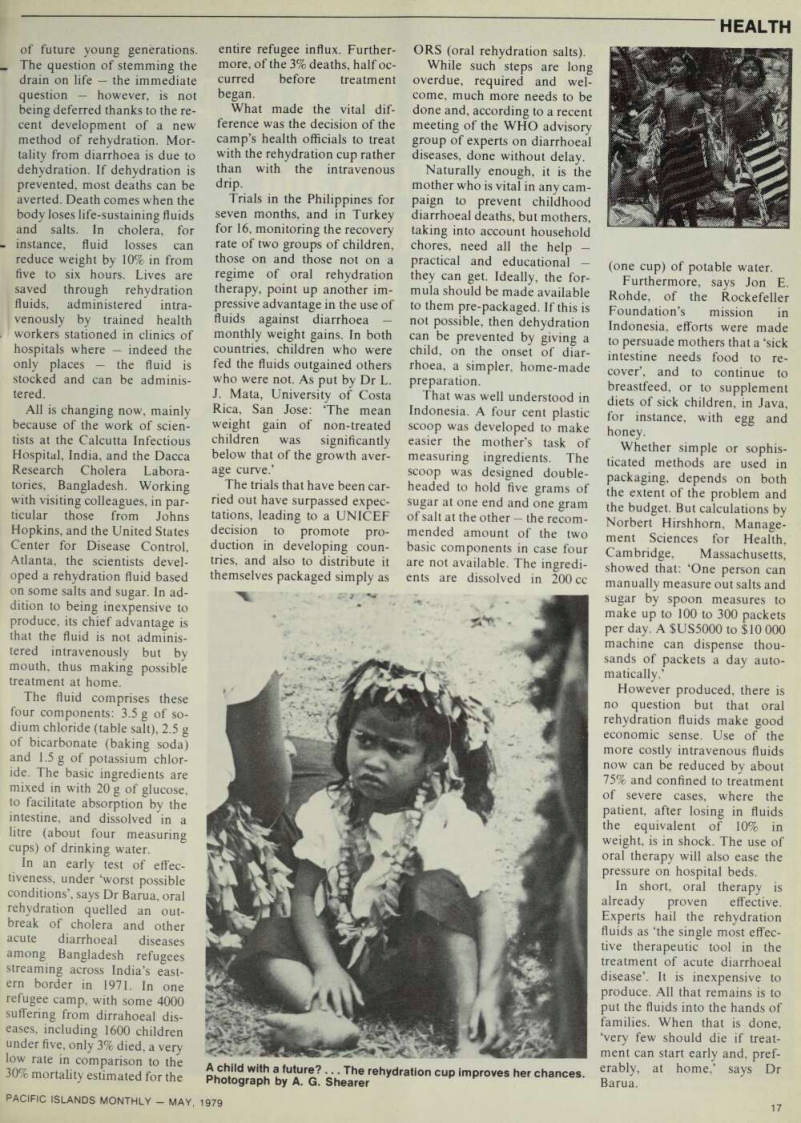
A child with a future?... The rehydration cup improves her chances.
Photograph by A. G. Shearer