Where the pressure
pp. 11-15 · Read in the full issue


is off the mystery is on
Some island communities enjoy their whole lives free from that de veloped society plague, high blood pressure. Why? It's a mystery the World Health Organisation (WHO) is trying to solve. Dr lan Pryor of WHO tells the story so far.
Somewhere in our world there are healthy populations whose blood pressure does not increase with age. This means that a significant clue must exist to solve the riddle of high blood pressure or hy pertension. If such groups of people rarely have hyperten sion, coronary attacks, and strokes, this may mean that these are not inevitable and we may be able to find out what it is that prevents them.
A number of such healthy populations live in the Pacific region and studies on them over the last decade are beginning to throw some light on what processes maintain health. These low-risk
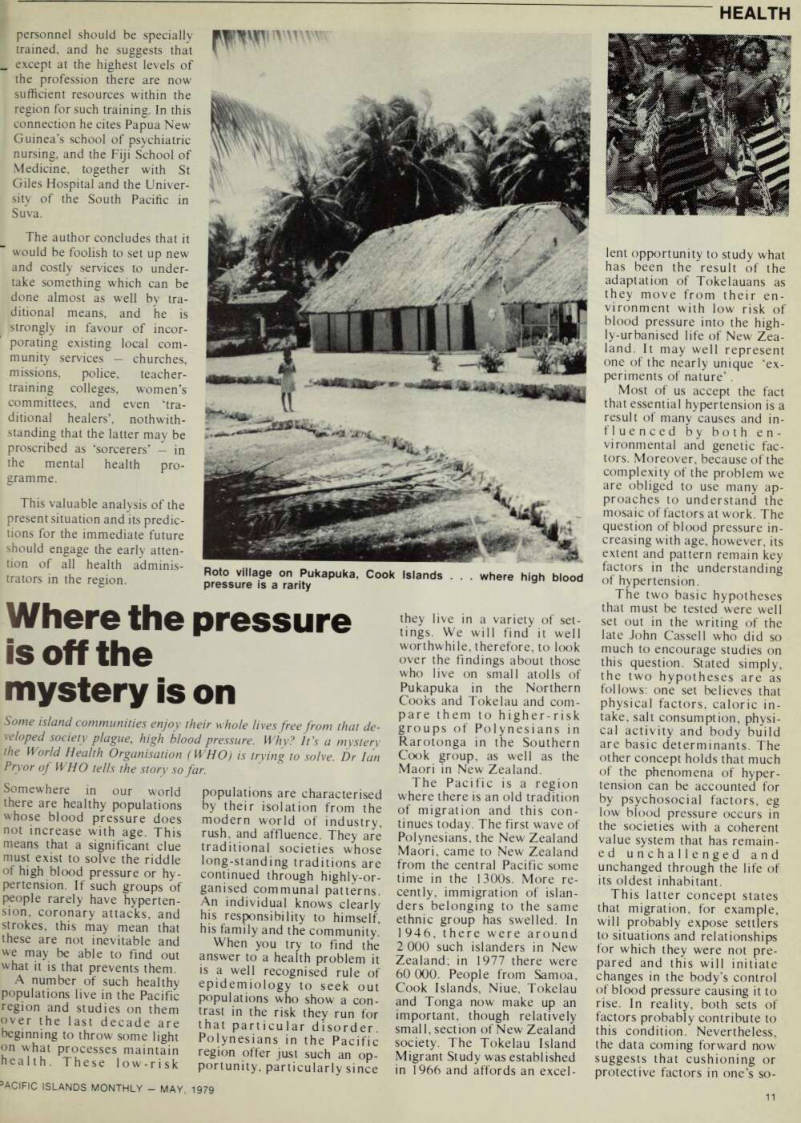
populations are characterised by their isolation from the modern world of industry, rush, and affluence. They are traditional societies whose long-standing traditions are continued through highly-or ganised communal patterns.
An individual knows clearly his responsibility to himself, his family and the community.
When you try to find the answer to a health problem it is a well recognised rule of epidemiology to seek out populations who show a con trast in the risk they run for that particular disorder.
Polynesians in the Pacific region offer just such an op portunity, particularly since
they live in a variety of set tings. We will find it well worthwhile, therefore, to look over the findings about those who live on small atolls of Pukapuka in the Northern Cooks and Tokelau and com pare them to higher-risk groups of Polynesians in Rarotonga in the Southern Cook group, as well as the Maori in New Zealand.
The Pacific is a region where there is an old tradition of migration and this con tinues today. The first wave of Polynesians, the New Zealand Maori, came to New Zealand from the central Pacific some time in the 1300 s. More re cently, immigration of islan ders belonging to the same ethnic group has swelled. In 1946, there were around 2 000 such islanders in New Zealand: in 1977 there were 60 000. People from Samoa, Cook Islands, Niue, Tokelau and Tonga now make up an important, though relatively small, section of New Zealand society. The Tokelau Island Migrant Study was established in 1966 and affords an excel-
lent opportunity to study what has been the result of the adaptation of Tokelauans as they move from their en vironment with low risk of blood pressure into the high ly-urbanised life of New Zea land. It may well represent one of the nearly unique ‘ex periments of nature’.
Most of us accept the fact that essential hypertension is a result of many causes and in flue nc e d by both en vironmental and genetic fac tors. Moreover, because of the complexity of the problem we are obliged to use many ap proaches to understand the mosaic of factors at work. The question of blood pressure in creasing with age, however, its extent and pattern remain key factors in the understanding
of hypertension.
The two basic hypotheses that must be tested were well set out in the writing of the late John Cassell who did so much to encourage studies on this question. Stated simply, the two hypotheses are as follows: one set believes that physical factors, caloric in
take, sail consumption, physi
cal activity and body build are basic determinants. The other concept holds that much of the phenomena of hyper tension can be accounted for by psychosocial factors, eg low blood pressure occurs in the societies with a coherent value system that has remain ed unchallenged and unchanged through the life of its oldest inhabitant.
This latter concept states that migration, for example, will probably expose settlers to situations and relationships for which they were not pre pared and this will initiate changes in the body’s control of blood pressure causing it to rise. In reality, both sets of factors probably contribute to this condition. Nevertheless, the data coming forward now suggests that cushioning or protective factors in one’s so
ciety may be just as important as those causing stress and could perhaps be enlisted as a means to keep pressure down.
Studies carried out in 1964 in the Cook Islands, Pukapuka and Rarotonga, established very different patterns of blood pressure between these groups. But blood pressure was not the only important difference weight differed as well. In fact. weight patterns give an idea of the availability and use of resources and in some areas act as an index of modernisation.
There was a considerable difference in diet and salt intake.
The Pukapukan took little salt ordinarily, and even added no salt to his cooking on the rare occasions when he baked bread. The Rarotongans, who are moving towards a more modern form of diet, had a much higher salt intake. Salty tinned corned beef was a much sought-after food.
Yet an analysis of results showed that differences in blood pressure between the two groups could not be completely explained on the basis of body weight or salt intake alone. The sociocultural differences between the two groups were also considerable; those Rarotongans who live in Avarua, the main town of the group of islands, were being exposed to the ideas, customs, foods and goals of
industrialised society, in con trast to the traditional sub sistence living patterns of the Pukapukans.
New Zealand Maoris have made a major shift in their way of life in recent years as they left rural areas for the ci ties. In 1946 there were only about 20% living in urban areas, but by 1977 this pro portion had grown to include 80% of all the Maoris. The availability of standardised mortality data in 1960 brought out for the first time some of the price they were paying for this change in In ing pattern. They were now becoming high risk from the chronic endemic diseases of industrialised societies, hy pertension, hypertensive heart disease, coronary heart dis ease, diabetes, asthma and
kidney problems,
Mortality data showed that Maori men and women had even higher rates of hyperten sive heart disease than Euro peans. Even more striking, Maori women suffered a four fold higher rate from coron ary heart disease than their European counterparts, In 1973, WHO assisted the Medical Department of the Kingdom of Tonga to carry out a study of blood pressure and diabetes in a sample group of adults living in Nukualofa, the main centre of the kingdom, and a con
trasting group who had re mained living in their tradi tional villages on the island of Foa. Those who had remained on Foa lived on a subsistence economy, engaged in much greater physical activity and had less material goods and lower cash incomes. Again, there were highly significant differences between the two groups in blood pressure and in weights.
Since differences in blood pressure cannot be explained by weight change alone other factors are being considered.
Low salt use stands out as a further difference between the two groups, just as it had in the Cook Islands.
We need to know more about what happens as groups move from traditional socie ties into an urbanised, indus trialised, way of life and stu dies of migrants can furnish a lot of important data. They can also help us find out who are high-risk individuals, families and groups so that programmes to help them can be set up.
The Tokelau islanders are Polynesians living on three small atolls lying 470 km north of Samoa and 8° south of the equator. The islands had been a New Zealand de pendency but in 1948 the islanders were granted New Zealand citizenship and the right of free entry to New Zea-
land. After a hurricane in 1 966, the New Zealand Government established the Tokelau Island Resettlement Programme to deal with the expanding population which was having difficulty in cop ing with the very limited re sources and scope for development on the atolls.
Over the years, the popula tion of the atolls has under gone many fluctuations.
Migration has become im portant since the 1940 s but until recently it was directed principally to Western Samoa and only after 1 966 did migration to New Zealand in crease sharply. The number of Tokelauans in New Zealand was 600 in 1965 but had grown to 2 200 in 1975 with a significant number coming from Western Samoa as well as Tokelau.
The Tokelau Island Migrant Study was begun in 1966 after the establishment of the Resettlement Program me. The multidisciplinary stu dy works with clear hy potheses about the ways in which psychosocial, physical and cultural changes as sociated with migration may affect health and disease pat terns. Particular emphasis has been given to factors relating to blood pressure to see if the move to urbanised New Zea land would cause it to rise and have hypertension emerge as a problem.
Major expeditions were made to Tokelau in 1968, 1971 and 1976 and they in cluded a medical team, social anthropologists and nutri tionists. The teams gathered detailed data for the total population. Examination of migrants following arrival in New Zealand, and an ex tension of the programme, to include all Tokelauans in New Zealand irrespective of their time of arrival, has ex tended the study.
The study had a number of points in its favour. It was
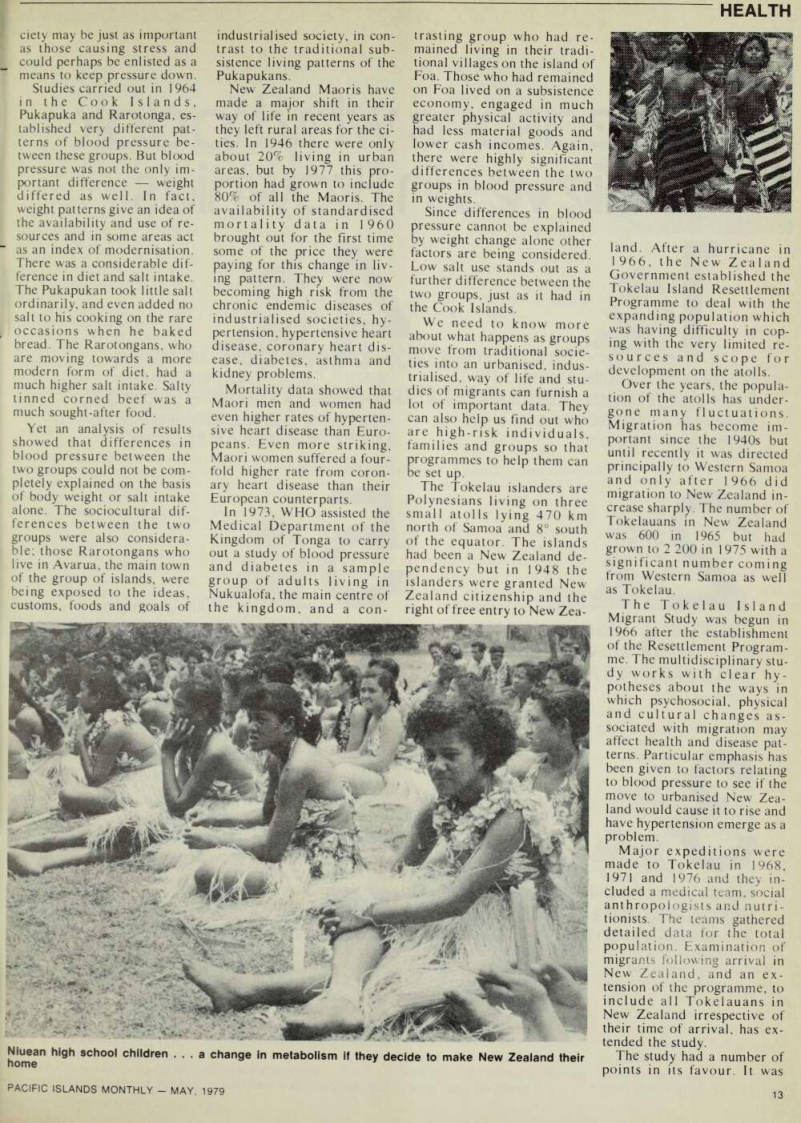
Niuea n hi gh children... a change in metabolism if they decide to make New Zealand their
able to draw upon material - that included the examination of many of the migrants before they emigrated. The fact that groups of the same genetic makeup are being followed in two environments will allow a critical assessment of what is genetic and what is en vironmental in nature of the interaction of these two areas.
The number participating in the study includes the 2 200 Tokelauans in New Zealand . and 1 560 in Tokelau. Par ticipation in the examinations has been excellent, about 98% in Tokelau and 96% in New Zealand.
Comparing adults in both places it was found that adults in New Zealand have sig nificantly higher blood pressures. Also, adults who live in New Zealand tend to be heavier in weight. One of the most interesting points is the degree to which inte gration in a new way of life is correlated to a rise in blood pressure. Taking into account how the migrant lived, his work and his leisure, his club, church and personal ac tivities, it was found that those who were the most cushioned by, or restricted themselves to, Tokelauan societies and activities were less subject to high blood pressure than those who were more inte grated into a European way of life. In other words, there seems to be a basis for believ ing that those who were more involved in the European way of life were paying for it in higher blood pressure.
There is increasing emphasis on study of children to find precursors of hyper tension in adults. Results are now beginning to come in.
Data on children up to the age of 14 show that systolic pressure in both girls and boys in New Zealand was higher than those who had remained in Tokelau. The fact that these differences have now been shown to occur both in children and adults strongly suggests the role of en vironmental factors in blood pressure.
Since higher blood pressures in New Zealand cannot be explained solely on the basis of weight, other fac tors are now being closely examined. For one thing, salt intake is higher in New Zea land than the islands and there is a possibility that rais ing salt intake above a certain level sets in motion a series of changes that result in high
blood pressure. It has not yet been demonstrated, however, that there is a direct relation ship between blood pressure and salt intake. Nevertheless there is so much evidence, from so many places, that a change in salt-use is one of the things that go with migration and urbanisation that it can not be ignored.
We feel that studies with controlled tests on the effect of an habitual low salt-intake are needed. They should be given a high priority and WHO should play an active
coordinating role.
A task force on car diovascular disease preven
tion has been established in the Western Pacific region.
This part of the world offers a wide range of opportunities to document present patterns and test out ways of prevent ing cardiovascular disease at the earliest stages.
Clear evidence that hyper tension is not an inevitable part of the ageing process challenges us to do something about it. Environmental changes play a key role in determining its occurrence.
Traditional societies with their support for the indi vidual and the community may show the way to helping many who need it.