The Storm?
pp. 9-11 · Read in the full issue

Health
Calm Before
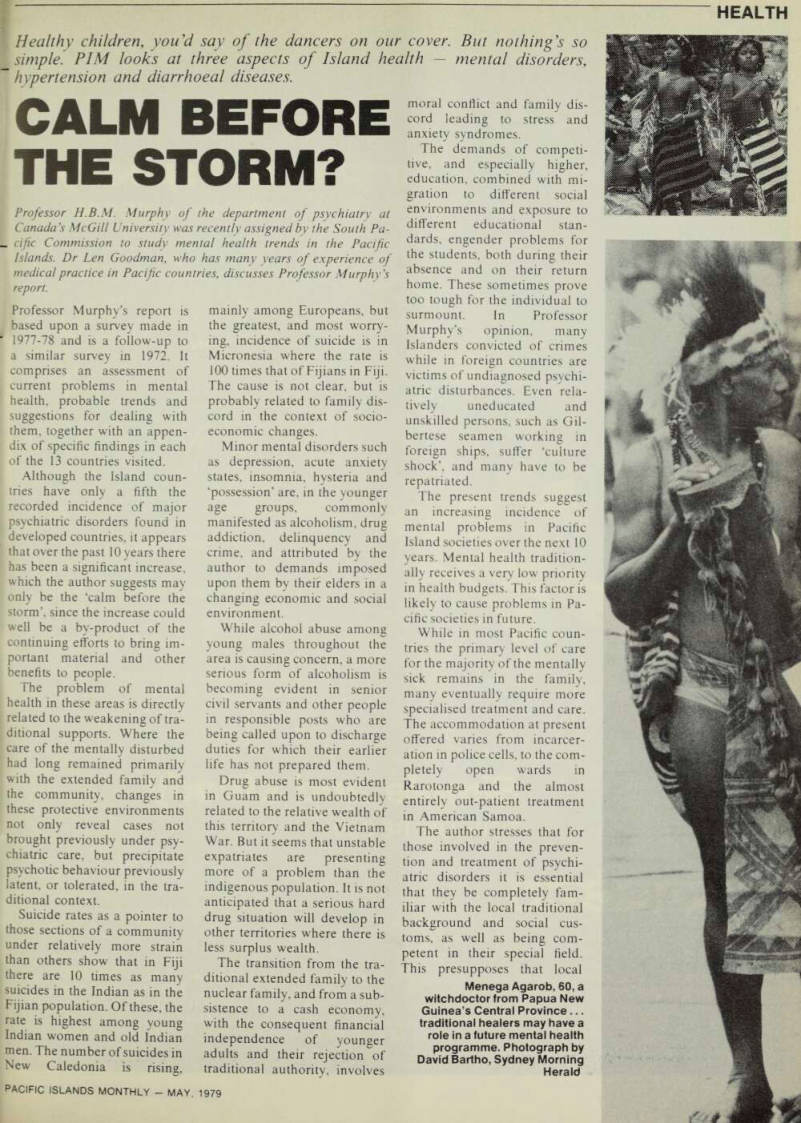
Healthy children, you'd say of the dancers on our cover. But nothing's so simple. PIM looks at three aspects of Island health mental disorders, hypertension and diarrhoeal diseases.
Professor H.B.M. Murphy of the department of psychiatry at Canada’s McGill University was recently assigned by the South Pa cific Commission to study mental health trends in the Pacific Islands. Dr Len Goodman, who has many years of experience of medical practice in Pacific countries, discusses Professor Murphy’s report.
Professor Murphy’s report is based upon a survey made in 1977-78 and is a follow-up to a similar survey in 1972. It comprises an assessment of current problems in mental health, probable trends and suggestions for dealing with them, together with an appen dix of specific findings in each of the 13 countries visited.
Although the Island coun tries have only a fifth the recorded incidence of major psychiatric disorders found in developed countries, it appears that over the past 10 years there has been a significant increase, which the author suggests may only be the ‘calm before the storm’, since the increase could well be a by-product of the continuing efforts to bring im portant material and other benefits to people.
The problem of mental health in these areas is directly related to the weakening of tra ditional supports. Where the care of the mentally disturbed
had long remained primarily
with the extended family and
the community, changes in
these protective environments not only reveal cases not
brought previously under psy
chiatric care, but precipitate psychotic behaviour previously latent, or tolerated, in the tra ditional context.
Suicide rates as a pointer to those sections of a community under relatively more strain than others show that in Fiji there are 10 times as many suicides in the Indian as in the Fijian population. Of these, the rate is highest among young Indian women and old Indian men. The number of suicides in New Caledonia is rising,
mainly among Europeans, but
the greatest, and most worry ing, incidence of suicide is in Micronesia where the rate is 100 times that of Fijians in Fiji.
The cause is not clear, but is probably related to family dis cord in the context of socio
economic changes.
Minor mental disorders such
as depression, acute anxiety
states, insomnia, hysteria and ‘possession’ are, in the younger age groups, commonly manifested as alcoholism, drug addiction, delinquency and crime, and attributed by the author to demands imposed upon them by their elders in a changing economic and social environment.
While alcohol abuse among young males throughout the area is causing concern, a more serious form of alcoholism is becoming evident in senior civil servants and other people in responsible posts who are being called upon to discharge duties for which their earlier life has not prepared them.
Drug abuse is most evident in Guam and is undoubtedly related to the relative wealth of this territory and the Vietnam War. But it seems that unstable
expatriates are presenting
more of a problem than the indigenous population. It is not anticipated that a serious hard drug situation will develop in other territories where there is less surplus wealth.
The transition from the tra ditional extended family to the nuclear family, and from a sub sistence to a cash economy, with the consequent financial independence of younger adults and their rejection of traditional authority, involves
moral conflict and family dis cord leading to stress and
anxiety syndromes.
The demands of competi
tive, and especially higher,
education, combined with mi gration to different social environments and exposure to different educational stan
dards, engender problems for
the students, both during their absence and on their return home. These sometimes prove too tough for the individual to surmount. In Professor
Murphy’s opinion, many
Islanders convicted of crimes while in foreign countries are
victims of undiagnosed psychi
atric disturbances. Even rela tively uneducated and unskilled persons, such as Gil bertese seamen working in
foreign ships, suffer ‘culture
shock’, and many have to be
repatriated.
The present trends suggest an increasing incidence of mental problems in Pacific Island societies over the next 10 years. Mental health tradition ally receives a very low priority in health budgets. This factor is likely to cause problems in Pa cific societies in future.
While in most Pacific coun tries the primary level of care for the majority of the mentally sick remains in the family,
many eventually require more
specialised treatment and care.
The accommodation at present offered varies from incarcer ation in police cells, to the com pletely open wards in Rarotonga and the almost
entirely out-patient treatment
in American Samoa.
The author stresses that for those involved in the preven tion and treatment of psychi atric disorders it is essential that they be completely fam iliar with the local traditional background and social cus toms, as well as being com petent in their special field.
This presupposes that local
Menega Agarob, 60, a witchdoctor from Papua New Guinea’s Central Province... traditional healers may have a role in a future mental health programme. Photograph by David Bartho, Sydney Morning Herald
personnel should be specially trained, and he suggests that except at the highest levels of the profession there are now sufficient resources within the region for such training. In this connection he cites Papua New Guinea’s school of psychiatric nursing, and the Fiji School of Medicine, together with St Giles Hospital and the Univer sity of the South Pacific in Suva.
The author concludes that it would be foolish to set up new and costly services to under take something which can be done almost as well by tra ditional means, and he is strongly in favour of incor
porating existing local com
munity services - churches, missions, police, teacher
training colleges, women’s
committees, and even ‘tra ditional healers’, notwith standing that the latter may be proscribed as ‘sorcerers’ - in the mental health pro gramme.
This valuable analysis of the present situation and its predic tions for the immediate future should engage the early atten tion of all health adminis trators in the region.
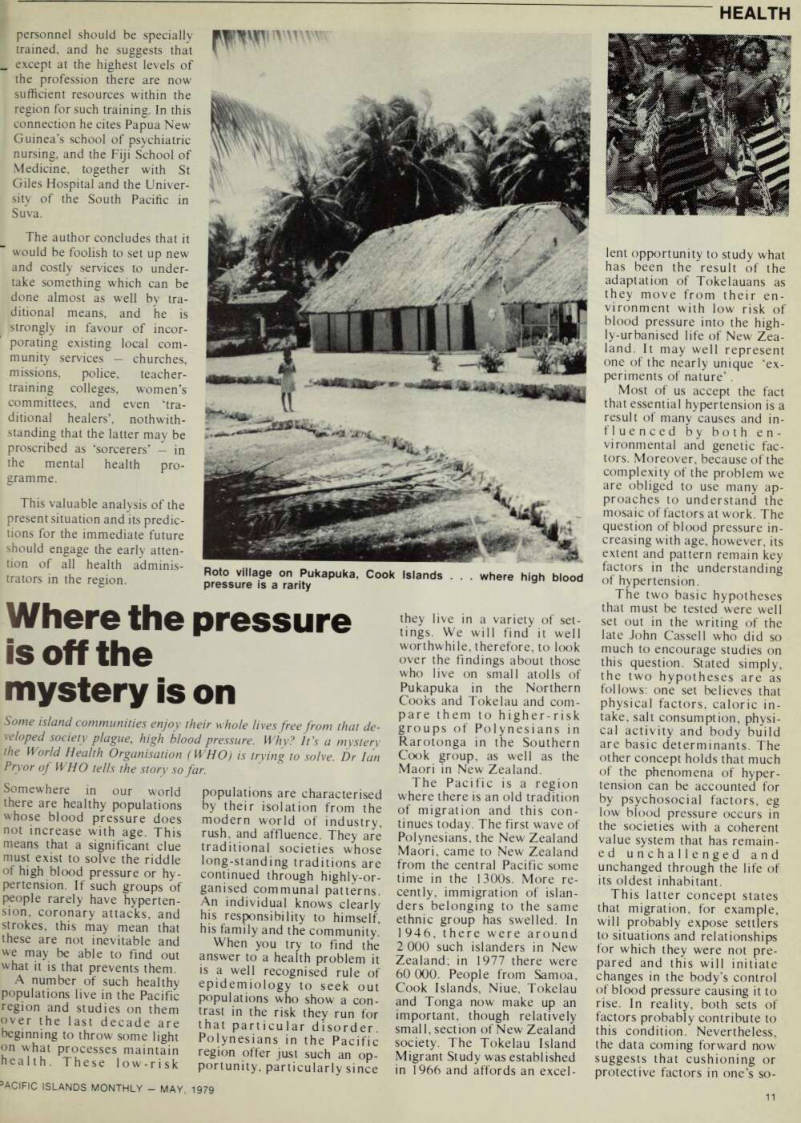
Roto village on Pukapuka, Cook Islands... where high blood pressure is a rarity a