stayput policy stick?
pp. 19-22 · Read in the full issue

France In The Pacific
Paris Planning:
Practical Or
Pipedream?
Can it make its stayput policy stick?
France's most influential daily newspaper, Le Monde, recently car ried a series of seven major articles from staff correspondents review ing the situation in France's Pacific territories. New Caledonia and the Marquesas merited two articles each, and the New Hebrides, Tahiti, and Wallis/Futuna one apiece. PIM staff writer Malcolm Salmon has read the Le Monde series, and, in the first of two articles, reviews those dealing with New Caledonia, Tahiti and the New Hebrides. He will review the articles on the Marquesas and Wallis/Futuna in the June issue of PIM.
Publication of the articles on France’s Pacific territories in Le Monde began just before a top-level review of France’s Pacific policy in Paris in October (with the then foreign minister Louis de Guiringaud presiding) and continued over a period of several months.
Journalist Jean-Marie Colombani summed up the objects and outcome of the meeting in the following terms in Le Monde: ‘All the French Pacific territories are actually in an Anglo-Saxon zone of in fluence, dominated to the east by the United States and to the west by Australia and New Zealand, all powers which have traditionally been hostile to any French presence in the re gion. By at last presenting to these countries, and especially to the many newly indepen dent states in the region, the image of a liberal France, it will be possible, the govern ment believes, to conduct an active policy in this part of the world. This policy... will involve a new distribution of power and wealth in the over
seas territories to counter the challenge from advocates of
independence...
‘Procedures for the establish ment of 200-mile economic zones, which, thanks to its Pa cific territories, will put France in third place in the world in terms of area of ocean covered, were discussed at the meeting, as were questions associated with the organisation of fisheries in the region (nego tiations on this matter are under way at present with Japan and South Korea). ‘ln this zone where the wealth of the seas and the min eral riches of New Caledonia arouse the appetites of multi nationals and the covetousness of great powers, the govern ment believes it is important to develop France’s cultural and technical activities. Such activi ties, in the government’s view, must involve the territories themselves, and call for co operation between the respon sible people on the spot in the territories and the respresenta tives of France in the states of the region. Thus, a programme
of co-ordination with the University of the South Pacific in Suva, Fiji, will be set up. The future embassy of France in the New Hebrides will be called upon to play an import ant regional role in this field. ‘The course to be taken by France over the next decade has thus been set.’
While generally endorsing
the lines of this policy, the Le
Monde journalists frequently
point to serious obstacles to its realisation, often embedded in the social structure of the terri tories themselves. For
example, writing on New
Caledonia, where the respon sible minister Paul Dijoud seeks to build ‘a new, generous, more united, more brotherly society, where everyone will have his place’, Jean-Marie Colombani notes: ‘How can New Caledonia start again (after the collapse of the nickel boom)? Nobody on the spot can reply to this question or even wants to, because the mis givings of the “haves” about their own future is one of the basic elements of the Caledonian problem. These “haves”, most of whom have lived a long time in the terri tory, are Europeans. They hold the controlling levers of the economy (in commerce as in the exploitation of mineral re sources) and the biggest landed estates. This concentration of wealth permits its owners to make abundant savings. But these are not invested in New Caledonia, but go to swell the volume of capital flowing out of New Caledonia to its Anglo-
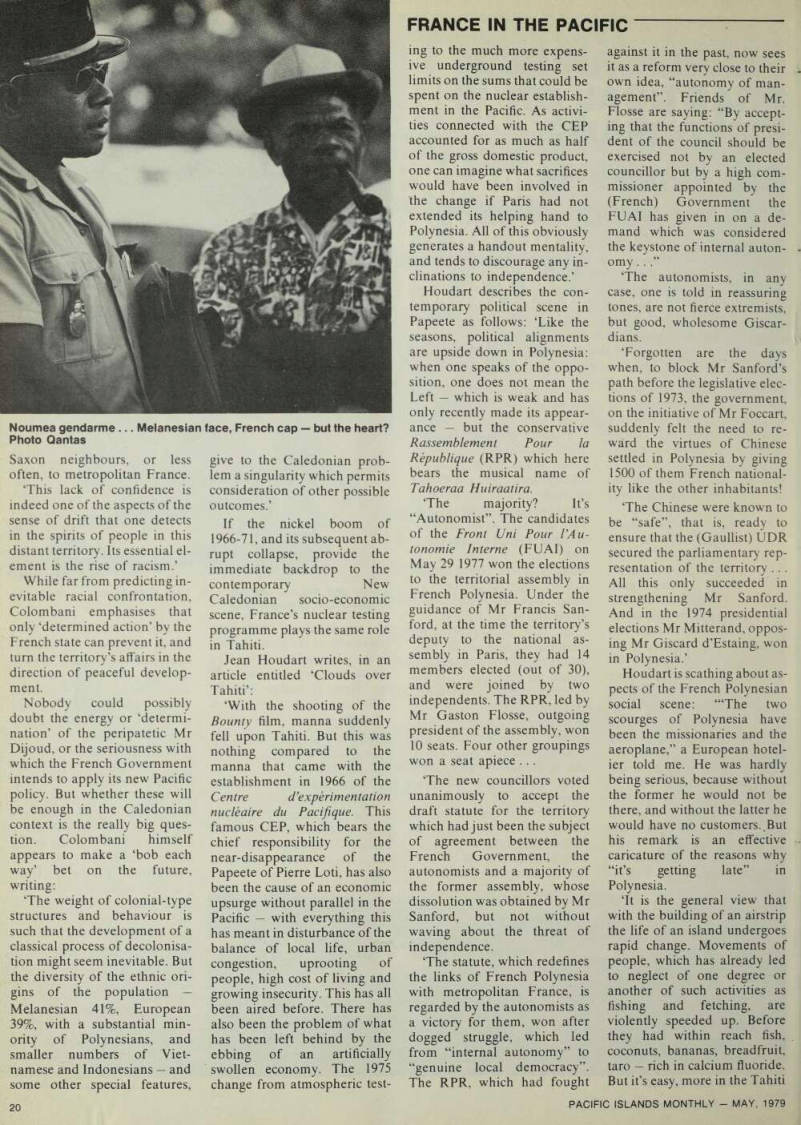
Smoke bel ches fro m Noumea's nicke l sme lter... collapse of the boom In 1971 left many questions
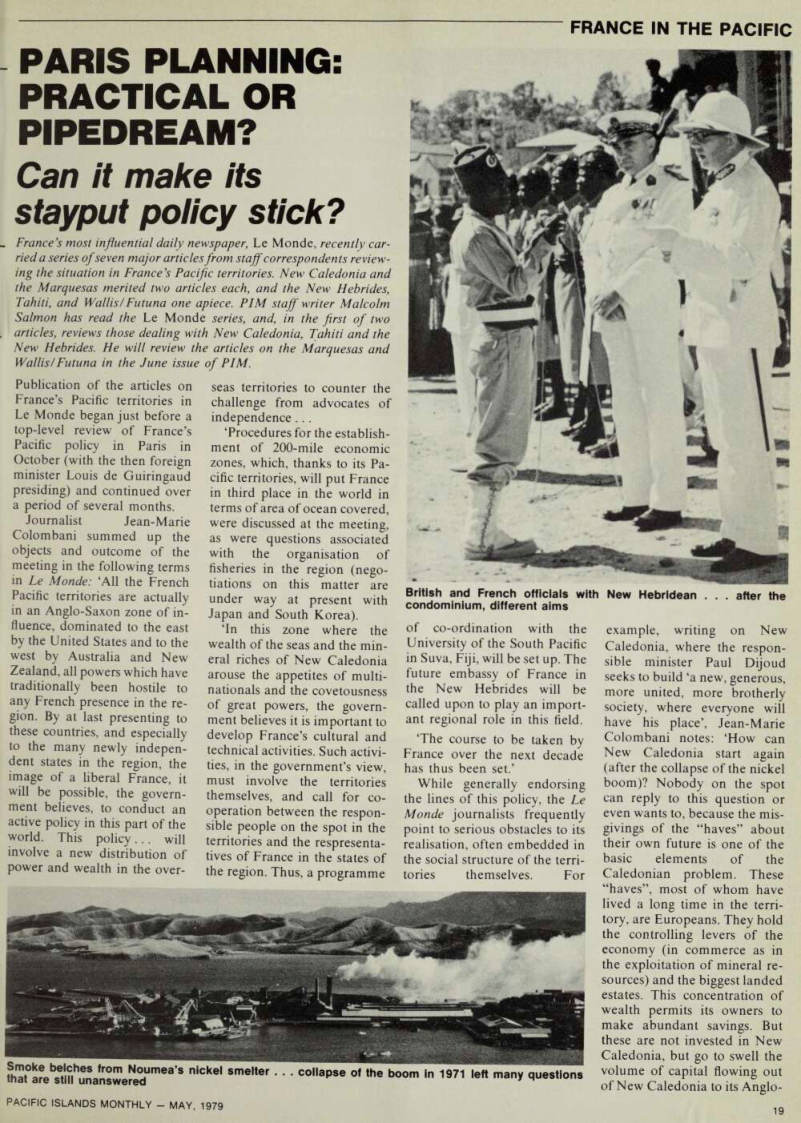
British and French officials with New Hebridean... after the condominium, different aims
Saxon neighbours, or less often, to metropolitan France. ‘This lack of confidence is indeed one of the aspects of the sense of drift that one detects in the spirits of people in this distant territory. Its essential el ement is the rise of racism.’
While far from predicting in evitable racial confrontation, Colombani emphasises that only ‘determined action’ by the French state can prevent it, and turn the territory’s affairs in the
direction of peaceful develop
ment.
Nobody could possibly
doubt the energy or ‘determi nation’ of the peripatetic Mr Dijoud, or the seriousness with which the French Government intends to apply its new Pacific policy. But whether these will be enough in the Caledonian context is the really big ques tion. Colombani himself appears to make a ‘bob each way’ bet on the future,
writing:
‘The weight of colonial-type
structures and behaviour is such that the development of a classical process of decolonisa tion might seem inevitable. But the diversity of the ethnic ori
gins of the population
Melanesian 41%, European 39%, with a substantial min
ority of Polynesians, and
smaller numbers of Viet namese and Indonesians and some other special features,
give to the Caledonian prob lem a singularity which permits consideration of other possible outcomes.’
If the nickel boom of 1966-71, and its subsequent ab
rupt collapse, provide the
immediate backdrop to the contemporary New Caledonian socio-economic scene, France’s nuclear testing programme plays the same role in Tahiti.
Jean Houdart writes, in an article entitled ‘Clouds over Tahiti’: ‘With the shooting of the Bounty film, manna suddenly fell upon Tahiti. But this was
nothing compared to the
manna that came with the establishment in 1966 of the
Centre d’experimentation
nucleaire du Pacifique. This famous CEP, which bears the chief responsibility for the near-disappearance of the Papeete of Pierre Loti, has also been the cause of an economic upsurge without parallel in the Pacific with everything this has meant in disturbance of the balance of local life, urban
congestion, uprooting of
people, high cost of living and
growing insecurity. This has all been aired before. There has also been the problem of what has been left behind by the
ebbing of an artificially
swollen economy. The 1975
change from atmospheric test
ing to the much more expens
ive underground testing set
limits on the sums that could be spent on the nuclear establish ment in the Pacific. As activi ties connected with the CEP accounted for as much as half of the gross domestic product, one can imagine what sacrifices would have been involved in the change if Paris had not extended its helping hand to Polynesia. All of this obviously generates a handout mentality, and tends to discourage any in clinations to independence.’
Houdart describes the con temporary political scene in Papeete as follows: ‘Like the
seasons, political alignments
are upside down in Polynesia: when one speaks of the oppo sition, one does not mean the Left which is weak and has only recently made its appear ance but the conservative Rassemblement Pour la Republique (RPR) which here bears the musical name of Tahoeraa Huiraatira. ‘The majority? It’s “Autonomist”. The candidates of the Front Uni Pour VAu tonomie Interne (FUAI) on May 29 1977 won the elections to the territorial assembly in French Polynesia. Under the guidance of Mr Francis San ford, at the time the territory’s deputy to the national as sembly in Paris, they had 14 members elected (out of 30), and were joined by two independents. The RPR, led by Mr Gaston Flosse, outgoing president of the assembly, won 10 seats. Four other groupings won a seat apiece ... ‘The new councillors voted unanimously to accept the draft statute for the territory which had just been the subject of agreement between the French Government, the autonomists and a majority of the former assembly, whose dissolution was obtained by Mr Sanford, but not without waving about the threat of
independence.
‘The statute, which redefines the links of French Polynesia with metropolitan France, is regarded by the autonomists as a victory for them, won after
dogged struggle, which led
from “internal autonomy” to
“genuine local democracy”.
The RPR, which had fought
against it in the past, now sees it as a reform very close to their own idea, “autonomy of man agement”. Friends of Mr.
Flosse are saying: “By accept ing that the functions of presi dent of the council should be exercised not by an elected councillor but by a high com
missioner appointed by the
(French) Government the FUAI has given in on a de mand which was considered the keystone of internal auton omy .. ‘The autonomists, in any case, one is told in reassuring tones, are not fierce extremists, but good, wholesome Giscar dians.
‘Forgotten are the days
when, to block Mr Sanford’s path before the legislative elec tions of 1973, the government, on the initiative of Mr Foccart, suddenly felt the need to re ward the virtues of Chinese
settled in Polynesia by giving
1500 of them French national ity like the other inhabitants! ‘The Chinese were known to be “safe”, that is, ready to ensure that the (Gaullist) UDR secured the parliamentary rep resentation of the territory ...
All this only succeeded in strengthening Mr Sanford.
And in the 1974 presidential elections Mr Mitterand, oppos ing Mr Giscard d’Estaing, won
in Polynesia.’
Houdart is scathing about as pects of the French Polynesian social scene: “The two scourges of Polynesia have been the missionaries and the aeroplane,” a European hotel ier told me. He was hardly being serious, because without the former he would not be there, and without the latter he would have no customers. But his remark is an effective caricature of the reasons why “it’s getting late” in
Polynesia.
‘lt is the general view that with the building of an airstrip the life of an island undergoes
rapid change. Movements of
people, which has already led to neglect of one degree or another of such activities as
fishing and fetching, are
violently speeded up. Before
they had within reach fish, coconuts, bananas, breadfruit, taro rich in calcium fluoride.
But it’s easy, more in the Tahiti
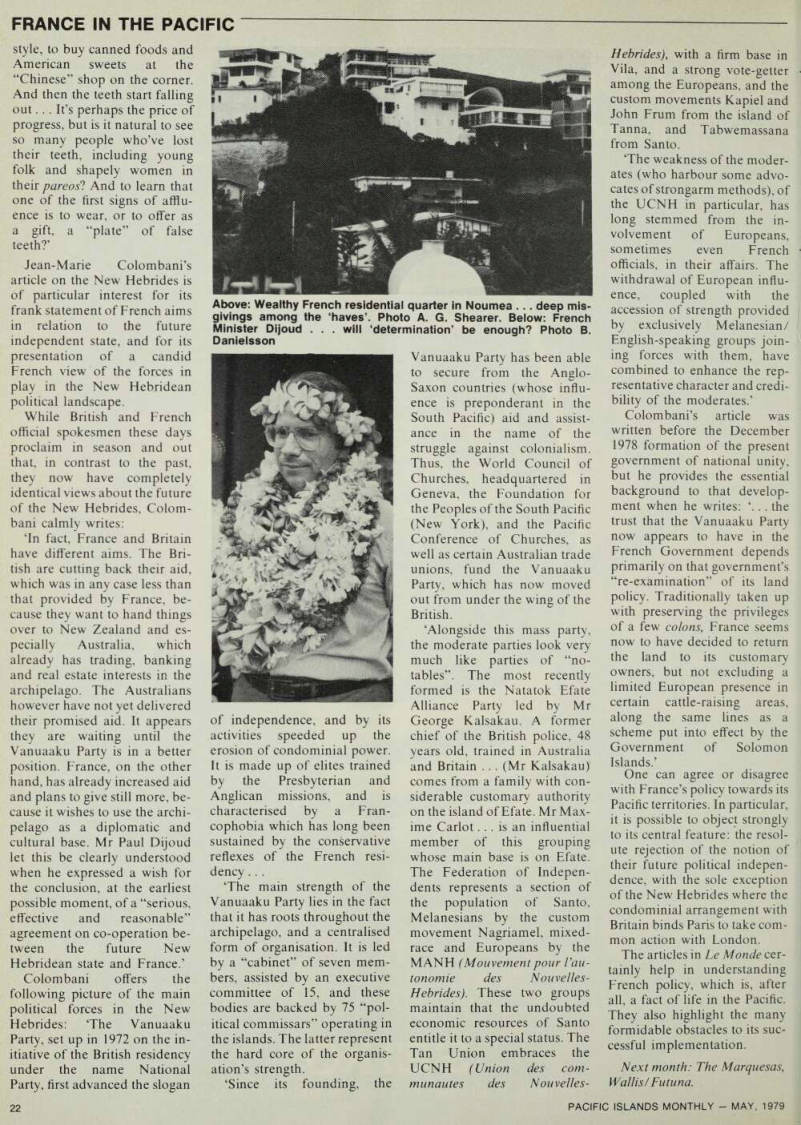
Noumea gendarme... Melanesian face, French cap but the heart?
Photo Qantas
style, to buy canned foods and American sweets at the “Chinese” shop on the comer.
And then the teeth start falling
out... It’s perhaps the price of
progress, but is it natural to see so many people who’ve lost their teeth, including young folk and shapely women in their pareosl And to learn that one of the first signs of afflu ence is to wear, or to offer as a gift, a “plate” of false teeth?’
Jean-Marie Colombani’s article on the New Hebrides is of particular interest for its frank statement of French aims in relation to the future independent state, and for its presentation of a candid French view of the forces in play in the New Hebridean
political landscape.
While British and French
official spokesmen these days
proclaim in season and out that, in contrast to the past,
they now have completely
identical views about the future of the New Hebrides, Colom bani calmly writes: in fact, France and Britain have different aims. The Bri tish are cutting back their aid, which was in any case less than that provided by France, be cause they want to hand things over to New Zealand and es pecially Australia, which
already has trading, banking
and real estate interests in the archipelago. The Australians however have not yet delivered their promised aid. It appears they are waiting until the Vanuaaku Party is in a better position. France, on the other hand, has already increased aid and plans to give still more, be cause it wishes to use the archi pelago as a diplomatic and cultural base. Mr Paul Dijoud let this be clearly understood when he expressed a wish for the conclusion, at the earliest possible moment, of a “serious, effective and reasonable” agreement on co-operation be tween the future New Hebridean state and France.’
Colombani offers the following picture of the main political forces in the New Hebrides: ‘The Vanuaaku Party, set up in 1972 on the in itiative of the British residency under the name National Party, first advanced the slogan
of independence, and by its activities speeded up the erosion of condominial power.
It is made up of elites trained
by the Presbyterian and
Anglican missions, and is characterised by a Fran cophobia which has long been sustained by the conservative reflexes of the French resi
dency ...
‘The main strength of the Vanuaaku Party lies in the fact that it has roots throughout the archipelago, and a centralised form of organisation. It is led by a “cabinet” of seven mem bers, assisted by an executive committee of 15, and these bodies are backed by 75 “pol itical commissars” operating in the islands. The latter represent the hard core of the organis ation’s strength. ‘Since its founding, the
Vanuaaku Party has been able to secure from the Anglo- Saxon countries (whose influ ence is preponderant in the South Pacific) aid and assist ance in the name of the
struggle against colonialism.
Thus, the World Council of Churches, headquartered in Geneva, the Foundation for the Peoples of the South Pacific (New York), and the Pacific Conference of Churches, as well as certain Australian trade unions, fund the Vanuaaku Party, which has now moved out from under the wing of the British. ‘Alongside this mass party, the moderate parties look very much like parties of “no tables”. The most recently formed is the Natatok Efate Alliance Party led by Mr George Kalsakau. A former chief of the British police, 48 years old, trained in Australia and Britain ... (Mr Kalsakau) comes from a family with con siderable customary authority on the island of Efate. Mr Max ime Carlot... is an influential member of this grouping whose main base is on Efate.
The Federation of Indepen dents represents a section of the population of Santo, Melanesians by the custom movement Nagriamel, mixed race and Europeans by the MANH (Mouvement pour Tau tonomie des Nouvelles- Hebrides). These two groups maintain that the undoubted economic resources of Santo entitle it to a special status. The Tan Union embraces the UCNH (Union des com munautes des Nouvelles-
Hebrides), with a firm base in Vila, and a strong vote-getter among the Europeans, and the custom movements Kapiel and John Frum from the island of Tanna, and Tabwemassana from Santo.
The weakness of the moder ates (who harbour some advo cates of strongarm methods), of the UCNH in particular, has long stemmed from the in volvement of Europeans, sometimes even French officials, in their affairs. The withdrawal of European influ ence, coupled with the
accession of strength provided
by exclusively Melanesian/
English-speaking groups join
ing forces with them, have combined to enhance the rep resentative character and credi bility of the moderates.’
Colombani’s article was written before the December 1978 formation of the present government of national unity, but he provides the essential
background to that develop
ment when he writes; ‘... the trust that the Vanuaaku Party now appears to have in the French Government depends primarily on that government’s “re-examination” of its land
policy. Traditionally taken up
with preserving the privileges
of a few colons, France seems now to have decided to return the land to its customary owners, but not excluding a limited European presence in certain cattle-raising areas, along the same lines as a scheme put into effect by the Government of Solomon Islands.’
One can agree or disagree with France’s policy towards its Pacific territories. In particular,
it is possible to object strongly
to its central feature; the resol ute rejection of the notion of
their future political indepen
dence, with the sole exception of the New Hebrides where the condominial arrangement with Britain binds Paris to take com mon action with London.
The articles in Le Monde cer
tainly help in understanding
French policy, which is, after all, a fact of life in the Pacific.
They also highlight the many formidable obstacles to its suc
cessful implementation.
Next month: The Marquesas, Wallis/Futuna.
Above: Wealthy French residential quarter In Noumea... deep mis givings among the ‘haves’. Photo A. G. Shearer. Below: French Minister Dijoud... will ‘determination’ be enough? Photo B.
Danielsson