Pago looks
p. 57 · Read in the full issue
to big sister Hawaii
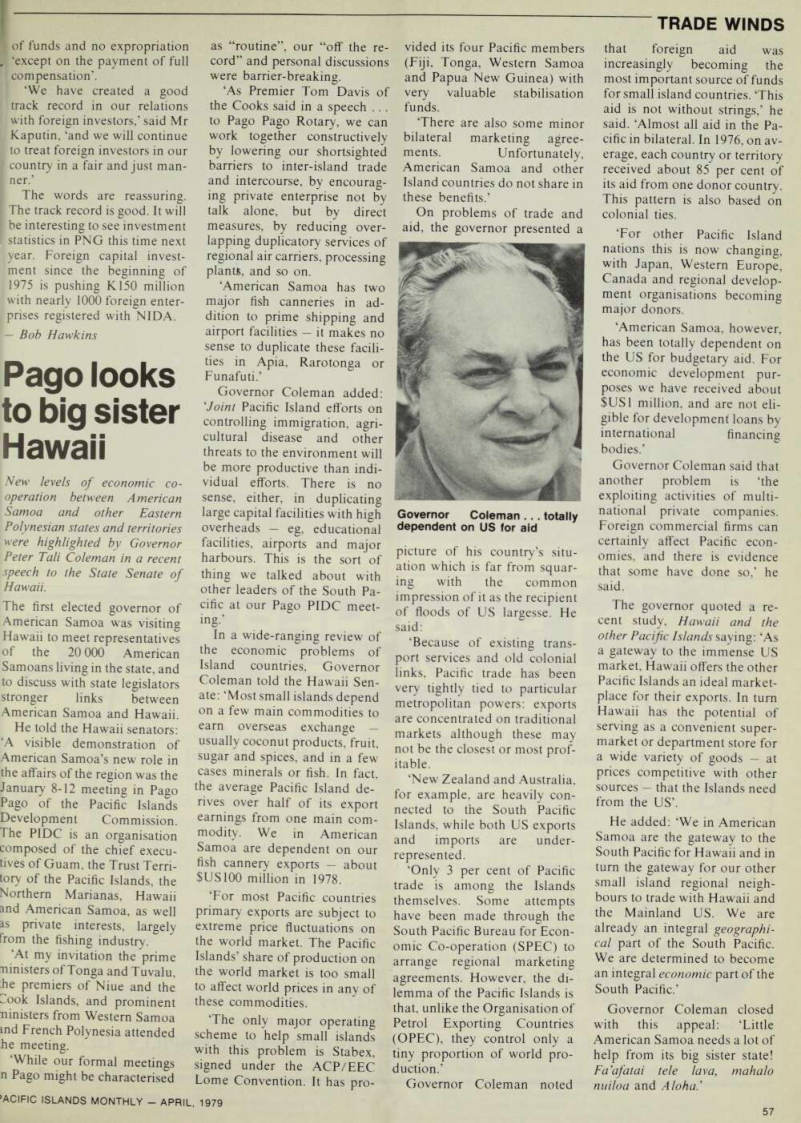
New levels of economic co operation between American Samoa and other Eastern Polynesian states and territories were highlighted by Governor Peter Tali Coleman in a recent speech to the State Senate of Hawaii.
The first elected governor of American Samoa was visiting Hawaii to meet representatives of the 20 000 American Samoans living in the state, and to discuss with state legislators stronger links between American Samoa and Hawaii.
He told the Hawaii senators: ‘A visible demonstration of American Samoa’s new role in the affairs of the region was the
January 8-12 meeting in Pago
Pago of the Pacific Islands
Development Commission.
The PIDC is an organisation composed of the chief execu tives of Guam, the Trust Terri tory of the Pacific Islands, the Northern Marianas, Hawaii and American Samoa, as well
as private interests, largely
from the fishing industry.
‘At my invitation the prime ninisters of Tonga and Tuvalu, he premiers of Niue and the lslands, and prominent ninisters from Western Samoa
md French Polynesia attended
he meeting.
‘While our formal meetings n Pago might be characterised
as “routine”, our “off the re cord” and personal discussions
were barrier-breaking.
‘As Premier Tom Davis of the Cooks said in a speech .. . to Pago Pago Rotary, we can work together constructively
by lowering our shortsighted
barriers to inter-island trade and intercourse, by encourag
ing private enterprise not by
talk alone, but by direct measures, by reducing over
lapping duplicatory services of
regional air carriers, processing plants, and so on. ‘American Samoa has two major fish canneries in ad dition to prime shipping and airport facilities it makes no sense to duplicate these facili ties in Apia, Rarotonga or Funafuti.’
Governor Coleman added: ‘Joint Pacific Island efforts on
controlling immigration, agri
cultural disease and other threats to the environment will be more productive than indi vidual efforts. There is no sense, either, in duplicating large capital facilities with high overheads eg, educational facilities, airports and major harbours. This is the sort of thing we talked about with other leaders of the South Pa cific at our Pago PIDC meet ing.’
In a wide-ranging review of the economic problems of Island countries, Governor Coleman told the Hawaii Sen ate: ‘Most small islands depend on a few main commodities to earn overseas exchange usually coconut products, fruit, sugar and spices, and in a few cases minerals or fish. In fact, the average Pacific Island de rives over half of its export earnings from one main com modity. We in American Samoa are dependent on our fish cannery exports about SUSIOO million in 1978. ‘For most Pacific countries primary exports are subject to extreme price fluctuations on the world market. The Pacific Islands’ share of production on the world market is too small to affect world prices in any of these commodities. ‘The only major operating scheme to help small islands with this problem is Stabex, signed under the ACP/EEC Lome Convention. It has pro
vided its four Pacific members
(Fiji, Tonga, Western Samoa
and Papua New Guinea) with very valuable stabilisation funds. ‘There are also some minor bilateral marketing agree
ments. Unfortunately,
American Samoa and other Island countries do not share in these benefits.’
On problems of trade and aid, the governor presented a
picture of his country’s situ ation which is far from squar ing with the common impression of it as the recipient of floods of US largesse. He said: ‘Because of existing trans port services and old colonial links. Pacific trade has been very tightly tied to particular metropolitan powers: exports are concentrated on traditional markets although these may not be the closest or most prof itable. ‘New Zealand and Australia, for example, are heavily con nected to the South Pacific Islands, while both US exports and imports are under
represented.
‘Only 3 per cent of Pacific trade is among the Islands themselves. Some attempts have been made through the South Pacific Bureau for Econ omic Co-operation (SPEC) to
arrange regional marketing
agreements. However, the di lemma of the Pacific Islands is that, unlike the Organisation of Petrol Exporting Countries (OPEC), they control only a tiny proportion of world pro duction.’
Governor Coleman noted
that foreign aid was
increasingly becoming the
most important source of funds for small island countries. ‘This aid is not without strings,’ he said. ‘Almost all aid in the Pa cific in bilateral. In 1976, on av erage, each country or territory received about 85 per cent of its aid from one donor country.
This pattern is also based on colonial ties. ‘For other Pacific Island nations this is now changing,
with Japan, Western Europe,
Canada and regional develop
ment organisations becoming
major donors. ‘American Samoa, however, has been totally dependent on the US for budgetary aid. For economic development pur poses we have received about SUSI million, and are not eli
gible for development loans by
international financing
bodies.’
Governor Coleman said that another problem is ‘the exploiting activities of multi
national private companies.
Foreign commercial firms can certainly affect Pacific econ omies, and there is evidence that some have done so,’ he said.
The governor quoted a re cent study, Hawaii and the other Pacific Islands saying: ‘As a gateway to the immense US market, Hawaii offers the other Pacific Islands an ideal market place for their exports. In turn Hawaii has the potential of serving as a convenient super market or department store for a wide variety of goods at
prices competitive with other
sources - that the Islands need from the US’.
He added: ‘We in American Samoa are the gateway to the South Pacific for Hawaii and in turn the gateway for our other
small island regional neigh
bours to trade with Hawaii and the Mainland US. We are
already an integral geographi
cal part of the South Pacific.
We are determined to become an integral economic part of the South Pacific.’
Governor Coleman closed with this appeal: ‘Little American Samoa needs a lot of help from its big sister state!
Fa’afatai tele lava, mahalo nuiloa and Aloha.''
Governor Coleman... totally dependent on US for aid