Kaputin
pp. 55-57 · Read in the full issue

Plays
It Cool
When Prime Minister Michael
; Somare brought John Kaputin
into his ministry, just before
the Pangu-People’s Progress Party split in November, a tremor or two ran through the Papua New Guinea expatriate business community. Es pecially so as Mr Kaputin’s portfolio was ‘national plan
ning and development’.
Although a businessman in his own right for several years, John Kaputin is better known for his radical utterances, par ticularly on the question of
Papua New Guinean partici
pation in the national econ omy, and as a bitter opponent of expatriates ready to take but reluctant to give.
When Mr Kaputin turned up in Sydney in February to talk about his government’s econ omic policies and its attitude
toward foreign investment, just
about everybody who was any body in the Pacific market place went along to listen to him. PNG officials were obviously delighted at the turn out.
And what Mr Kaputin had to say was not frightening in the least although he gave clear warning that in no way has he changed his longheld view that there’s no room for fly-by nighters in PNG’s economic
scheme of things.
From the outset he stressed that ‘there must be a continu
ing dialogue’ between PNG
and Australia because ‘lack of proper communication be tween our two countries can
only lead to misunderstanding
and distrust which are un necessary ingredients so far as
economic development is con
:erned’.
Mr Kaputin, drawing atten
tion to his own attitudes toward
economic development ex
pressed before independence,
said; T am deeply committed
to economic justice for Papua
Slew Guineans ... but there is
no reason why foreign invest
ment and the kind of develop
ment I favour cannot go
together.’
The break with its colonial past, he said, had allowed PNG to open up new opportunities for both Papua New Guineans and foreign investors but only for ‘investors who are prepared to respect our laws and people; investors who are prepared, in fact, to invest and are not just out for “a quick quid or kina”. .. We do want, indeed we need, overseas involvement in our economy, but it must be to our advantage . ..’
Mr Kaputin offered an econ omic record which had achieved an average annual real increase of 2.4% in gross domestic product since 1975; consumer price index ratings of 6% or less since 1976; and a 22% rise in domestic private investment in 1978 over the
previous year.
The main points of his government’s economic policy, he said, were; • to stabilise important private sector incomes such as coffee and cocoa; • to pursue an exchange rate policy which would maintain the purchasing power of the kina; • to hold down urban wages but allow modest increases in rural wages; • to hold down taxation levels to keep them attractive and in crease taxation revenue by
broadening the productive
base of the private sector;
• to develop merchant bank ing in PNG to fit in with its development strategies.
PNG’s was not an ‘open door policy to foreign investment’ he said, quoting an example: ‘We would give every assist ance to foreign investment coming into a fisheries venture, but would certainly not allow the same investment in setting up a gambling venture.’
Areas in which PNG was actively seeking investment, he said, were in minerals and pet roleum exploration; in agricul-
ture including oil palm, sugar, rice, rubber and cocoa; timber; and fishing. All of these come within the first category of the National Investment Priorities Schedule published by the National Investment and
Development Authority
(NIDA) in April last year. It is only in this category that foreign investors could expect active government support in getting their project off the ground.
Mr Kaputin said that in cer tain areas, where the private sector had not taken the initiat ive, ‘the government has formed the company, sub scribed initial capital, ident ified foreign investors, appointed project managers, and then, most important, phased out of active manage ment inputs, leaving the pro ject under private sector management’.
PNG offers no tax holidays because that would only attract ‘short term investors’. Tax incentives for primary pro ducers and the mining indus try, he said, were ‘more or less’ the same as in Australia, and ‘the writing off of certain items of capital expenditures and the indefinite carry forward of losses is incentive enough to long term investors’.
Three incentives recently introduced included the possi
bility of government meeting
costs of feasibility studies to set up an industry; a tax rebate of 50% on ‘profits related to any increases in exports in any year’; and government loan as sistance for ‘infant industry’ in its ‘initial, teething stages’.
The minister guaranteed foreign investment a free flow
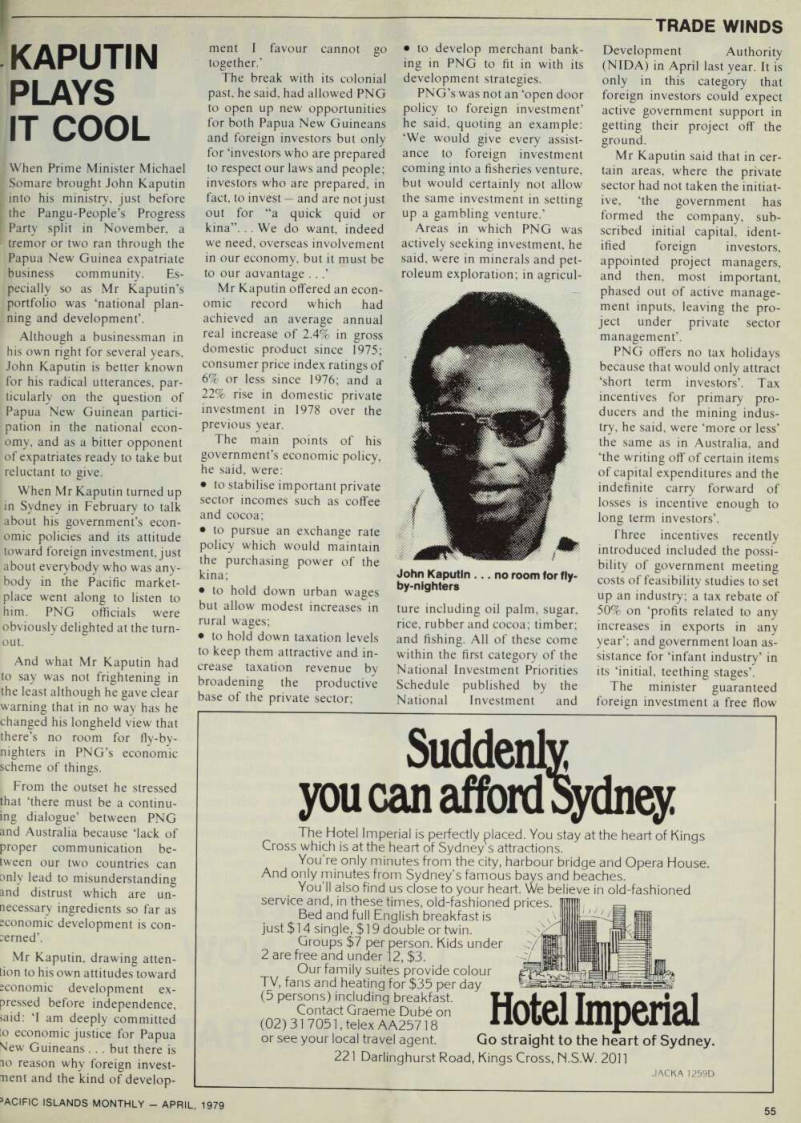
John Kaputin... no room for fly by-nighters
I of funds and no expropriation ‘except on the payment of full
compensation’.
‘We have created a good track record in our relations with foreign investors,’ said Mr Kaputin, ‘and we will continue j to treat foreign investors in our 1 country in a fair and just man ner.’
The words are reassuring.
The track record is good. It will be interesting to see investment statistics in PNG this time next
year. Foreign capital invest
ment since the beginning of 1975 is pushing Kl5O million with nearly 1000 foreign enter
prises registered with NIDA.
Bob Hawkins