Shopping
pp. 35-38 · Read in the full issue
Low Duty
Is A Big
Come On
Mr Justice Nimmo, who in 1976 held a royal commission into the affairs of Norfolk Island, did not delude himself that Norfolk’s famous low
duty shopping possesses only
marginal appeal to tourists, as some experts had tried to tell him. ‘Human nature being what it is,’ the commissioner said in his report, ‘one should not accept too readily assertions that opportunities to save money do not weigh significantly in the
thoughts of high-minded tour
ists purporting to be mere seekers of rustic charms. The
authority responsible for set
ting customs duties should always take care to maintain opportunity for these seekers
of simple pleasures to indulge
their acquisitive instincts by the purchase of goods at prices up to a third less than mainland
prices.
‘The loss in customs revenue will not be large and will be outweighed by the benefits to the island’s economy. It is fre quently commented that the air fare of a tourist to Norfolk can
be virtually recouped by the savings effected on purchases made in the island. That, com bined with the relative cheap ness of accommodation in Norfolk, enables many to have a holiday they could not other wise afford. It is an important component of the whole tourist
industry.’
In Norfolk’s last financial year to June 30, the island imported goods to a total value of almost $8 million.
Exports were less than $1 million. In fact the greater part of that import figure represents invisible exports, because visi tors took goods out of the island almost as soon as they arrived.
A study of import details re veals the picture. This island of only about 1800 residents last year imported footwear to the total value of $370,000, jewellery $293,000, cosmetics $109,000, clocks and watches $189,000, drapery and fabrics $820,000, photographic goods $220,000, radios $304,000, ‘fancy goods’ $295,000, and
liquor a staggering $386,000.
The shopkeepers who imported and sold these goods
paid comparatively little duty
and no income or company taxes.
Nearly all that footwear was sold by two shops, Max Craig’s
Quality Shop (for women’s
shoes) and Ray Spragg’s Franks Shoe Store (for men).
In the Quality Shop, a best
seller is Rayne’s Raquette,
straight from London and sell ing at $59 compared with $lO5 in Melbourne. All the high fashion shoes from London, Paris, Rome and Spain are there at similar discounts, air mailed in by parcel post and backed up by a storeroom on the premises stacked with shoes insured for a third of a million dollars.
Ray Spragg, who is a former New Guinea plantation ‘old hand’, can bring shoes direct from Europe and sell them 40% cheaper than Australian retail and 50% cheaper than in New Zealand. He says it wouldn’t pay him to import from Aus tralia.
This, generally, ii the secret of Norfolk’s lower prices: di rect imports from overseas, usually from the manufac turers. Some shops which do import mostly from Australia can survive because they pitch their sales to New Zealanders who have to pay considerably more for most goods at home.
Consequently items which give Australians a small saving can be excellent bargains for New Zealanders. This is especially true of electrical goods and
clothing.
Danny Yager, of Leeside, who buys mostly from Aus tralia, considers that New Zealanders purchase Aus tralian goods because of price and quality, and that Aus tralians go for English and US goods for the same reason.
Peter Woodward, of Pete’s Place, sells a steady supply of Monier crockpots at $25 to
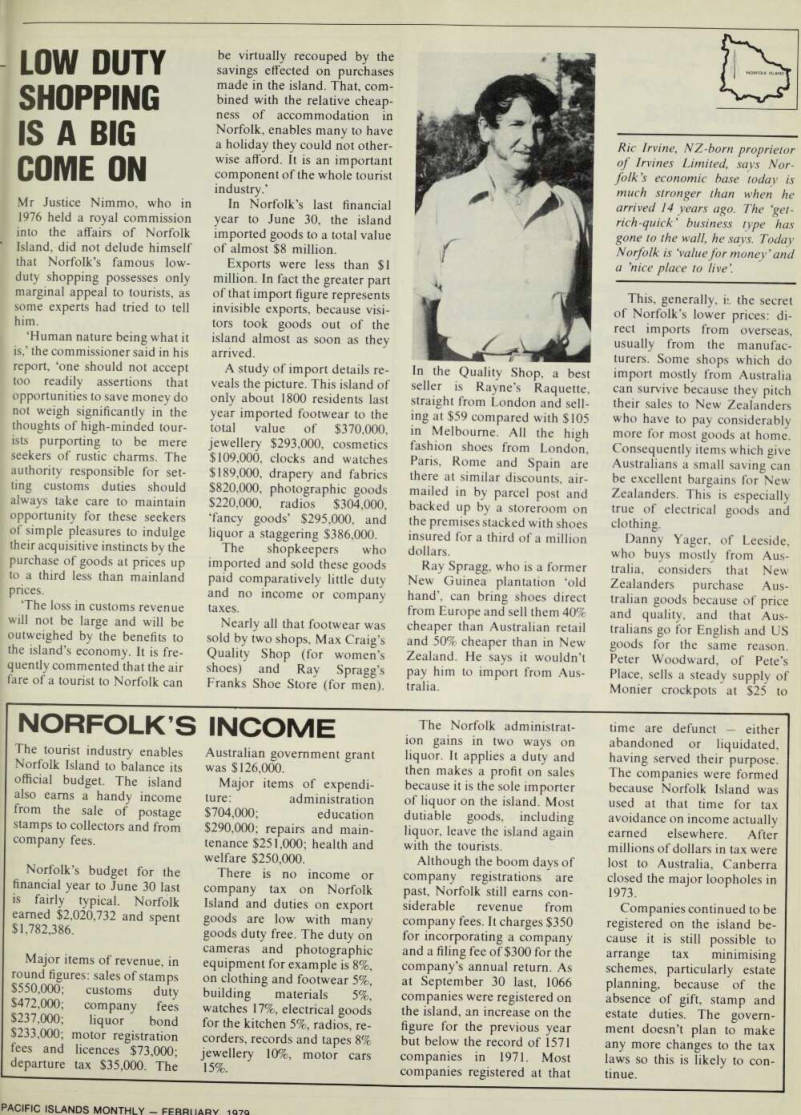
Ric Irvine, NZ-born proprietor of Irvines Limited, says Nor folk's economic base today is much stronger than when he arrived 14 years ago. The "get rich-quick' business type has gone to the wall, he says. Today Norfolk is ‘value for money' and a 'nice place to live'.
New Zealanders to whom they are good bargains because they can’t buy them at home. The saving for Australians wouldn’t be worth their effort in carting the goods back.
Australians are in the same boat when selecting radios and cameras, and the point is to know how to identify the bar gains. Ken Nobbs, managing director of Cameralines Lim ited, comments that single re flex cameras can be dearer in Norfolk for Australians if they
have been imported through
Australian distributors. Prices for cameras imported direct from country of origin are
sometimes only slightly lower
than Australian discount prices. One reason for this is because Norfolk shops order smaller supplies at one time and thus are more frequently affected by currency fluctu ations. However, when Aus tralian retail prices take a hike for some reason, Norfolk be comes far more competitive.
Mr Nobbs says there is at least 20 per cent saving on Aus tralian duty-free prices on cameras imported from manufacturers. He estimated a 50 per cent saving on New Zealand retail prices. Most cine cameras, 35mm automatics, 110 and 126 cameras are half the Australian retail prices and
‘a lot lower than the best dis count prices’. He lists Canon Yashica, Kodak, Polaroid and Bolus as equipment which has to come through Australian suppliers.
Accessories, he says, are
cheaper than Hong Kong
prices. He quotes a 24mm wide angle Rokhor lens selling for $lB6 in Norfolk, as against a Sydney wholesale price of $204.50, a professional price of $286 and a recommended retail price of $371.50. He tries to keep his camera prices below Australian distributors’ whole sale prices, Norfolk’s landed prices are
increased by airfreight charges,
Airfreight is he says, necessary, ‘because we lost consignments when we shipped by sea; some times we would get only empty boxes’, Lyle Hutchinson, of Pren tice’s, Ross Reynolds of Burns
Philp’s duty free department
and John Anderson of Hibiscus Radio, agree that radio bar gains aren’t what they were for Australians, but they are excellent for New Zealanders, Yet there are pockets of excep tions. ‘Pioneer equipment for cars, which comes from Aus tralia is excellent value for money,’ says Mr Reynolds Mr Anderson says the heavier hi-fi equipment still
carries a tariff in Australia but only 8 per cent duty in Norfolk.
There is a decided advantage in
Australians buying this equip
ment rather than the portable stuff.
The Sony TCI99 cassette deck, for example, selling for $250 at Hibiscus, has a Sydney discount price of $379 and a retail price of $420. But again, for New Zealanders, all equip ment is good value.
Lyle Hutchinson, who is an old hand in Norfolk commerce and managing director of Pren tice Ltd since 1966, recalls the time in Ken Prentice’s original store when radios sold for one third of the Australian price and tourists swept them off the shelves. Those were the boom days, when a shipment of 100 cameras would be flown in on a Friday and sold over the weekend. ‘Now there is not much in cameras,’ he says.
Ken Prentice is not now in the business and Mrs Eunice McKenzie, who was Mrs Ken Prentice in those days, who re members selling the first 35mm camera on Norfolk, now specialises in Chinese goods in her store, Pioneers. This under lines the fact that the dramatic change of fortunes which has affected the ‘glamour’ radio and camera sales should not be allowed to conceal the truth that there are still bargains galore on Norfolk but they are different bargains.
The greatest savings are in
high quality goods - luxury
items, although not always, as brisk sales in toys and records testify.
High quality china, figur ines, cloisonne, watches, jewellery, perfumes, expensive rugs, are the kind of goods where savings can cover the
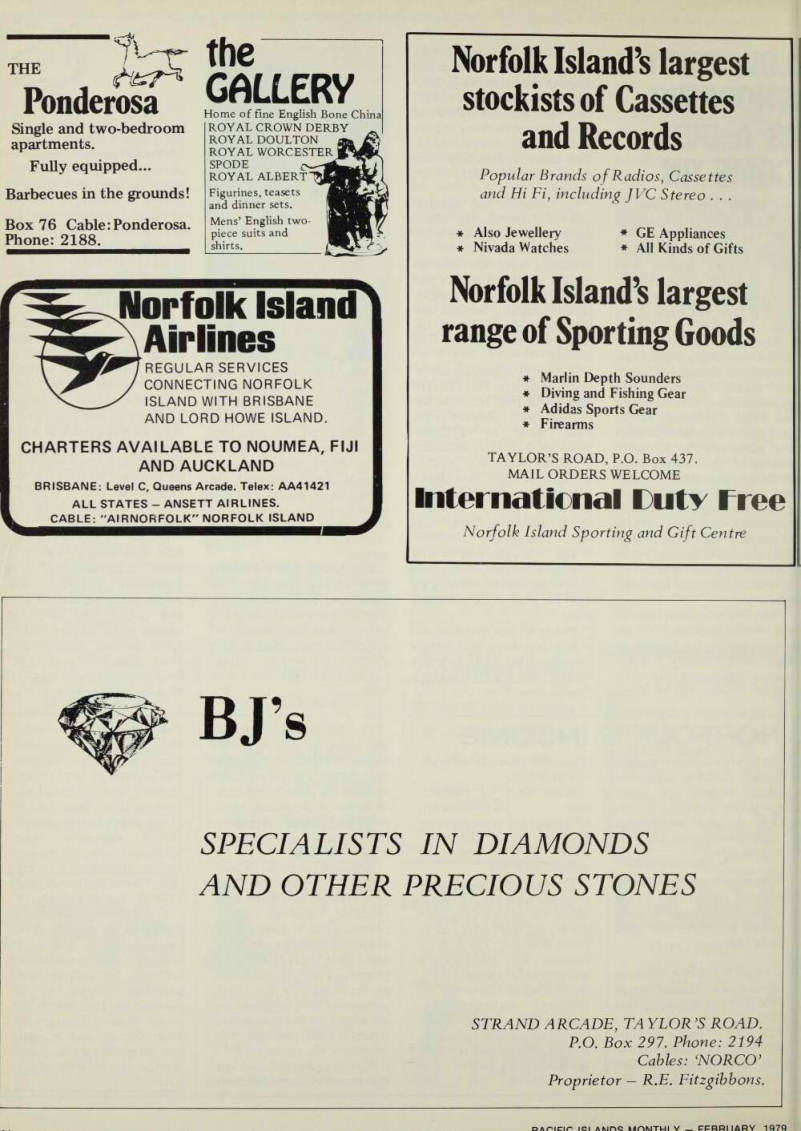
Dick Cavell began Norfolk's first a la carte restaurant. The Garrison, 11 years ago. Tourists' needs are changing, he says. With packaged travel more popular, the set menu dinner has become the way to operate. He and his wife have planted 200 fruit trees to offer wider menus of island fruits. Adding to the variety of Norfolk's food service are hostesses such as Aunt Em' and Elva Yager who are off erin g on increasing number of dishes for people with smaller appetites.
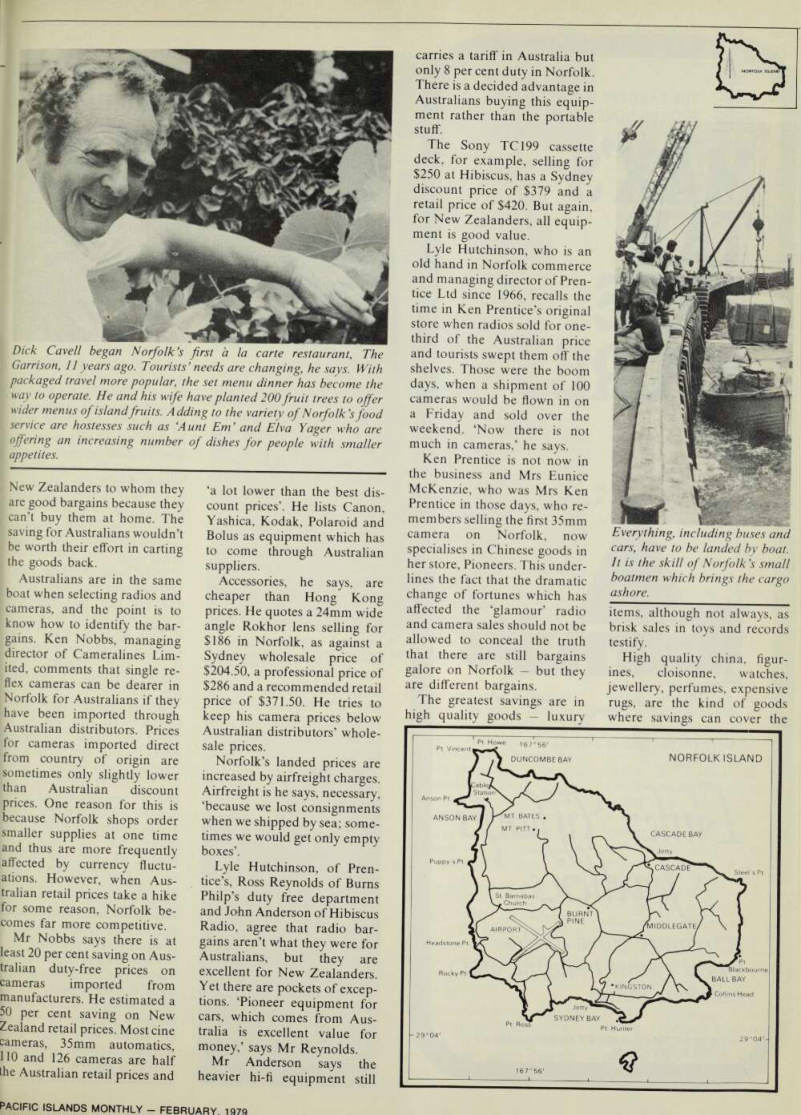
Everything, including buses and
cars, have to be landed by boat.
It is the skill of Norfolk's small boatmen which brings the cargo ashore.
tourist’s airfare. Shops like Little Tiffany’s in Max’s store and BJ’s, depend on this when it comes to jewellery. The greater the expenditure the greater the saving.
Bob Fitzgibbons of BJ’s buys his raw stones overseas and has them made up overseas. He will buy rubies in Bangkok, diamonds in South Africa and have them made up, perhaps, in London. Tt makes sense to buy on the best market, and markets vary depending on what stones you want and what styles you want made up,’ says Mr Fitzgibbons, who has been selling jewellery in Norfolk for 13 years and in his own shop for nine.
As an example, he recently
bought a rough ruby of almost
a carat in Burma, took delivery in Bangkok, where he had it cut, and sent it to London for setting with eight diamonds.
The first tourist who saw it bought it for $593, with an insurance valuation from Fitz gibbons of $l3OO. He says a
typical price for good jewellery
in Norfolk shops would be $6OO for a ring selling in Syd ney for $ 1100. Jewellery can be taken duty free into Australia or New Zealand if the pur chaser carries it as her personal property.
In the watch trade, Tony Mathys of Swiss House says the best bargains are in the expens ive watches. Swiss watches haven’t increased to the same
extent as Japanese watchesz (due to the upward valuation inr the yen) and Norfolk can selll the higher price Swiss models 2 at half the Australian prices ‘cheaper than in Switzerland.’ ' Direct importing is thes answer but Australian distribu tors do not all endorse this andt there have been strong andt sometimes successful pressuresg from some Australian whole salers aimed at getting overseas 2 manufacturers of various pro ducts to cease supplying Nor folk direct.
Bill Blucher, president ofl committees of the Island Council, and a leadings Norfolk businessman (Martin’s 2
Agencies), says
business would be strangled if! these pressure groups achievedt their aims. He stresses that!
Norfolk Island is an island ter ritory that will attain self government and that!
Australian distributors have noo automatic rights over fran chises there.
Some other Norfolk busi nessmen take a stronger standb and say that abroad who persist in treatingg Norfolk as part of the Aus-. tralian mainland run the risk oft
finding their products boy
cotted in favour of competi-i tors.
Honda agent, Jack Fitz-: patrick, who sells Honda ali about two-thirds Australian!
prices, points out that high!
freights would penalise Nor-i
folk car buyers and hirers if hes couldn’t buy direct. And if hes
bought spares through Aus-;
tralian distributors he would bea
paying duty on duty. Ceo:
Bunker, who hires out 80 carsg" and 31 motorbikes, says tour-i ists can’t do without transport! on the Island.
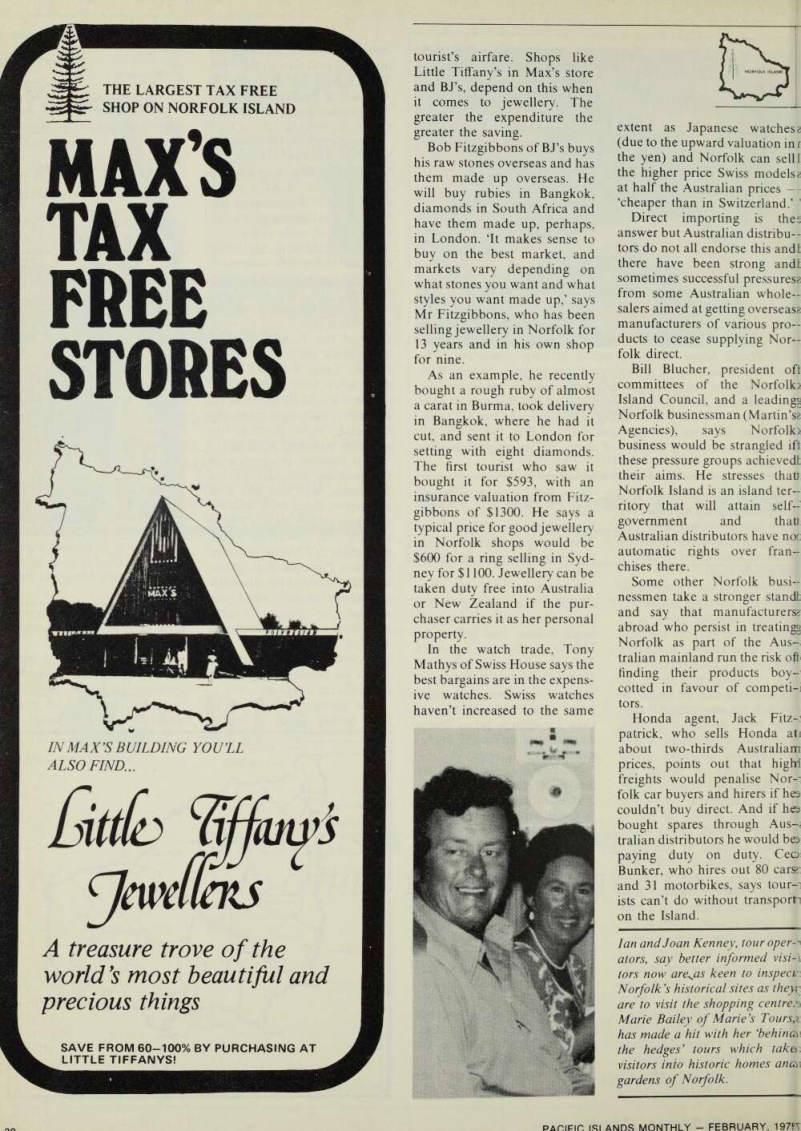
lanand Joan Kenney, tour oper[?] ators, say better informed visi-[?] tors now arenas keen to inspec[?] Norfolk's historical sites as they[?] are to visit the shopping centr[?] Marie Bailey of Marie’s Tours,[?] has made a hit with her ‘behin[?] the hedges’ tours which tak[?] visitors into historic homes an[?]
gardens of Norfolk.