Islanders Or
pp. 31-34 · Read in the full issue
Australians?
Norfolk Island is the second oldest British settlement in the South Seas, having been occupied within a few weeks of the first British settlement at what is now Sydney in 1788. It is the oldest of Australia’s external territories.
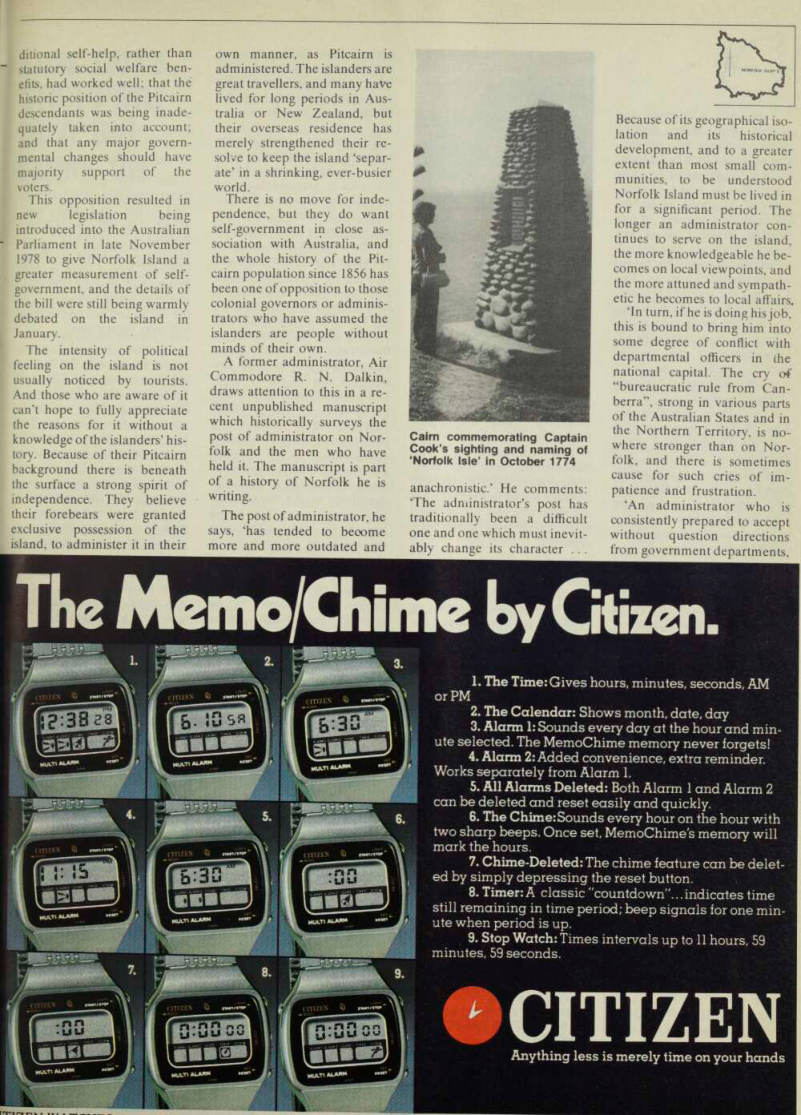
Its European discoverer was Captain James Cook who, on October 10, 1774 landed at Duncombe Bay where today a monument stands. He found the island uninhabited and took possession of it for Britain. Little is known of the island’s previous history although there is evidence that it may have been inhabited in earlier times.
The Sydney colony was
established on January 26, 1788, and on February 14 the
armed tender Supply, carrying
Lieutenant Philip Gidley King
and a party of convicts, set sail for Norfolk to occupy it. After some difficulty in finding a suitable landing site, they came ashore in what is now the Kingston area on March 6, 1788.
King had been appointed superintendent and commandam of Norfolk.
The early days of settlement were difficult especially because of the amount of heavy clearing that had to be done before crops could be planted. 1 his period has become known as th ® FirSt Settlement ’- When King left in 1796 the
settlement was still a develop ing community of nearly 900 people with many public build ings. By 1804 the population, settlers and convicts, had reached 1100 and by 1810 over a quarter of the island had been cleared. But the long sea con nection to Sydney and the gen eral difficulties of keeping the Norfolk Island settlement going resulted in it gradually being run down and finally abandoned, On June 6, 1825, Captain Turton, of the 40th Regiment, with a detachment of soldiers and convicts, landed at King ston to begin the ‘Second Settlement’. This was a penal settlement and the prisoners were those judged to be the worst from the gaols of New South Wales and Tasmania.
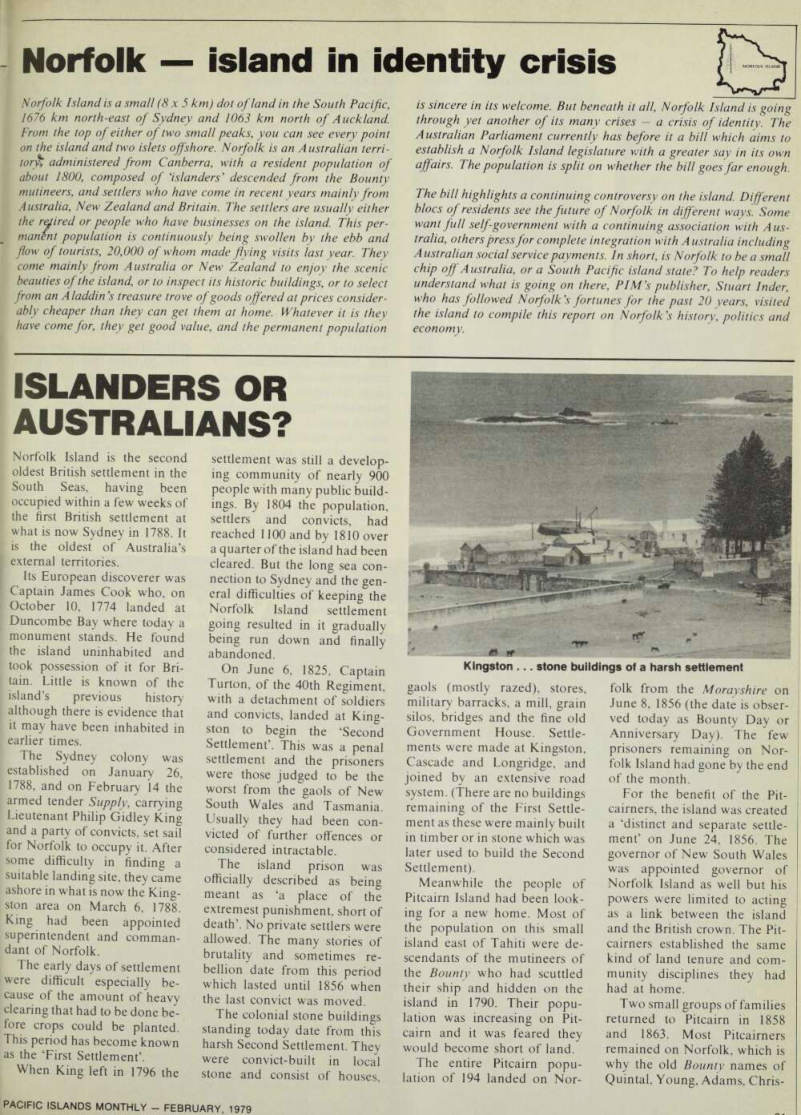
Usually they had been con victed of further offences or considered intractable The island prison was officially described as being meant as ‘a place of the extremes! punishment, short of death’. No private settlers were allowed. The many stories of brutality and sometimes re bellion date from this period which lasted until 1856 when the last convict was moved The colonial stone buildings standing today date from this harsh Second Settlement. They were convict-built in local stone and consist of houses,
gaols (mostly razed), stores,
military barracks, a mill, grain silos, bridges and the fine old Government House. Settle ments were made at Kingston, Cascade and Longridge, and joined by an extensive road system. (There are no buildings remaining of the First Settle ment as these were mainly built in timber or in stone which was later used to build the Second Settlement).
Meanwhile the people of Pitcairn Island had been look ing for a new home. Most of the population on this small island east of Tahiti were de scendants of the mutineers of the Bounty who had scuttled their ship and hidden on the island in 1790. Their popu lation was increasing on Pit cairn and it was feared they would become short of land.
The entire Pitcairn popu lation of 194 landed on Nor
folk from the Morayshire on June 8, 1856 (the date is obser
ved today as Bounty Day or
Anniversary Day). The few
prisoners remaining on Nor
folk Island had gone by the end of the month.
For the benefit of the Pit cairners, the island was created a ‘distinct and separate settle ment’ on June 24, 1856. The governor of New South Wales was appointed governor of Norfolk Island as well but his powers were limited to acting as a link between the island and the British crown. The Pit cairners established the same kind of land tenure and com
munity disciplines they had
had at home.
Two small groups of families returned to Pitcairn in 1858 and 1863. Most Pitcairners remained on Norfolk, which is why the old Bounty names of Quintal, Young, Adams, Chris-
Kingston ... stone buildings of a harsh settlement
tian and McCoy are still promi nent.
The Melanesian mission established a missionary train
ing school and headquarters
for the Bishop of Melanesia on the island in October 1866. The station was named Saint Bar nabas, on whose feast day the site was selected. The beautiful Saint Barnabas Chapel was completed in 1880. From this base on Norfolk Island the mission took Christianity to the islands in the Western Pacific until 1920 when mission head quarters was moved north to the Solomons and Norfolk affairs were terminated.
In 1897 full administration of Norfolk Island became the responsibility of the governor of New South Wales. The island remained a separate Bri tish colony but the islanders lost their rights to elect a local head of government and to enact or repeal the island’s laws.
This continued until 1914 when, under the Norfolk Island Act, the island became a territory of the Common wealth of Australia. Various
legislative changes later gave
the island, among other things, a local advisory council of ■elected members.
In its modem history, Nor folk Islanders have had various inquiries instituted as to the exact constitutional position of the island with Australia, it being claimed on the island time and again that Britain meant the Pitcairners to run their affairs independently when it transferred them there in 1856. Petitions have been made to the Queen and to the Australian governor-general.
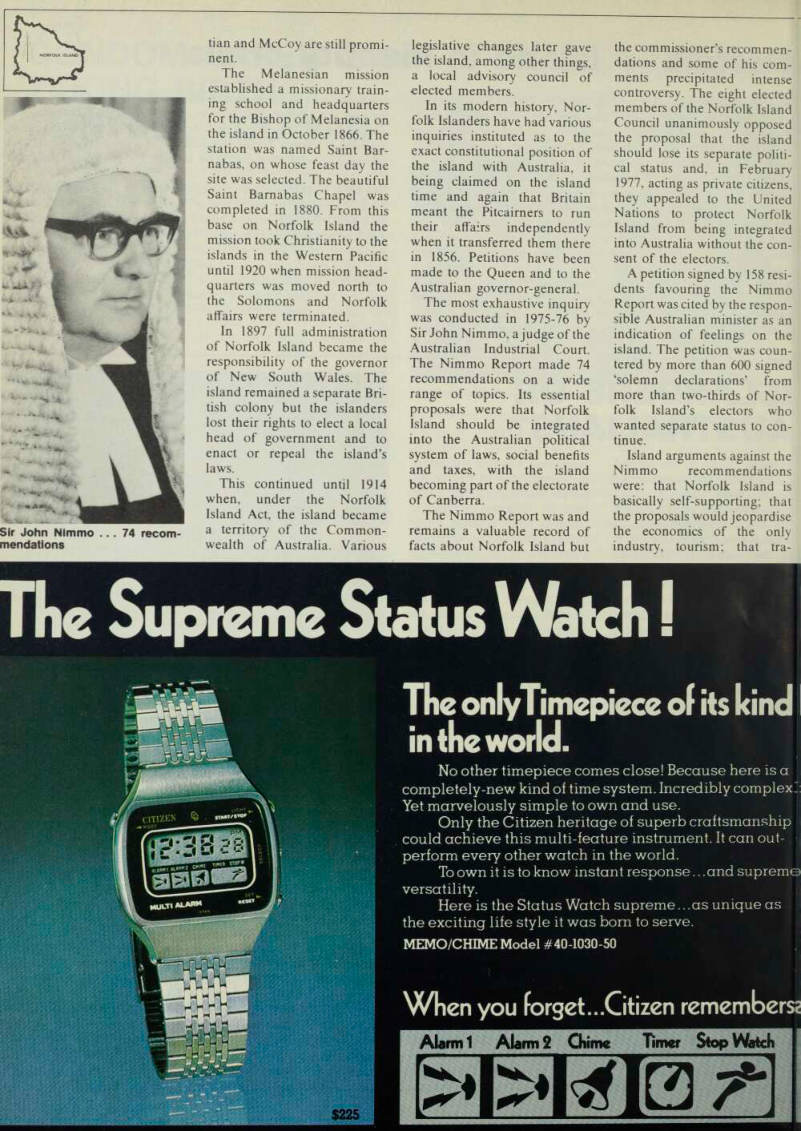
The most exhaustive inquiry was conducted in 1975-76 by Sir John Nimmo, a judge of the Australian Industrial Court.
The Nimmo Report made 74 recommendations on a wide range of topics. Its essential proposals were that Norfolk Island should be integrated into the Australian political system of laws, social benefits and taxes, with the island becoming part of the electorate of Canberra.
The Nimmo Report was and remains a valuable record of facts about Norfolk Island but
the commissioner’s recommen dations and some of his com ments precipitated intense controversy. The eight elected members of the Norfolk Island Council unanimously opposed the proposal that the island should lose its separate politi cal status and, in February 1977, acting as private citizens, they appealed to the United Nations to protect Norfolk
Island from being integrated
into Australia without the con sent of the electors.
A petition signed by 158 resi
dents favouring the Nimmo Report was cited by the respon sible Australian minister as an indication of feelings on the island. The petition was coun tered by more than 600 signed ‘solemn declarations’ from more than two-thirds of Nor folk Island’s electors who wanted separate status to con tinue.
Island arguments against the Nimmo recommendations were: that Norfolk Island is
basically self-supporting; that
the proposals would jeopardise
the economics of the only industry, tourism; that tra
Sir John Nimmo ... 74 recom mendations
ditional self-help, rather than statutory social welfare ben efits, had worked well; that the historic position of the Pitcairn descendants was being inade quately taken into account; and that any major govern mental changes should have majority support of the voters.
This opposition resulted in
new legislation being
introduced into the Australian Parliament in late November 1978 to give Norfolk Island a greater measurement of self government, and the details of the bill were still being warmly debated on the island in January.
The intensity of political feeling on the island is not
usually noticed by tourists.
And those who are aware of it
can’t hope to fully appreciate
the reasons for it without a knowledge of the islanders’ his tory. Because of their Pitcairn background there is beneath the surface a strong spirit of
independence. They believe
their forebears were granted exclusive possession of the island, to administer it in their
own manner, as Pitcairn is administered. The islanders are great travellers, and many have lived for long periods in Aus tralia or New Zealand, but their overseas residence has merely strengthened their re solve to keep the island ‘separ ate’ in a shrinking, ever-busier world.
There is no move for inde pendence, but they do want self-government in close as sociation with Australia, and the whole history of the Pit cairn population since 1856 has been one of opposition to those colonial governors or adminis trators who have assumed the islanders are people without minds of their own.
A former administrator, Air Commodore R. N. Dalkin, draws attention to this in a re
cent unpublished manuscript
which historically surveys the post of administrator on Nor folk and the men who have held it. The manuscript is part of a history of Norfolk he is
writing.
The post of administrator, he says, ‘has tended to become more and more outdated and
anachronistic.’ He comments: ‘The administrator’s post has traditionally been a difficult one and one which must inevit ably change its character .. .
Because of its geographical iso lation and its historical development, and to a greater extent than most small com munities, to be understood Norfolk Island must be lived in for a significant period. The longer an administrator con tinues to serve on the island, the more knowledgeable he be comes on local viewpoints, and the more attuned and sympath etic he becomes to local affairs. ‘ln turn, if he is doing his job, this is bound to bring him into some degree of conflict with departmental officers in the national capital. The cry of “bureaucratic rule from Can berra”, strong in various parts of the Australian States and in the Northern Territory, is no where stronger than on Nor folk, and there is sometimes cause for such cries of im patience and frustration. ‘An administrator who is consistently prepared to accept without question directions from government departments,
Cairn commemorating Captain Cook’s sighting and naming of ‘Norfolk Isle’ in October 1774
or even from a minister, and comply with them without query, analysis or counter advice, would be a bad admin istrator. On the other hand he would also be a bad adminis trator if he opted to be the unquestioning servant of the Norfolk Island Council and island factions. In time the ad ministrator is inevitably forced into impossible situations. This is largely the result of factions, groups and individuals taking
up positions involving varying
degrees of opposition to the ad ministrator’s or the govern ment’s policies, decisions,
methods and general handling
of island matters.’
In his survey, Air Commo dore Dalkin points out that from the time of arrival of the Pitcairners in 1856 until 1896 the chief magistrate of Norfolk Island was always a Pitcairner
who was elected annually by
the islanders, subject to the ap proval of the governor (of Nor folk Island) in Sydney. In fact,
the chief magistrate governed
the island with the assistance of a council of elders. HMS Bounty and Pitcairn names are the only ones that appear on
the list of 21 chief magistrates during that period: Christian, Quintal, Young, Adams, Buf fett and Nobbs.
Air Commodore Dalkin writes: ‘From 1896 the position of the chief magistrates and ad ministrators who have been appointed from outside the
island community has always
been an unusual and delicate one, and their relationships with the island council and the people have sometimes been strained and stormy.’
Colonel Warner Spalding was appointed as the first ‘out sider’ chief magistrate in 1896, and proved a disaster, largely because of his inept handling of the local populace. He was removed from office in 1898
after a public inquiry. Spalding
was followed by three other
‘imported’ chief magistrates
before the office became that of administrator in 1913. The administrator was also com missioned as chief magistrate.
Norfolk Island in that year got a completely new set of laws, all the earlier laws having been repealed.
But the dual post of adminis trator and chief magistrate wasn’t very effective because the responsibilities were in conflict and yet, says Air
Commodore Dalkin, the sys tem was maintained until 1936 when the duties of chief magis trate were divorced from the functions of administrator.
The persons occupying the position of administrator over the years have been a mixed lot, with a preponderance of ex-military officers. One, Co lonel E. T. Leane (1924-26), was apparently totally unsuited for the Norfolk post, and the populace was in a frequent state of turmoil which ended when a royal commission in 1926 found that ‘in the interests of the Commonwealth and Norfolk Island, the present ad ministrator be recalled without delay’. The commissioner also reported that ‘in future selec tions, due consideration to the psychology of the Norfolk Islanders should be given; the temperament of a prospective administrator, if not compat ible with, should be capable of ready adaptability to the social conditions of the island. This applies with equal force to the appointee’s wife, who must necessarily at all times be in close association with the inhabitants, and whose normal influence upon the lives of the people is a factor to be seriously considered’. Leane
was hurriedly replaced.
Air Commodore Dalkin says that a ‘study of the record shows that the above dictum, at least in relation to the adminis trator himself, was by no means always adhered to in
subsequent years’.
But even good adminis trators had their special prob lems. One successful man, Major General Sir Charles Rosenthal (1937-45) com plained in a letter to Prime Minister John Curtin in 1944 that he had served under eight ministers whilst he had been on the island and not one of them had ever visited him.
An island view of adminis trators was given to the Nimmo royal commission by a Norfolk councillor while discussing a legislative problem which de veloped a few years ago. ‘lt is like many other things that happened in the history of the island,’ he said. ‘The outcome of it was the result of how it was handled. The administrator at the time was a most intractable man. He was very hard to get on with. If you want to hear the truth, he told me at one time that he had no more sentiment than a concrete tank, and he was right. On Norfolk Island you need some sentiment.’