People
pp. 15-19 · Read in the full issue
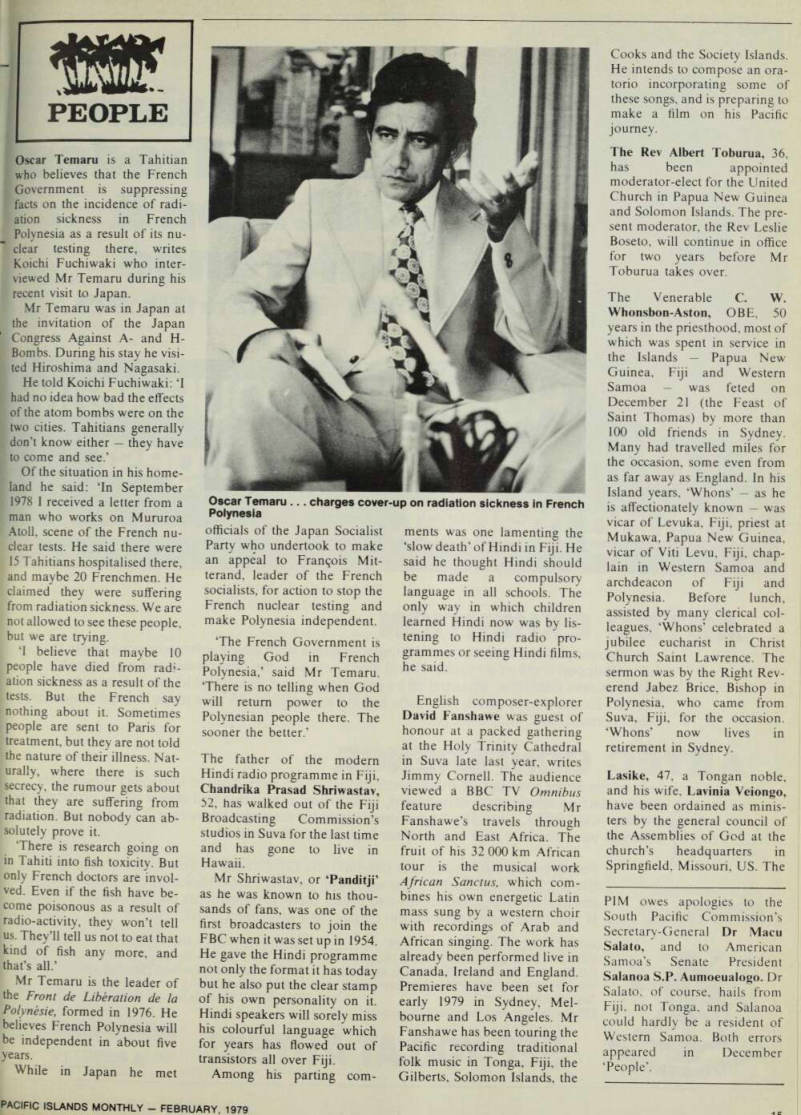


Oscar Temaru is a Tahitian who believes that the French
1 Government is suppressing
facts on the incidence of radi ation sickness in French Polynesia as a result of its nu clear testing there, writes Koichi Fuchiwaki who inter viewed Mr Temaru during his recent visit to Japan.
Mr Temaru was in Japan at the invitation of the Japan Congress Against A- and H- Bombs. During his stay he visi ted Hiroshima and Nagasaki.
He told Koichi Fuchiwaki: T had no idea how bad the effects of the atom bombs were on the two cities. Tahitians generally don’t know either they have to come and see.’
Of the situation in his home land he said: ‘ln September 1978 I received a letter from a man who works on Mururoa Atoll, scene of the French nu clear tests. He said there were 15 Tahitians hospitalised there, and maybe 20 Frenchmen. He
claimed they were suffering
from radiation sickness. We are not allowed to see these people, but we are trying.
T believe that maybe 10 people have died from rad»ation sickness as a result of the tests. But the French say nothing about it. Sometimes people are sent to Paris for treatment, but they are not told the nature of their illness. Nat urally, where there is such secrecy, the rumour gets about that they are suffering from radiation. But nobody can ab solutely prove it. ‘There is research going on in Tahiti into fish toxicity. But only French doctors are invol ved. Even if the fish have be come poisonous as a result of
radio-activity, they won’t tell
us. They’ll tell us not to eat that kind of fish any more, and that’s all.’
Mr Temaru is the leader of the Front de Liberation de la Polynesia, formed in 1976. He believes French Polynesia will be independent in about five years.
While in Japan he met
officials of the Japan Socialist Party who undertook to make an appeal to Francois Mit terand, leader of the French socialists, for action to stop the French nuclear testing and
make Polynesia independent.
‘The French Government is playing God in French Polynesia,’ said Mr Temaru. ‘There is no telling when God will return power to the
Polynesian people there. The
sooner the better.’
The father of the modem Hindi radio programme in Fiji, Chandrika Prasad Shriwastav, 52, has walked out of the Fiji
Broadcasting Commission’s
studios in Suva for the last time and has gone to live in Hawaii.
Mr Shriwastav, or ‘Panditji’ as he was known to his thou sands of fans, was one of the first broadcasters to join the FBC when it was set up in 1954.
He gave the Hindi programme not only the format it has today but he also put the clear stamp of his own personality on it.
Hindi speakers will sorely miss his colourful language which for years has flowed out of transistors all over Fiji.
Among his parting com
ments was one lamenting the ‘slow death’ of Hindi in Fiji. He said he thought Hindi should be made a compulsory language in all schools. The only way in which children learned Hindi now was by lis tening to Hindi radio pro grammes or seeing Hindi films, he said.
English composer-explorer
David Fanshawe was guest of honour at a packed gathering at the Holy Trinity Cathedral in Suva late last year, writes Jimmy Cornell. The audience viewed a BBC TV Omnibus feature describing Mr Fanshawe’s travels through North and East Africa. The fruit of his 32 000 km African tour is the musical work African Sanctus, which com bines his own energetic Latin mass sung by a western choir with recordings of Arab and African singing. The work has already been performed live in Canada, Ireland and England.
Premieres have been set for early 1979 in Sydney, Mel bourne and Los Angeles. Mr Fanshawe has been touring the Pacific recording traditional folk music in Tonga, Fiji, the Gilberts, Solomon Islands, the
Cooks and the Society Islands.
He intends to compose an ora torio incorporating some of these songs, and is preparing to make a film on his Pacific
journey.
The Rev Albert Toburua, 36, has been appointed moderator-elect for the United Church in Papua New Guinea and Solomon Islands. The pre sent moderator, the Rev Leslie Boseto, will continue in office for two years before Mr Toburua takes over.
The Venerable C. W.
Whonsbon-Aston, OBE, 50 years in the priesthood, most of which was spent in service in the Islands Papua New Guinea, Fiji and Western Samoa was feted on December 21 (the Feast of Saint Thomas) by more than 100 old friends in Sydney.
Many had travelled miles for the occasion, some even from as far away as England. In his Island years, ‘Whons’ as he is affectionately known was vicar of Levuka, Fiji, priest at Mukawa, Papua New Guinea, vicar of Viti Levu, Fiji, chap lain in Western Samoa and archdeacon of Fiji and Polynesia. Before lunch, assisted by many clerical col leagues, ‘Whons’ celebrated a jubilee eucharist in Christ Church Saint Lawrence. The sermon was by the Right Rev erend Jabez Brice, Bishop in Polynesia, who came from Suva, Fiji, for the occasion. ‘Whons’ now lives in retirement in Sydney.
Lasike, 47, a Tongan noble, and his wife, Lavinia Veiongo, have been ordained as minis ters by the general council of the Assemblies of God at the church’s headquarters in Springfield, Missouri, US. The
PIM owes apologies to the South Pacific Commission’s Secretary-General Dr Macu Salato, and to American Samoa’s Senate President Salanoa S.P. Aumoeualogo. Dr Salato, of course, hails from Fiji, not Tonga, and Salanoa could hardly be a resident of Western Samoa. Both errors appeared in December
‘People’.
Oscar Temaru . . . charges cover-up on radiation sickness In French Polynesia
first Tongans ordained to the fellowship, they have been assigned to work with the Ton gan community in Santa Cruz, California. They left Tonga in 1974 with their four sons and two daughters with the aim of furthering the children’s edu cation in California.
Kevin Conlan, 43, has taken up the newly created post of coun sellor (development assistance) . at the Australian High Com mission in Fiji. He will head a four-man team responsible for the administration of Aus tralia’s aid programme to Fiji, Tonga, Western Samoa and Tuvalu. Mr Conlan has pre
vious diplomatic experience in
Kuala Lumpur and Jakarta.
Before his new appointment he was acting head of the Multi lateral Financial Institutions Section of the Australian Development Assistance Bu reau in Canberra.
Raman Nair, Fiji’s first high commissioner to Australia, is back in diplomatic service as his country’s first consul general in Sydney. Mr Nair’s public service career, which stretched from beginnings as a school teacher in 1941 to 1976 when he left his diplomatic post in Canberra, retired at 53 to work in private enterprise.
But last year, with Fiji deter mined to build up its drive for
improved trading links with
Australia and to encourage Australian investment in Fiji, he was asked to open the
consulate-general in Sydney.
Mr Nair, now 55, with elec tricians busily laying the lines of communication to the Aus tralian businessworld in his
third floor Papua New Guinea House, Clarence Street, office, said: ‘I have taken on a number
of challenging jobs during my
career but this is the most chal lenging. If I can make some im provement here in Fiji’s relationship with Australia it will be the most satisfying re sult of my whole career. It will be a real contribution to Fiji if I am successful.’ Mr Nair, look ing around for an Australia based marketing officer, obviously was warming to the
challenge of whittling away
Australia’s enormously favour able balance of trade.
Douglas Law, 42, will bring considerable experience of Asian affairs to the job of New Zealand High Commissioner to Western Samoa when he takes up the post in March. His appointment comes at a time when more Asian countries, including China, are taking a close interest in the South Pa cific. Mr Law who succeeds Don Harper, joined the NZ Ministry of Foreign Affairs in 1957 and has served in Sin gapore, New Delhi, Canberra and Tokyo. When appointed to the Western Samoa post he was deputy head of mission at the
NZ Embassy in Tokyo.
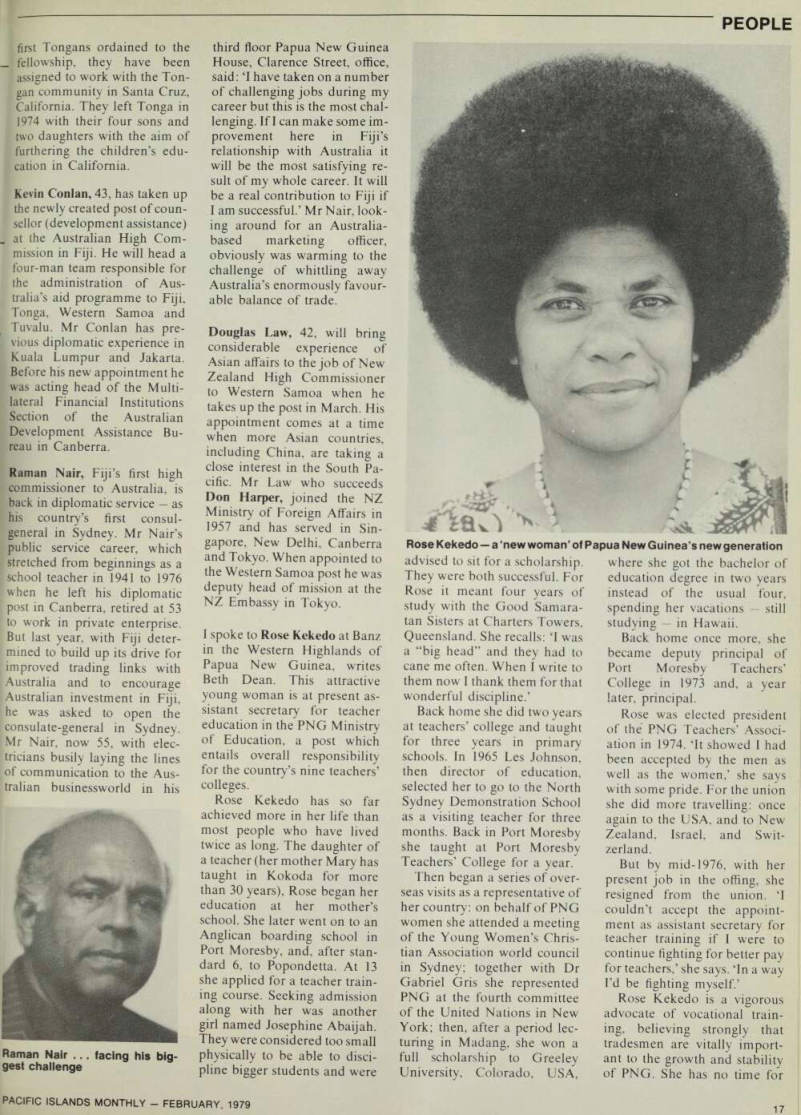
I spoke to Rose Kekedo at Banz in the Western Highlands of Papua New Guinea, writes Beth Dean. This attractive young woman is at present as sistant secretary for teacher education in the PNG Ministry of Education, a post which entails overall responsibility for the country’s nine teachers’
colleges.
Rose Kekedo has so far achieved more in her life than most people who have lived twice as long. The daughter of a teacher (her mother Mary has taught in Kokoda for more than 30 years). Rose began her education at her mother’s school. She later went on to an
Anglican boarding school in
Port Moresby, and, after stan dard 6, to Popondetta. At 13 she applied for a teacher train
ing course. Seeking admission
along with her was another
girl named Josephine Abaijah.
They were considered too small physically to be able to disci pline bigger students and were
advised to sit for a scholarship.
They were both successful. For Rose it meant four years of study with the Good Samaratan Sisters at Charters Towers, Queensland. She recalls: T was a “big head’’ and they had to cane me often. When I write to them now I thank them for that
wonderful discipline.’
Back home she did two years at teachers’ college and taught for three years in primary schools. In 1965 Les Johnson, then director of education, selected her to go to the North Sydney Demonstration School as a visiting teacher for three months. Back in Port Moresby she taught at Port Moresby Teachers’ College for a year.
Then began a series of overseas visits as a representative of her country: on behalf of PNG women she attended a meeting of the Young Women’s Christian Association world council in Sydney; together with Dr Gabriel Gris she represented PNG at the fourth committee of the United Nations in New York; then, after a period lecluring in Madang, she won a
full scholarship to Greeley
University, Colorado, USA,
where she got the bachelor of education degree in two years instead of the usual four, spending her vacations still studying in Hawaii.
Back home once more, she
became deputy principal of
Port Moresby Teachers’
College in 1973 and, a year
later, principal.
Rose was elected president of the PNG Teachers’ Associ ation in 1974. ‘lt showed I had been accepted by the men as well as the women,’ she says with some pride. For the union she did more travelling: once again to the USA, and to New Zealand, Israel, and Swit zerland.
But by mid-1976, with her present job in the offing, she resigned from the union. T couldn’t accept the appoint ment as assistant secretary for teacher training if I were to continue fighting for better pay for teachers,’ she says. Tn a way
I’d be fighting myself.’
Rose Kekedo is a vigorous advocate of vocational train
ing, believing strongly that
tradesmen are vitally import
ant to the growth and stability of PNG. She has no time for
Raman Nair ... facing his big gest challenge
Rose Kekedo a‘new woman’ of Papua New Guinea’s new generation
people who won’t dirty their hands. She says; ‘The young s people who go away to train .* thinking only of desk jobs and when they come back find
■ themselves posted to outlying
f areas soon learn that the need is to build classrooms, do
agriculture and many things
that require manual skills. I say to my students; “Do something with your hands. Learn to be practical. Don’t expect some one else always to be on hand.
Do it yourself.” I get people in my classes to build maybe a basketball court. Or I get them to raise a pig or chickens, make a garden. Teachers of English, science and maths are certainly needed. But they must be able to cope with the problems of village life too.’
Rose Kekedo is no desk ad ministrator. She is one of the ; new generation who are moulding the future of PNG.
As she says: ‘Today differs from the past for me, a woman.
Even the men come to me for advice now. I’ve been asked to stand for parliament. I said no.
My life is bound up with edu cation.’ ‘Akau’ola, 43, a Tongan noble, minister of police of the king dom of Tonga, has wanted to be a policeman ever since he was a boy, writes lawyer Robert Moin in Nukualofa.
Born George Faletau, he was the first son of ‘Akau’ola, a member of Tonga’s parliament who held this hereditary title until his death in 1955. George then succeeded to the title. The family estate is in Vavau, repu tedly the home of the finest and fiercest warriors in the South Pacific. The name Faletau means ‘house of war’.
After studies in New Zealand and Tonga,‘Akau’olajoined the New Zealand police force in Auckland. After two years training he returned to Tonga
to join his own country’s police.
In the ensuing years, he has attended virtually every police training course available in the
Commonwealth, including the
highest of all, the United King dom commando course. He
was appointed Tonga’s minis
ter of police in 1968.
On the subject of law, the minister said he believed that
although current law was basi cally a product of the British system, Tonga could still exist peaceably without it. The king dom’s heritage was one of cus tom and culture which had been stable for centuries. ‘Although at first there would be some bloodshed if we re turned to the old system of
forcing peace through custom,
it would eventually be accepted as the proper legal system,’ he said.
The combination of British law and custom had made the country and the parliament very conservative, he said. He cited the proposal for a pure foods act which was rejected by parliament basically on the grounds that Tongans were already healthy and had lived in the same way for centuries.
Tonga could therefore con tinue to rely on the existing health act which embodies the basic and customary provisions of centuries of usage. Tt would take several cases of food poisoning to change this atti tude,’ he said.
Other matters on which the minister expressed his views in cluded: Capital punishment: Al though the idea is frowned on by other countries in the re
gion, he believes capital
punishment should be retained. Once abandoned, it would be almost impossible to reintroduce it, he said.
Although the incidence of mur der is quite high in Tonga an average of five cases a year over the past 20 years only three people had been hanged since 1956. Several death sen
tences have been commuted by the Privy Council.
Terrorism: Such activity de serves nothing less than the death penalty. It will not be tolerated in Tonga.
Rape: Not a serious problem the extended family system seems to provide the anti dote.
Drugs: The problem affects the better educated groups such as civil servants. Hard
drugs are now being used by
Tongans and expatriates alike.
The main supply line to the kingdom is by way of yachts.
Unfortunately for the inno cent, all yachts coming to Tonga are viewed with sus picion by the authorities. Ton gan police and customs officers are being trained in the latest detection methods and drug detectives have been
appointed.
Alcohol: The present system of having to obtain a licence to purchase liquor could be a con tributing factor to the drinking problem in Tonga. The licence system is under review. It tended to make people collect alcoholic drinks and then con sume them in one heavy bout.
Adults should be treated as adults. The strongly conserva tive government would eventu ally repeal licence provision, he believed.
Land ownership: The Ton gan leasehold land system was the prime example of main taining custom and had proven to be one of the most stable in the developing world. Most Tongans accept the system.
The minister claimed that if it were abandoned, and if the no
bility were to forego their hereditary estates, there would be benefits to no more than 400 people, or less than 0.5% of the population. He saw no possi bility of change in this system or of revolt against it. , ‘Akau’ola is a bachelor, but there are rumours he could marry soon. In the meantime, he is far from lonely. His home is a fine example of the Ton gan extended family system. At the time of this interview he had 15 cousins and other rela tives living with him. (He has supported the education of two of them, who have become policewomen.) The number rises to more than 20 at Christ mas.
Former school teacher Colin Gauwane, 48, MP for Central Malaita, Solomon Islands, is his country’s new minister of law and information. The newly created ministry will be responsible for law, infor mation, public relations,
registrar-general’s department
and the Solomon Islands Broadcasting Corporation. In formation, public relations and the SIBC had previously been under the prime minister’s department, and the other functions were exercised by the attorney-general.
Captain Jens Ehle believes it is only a matter of time and money before the mineral riches of the Pacific Ocean are
being exploited. Captain Ehle
is in charge of the West Ger man research ship, Sonne, which has just finished a pro gramme of geophysical re search of Pacific seabeds.
Tonga’s minister of police, the Honourable ‘Akau’ola (left), pictured in England with John Kelland, former commissioner of police, Fiji
Colin Gauwane ... a brand-new ministry