Torres
p. 13 · Read in the full issue
Strait
Now To
Make
Torres
Work
That the road to a treaty on the Torres Strait had been a tough one, with bitter milestones along the way, was somehow confirmed by the manner in which each speaker at the
December Sydney signing
almost fell over himself to con gratulate everyone else con cerned on the brilliance of their achievements.
Each of the four speakers Papua New Guinea’s Prime Minister Michael Somare and Deputy Prime Minister and Minister for Foreign Affairs Ebia Olewale, and Australia’s Prime Minister Malcolm Fraser and Foreign Minister Andrew Peacock was lavish in his praise for the work done
by others.
Among those mentioned was Sir Maori Kiki who, as Minis ter for Foreign Affairs until his election loss in 1977, had kept
the negotiations going.
Few journalists who attended a press conference by Mr Peacock in 1977, when Sir Maori was still PNG’s senior negotiator, will forget the ten sion in the Port Moresby air port VIP lounge when first Mr Somare and then Sir Maori walked in, sitting, thunder browed, either side of Mr Peacock.
Obviously the talks at that stage had not been going well.
Equally obviously, the ‘middle
line’ which Sir Maori is be lieved to have been pushing at the time was not acceptable to Canberra which knew it could never sell such a settlement to Queensland’s Premier Joh
Bjelke-Petersen.
Easily the most satisfied man at the Sydney signing was Mr Olewale who comes from Western Province which forms the northern limit of the Torres Strait. Mr Olewale was the man who, as a back bencher, started it all by claiming that he prac tically had to go to Australia to get home, and that Australia should be asked to agree on a
more equitable boundary. For
Mr Olewale, the December
signing gave him the pleasure of finishing something he had started.
Though Mr Olewale can claim to have set the ball roll ing, it was not until after self government was achieved in 1972 that things really got mov ing. Bill Conroy, who was at the signing, recalled that in 1972, as Secretary for Foreign Affairs and Trade in Port Moresby, he had told Sir Maori that the department’s first big task was to clear up the Torres border question.
As the years rolled by there was only modest progress but after independence in 1975 the pace quickened. Sir Maori and Mr Peacock shuttled back and forth. Sometimes they’d come out smiling. Other times glum.
It seemed that on occasions only the basic goodwill, which has persisted post independence between Aus tralia and Papua New Guinea at government level, prevented a collapse of talks.
At one stage, rumour was rife that PNG was going to take its case to the World Court.
There is no knowing what the outcome of a move of that nature might have been but PNG certainly would have had a compelling moral case. How could it be fair that another nation, with its mainland shore about 150 km away, should have its ‘international bound ary’ not much short of its neighbour’s low water mark?
But the negotiations went on, Mr Olewale stepping in to Sir Maori’s shoes after the 1977 PNG election. The PNG line, it seems, if the terms of the treaty are any guide, softened somewhat. Australian Govern ment officials will privately concede that PNG has been very reasonable if not gener ous in its attitude.
Perhaps Port Moresby
couldn’t bear the thought of
Canberra being monstered by
Premier Bjelke-Petersen. Aus tralia’s federal system fre quently renders the national government helpless in the face of state government intran sigence. And Queenslanders didn’t look as if they could be persuaded to give away some
thing which they thought they
owned.
Sweetness and light prevailed. A deal was struck.
And the Torres Strait map has ended up with four main lines drawn on it a red seabed jurisdiction line, a blue fisheries jurisdiction line, a red-blue line where seabed and fisheries jurisdiction coincides, and a green ‘protected zone’ line. And then there’s a line around each Australian out crop marking the Australian territorial sea boundaries in what has now become Papua New Guinea ocean.
PNG has sovereignty over Kawa Island, Mata Kawa Island and Kussa Island, and Australia has sovereignty over all others, but the treaty establishes an ‘equitable’ div ision of rights over fisheries and seabed resources in the whole area of islands between Australia and PNG. Tra ditional inhabitants will be able to move about freely and carry out traditional activities.
Mining and oil drilling is banned for 10 years.
It’s all very unusual and everyone is keeping their fingers crossed that each government will achieve ratifi cation of the signing of the treaty. And if that is achieved, that the treaty will actually work. Both sides seem con fident that it will, and Mr Somare said privately at the signing that he was determined that it will. Bob Hawkins
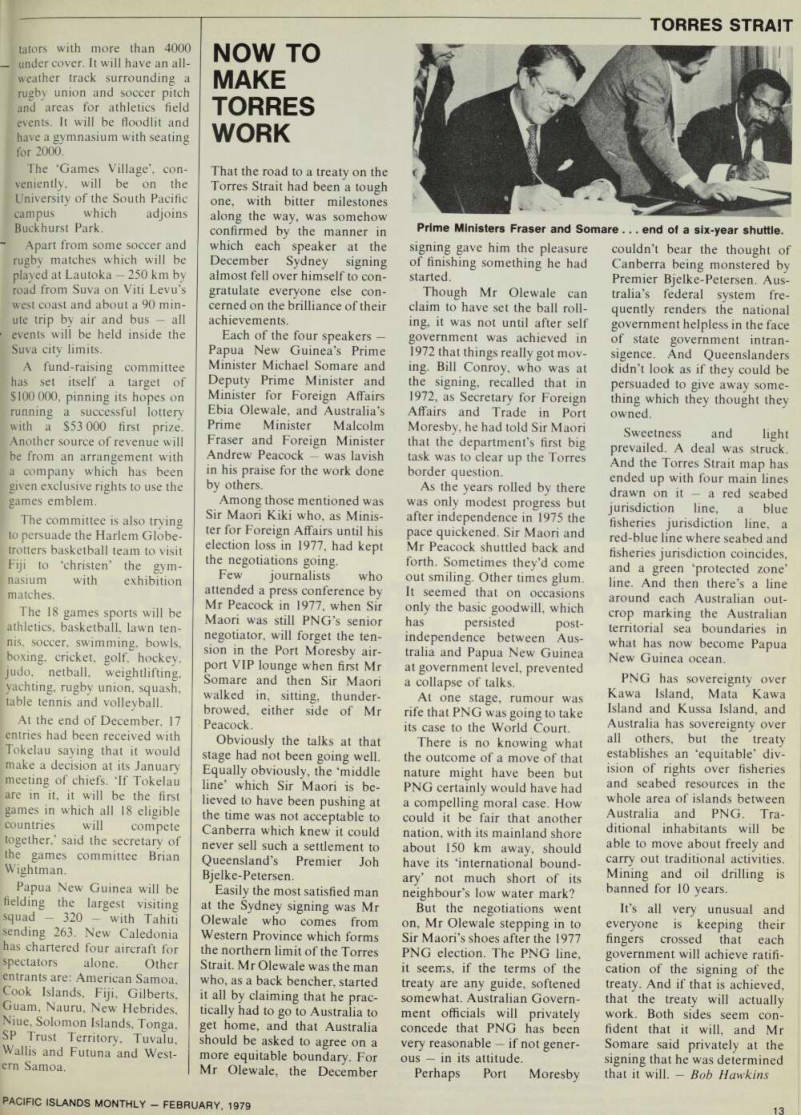
Prime Ministers Fraser and Somare ... end of a six-year shuttle.