New Zealand’S
pp. 11-12 · Read in the full issue
Defence Comes
Closer To Home
It looks as if New Zealand’s defence capacity, like A ustralia’s, is shrinking in relation to its economic health. William Gas son in Wellington looks at New Zealand’s recently-released,
long-awaited defence policy review.
New Zealand’s long-awaited
defence policy places the
country now firmly within the South Pacific region. In a 57 page review released late last year the government sets out a defence strategy for the 1980 s that takes the military presence out of Singapore and turns its role primarily towards the emergencies it believes could arise in the South Pacific. ‘New Zealand can best con tribute to the strength of the Western world by helping to preserve peace and security in our own part of the world, par ticularly the South Pacific,’ the review says.
While it did not foresee any major direct military threat to New Zealand in the next dec ade provided there was no change in the global balance of power the review accepted that challenge to New Zealand, in its broadest sense, could arise from a shift in the balance of forces in the Pacific Basin. ‘With such powerful interests involved, the indefinite preservation of stab ility cannot be assumed. Nor can it be taken for granted that
competition by major powers
for influence and advantage in the South Pacific could not in crease tensions and directly threaten New Zealand interests. ‘Pacific countries can be expected to recognise the potential danger of inter national pressures; the remark able capacity for consultation
and co-operation already
demonstrated by the members of the South Pacific Forum should ensure that risks are minimised. Emergencies can not, however, be ruled out.’
While noting that the Soviet Union ' and China had established diplomatic contacts with South Pacific Island governments it adds that
neither ‘has yet attempted to assert a military presence. The South Pacific is no longer insulated against outside press ures’.
The review says that since tranquillity in the South Pacific is of great importance to New Zealand, considerable efforts are being made to strengthen relations with the island states. ‘These efforts are the more effective because the island states know that New Zealand has the means of helping them in time of need,’ it says. This theme of helping the South Pa cific states runs throughout the review as it links its defence with its ANZUS partners and, through them, the Western al lies. ‘At the same time we must have the means of knowing and controlling our own re
gion, and preventing unwanted
intrusions from outside. We must also have the means of helping the Island states of the South Pacific if and when they should call for our help.’
Now that the United States, like Britain, had withdrawn its forces from Southeast Asia, the focus had shifted to the Pacific
area proper and New Zealand was better able to concentrate on its defence role in the South Pacific.
New Zealand plans to bring its defence force, consisting mainly of the first battalion of some 500 men of the infantry regiment, out of Singapore in three to four years or just as soon as the government can find somewhere to house them. ‘lt is an essentially close-to
home policy compared with
the forward defence concept in the past,’ says Chief of Defence Staff Air Marshal R. B. Bolt, outlining the main points of the review.
The second main point is New Zealand’s growing de fence relationship with Aus tralia. In a strategic sense the two countries are one, says the review. ‘lt is difficult to conceive of any situation in which an attack or threat of attack on Australia would not call for a response from New Zealand.’
It rejects as ‘quite unreason able’ any idea of a ‘go-it-alone’ defence policy and stresses: ‘The theme of collective secur ity as reflected in ANZUS will continue to be fundamental to New Zealand defence policy.’
The review also stresses the
joint development of rational
isation of equipment, research and defence production be tween Australia and New Zealand and makes the point that in future local industries could produce a greater share of defence requirements.
In place of Singapore’s
attraction as an overseas base
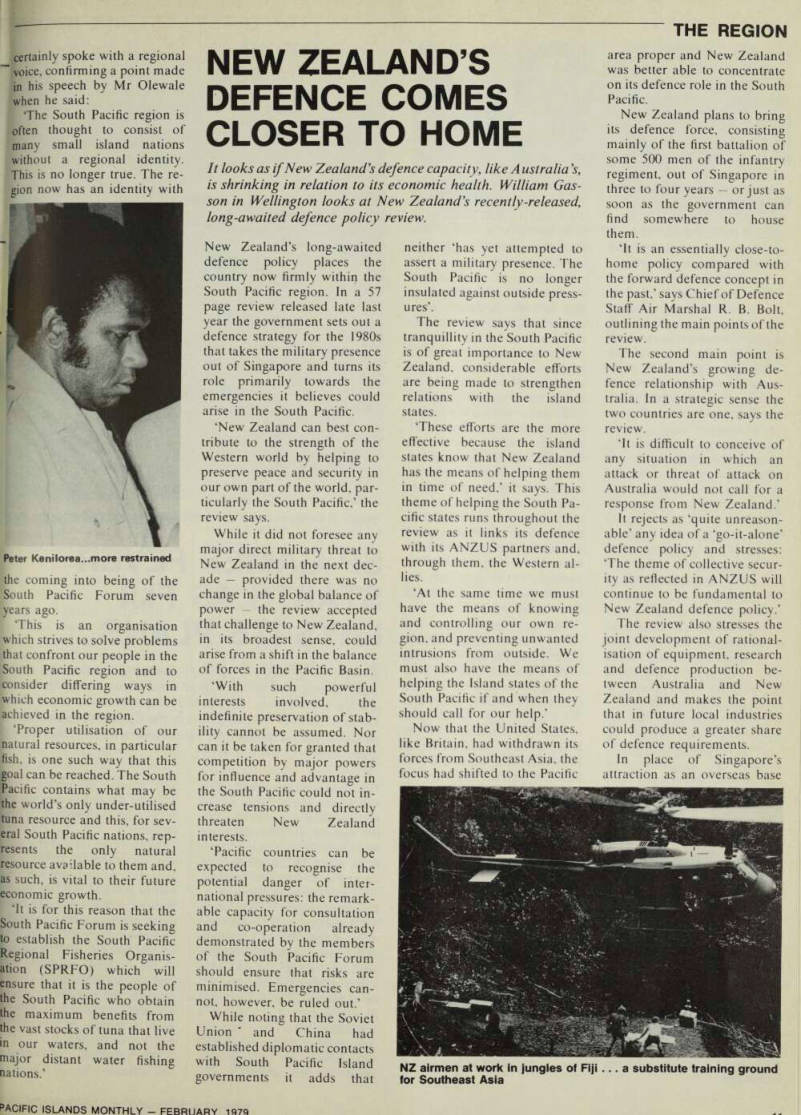
NZ airmen at work in jungles of Fiji ... a substitute training ground for Southeast Asia
the New Zealand military chiefs will lean even more heavily than in the past on a comprehensive programme of training exercises that will have groups of forces in Australia, the South Pacific, ASEAN countries, Hawaii and else where if this can be arranged.
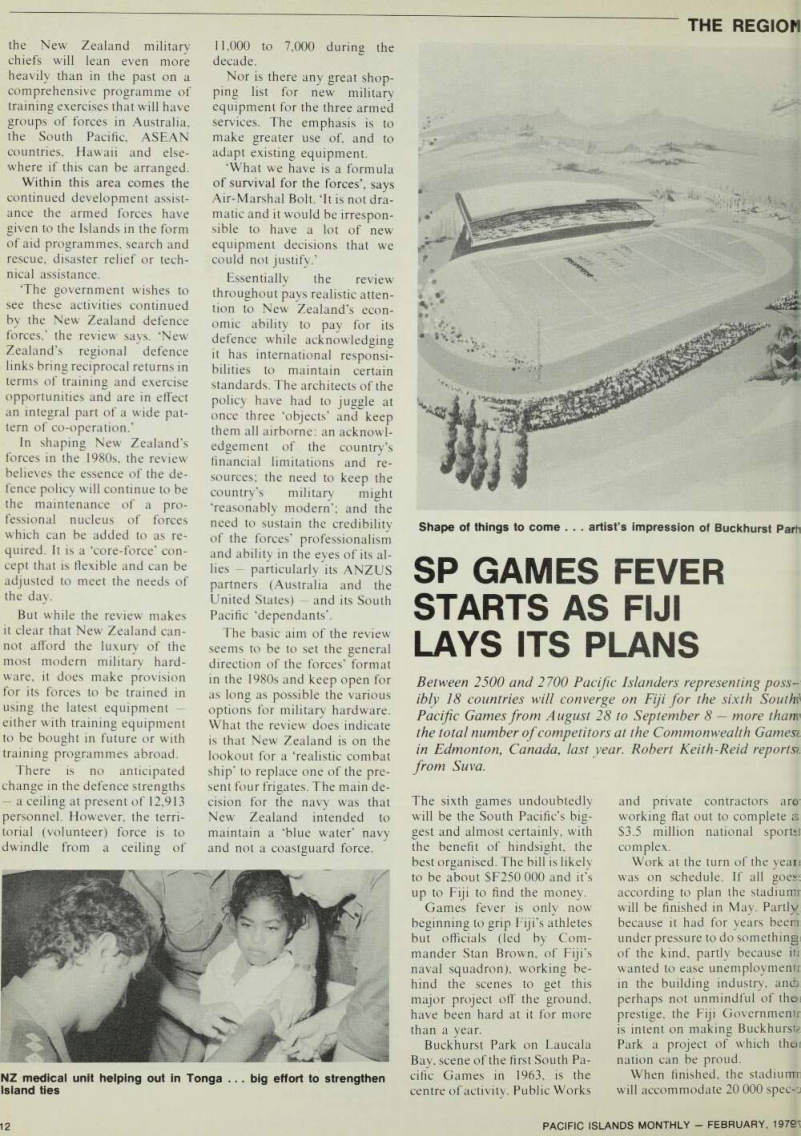
Within this area comes the continued development assist ance the armed forces have given to the Islands in the form of aid programmes, search and rescue, disaster relief or tech nical assistance. ‘The government wishes to see these activities continued by the New Zealand defence forces,' the review says. ‘New Zealand’s regional defence links bring reciprocal returns in terms of training and exercise opportunities and are in effect an integral part of a wide pat tern of co-operation.’
In shaping New Zealand’s forces in the 1980 s, the review believes the essence of the de fence policy will continue to be the maintenance of a pro fessional nucleus of forces which can be added to as re quired. It is a ‘core-force’ con cept that is flexible and can be adjusted to meet the needs of
the day.
But while the review makes it clear that New Zealand can not afford the luxury of the most modern military hard ware, it does make provision for its forces to be trained in using the latest equipment -
either with training equipment
to be bought in future or with training programmes abroad.
There is no anticipated change in the defence strengths - a ceiling at present of 12,913 personnel. However, the terri torial (volunteer) force is to dwindle from a ceiling of
11,000 to 7,000 during the decade.
Nor is there any great shop ping list for new military equipment for the three armed services. The emphasis is to make greater use of, and to
adapt existing equipment.
‘What we have is a formula of survival for the forces’, says Air-Marshal Bolt. Tt is not dra matic and it would be irrespon sible to have a lot of new equipment decisions that we could not justify.’
Essentially the review throughout pays realistic atten tion to New Zealand’s econ omic ability to pay for its defence while acknowledging it has international responsi bilities to maintain certain standards. The architects of the policy have had to juggle at once three ‘objects’ and keep them all airborne: an acknowl edgement of the country’s financial limitations and re sources; the need to keep the
country’s military might
‘reasonably modern’; and the need to sustain the credibility of the forces’ professionalism and ability in the eyes of its al lies - particularly its ANZUS partners (Australia and the United States) and its South
Pacific ‘dependants’.
The basic aim of the review seems to be to set the general direction of the forces’ format in the 1980 s and keep open for as long as possible the various
options for military hardware.
What the review does indicate is that New Zealand is on the lookout for a ‘realistic combat ship’ to replace one of the pre sent four frigates. The main de cision for the navy was that New Zealand intended to maintain a ‘blue water’ navy and not a coastguard force.
NZ medical unit helping out in Tonga ... big effort to strengthen Island ties